Information & Resources

Find information and resources to help manage your pain.

Get Help & Support

Find the tools you need to
help you manage your pain.

Get Involved

Help make a real difference to people
in the UK living with chronic pain.

About Us

Find out about Pain Concern and how
we can help you.

Join Pain Concern as an Outreach Worker – make a difference in chronic pain support

Your chance to be part of a small, dedicated team supporting people living with chronic pain.


About Pain Concern

Pain Concern is a charity providing information and support to people with pain and those who care for them – whether family, friends or healthcare professionals. Our work includes:

  • The Airing Pain podcast
  • Pain Matters magazine
  • A helpline offering support and guidance
  • Community Pain Education sessions
  • Research and campaigning on chronic pain issues

All pain is unpleasant, but for the 7.8 million people in the UK living with long-term pain it is a part of everyday life. It diminishes quality of life more than any other condition, leading often to loss of work, depression and disability. Anyone at any age can develop persistent pain and you will very probably know somebody affected. Although there is usually no cure, people who receive the appropriate treatment, information and support can manage their condition effectively with life-changing results.


Role Purpose

This non-clinical role supports our aim in delivering community Pain Education and providing information to help people in the self-management of their chronic pain. We are looking for a proactive, person-centred individual to raise awareness, generate referrals into our Pain Education sessions and identify barriers to engagement or access.

Our organisation is committed to safe recruitment in line with the relevant legislation and guidance. Due to the nature of the role, successful applicants will be required to undertake a PVG check and will successfully complete Safeguarding, PREVENT Duty and Trauma online training. The cost of a PVG will be covered by Pain Concern.


What You’ll Be Doing

This role is a key part of Pain Concern’s vital work in building connections with individuals, communities and partner organisations to raise awareness of chronic pain and the support available to people living with chronic pain.

  • Identify and engage individuals, groups and professionals who may benefit.
  • Promote Pain Education sessions to individuals, groups and professionals in the community.
  • Encourage referrals by proactively building strong relationships with Community Partners (e.g. local health care professionals, link workers, pharmacies and community groups).
  • Distribute educational materials and resources to ensure information is accessible and visible in key community settings.
  • Represent Pain Concern at community events and fairs to increase visibility and engagement.
  • Ability to identify barriers to engagement, access or participation within the community,
  • Adhere to Pain Concern’s policies including Safeguarding.
  • Signpost to NHS and Pain Concern’s suite of resources.
  • Assist with data collection and evaluation. 
  • Attend training sessions and supervision sessions.
  • Proactively and accurately communicate with our Line Manager.
  • Undertake general administrative duties.
  • Undertake any other reasonable duties as may be required.

At Pain Concern, it is the nature of the organisation where roles can be varied. That’s why we value flexibility – everyone may occasionally be asked to take on tasks outside their usual responsibilities to support the team and our mission.


Is This Role Right for Me?

We are looking for someone with experience, skills and qualities such as:

  • Lived experience of chronic pain or a strong interest in chronic pain and self-management
  • Excellent communication and relationship-building skills
  • The ability to work independently and as part of a team
  • Comfortable with Microsoft Teams and admin tasks
  • A positive, organised and adaptable approach

Previous experience in community outreach, coaching or facilitation is an advantage, but not essential.


Role Details

Location:

  • Based in and around Edinburgh and the Lothians.

  • Occasionally there may be the requirement to travel for beneficiary face-to-face appointments and other organisational meetings and training across Edinburgh and the Lothians. Occasional travel to Stirling and other areas across Scotland may be required.

  • This role is 90% office- or community-based.

  • Travel expenses between our office and meetings or events are covered in line with our expenses policy.

  • Please note the commute to/from the office (from your home) is not included in the working hours, and these costs are not covered.

Hours:

  • 8 hours per week.
  • Hours will be within our operational hours Monday to Friday 8am to 5pm.

Rate of pay:

  • £12.60 per hour
  • Fixed-term contract for 6 months

Benefits to you:

  • Supported by a friendly and approachable line manager
  • Access to an Employee Assistance programme
  • Regular check-ins and supervision sessions to support you in your role
  • Free on-site parking at the office

Reporting to:

  • People and Operations Manager

How to Apply

💙 Know someone who might be interested? Share this opportunity!

Living Wage Employer Credentials

Proud to be an accredited Living Wage Employer

Peer Support. Join the community

“Having chronic pain is very lonely.”

Join the community

Subscribe to Pain Matters

Everything you need to know about how to live with chronic pain

Subscribe


In pain? Don’t understand what’s happening?

“Having someone to help you prepare for your life through pain”

Our Pain Education Sessions

Fundraise for Pain Concern

Help us to help others

Fundraise


First broadcast: 16 September 2025

This edition of Airing Pain explores the transformative impact of pain education classes.

The edition is presented and produced by Paul Evans.

Edition features:

Dr David Craig

Joan Melville

Georgina McDonald

Mairi McWilliams

Lindsay McLean

Heather Wallace

Transcript begins

Paul Evans: This is Airing Pain, a programme brought to you by Pain Concern, the UK charity providing information and support for those of us living with pain, our families, supporters and the health professionals who care for us. 

I’m Paul Evans.

Heather Wallace: If you get a condition like diabetes, you are given education. It should be the same with pain.

Evans: That’s Pain Concern’s founder and CEO, Heather Wallace. Thirty years ago, she and her fellow graduates of a twelve-week pain management rehabilitation programme at Edinburgh’s Astley Ainsley Hospital were asked to set up a support group for future attendees.

That support group grew into what is now this charity, Pain Concern.

Wallace: When we talked about what people with chronic pain needed, we all wondered why it had taken so long before someone explained to us how you can turn the volume of pain up, but you can also turn the volume of pain down. And if you can learn to turn the volume of pain down, you can bring back joy, enjoyable activities and an ability to participate in life and do the things that you want to do but you thought you couldn’t do because of chronic pain. So, from twelve weeks, pain is officially known as chronic pain or persistent pain because it should have healed, and it hasn’t healed.

The brain becomes very confused at that point, and it starts sending pain signals. You don’t feel pain till it hits the brain, but the signals start firing in a confused way. So, your brain is confused, you are confused. You don’t know how to manage your pain. It doesn’t respond to medication in the way that pain should, but you need help to understand that. So, we thought that we should have education that was open to people, from twelve weeks of experiencing pain, to give them strategies to deal with the pain.

Evans: That’s Pain Concern’s founder and CEO, Heather Wallace.

Attending a multi-week pain management course for the over 8 million adults reported to be living with chronic pain in the UK is neither affordable for the NHS, nor is it convenient for every one of those persons living with chronic pain. But the key messages can be distilled in a way that’s effective and life-changing. So, the NHS Greater Glasgow and Clyde pain service team, in collaboration with Pain Concern, have developed a programme that lasts just two hours and, crucially, these are delivered not by healthcare professionals, but by volunteer graduates of the longer pain management programme – those with lived experience of living well with chronic pain. 

Consultant Psychologist Dr David Craig of the NHS Greater Glasgow and Clyde pain service —

Dr David Craig: These classes are designed to empower patients with chronic pain to understand more about the pain and how to manage it themselves. The power of these classes comes through the delivery of the information by people with lived experience. That takes the information to a whole other level – and a level that health professionals who don’t experience chronic pain really can’t take that information to.

Evans: David Craig of NHS Greater Glasgow and Clyde pain service.

So, I eavesdropped on one of those two-hour sessions at Clydebank Health Centre in Glasgow. The educators were Joan Melville and Georgina McDonald, both of whom had attended the ten-week NHS Greater Glasgow and Clyde pain management programme.

Joan started the session.

Joan Melville: One of the first things that I learned on the programme was there’s more than one type of pain, because I just thought that pain was pain, and I had lots of it. And I always thought I had quite a high threshold of pain, you know, I’ve had childbirth, I’ve broken a bone. I thought I was ok and I was managing it, but see, once my pain got to the stage that it was chronic and I was in pain constantly, I had no idea whether I was coming or going. I think I spent more time crying than anything else – and not so much crying because of the pain, but crying for me. I wasn’t me anymore. The only way that I could cope with it was to go to the doctor’s, get more pills.

Some of the pills that I got made me feel really numb. I didn’t know whether I was coming or going. It was not a life to live really. I became a bit of an emotional wreck through it all. So not all pain’s the same. So, I’m going to read this wee bit because it’s a definition by the British Pain Society. It says that ‘Pain is an unpleasant sensory and emotional experience with, or resembling that, associated with actual or potential tissue damage’.[1]

So, you break your ankle or you burn yourself. That’s acute pain, and that’s a type of pain that comes, you will heal, and things go back to normal.

Then there’s what we call chronic pain. So, there’s a number of different terminologies for that. Some people might say persistent pain or long-term pain. I was taught to call it chronic pain, and chronic pain is defined as ‘a pain that lasts for more than three months’.

And, for some of us sitting here, it’s lasted for more than three years, but it’s less easy to explain.

So, if you go to the doctor and you say I’ve got a pain here and it’s happening every day, the first thing they’re gonna tell you is what you’ve not got. So, they start doing tests to find out what you’ve not got, and it doesn’t respond as well to drugs. You know, if you’ve burnt yourself or you’ve broken something, you get medication and it takes the pain away. Chronic pain doesn’t work that way, it just happens all the time.

But the biggest thing for me was it turned my life upside down. It was the impact that it had in my life. All the little things. I love cooking but I found I couldn’t stand in the kitchen. I couldn’t stand and cook a meal. So, I stopped cooking. My husband became the main cook, and that was something I loved. You start to give up on the things that are important to you.

I stopped going for walks with my pal because it hurt too much to go for a walk. I stopped visiting other friends that had kids because the kids were too much hassle to deal with. And then I got grumpy and I got really tired.

And I was a nightmare to live with, and I think I took it out on everybody around me. I never bothered explaining to anybody how I felt. So, my family and friends clearly didn’t understand what was going wrong. Now, if I’d turned up with a plaster cast on, they would have said ‘Ooh – you broke your leg, you broke your arm’. It’s something visible. They see it, and you get that empathy. But not when you’ve got an invisible pain that nobody – including you and your doctor – knows what it is. But then I learned on the pain management programme that we’ve got a thing called a ‘nervous system’, and that was a big thing for me. At school, I didn’t do biology or anything, and I had no idea what a nervous system was. But once I understood what it was, I understood where my pain was coming from.

Now, I’m not a scientist but there’s nerve endings. And then you’ve got your spinal column. And then you’ve got your brain stem at the back of your neck, and then your brain. So, effectively, if you damage a nerve, that pain goes all the way up and your brain sends a signal saying ‘Help – you’ve been damaged’.

And, in chronic pain, when we see that your tissues have not been damaged, it’s because somewhere along the line the system’s got a wee bit confused and it just keeps sending the signal back and forward. So, there may well be no damage, like the broken leg, but your system says ‘I’m in pain. I’m trying to stop the threat of you being injured’, and that message doesn’t stop. And actually, it’s really hard to try and reset it. So, you constantly get that. It doesn’t matter how many drugs you take or how many devices you use. Like me, that message still comes – ‘I’m still in pain’.

There was a video we watched in the programme, and it was called ‘Why Things Hurt’ – have a look for it on YouTube if you can – and it was this Australian guy who told us that he had been out in the outback, he got a wee jab in his left leg, the nervous system sent a message to the spine, sent a message to the brain cell up to the brain and said ‘Ah, you’ve been poked by a twig’. He nearly died. He’d been bitten by a brown snake, which is poisonous.

But, the thing was, the next time he was out in the outback, he got jabbed in the leg and he immediately screamed ‘Aaah’, and shouted, ‘I’ve been bitten by a snake’ because his brain told him that – he was in the same environment, it was the same sort of sensation, so his brain, the memory in his brain, said ‘Hey you’ve been bitten by a snake’ and he hadn’t, he had been poked by a twig!

So, what helps these messages go back and forward is your memories, your expectations, your external environment, past experiences, beliefs – all these things are feeding into the message that the nerve endings send to the brain.

And that’s why it’s so difficult to change it, because all these things have to change. So, it means we need to understand that pain is an output for the brain. It’s the brain’s way of making sure that we’re safe. But the most important thing is that pain is not in the mind. Don’t ever let anybody tell you that your pain is in your mind. It’s just the brain’s interpretation of the signals that it’s received. It doesn’t necessarily mean that there’s damage to the tissue, but the pain is real. It’s the hard bit, trying to change the signal but it also means that your pain is very unique to you.

So, if we accept that there’s a pain signal jumping along the system. To get there, it’s released by a chemical called a neurotransmitter. And there are good neurotransmitters and there are bad neurotransmitters. And I’m sure you’ve all heard that you get painkillers that give you good neurotransmitters, and there are things that make it bad.

So, some of the things that release the same chemical to make the neurotransmitters good are exercise, doing things that make you laugh, meeting up with friends – all the things we stop doing because we’re in pain.

But there’s also things that feed the bad neurotransmitters, and that’s the depression, the feeling bad, the feeling low, excluding yourself from things that are going on. So, we need to focus on strengthening the good neurotransmitters. And that’s what’s in my toolbox. There’s a whole set of tools. Georgina is going to start touching on some of those now.

Georgina McDonald: So, how do we live our lives when we have chronic pain? We start off often by wanting to do so much. We have a good day, so we think, ‘It’s lovely, I’ll do all the gardening or I’ll do all the washing, I’ll hang it out’. You know, you do as much as you possibly can, thinking, ‘It’s a good day, I’m going to get this all done’.

But in actual fact, what happens is that our pain levels stay higher, but we haven’t been able to achieve as much and, eventually, our activity comes down, and that is this ‘boom and bust’ cycle, which we’re going to explain is not the best thing to do. So, there are ways that we can work this out, there are ways that we can change that, and that’s what’s in the toolbox. It’s giving you some ideas as to what to do.

We have this vicious cycle when we have chronic pain. One of the worst things about having chronic pain is the fear. ‘What’s going to happen, am I not going to be able to keep my job’ or ‘Am I not going to be able to look after my family?’. For me, I was in a wheelchair for quite some time and it was, ‘Am I going to have to stay in the wheelchair?’. There was this constant worry about the future, and because you’re frightened that the more that you do, the worse it’s going to be, you do less, and by doing less we lose fitness.

It’s a well-proven fact that you have to keep active to stay active. And, I think, with chronic pain the vicious cycle works right round so that eventually, because of the pain, because of the way you think, you stop doing what you want to do and what you think you can do and you then lose fitness.

And there’s another cycle where, if you think back to that pushing on, we almost try to ignore that we’re in pain. So, we have the pain and we try to ignore it, so we just keep on doing what we’re doing.

So, what’s our options? Because, as I can honestly say, there have been times in the past where I was doing nothing and could do nothing but, through using a lot of these options, I’ve now got to the stage where I am today. That’s not to say that I don’t have chronic pain still – I do, and there are days when I’m quite low because of it.

If we look at this toolbox that we’ve been talking about then there are ways of actually managing your pain and managing your activity.

Spacing is where you break up a job that needs to be done, or break up something that you’re wanting to do.

Doing what you can when you can and going with the flow. Some people will use that as an option. I don’t because the thing with that is, you can’t actually plan what you’re going to do. So, if you’re only doing what you can when you can, you’re not sure when you’re going to have a good day and when you’re going to be able to do what you want to do.

Activity planning is, I think, very important, and I plan all my activities, literally from my housework through to seeing my grandchildren.

I have a written diary. I have a proper book diary in my bag and I write down on each day what I’m doing so that I can look at it and say, ‘I’ve got something on three days next week. That’s not going to be good’. So I deliberately don’t put anything else in the diary.

I also look at what I’ve got to do. If friends say to me, ‘Would you like to go out for lunch?’ or – and that happened today – ‘Would you like to go for coffee?’ or whatever, I now ask if I can book it because I can plan to go somewhere that is safe for me and is accessible for me and I don’t have to leave the car in the car park and then walk for a mile. And don’t be frightened to tell people, ‘Actually, I’m not that good today, so can we do …?’ and describe the change, maybe what’s in your diary.

Mairi McWilliams: My name is Mairi McWilliams, I’m originally from the Isle of Lewis. I moved to Glasgow when I was 19 to study. And I’m a pain educator for Pain Concern.

I have been living with chronic pain since I was 17. It stemmed from a kidney operation that I had – pyeloplasty of the right kidney. The operation was a ‘success’, but it’s not improved my kidney, and I’ve had pain since then.

When I had the pain before my surgery, I was prescribed lots of different medications which numbed it. I’m 29 years of age now. It’s still the same, but I manage it better.

Evans: So, what has changed between now and then?

McWilliams: Educating myself on pain, chronic pain, learning ways how to manage it. I always talk about the toolbox, my toolbox. When I first discovered pain, the toolbox was non-existent, it was very much medication – like everybody goes to their GP. That’s the first protocol.

But the best thing that happened with me is not that my pain has got worse or better; I still have the same pain, but I manage it a lot better through education and adding more tools to my toolbox so that I’m in control of the pain instead of the pain being in control of me. 

The biggest hurdle you’ll come through is accepting that you may have pain for the rest of your life. And that was really difficult for my family, more than me, to accept. My mum used to be very, very desperate to fix my pain and I say to her now, ‘The best thing that I ever did, mum, the best thing you can do to help yourself is accept the fact that I have pain and I am 29 and I might live to 99 and I will have pain and I’m ok with that because I’m managing it’. If we had spoken a few years ago, I wouldn’t have been able to do this ‘cos I was such a zombie. But over time, I’ve learned to be more switched on because I’ve managed my pain. But that doesn’t mean I don’t get flare-ups, and some days it’s really bad and I can’t control that either, which is quite frustrating.

I’m easier on myself when I have pain, just to say, ‘Can’t work today, and that’s ok because I know I’m in pain. I don’t need to justify it to anyone else’.

Evans: So, people have to find their own way to live with pain?

McWilliams: Yeah, I would say it’s a very individual experience. Everyone’s pain journey is different. I think talking with people with chronic pain helps. I used to speak to people, anybody. At Tesco, ‘How are you today?’ ‘Oh well, let me tell you about this …’.  But I was exhausting myself. See, now I’ve got a community of pain educators around me. And see, when we deliver the sessions to people, it’s not pain educators and participants. It’s one big community. We are all living with chronic pain. We get it. We’re seeing it in our feedback all the time. I did a session yesterday and somebody said, ‘Yes, the presentation’s wonderful, but the most important thing for me was the fact that I was with people that could relate’.

McDonald: So, we want to go back to pacing. So, pacing is where you have something to do or where you want to build your activity. But you do it in manageable steps. Even on a good day, we often have a bit of background pain. Our baseline is what we can do comfortably before the flare-up pain kicks in. Baseline is starting off very steadily and then building up something.

For me, it’s Braehead. I like to go to Braehead shopping. But it used to be that I could get out the car and go to Marks & Spencer’s and back to the car, and that would be my first line. And then I would walk to the next entrance at Braehead. And there’s a coffee shop, and that would be the next step up. And so it went on till, on good days, I can go right along to Next and have a coffee at Next, walk back knowing that the car’s at the other end. I can have a coffee or a seat if I need it when I get to the other end.

But that’s not to say that there are not days when I get to Braehead and I walk in and I get along to where the lifts are and think, ‘You know what …’. And it happened the other day, I was going to Superdrug to do all sorts of things, and I just turned and came back. But it just means that I start off again and build that up. And if you have goals in your life of things that you really want to do, then achieving them, it’s an amazing feeling. So, all of that then comes through when I keep myself active and keep my mind active as well. It’s not just about your body, it’s the mind as well.

So, look for things that are important to you. Do a self-assessment. How much can you really do? Don’t start off at the top of that activity level. Start off carefully, pacing yourself from your baseline, so that you’re starting at a level that is good for you, and build on that because there’s nothing worse than going at something and then not being able to do it, and you get all these negative feelings coming in rather than positive ones.

Develop a plan and aim to build it up gradually, so that may be anything from walking to swimming to cooking, knitting, gardening, whatever it is. Look at what you want to do and build it up properly – thinking through, ‘How will I achieve that?’. Don’t set yourself a plan that’s going to be outwith your capability.

Reward yourself along the way, but be kind to yourself, because the one thing about chronic pain is nobody else knows what your pain is like. It’s invisible. It’s only you who knows exactly what the pain is like. So, when you’ve achieved something, reward yourself, and that gives you that positive feeling, and just say ‘I’ve done well, I’ve done something’.

Lindsay McLean: I am Lindsay McLean, and I have lived with chronic pain for 15 years.

I went from being a very independent, energetic, social, active, employed person to having to leave work, having to depend on others for basic care. I became housebound and bedbound, and all my future plans – everything –just stopped, and that was just as I was turning 30. It was quite a bitter pill to swallow because I always thought as well that pain doesn’t improve with age. The older I got, it would get worse. So, I thought ‘Oh, that’s me. This is my life now, and it’s going to be a very miserable, lonely and just really restrictive life’.

Evans: And has it been?

McLean: No. I am very pleased to say it has not been.

I had a lot of medical appointments, a lot of medications, investigations with very little success. But then, when I moved to Glasgow, I was referred to the Glasgow pain management programme. I had these preconceived ideas of what I would expect at this group. I thought it would all be people above a certain age. I thought everybody would be judging me because I heard frequently that I was too young to have chronic pain.

And so I thought I would actually be told to leave the group, but when I got there, it was such a welcoming and friendly environment, the pain management team were so informed. And, for the first time, I just felt ‘I’m not alone with this’. And these people get it. They took me through the science of pain, pain education, stress management, sleep hygiene, pacing – just lots of techniques and strategies on how to self-manage my pain and basically give me the power back, where I was in control of my pain and not the other way round. And it was a very, very slow process, but over time, I was getting my life back step by step, and it’s just, even now, even after ten-plus years of doing it, I just felt it was fantastic.

Evans: Well, you mentioned one word, well two words actually – self-management.

McLean: Yes.

Evans: You’re on your own. Get on with it. Is that what it means?

McLean: It’s really about informing the person with pain about how to manage their pain and how to put these practices into their daily life and how to challenge your own thinking, your thoughts, again, the limitations we can put on ourselves. Having the information helped me a lot because of the things I was trying to do. 

For an example, I used to love going to the cinema, and that was something I had to stop completely because it just didn’t seem worth it for the pain I was getting. When I was on my elbow crutches and I thought, ‘Oh, we’ll try this again’, I would go and I would manage it fine with my friends and the support they would provide, but then I would start thinking, ‘Well, what happens if I have a flare-up and I can’t go out, what happens if I flare-up when I’m out and then I’m stuck, what happens if my friends think “Oh, you know, I’m getting annoyed with this”’. The fact that I had to make little adjustments like ‘Oh, can we stop here for a seat first?’ or ‘Can we go to a cinema closer to me so it’s not too much travelling distance?’. And I just got so consumed with all these thoughts and worries and fears that I thought ‘Do you know what, it’s not worth it, I’m better off just not going. I’ll try again on a better day’.

And then, of course, I worried that I wouldn’t be able to sit in the cinema seat for the duration of the film. But again, these fears became like a self-fulfilling prophecy because when I did try, it was like a shock to my system. My body did flare up in pain so I went away thinking, well I tried, I have pain so therefore it means I cannot go to the cinema anymore.

Now, that was not because of my pain. That was because of my fears and my thoughts, and that made me stop going to the cinema, and my body started to lose fitness, and I didn’t understand all that. So, I just thought chronic pain means no cinema. Whereas when I went and learned about pacing up and strategies and techniques and, again, challenging my thoughts and my fears and thinking how I would support somebody if they had chronic pain and what my attitude would be towards them, and things like that, I tried again and I was successful. Now I frequently go to the cinema, despite pain, and even times when I have flare-ups I can still go to the cinema but I make adjustments. But, again, it was having that knowledge and that guidance to self-manage in the correct way, because activity is very, very helpful for pain but you have to know how, and recognise your limits, and that’s why the education was so vital to that because it really did show me ‘Right, ok you’ve got the motivation, you’ve got the goal that you want to work towards, let’s find a way to do it’.

McDonald: If I’m honest, fear is one of the biggest emotions that I have with regard to chronic pain. If I have a new pain, or if it gets a bit worse, I think ‘Ahh’ and the frustration of not being able to do what you want to do brings with it stress. It can affect our thinking. ‘I can’t cope’ and ‘What if’ and ‘I’m useless’ – that’s all coming into that anxiety and fear.

What has stress got to do with chronic pain? Well, pain is stressful. If you go to get up off a seat or if you go to do something and you’re in pain, immediately your shoulders get tight, your chin goes down, and you feel that kind of ‘pulling yourself in’, that’s a sign of stress. And all of that, the pain, the worry, the less activity, is in that cycle that we talked about earlier where the pain causes us to worry, so to do less – sensitised nerves – the whole thing goes round and round into a vicious cycle.

If you think about your behaviour when you have chronic pain – you stop doing things, maybe things that you’ve really enjoyed. You are so concentrating on, ‘I’ve got to keep going but I’ve got this pain’, then your thinking becomes the next step, ‘I’m useless, I’m not able to do things, I’m getting worse’ and your thoughts then almost take over and you will then end up with physical sensations of tummy upsets, perhaps a headache.

My biggest problem was I used to sit with the shoulders up because I was trying to protect myself. So, physical sensations come in and then you have the fear, all the emotions that you have, the feelings of being useless, the feelings of, ‘What are people saying about me?’, and that comes in with the thoughts as well, because if you have to cancel something, you know, you’ve maybe been asked to do something and you think ‘It’s a bad day – I can’t do that’ – your first reaction is they’re going to think, ‘Och, she’s sore again’. You’re feeling as if you’ve let people down.

So, there’s all sorts of things tied up in that, and all of these interact with each other, but if we can just find a way of altering one of them, then it breaks that cycle.

The more I could have positive thoughts and say, ‘Well, do you know what?  I actually did such and such today, I’ve achieved this’, and the thoughts that are positive can break a bit of that stress cycle. There might be things that we can change, and there might be things that we can’t change.

So, feelings and pain aren’t easily changed but we can influence how we think, and we can influence what we do, and that’s your behaviour. If we’re thinking about what we do, it’s about not, maybe, cancelling something, but saying ‘Well could we do it in a slightly different way?’ and changing one or two of the parts will help all of them. It can influence the others. It can break that cycle. And that’s what we want to do, so that that doesn’t just keep going round.

So, sometimes we need to look for help. If you want to go out for a walk but you know you’re not keen on being on your own, then ask someone to go with you. I remember not telling people that I was in pain, and I would make all sorts of excuses, and I was giving myself more stress because I wasn’t actually being honest with other people.

Well, sometimes when we have chronic pain, it’s hard to sit down quietly and think through things. Later on we talk about mindfulness or relaxation, and that’s when you’re able to sit and think things through calmly and see things in the right way. A thought is just that – a thought.

McLean: I am confident in my own abilities now – how to manage my pain and when flare-ups happen. I’m still learning to this day because life revolves, it doesn’t stay all the same. I found my rhythm with my strategies in place and the education that I had, it got into a kind of rhythm and a routine, – but then, when I had my son, obviously having a child will throw that routine out the window, and you have to kind of evolve and learn and take a step back and think ‘Right, what do I need to work on?’. And, again, I’m a single mum to my son. Even when I was pregnant, I thought the only reason that I can have my son and keep up with him is because I have my partner’s support. Well, again, I was putting limitations on myself and, having the education at my back, it really again reminded me to challenge my limitations and, again, now my son and I, we have a wonderful life, a very independent, active life, and even now I never thought I could do that myself. But again, I have all these tools and the knowledge and the strategy and the confidence and motivation. It’s expanded my world, and I did not believe that that would ever be possible.

Evans: But it’s a huge, monumental step from ‘I can’t do it’ to ‘I can do it’.

McLean: Yes, it’s about kicking those ‘buts’. ‘I have pain but I need to go shopping’ as opposed to ‘I have pain and I need to go shopping’. Even just changing the words – just going ‘Well, I have pain and I need to go shopping, I can do this’ rather than ‘I have pain but I need to go shopping’.  It’s again, just challenging the thoughts, challenging your thinking. It’s just been a very life-changing experience.

Melville: Georgina spoke about overthinking things and changing your thought process. I don’t need my brain system to tell me that there’s potential for fear. I make it all up in my sleep. So, I can go to bed, quite the thing, and then wake up in the middle of the night and I’m dying because I start overthinking – one thing leads to another, leads to another, and I can’t get back to sleep, and I toss and turn. And then I get upset, and then I start to worry, and then I get stressed, and we’re back in that stress cycle – I can’t get to sleep, pain wakes me up, and I just go round and round in circles.

I learned through the pain management programme to slow down my breathing. The mindfulness bit I was never very good at it. We had a guided mindfulness, and the guy that spoke, his voice went through me, and I’ve got a thing about symmetry, and he had done all of the guided meditation up the left-hand side of your body, but he didn’t spend the same amount of time or touch the same bits of body on the right-hand side, and I was ‘No, I cannae do that’ [laughter], so that stressed me.

So, I went and I found somebody who had a voice that I did like on YouTube, and I used that. And, whilst it’s not my favourite thing, what I did learn was how to relax. I learned what it was like to have your shoulders up and what it meant to relax your shoulders, and I had relaxed bits in my body that I’d never relaxed before. So, I do use that when I’m up during the night. 

There is a myth about, you know, you need eight hours sleep – you don’t, and you can’t catch up on sleep because your sleep has to go through a number of different cycles.

So, you’ve got REM. Have you heard of that? That’s when you start to dream. And then you’ve got your light sleep, and then you’ve got your core sleep, so your body will naturally balance out – if you miss it in deep sleep, it will fix it over the next couple of nights. So, you don’t need to ‘catch up’ on your sleep. 

Turning your bedroom into a living room [laughter] – I’ve got crochet at the side of my bed!! I’ve got several books because when I wake up, I used to do something because I couldn’t get back to sleep. But you end up… you’ve got a TV in your room, so you put the TV on or you get your iPad up, and before you know it, you’ve turned night into day. So, you’ve been up all night doing things, and then you’ve slept all day.

So, what I found was trying to set a routine. I have a really strict routine, and this is how I get to sleep at night and how I stay asleep. I have an alarm that goes off at 10.45 pm each night that tells me it’s time to go to bed, and I follow the same routine every night. I go to bed and I get up at the same time in the morning, every morning – weekends and holidays – because that’s my routine now. That’s what helps me sleep.

Now, when I set that up as my routine, that didn’t mean to say that I was used to going to bed at 10.45 pm every night. I certainly was not. It could have been 3 am because I had been up or I had slept half the day. So, you set your watch ten minutes earlier. Go to bed at 2.50 am and, just as Georgina said about the pacing and spacing, pace until you get back into a normal routine. So, half an hour earlier, half an hour earlier, half an hour earlier until you get to bed at the time that you need to be in bed, and you can get up at the time that you need to get up.

So, I’m one of these people – I make my bed when I get up in the morning. So, when I go up to my bedroom, my bedroom looks like a bedroom. And I know that I need to go to bed and have that routine – 10.45 pm up the stairs, jammies on, toothbrush, hairbrush, all of the things that I do… plaster myself in cream hoping that I’ll look younger in the morning! That’s my routine. Takes me 15 minutes, and in that 15 minutes, I’ve told my brain it’s bedtime.

So, when I wake up in the middle of the night because I haven’t been able to get to sleep, my go-to is not to lie in bed and think and worry about it and then overthink things and get back into that cycle – I get up. I have a 15-minute rule. So, if you haven’t fallen asleep in the first 15 minutes, get up for 15 minutes.

But, in the pain management programme, they told me not just to get up for the 15 minutes, but to go to a different room. So, it’s all about the brain.  So, I would go to a different room – that could be a walk downstairs and then a walk back up – and then I’ll go through my same routine that I have to go to bed. So, I’ll go back to the bathroom, brush my teeth, brush my hair, put my cream on because I’m telling my brain again, ‘It’s time to go to bed’. And then I start to feel sleepy. What I don’t do is put on an iPad or a phone because the blue light will make you even more awake.

So, what are the sort of things that stop you from getting to sleep at night? 

Tea and coffee, make sure it’s quiet and dark. I’ve never had curtains in my bedroom – I like the sunlight coming in – but now I’ve got curtains up in it. I follow my 15-minute rule. I go to bed at the same time, so I’ve gradually got to the stage that I can get a decent night’s sleep now. For me, it’s 4 am, that’s when I wake up. That’s usually when my pain threshold’s enough. And I get up. That’s when I start to sit and worry. And that’s when I’ll apply some of the techniques that Georgina spoke about in stress. So, I will try to use my meditation to relax myself, not to overthink things and slow down my breathing. What happens to me if I wake up is that worry – I’m not gonna be able to work tomorrow, I’m self-employed, I’m gonna be overtired and can’t work, that means I’ll not get any money, but if I’ve not got any money, how am I gonna pay for the electricity bill? I need to turn the heating off, and it is just one thing into another into another.

So, one of the other techniques we were given was ‘park it’. Park your worries. So, notepad at the side of your bed. If I start worrying about something in the middle of the night, I write it in my notepad and I deal with it tomorrow. And that allows me to clear my mind enough sometimes to get back to sleep.

Don’t get desperate. So, if you can’t get to sleep one night, then still try the next night to bring it forward by half an hour or get up and do the 15-minute rule. None of us can change things overnight. Everything takes time. Persevere. You’ll find the thing that’s right for you.

McDonald: So, life is still worth living, even with chronic pain.

You can have a different life but you can have a good quality of life, and I think probably Joan and I are evidence of that fact that, yes, it’s not all sweetness and light, and we’re not saying that it is. But what we’re saying is there are ways of dealing with the chronic pain. There are days when I think ‘I can’t cope with this’, but you do, you get on. You look back at what you’ve learned, and you think ‘Yep, tomorrow will be better’. And look for the help that you can get, whether it be from your pharmacist, your doctor, your community nurse or your family, and get the support that you need.

And don’t forget to be good to yourself. Be kind to yourself, be selfish. That’s the only way you’ll actually get through.

I hope you’ve enjoyed… Do you have any questions, or have you found it challenging or has it made you think? [fades away]

Evans: Georgina McDonald bringing that pain education session to a close.

Now, these in-person sessions are for people living within the NHS Greater Glasgow and Clyde Region. They take place at the Clydebank Health Centre between 5 pm and 7 pm on the second Thursday of each month and at Easter House Health Centre from 10 am until 12 noon on the last Thursday of each month.

You don’t need a referral, but you must phone 0141 355 1493 to book your place or to find out more information. That’s 0141 355 1493, or you can pick up an information leaflet at your local GP Health Centre.

This edition of Airing Pain was recorded in mid-2025, so do check for the current arrangements.

But for those not living in Glasgow, or unable to attend the in-person sessions, here is an alternative. Pain Concern’s Heather Wallace —

Wallace: We’re now working with the NHS to provide sessions online because so many people, one in five, have chronic pain. Everyone needs to take a role in trying to change that situation, and we’re just trying to widen access and allow as many people as possible to get access to pain education that gives them the tools that, with practice, enable them to live well with pain.

Evans: Pain Concern’s Heather Wallace.

For more information on those online sessions, go to the Pain Concern website, which is painconcern.org.uk, or just put ‘Pain Concern Education Session’ into your search engine. As in the NHS Greater Glasgow and Clyde in-person sessions, these are free of charge.

For more information or to book a place on one of Pain Concern’s online pain education sessions, call or text 07421 125638; or you can email pain-education@painconcern.org.uk; or go to Pain Concern’s website at painconcern.org.uk to book online.

And I’ll remind you, as I always do, that whilst we in Pain Concern believe the information and opinions on Airing Pain are accurate and sound, based on the best judgements available, you should always consult your health professionals on any matter relating to your health and well-being. They’re the only people who know you and your circumstances and, therefore, the appropriate action to take on your behalf.

Now, it’s important for us at Pain Concern to have your feedback on these podcasts so that we know that what we’re doing is relevant and useful, and to know what we’re doing well and maybe not so well. So, do please leave your comments or ratings on whichever platform you’re listening to this on, or the Pain Concern website of course. And, once again, it’s painconcern.org.uk. That will help us develop future editions of Airing Pain.

We’ll end this edition of Airing Pain with pain educators Mairi McWilliams and Lindsay McLean. And, in case you’re still in doubt as to why you should attend a Pain Education session…

McWilliams: There’s lots of reasons why you should join a session, but the biggest one for me as an educator is the fact that we’re all the same. It’s just a big chat. It’s not like you’re the participants and we’re presenting a presentation to you – a generic presentation. It’s tailored, it’s evidence-based. We talk about things like sleep hygiene, which I’ve never thought about before, stress and pain, activity and pain.

McLean: When people come to pain education sessions, they are maybe still in a place where they’ve not had very much success managing their pain. They’ve maybe perhaps started to distrust, maybe a strong word, but the health professionals or the advice that’s coming. So, when they hear somebody that’s been part of that process and going, you know, ‘This information will help, it’s not a quick fix, it’s something you have to work to but it’s something you can be supported with’, you find a lot of people start to become more open, more receptive to it. I feel it gives them that bit of hope because I can honestly say I have been where you’ve been and I get it. Obviously, I never understand everything that that person’s going through, but enough to know that it’s not hopeless.

There are so many possibilities ahead, it’s just a bit of encouragement.

McWilliams: I just guarantee that you’ll come away with something.

Just do it!


[1] https://www.iasp-pain.org/publications/free-ebooks/classification-of-chronic-pain-second-edition-revised/.

Transcript ends

© 2010-2025 Pain Concern. All Rights Reserved. 

Registered Charity no. SC023559.  

Company limited by guarantee no. SC546994.  

62-66 Newcraighall Road, Edinburgh EH15 3HS. 

Peer Support. Join the community

“Having chronic pain is very lonely.”

Join the community

Subscribe to Pain Matters

Everything you need to know about how to live with chronic pain

Subscribe


In pain? Don’t understand what’s happening?

“Having someone to help you prepare for your life through pain”

Our Pain Education Sessions

Fundraise for Pain Concern

Help us to help others

Fundraise


‘Now I’m in control of the pain instead of the pain being in control of me

This episode of Airing Pain explores the transformative impacts of pain education classes.

Featuring excerpts from a live education session, here we look at how a brief, free course—delivered by trained volunteers with lived experience—is empowering people to navigate life with chronic pain.  

Listen to hear how patients are learning more about their pain and the toolbox of techniques available to manage it. 

These sessions are the result of a unique collaboration between Pain Concern and the NHS. They are available both online and in person (in Glasgow, run by NHS Greater Glasgow and Clyde’s pain management team).


Contributors: Dr David Craig; Joan Melville; Georgina McDonald; Mairi McWilliams; Lindsay McLean; Heather Wallace.


Thanks

Pain Concern thanks the following funders for their unrestricted educational grants: Richer Sound; NHS Lothian Charity, The National Lottery Community Fund; The Hugh Fraser Foundation; The Trades House of Glasgow Commonweal Fund.


If you have any feedback about Airing Pain, you can leave us a review via our Airing Pain survey  

____________________________________________________________

Peer Support. Join the community

“Having chronic pain is very lonely.”

Join the community

Subscribe to Pain Matters

Everything you need to know about how to live with chronic pain

Subscribe


In pain? Don’t understand what’s happening?

“Having someone to help you prepare for your life through pain”

Our Pain Education Sessions

Fundraise for Pain Concern

Help us to help others

Fundraise


Chronic pain affects 1 in 4 people in the UK, yet it is often misunderstood or dismissed.

Misconceptions don’t just create stigma, they can prevent people from getting the support and treatment they need.

Raising awareness is essential to change this.

By challenging myths and sharing the truth about chronic pain, we can build greater understanding among families, workplaces, and health professionals, and ensure that people living with pain feel seen and supported.

Here are a few of the most common myths and the truths that set them straight:

📹 Watch our short video to learn more:

Peer Support. Join the community

“Having chronic pain is very lonely.”

Join the community

Subscribe to Pain Matters

Everything you need to know about how to live with chronic pain

Subscribe


In pain? Don’t understand what’s happening?

“Having someone to help you prepare for your life through pain”

Our Pain Education Sessions

Fundraise for Pain Concern

Help us to help others

Fundraise


This Airing Pain Short is an interview by Christine Johnston with the artist Jason WIlsher-Mills.


Contributors: 

Jason Wilsher-Mills is an artist from West Yorkshire who creates work about disability and childhood trauma. Jason has lived with pain, chronic polyneuropathy, since he was a child.


Additional Resources: 


If you have any feedback about Airing Pain, you can leave us a review via our Airing Pain survey  

____________________________________________________________

Peer Support. Join the community

“Having chronic pain is very lonely.”

Join the community

Subscribe to Pain Matters

Everything you need to know about how to live with chronic pain

Subscribe


In pain? Don’t understand what’s happening?

“Having someone to help you prepare for your life through pain”

Our Pain Education Sessions

Fundraise for Pain Concern

Help us to help others

Fundraise


First broadcast: 02 May 2025

This Airing Pain Shorts focuses on Christine Johnston’s interview with the artist Jason Wilsher-Mills

Jason Wilsher-Mills, is an artist from West Yorkshire who creates work about disability and childhood trauma. Jason has lived with pain, chronic polyneuropathy, since he was a child

Airing Pain Shorts: Interview with Jason Wilsher-Mills

First broadcast 02/05/2025

Transcript begins

Christine Johnston: Welcome to Pain Concern’s Airing Pain Shorts. As a companion to our longer Airing Pain podcast, this occasional series will bring you up to date information with what’s going on in the world of pain. I’m Christine Johnston.

Jason Wilsher-Mills is an artist from West Yorkshire who creates work about disability and childhood trauma. Jason has lived with pain, chronic polyneuropathy, since he was a child. I spoke to Jason about his current exhibition at the Wellcome Collection called “Jason and the Adventure of 254”.

Jason Wilsher-Mills: I really like that title because it’s, it’s like Indiana Jones and the, you know, whatever. Um, and the “254” relates to the 1st of August 1980 at 2:54pm when Sebastian Coe was racing against Steve Ovett and at that exact time I was being diagnosed with the condition that subsequently led to me, you know, becoming ill and disabled. And how is this for a bit of you know, planets aligning – that the jersey, that the… Sebastian Coe wore was 254. That was happening whilst I was being diagnosed and he’s telling mum and dad at the end of the bed, “Well, he’s not gonna, you know, he’s not gonna to make it to 16.” “Oh, Blimey..!” you know. “This is not very fair.” So I just tried to… I mean, you know, spoiler alert, you know, I’m 55. So obviously I was OK. But at the time I was really trying to cram in, you know? Reflectively I was sort of trying to cram in as much as I could.

Johnston: And how old were you then? And I also wonder if you can tell me, you mentioned art coming into your life. So did that happen when you were in hospital?

Wilsher-Mills: Um, when I was 11, I moved – because of the disability – I moved from the area and um, I went to a hospital school, so I was basically receiving 1-to-1 tuition. And it was like the- I was introduced to books and art and paint. So because I couldn’t move, they taught me to paint with my mouth. Which was… kind of huge really!

Johnston: I wonder if I could ask, you know, how are the relationship between art and pain for you?

Wilsher-Mills: Yeah, it’s, it’s a good one is, that. I mean, all I can say is that they- for me they go hand in hand, so… But I’ve always said I’m self medicating, art, that’s what I do to… I mean, I’m in pain now I feel pain constantly. But it’s kind of, um, I’ve kind of managed to shut it off and it is… It is sort of, um, present always. And it, when I’m working, because this arm’s not too good, it hurts even more. So, because I’ve- all the ligaments are very damaged along with the muscles. So it really hurts to, to, kind of sometimes to make art. But I’ve kind of come out myself and it’s, it’s kind of… I’m able to sort of work through it and disengage from it even though I know it’s there. It’s like, um, seeing something out the corner of your eye and knowing that that thing is there.

Johnston: And what would you, kind of, like people to take from it? When they go.

Wilsher-Mills: When I was putting the exhibition together, it came, the idea came together really quickly. I was asked what I wanted, and I said, “I want kids to be really inspired and go, wow!” And I also want adults to kind of tune into, you know, what it’s like to be a child again. And that sort of sense of wonder and creativity.

Johnston: And people can still go and see your exhibition, can’t they? How long is it on ‘til?

Wilsher-Mills: I think it’s the 15th of January that it’s on, so there’s not long, but then it’s going to tour. It’s going to tour around the UK. I’m not sure where it’s going, but it’s, um… It’s got a tour of two years. Stuff to be announced as well. There’s a… something very, very, very exciting with, fingers crossed, with a City of Culture project. So that, that’s going to be really cool. And of doing a book as well, hopefully, all being well, about endangered animals. So, um yeah, [laughs] I like to keep busy!

Johnston: It’s been really, really nice talking to you and yeah, well, definitely lots of diverse and exciting things for us to watch out for next year!

Wilsher-Mills: Thank you.

End

Transcribed by Alisa Anokhina
Edited by Lynn McNeil

© 2025 Pain Concern. All Rights Reserved.

Registered Charity no. SC023559.
Company limited by guarantee no. SC546994.
Pain Concern, 62-66 Newcraighall Road, Edinburgh EH15 3HS

Peer Support. Join the community

“Having chronic pain is very lonely.”

Join the community

Subscribe to Pain Matters

Everything you need to know about how to live with chronic pain

Subscribe


In pain? Don’t understand what’s happening?

“Having someone to help you prepare for your life through pain”

Our Pain Education Sessions

Fundraise for Pain Concern

Help us to help others

Fundraise


The BPS (British Pain Society) Annual Scientific Meeting in Newport, Wales (June 3–5 2025), might not appear, at first sight, to have much to offer the pain patient (or even the BPS’s own patient reps!). It’s an industry and academic jamboree packed with presentations on the very latest cutting-edge research and pharmaceutical developments. But the importance of the patient voice means many of those with lived experience actively take part in the sessions as well as providing useful ‘customer feedback’ to the pain professionals. And this year’s conference was particularly notable for a patient-centric presentation by the Welsh National Opera (WNO) of their Wellness with WNO programme. This fun, free and physical intervention began as a pilot project to help breathlessness post-COVID but has evolved to become a much broader programme successfully helping people suffering from a range of health conditions including chronic pain. It made national headlines earlier this year (Guardian , BBC ) and combines breathing exercises with vocal warm-ups and (of course) singing.

Making music is known to have a host of health benefits, from releasing dopamine to decreasing cortisol, so it’s no surprise that these sessions have proved effective for people with chronic pain. The initial six-week pilot programme ran from March 2024 to March 2025 and has since been adapted specifically to support people with chronic pain. And the key findings are impressive, making it clear that it’s an intervention that works, with more than two-thirds of participants reporting an improvement in their pain or discomfort.

Owen Hughes, former National Clinical Lead for Persistent Pain, NHS Wales, said: ‘This partnership with WNO has been hugely successful. Feedback from participants has been fabulous, with many telling us that being involved in the programme has been life-changing. Not only have they enjoyed learning to use breath and song to help manage their pain, but it has also given them the confidence to socialise again. Several participants have said that they’ve gone on to join choirs and some are looking to return to work. The power of music and song has really made a difference to their lives.’

June Evans, one of the Wellness with WNO participants, said: ‘The programme has genuinely changed my life. Before I started the sessions, I was consumed by grief for the life I had before my illness and felt constantly controlled by my pain. Wellness at the WNO has taught me how to tame the pain and every session brings me one step closer to the person I used to be. It has brought joy back into my life and has showed me how to smile again.’ You’d expect nothing less in the land of song!

June Evans, smiling again

Written by Tim Atkinson, this article was first published by Live Well with Pain.

It has been reprinted with kind permission from the Welsh National Opera.

Credit for the image ‘June Evans, smiling again’ goes to Polly Thomas.

Wellness with WNO is supported by Arts Council Wales via the Arts, Health and Wellbeing Lottery Fund, and NHS Wales health boards. The WNO pilot programme for Persistent Pain was funded by the Welsh Government and delivered in partnership with NHS Wales.

Peer Support. Join the community

“Having chronic pain is very lonely.”

Join the community

Subscribe to Pain Matters

Everything you need to know about how to live with chronic pain

Subscribe


In pain? Don’t understand what’s happening?

“Having someone to help you prepare for your life through pain”

Our Pain Education Sessions

Fundraise for Pain Concern

Help us to help others

Fundraise


In this blog I cover some of the difficulties that people with long-term pain and illness face with the UK benefits and welfare systems, and why governments should take on a deeper meaning of social security to improve health outcomes.

The social security system in the UK administers pensions, income support, health/disability-related payments, including Carer’s Allowance, and Personal Independence Payment (now Adult Disability Payment in Scotland), which helps people to live with the limitations and additional cost of disabilities (1).

Adult Disability payment leaflet image

Basic levels of income are needed to live a healthy life (2). In recent years, loss of social security payments and austerity measures have resulted in increased deaths and reduced life expectancy in the poorest areas (3,4). Recent proposals by the UK government to introduce further welfare cuts are therefore concerning, with potential to deepen health inequalities. I will return to government proposals at the end of this blog.

Some people are unable to undertake paid work due to illness or disabilities – they have the right to live as fulfilling lives as anyone else. Some may experience a relatively short period of pain that resolves (5), and not come into direct contact with the social security system. For others, distinctions between health, illness, pain, disabilities and capacities for paid work are less clear. I want to discuss this further from my perspective as a chronic pain physiotherapist and researcher.

The ‘clinical’ problem…

Many of my patients who develop chronic pain during their adult life often cannot continue in the same work roles as they did pre-pain and need to adapt work if possible, change jobs or stop work, bringing financial implications. When I meet patients initially they may be struggling to continue at work, with periods of sick leave, experiencing pain flares and often carrying a significant emotional burden, worrying about what any change will bring and mean for them. Most of my patients actually have multiple long-term conditions (MLTCs), and many have caring responsibilities, meaning that in terms of ‘work’, they also carry out unpaid and condition-management work (the tasks and burden involved in effectively managing any health condition). While they may have many conditions and symptoms to manage, pain often dominates, meaning that people find it difficult to carry out daily tasks, sleep and follow exercise advice.

Adjusting to chronic illness and the emotional impact of the benefits system

Experiences of my patients are borne out in research showing that there can be a sense of shame and guilt and that people can internalise stigmatising attitudes when it comes to claiming benefits, even if they are entitled to them (6,7). A person with chronic illness has to take stock of changes to their abilities, the meaning of any diagnosis and prognosis, which may be uncertain, and depend on access to quality care including rehabilitation. The processes of coming to terms with this and navigating systems can be complicated by judgements about self-worth and expectations (of society and the individual), and by stigmatising attitudes about disabled people, benefits recipients, people with pain and those who take drugs (69). Many find interacting with the benefits system stressful and dismissive, and patients are required to prove that they are ill (often running counter to the goals of healthcare) (6,7). The introduction of Universal Credit last decade led to further food insecurity, crimes of survival such as shoplifting, and worsening mental health (7) – it is understandable, therefore, that disabled and ill people may be incredibly concerned at prospects of further welfare reforms. 

Stress and psychological factors are well known to influence pain perception, with increased distress associated with the duration and severity of chronic pain (10, 11, 12). Mental health conditions and pain affect younger, working-age adults and occur more often in areas of socioeconomic deprivation (13). Marginalisation and stigmatisation can also lead to higher levels of pain, and are sources of inequities (8,14).

Approximately 1 in 20 people live with severe chronic pain that is intense, has a significant impact on everyday activities and mental health, and often brings them into contact with the benefits system (15). People with chronic pain and MLTCs are usually asked at healthcare appointments to live with limits and pain and to undertake condition-management activities – however, workplaces and social security also need to account for the realities of chronic illness.

Fix the systems

Recent evidence shows that people with health conditions are increasingly leaving the workplace, and are more likely to do so without flexibility and control over roles and tasks (16). Adapting the workplace is important for successful return to work, but the characteristics of chronic pain, including unpredictability, limited mobility and poor sleep, can bring challenges (17). To improve uptake of paid work by people with long-term health conditions we need a more proactive approach to worker health and earlier intervention, creating supportive and secure working conditions and benefits arrangements (16).

The language and policies promoted by the UK government and politicians in recent years has been criticised for stigmatising sick and disabled people (6,7). Given the detrimental impact this can have, we need both responsible dialogue and practical solutions that shift the focus towards inclusion and prevention. Navigating the welfare and social security systems is recognised as complex, with different funds and sources used – income maximisation and welfare advisers are therefore recognised as ways of lessening health inequities (18).

We need to get better at seeing the bigger picture of health and pain – alternative societal and economic models that centre health and inclusion could facilitate a shift in our thinking and approaches to prevention, where possible, and adaptation to the realities of chronic illness in ways that work for all (19).

Current reforms to social security

The pushback against UK government proposals to cut welfare has seen solidarity across civil society from disabled groups to those concerned about the long-term impact on health. Frances Ryan (a disabled journalist) has extensively documented concerns and responses in her newspaper columns.

The UK government is actively reforming work and social security arrangements – if you want to express a view/raise concerns, you can email your MP (and other elected representatives) here. The Scottish Government is conducting a consultation on the future of social security spending – give your views here.

JRF logo

Writing back in March, the Joseph Rowntree Foundation illustrates how proposed cuts to welfare, along with the lack of priority given to improving living standards, may actually prove counterproductive to any aims of moving people into the workplace, and that other choices can be made. As a society we need (and deserve) more ambitious plans from government to prevent ill health, and create societies that foster inclusion and wellbeing. Pushing disabled people and those with chronic pain and illness into poverty is not the answer – fairer choices are possible.

By Cassandra Macgregor

Cass is a PhD student and physiotherapist.

Email: Cassandra.Macgregor@gcu.ac.uk

Bluesky: @cassmacg.bsky.social

References

1. Heap D. Goodbye to PIP, but hello to what? disability, social security, devolution and policy change in scotland. Journal of Poverty and Social Justice 2024 -01-1532(1): 170 . doi: 10.1332/17598273y2023d000000011.

2. McCartney G, Dickie E, Escobar O, Collins C. Health inequalities, fundamental causes and power: Towards the practice of good theory. Sociol Health Illn 2020 -11-2243(1): 20–39 . doi: 10.1111/1467-9566.13181.

3. Seaman R, Walsh D, Beatty C, Mccartney G, Dundas R. Social security cuts and life expectancy: A longitudinal analysis of local authorities in england, scotland and wales. J Epidemiol Community Health 2023 -11-0778(2): 82 . doi: 10.1136/jech-2023-220328.

4. Walsh D, Dundas R, Mccartney G, Gibson M, Seaman R. Bearing the burden of austerity: how do changing mortality rates in the UK compare between men and women? J Epidemiol Community Health 202276(12)1027 p.

5. Wallwork SB, Braithwaite FA, O’keeffe M, Travers MJ, Summers SJ, Lange B, et al. . The clinical course of acute, subacute and persistent low back pain: A systematic review and meta-analysis. CMAJ 2024 -01-21196(2): E29 . doi: 10.1503/cmaj.230542.

6. Garthwaite K. Becoming incapacitated? long‐term sickness benefit recipients and the construction of stigma and identity narratives. Sociology Health & Illness 2014 -12-1937(1): 1 . doi: 10.1111/1467-9566.12168.

7. Cheetham M, Moffatt S, Addison M, Wiseman A. Impact of Universal Credit in North East England: a qualitative study of claimants and support staff. BMJ Open 2019 -079(7).

8. Scott W, Buchman DZ, Vasiiiou VS. The multi-dimensional stigma of chronic pain: A narrative review. Current Opinion in Psychology 2024 -12 doi: 10.1016/j.copsyc.2024.101980.

9. Nelson E. Social determinants of chronic pain management for people who use drugs: An ethics of care approach. Nursing Inquiry 2025 32 doi: 10.1111/nin.70003.

10. Nicholas M, Vlaeyen JWS, Rief W, Barke A, Aziz Q, Benoliel R, et al. . The IASP classification of chronic pain for ICD-11: Chronic primary pain. Pain 2019 Jan160(1): 28–37 . doi: 10.1097/j.pain.0000000000001390.

11. Mills SEE, Nicolson KP, Smith BH. Chronic pain: A review of its epidemiology and associated factors in population-based studies. British Journal of Anaesthesia 2019 -05-10123(2): e273 . doi: 10.1016/j.bja.2019.03.023.

12. Gatchel RJ, Peng YB, Peters ML, Fuchs PN, Turk DC. The biopsychosocial approach to chronic pain: Scientific advances and future directions. Psychological Bulletin 2007 133(4): 581 . doi: 10.1037/0033-2909.133.4.581.

13. Krauth SJ, Steell L, Ahmed S, Mcintosh E, Dibben GO, Hanlon P, et al. . Association of latent class analysis-derived multimorbidity clusters with adverse health outcomes in patients with multiple long-term conditions: Comparative results across three UK cohorts. eClinicalMedicine 2024 -0874 doi: 10.1016/j.eclinm.2024.102703.

14. Macgregor C, Walumbe J, Tulle E, Seenan C, Blane DN. Intersectionality as a theoretical framework for researching health inequities in chronic pain. British Journal of Pain 2023 -07-0917(5): doi: 10.1177/20494637231188583.

15. Morgan CL, Conway P, Currie CJ. The relationship between self‐reported severe pain and measures of socio‐economic disadvantage. European Journal of Pain 2011 -05-2615(10): 1107 . doi: 10.1016/j.ejpain.2011.04.010.

16. Atay A, Florisson R, Williams GD, Martin A, Leka S. Stemming the tide: Healthier jobs to tackle economic inactivity. The Work Foundation at Lancaster University; 2024 [cited 20/3/25]. Available from: https://www.lancaster.ac.uk/media/lancaster-university/content-assets/documents/lums/work-foundation/WF_Stemmingthetide-Healthierjobstotackleeconomicinactivity.pdf.

17. Grant M, Rees S, Underwood M, Froud R. Obstacles to returning to work with chronic pain: in-depth interviews with people who are off work due to chronic pain and employers. BMC Musculoskelet Disord 2019 -10-2720(1).

18. Blane D, Lunan C, Bogie J, Albanese A, Henderson D, Mercer S. Tackling the inverse care law in scottish general practice: Policies, interventions and the scottish deep end project. University of Glasgow, University of Edinburgh; 2024 Available from: https://www.health.org.uk/publications/tackling-the-inverse-care-law-in-scottish-general-practice.

19. Macgregor C, Blane DN, Tulle E, Campbell CL, Barber RJ, Hill O-Connor C, et al. . An ecosystem of accepting life with chronic pain: A meta-ethnography. British Journal of Pain 2024 -05-0718(4): doi: 10.1177/20494637241250271.

Peer Support. Join the community

“Having chronic pain is very lonely.”

Join the community

Subscribe to Pain Matters

Everything you need to know about how to live with chronic pain

Subscribe


In pain? Don’t understand what’s happening?

“Having someone to help you prepare for your life through pain”

Our Pain Education Sessions

Fundraise for Pain Concern

Help us to help others

Fundraise


Free mindfulness sessions for people living with pain in Edinburgh & the Lothians – book now for 2026

To book

Email: mindfulness@painconcern.org.uk
Call / text / WhatsApp: 07421 125638

Pain Concern is delighted to offer a range of free mindfulness sessions throughout 2026, thanks to generous support from the Nancie Massey Charitable Trust and Merchant Company Endowments Trust. These trusts are based in Edinburgh and the Lothians, so while the sessions are online, they are targeted at people local to that area. However, we welcome non-local registrations – you will be notified if a space becomes available.

Mindfulness doesn’t take the pain away, but it can change how we relate to it. Studies have shown that mindfulness-based cognitive therapies can help reduce the impact of conditions like lower back pain and improve quality of life. In fact, a recent article published by Pain News Network explores how mindfulness and cognitive behavioural therapy can reduce pain intensity and restore function.

Our sessions are led by Cath, a trained and accredited mindfulness teacher who first discovered mindfulness through an NHS Pain Clinic. Since 2020, Cath has supported others through the practice, creating a safe, welcoming space for people to learn and share.

Cath Ashby, mindfulness teacher

Cath Ashby Accredited mindfulness teacher

Book now

8-week course

For those ready to deepen their practice, this course includes weekly guided sessions, at-home practices and a follow-up session one month later.

Dates:

Core sessions: Jul 20, Jul 27, Aug 3, Aug 10, Aug 17, Aug 24, Aug 31 (Mondays, 6–8pm)

Follow-up session: Sep 28

Monthly drop-in sessions

For past participants or those with mindfulness experience. A chance to reconnect, reflect and practice in a friendly group setting.

Dates:

May 4, Jun 1, Jul 6, Aug 3, Sep 7, Oct 5, Nov 2, Dec 7

What participants say

“Using the breathing technique, I find getting off to sleep a lot easier”

“Although we all had different reasons for joining the course, we all were pain sufferers which meant we didn’t feel alone”

“I have now more mental space and can find calmness and feel grounded more easily”

How to book

Email: mindfulness@painconcern.org.uk
Call / text / WhatsApp: 07421 125638

Each session is capped at 12 participants to ensure a comfortable and supportive environment for everyone. They fill up fast, so if you’re interested please don’t hesitate to get in touch.

Learn more about mindfulness and pain

Let mindfulness become a gentle support in your pain journey. It’s free, it’s local and it just might help you feel a little more like yourself again.

Peer Support. Join the community

“Having chronic pain is very lonely.”

Join the community

Subscribe to Pain Matters

Everything you need to know about how to live with chronic pain

Subscribe


In pain? Don’t understand what’s happening?

“Having someone to help you prepare for your life through pain”

Our Pain Education Sessions

Fundraise for Pain Concern

Help us to help others

Fundraise


At Pain Concern, we always say “without our volunteers, we couldn’t do what we do.”

This statement rings especially true during Volunteers’ Week, a time to pause and recognise the incredible contribution our volunteers make to the charity every day.

Our volunteers are the heart of everything we do.Their time, skills, and dedication help us reach thousands of people living with pain.

Marjorie Fisher – Special Recognition Award

This year, we are thrilled to announce that Marjorie, our Web and Media Volunteer has been selected for a Special Recognition Award as Digital Volunteer at the 2025 Inspiring Volunteer Awards Ceremony. Marjorie has brought an abundance of both creativity and technical expertise to our digital outreach, and we are proud to see her work honoured in such a brilliant way. The award will be presented by The Rt. Hon. Lord Provost and Lord Lieutenant of the City of Edinburgh, Robert Aldridge at the City Chambers on Monday 2nd June. Our team will be there to collect the award on Marjorie’s behalf and celebrate this achievement.

Urszula Sadecka – Special Thanks

We are also proud to recognise Urszula, our diligent Accounts Assistant Volunteer who joined us May 2024. Urszula has transformed our finance processes, dedicating five hours each week to the charity. Thanks to her, we have strengthened our funding applications and budgeting for our highly rated and recommended Pain Education Sessions. In the words of our CEO Heather Wallace, “Urszula has processed thousands of transactions accurately. She just rolls up her sleeves and gets on with it. She’s helped me do my job, and that in turn helps us to help others.”

Celebrations

To celebrate Volunteers’ Week, we will also be sharing volunteer stories across our social media, hosting an online quiz and gathering for a virtual coffee morning. It’s our way of saying thank you for the time, commitment, and heart each of our volunteers bring to Pain Concern.

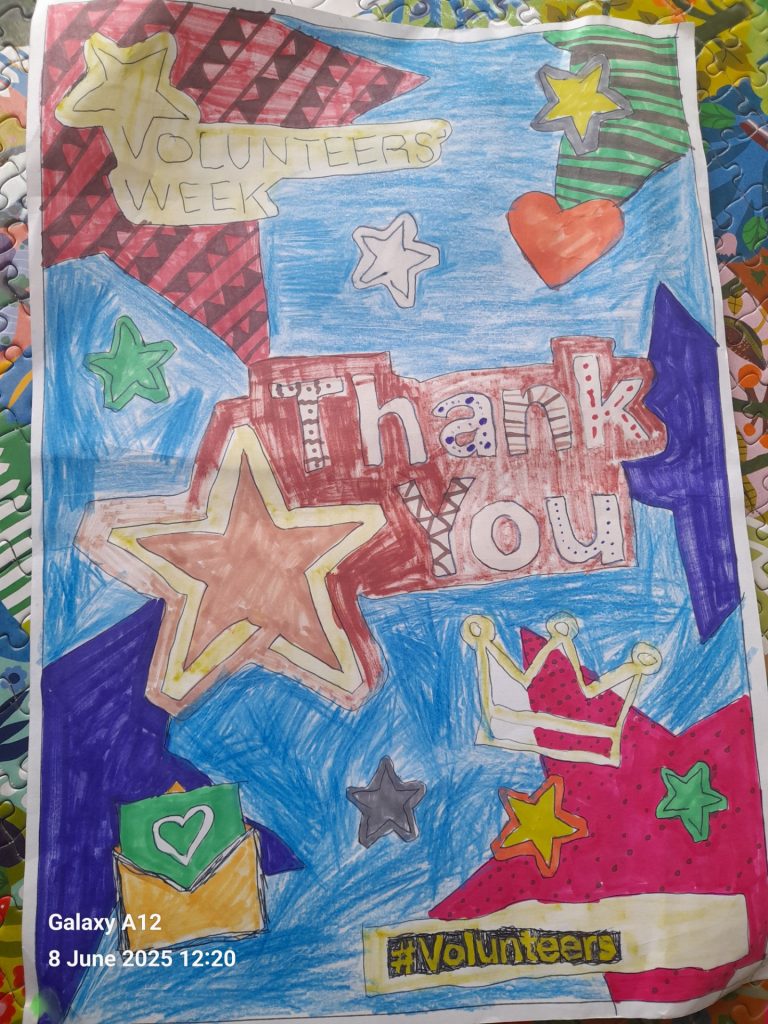
Colouring In Poster

To help celebrate Volunteers’ Week 2025 (2-8th June) we shared a Colouring in templates via social media. Here is Lizette’s (Forum Volunteer) masterpiece.

From all of us at the charity, and on behalf of the Trustee Board and our Co-Chairs: thank you.

Peer Support. Join the community

“Having chronic pain is very lonely.”

Join the community

Subscribe to Pain Matters

Everything you need to know about how to live with chronic pain

Subscribe


In pain? Don’t understand what’s happening?

“Having someone to help you prepare for your life through pain”

Our Pain Education Sessions

Fundraise for Pain Concern

Help us to help others

Fundraise


This edition of Airing Pain looks at the research into why pain persists, how we can identify people at risk and whether we could prevent it happening.

In this episode:

  • How does acute short-term pain turn into chronic, persistent pain? Kathleen Sluka explains that people who experience psychological trauma at young ages are more likely to have chronic pain later in life. What scientists think is happening is that psychological trauma or other stressful events actually change your immune system.
  • Shafiq Skikander adds that a lot of patients with fibromyalgia may have had early life stressors. In addition, when they come to clinic presenting with fibromyalgia, they usually have a history of depression.

So how does this happen?

  • Gareth Hathway explains that slowly but surely, our understanding of the basic mechanisms is advancing. We now understand that babies do feel pain, young people do feel pain. It has a long-term consequence. We need a specialist approach to managing pain at every part of the life course. We need to think about how we measure that pain and how we treat that pain.

The interviews were recorded at the British Pain Society’s Annual Scientific Meeting, 2024.


Contributors: 

Shafiq Sikander, a professor of sensory neurophysiology at the William Harvey Research Institute, Queen Mary University, London.

Gareth Hathway, professor of neuroscience at the University of Nottingham’s’ school of life sciences.

Kathleen Sluka, a professor in physical therapy and rehabilitation science at the University of Iowa in the United States.


Thanks

The interviews were recorded at the British Pain Society’s Annual Scientific Meeting, 2024. 


This programme describes research using laboratory animals that is consistent with Pain Concern’s Humane Care and Use of Animals in Medical Research Policy:


Additional Resources: 

You can join our Airing Pain online community:

If you have any feedback about Airing Pain, you can leave us a review via our Airing Pain survey  

____________________________________________________________

Peer Support. Join the community

“Having chronic pain is very lonely.”

Join the community

Subscribe to Pain Matters

Everything you need to know about how to live with chronic pain

Subscribe


In pain? Don’t understand what’s happening?

“Having someone to help you prepare for your life through pain”

Our Pain Education Sessions

Fundraise for Pain Concern

Help us to help others

Fundraise


Airing Pain 149: Why pain persists: from childhood trauma to faulty immunity

First broadcast 21st May 2025

This edition of Airing Pain looks at the research into why pain persists, how we can identify people at risk and whether we could prevent it happening.

The interviews were recorded at the British Pain Society’s Annual Scientific Meeting, 2024. 

Paul Evans talks to:

Shafiq Sikander, a professor of sensory neurophysiology at the William Harvey Research Institute, Queen Mary University, London.

Gareth Hathway, a professor of neuroscience at the University of Nottingham’s’ school of life sciences.

Kathleen Sluka, a professor in physical therapy and rehabilitation science at the University of Iowa in the United States.

The edition is presented and produced by Paul Evans. The interviews were recorded at the British Pain Society’s Annual Scientific Meeting, 2024. 

Transcript begins

Paul Evans: This is Airing Pain. The programme brought to you by Pain Concern, the UK charity providing information and support for those of us living with pain, our family and supporters and the health professionals who care for us. We’re grateful to the continued support of the British Pain Society for providing facilities to record at their annual scientific meetings and the content of this edition of Airing Pain was recorded at the 2024 meeting. I’m Paul Evans.

Gareth Hathway: We know that children, human children, rodent children, they’re much more sensitive to pain. Their pain thresholds are a lot lower, and their responses are longer, larger, and they’re a bit inappropriate. They don’t respond in the right way. And we learn how to become adults.

Shafik Sikander: A lot of patients with fibromyalgia may have had early life stressors, or often – when they come to clinic presenting with fibromyalgia – they have a history of depression.

Kathleen Sluka: We know that people with psychological trauma at young ages are more likely to have chronic pain later in life. But what we think is happening, and we’ve done a little bit of this, psychological trauma or some kind of a stressful event, actually changes your immune system.

Evans: One of the great things about coming to these British Pain Society scientific meetings is that you get to hear new insights and developments in the field of pain: things you won’t necessarily read in the popular media, which nevertheless could have a huge impact on how we live with pain now and into the future. Conditions like fibromyalgia, for instance. It’s one of those conditions that rarely makes headlines beyond how it affects sufferers, particularly, dare I say, celebrities. But not necessarily on understanding the causes and the mechanisms that will drive its management into the future. Shafik Sikander is a professor of sensory neurophysiology at the William Harvey Research Institute, Queen Mary University, London, and her work is trying to understand those mechanisms in animals in preclinical models, and in clinical studies.

Shafik Sikander: For decades it’s really been considered to be a brain-based disorder. But in the last five to ten years, there’s been quite a lot of exciting and emerging evidence suggesting that there is a peripheral pathology driving pain in this disease, which gives us hope that we can target the pain directly in the periphery. The real key question for us is to understand what is going wrong in the peripheral tissues when people say, “my arms hurt”, “my shoulders hurt”, “my legs hurt”. Well, what’s driving that pain in the arms and shoulders? We don’t think it’s only what’s going on in the brain. We think that input is coming from the peripheral tissues going into the brain, and then a patient will be perceiving pain as a result of that.

Evans: Explain to me how that works and why do you think that?

Sikander: One thing that I probably want to start out by saying or, just, sort of introducing the different lines of evidence is to say that I think fibromyalgia is more and more like an umbrella term for a group of disorders that might have the same manifestation, the same symptomatic manifestation. So, some people have found evidence for small fibro neuropathy in a small cohort of patients. Okay, great. We know a little bit about neuropathic pain – that makes sense. We understand why there might be pain in those patients. Other patients don’t have small fibro neuropathy. Some patients may have dysfunctional IGG, for example.

Evans: What’s that?

Sikander: This is an immunoglobulin. So, when there’s a change in the immune system. We recently discovered that a group of cells called the neutrophils, which are important cells in your innate immune system – important for normal host defence responses to infection and external pathogens and microbes – well, we think neutrophils, even though they tend to be very good for us and very important for your resolution of information, resolution of inflammatory pain, we’ve seen that in patients with fibromyalgia, actually, neutrophils can behave quite badly and they might be driving pain.

Evans: So, does that mean it could be an autoimmune disease?

Sikander: No, I wouldn’t call it an autoimmune disease per se, at this point. I would say that we’re looking at immune dysfunction and that the mechanism of pain lies along the neuroimmune axis, the way the nervous system and the immune system communicate.

Evans: Neuroimmune, what does that mean? Explain to me what neuroimmune is.

Sikander: Neuroimmune… “apartmento” between neurons and immune system.

Evans: Neurons – nerve cells?

Sikander: Yeah, nerve cells and the immune system. So, it’s just a term to describe that the nervous system (that comprises our nerve cells), and the immune system (that comprises our ability to defend ourselves against infection and disease): these two systems communicate. They’re two physiological systems that interact to a much greater depth than we currently understand, I think. And that communication is bidirectional. So, nerve cells, or neurons, can communicate to immune cells and vice versa.

Evans: What could be causing this in the first place?

Sikander: We can’t ignore the history that patients present with. With the immune system, it’s extremely plastic and it’s highly prone to coating memory to injury and particular salient events. And so, when we talk about the history of patients, a lot of patients with fibromyalgia may have had early life stressors. Or when they come to clinic presenting with fibromyalgia, they usually have a history of depression. So, you know, there might be different triggers that accumulate and then just tip an individual over the edge to then go on and develop a disease. And we’ve actually modelled this in mice, or this aspect of repeated, salient, noxious events driving chronic widespread pain. So, actually if we injure a mouse once in the leg, well, that mouse develops some pain for a little bit of time. The injury heals after a few days; pain behaviour seems normal. But actually, what we’ve done is we’ve primed the nervous system with that injury, so that after a subsequent insult we can trigger latent hypersensitivity and persistent pain. So, animals after another injury will not just have an acute pain episode, they’ll actually develop persistent pain.

Evans: So, the body is saying, “I remember what happened then. If it happens again, I’m going to continue hurting you”.

Sikander: Yeah, like a memory mechanism, akin to a memory mechanism, but yeah. So that’s kind of what we refer to when we talk about plasticity within the nervous system and within pain states. So, we know, for example, in some patients neutrophils are pathological, and they are the cells within the circulation that’s driving this widespread pain. So, we can try and target how neutrophils communicate with neurons to try and help relieve pain, but then we need to do even more work to try and characterise those neutrophils, to understand how they’ve come about to becoming these pathological cells. Why aren’t they just normal, healthy neutrophils, behaving in a good way, like they do in people that don’t have pain? I mean, if we understand what is driving the pain, then we can understand what has caused it. Because I think the root causes could be multiple mechanisms, there could be repeated stress injuries, and every patient history is very different. Right now, we’re dealing with this disease that’s very heterogeneous in terms of its mechanisms of pain. So, I think what we’re going to have to first do is actually be able to stratify different subpopulations of patients with fibromyalgia to understand, in different subpopulations are different mechanisms driving the pain? And then we come back to the root cause. I think trying to find the root cause for a very heterogeneous umbrella term of a disease is maybe not the most… yeah, effective way for us to spend our research time. But right now, what we know is that we have a number of patients coming through pain clinic that have debilitating pain, and we have this potential opportunity to treat their pain. And if that works, then we can go back and see if there’s any potential triggers that we can subdue, or we can prevent people from experiencing certain triggers that would transition their pain from an acute to chronic state.

Evans: That’s Shafiq Sikander of Queen Mary University, London. Well, let’s delve a little deeper into the differences between acute and chronic pain, and why preventing the transition from one to the other is so important. Kathleen Sluka is a professor in physical therapy and rehabilitation science at the University of Iowa in the United States.

Kathleen Sluka: An acute pain condition would occur after you fall down onto your ankle or have a surgical procedure. Under normal conditions, the great majority of people may recover from that, and their pain goes away. But there’s a proportion of somewhere between 20 and 30 per cent of people where that pain remains: three months, six months, a year later. And it’s those people that, if we could prevent that transition, if we knew it was happening either before that event – say, if they’re going into something that’s planned like a surgical procedure or during that very acute injury stage. If we knew what was different about them, then maybe we could intervene there, and stop them from ever getting into the phase of where they turn into a chronic condition. If we could do that, we can lower the total number of people that have chronic pain and reduce the burden altogether. So, our whole goal with this is to, really, just prevent that transition. We have some animal models of the transition from acute to chronic pain where we’ve begun to look at mechanisms in the central nervous system and in the immune system. But then we’re moving forward into also looking at those factors in people before and after surgery, so we can begin to identify what those factors are.

Evans: But not all chronic pain conditions start off as acute pain.

Sluka: What I think we’ve learned over the years is that, in order to induce chronic pain or long-lasting persistent pain, there’s a lot of ways to do it. Yes, after a surgical event, a certain number of those will not move on. In animal models, I’ve probably induced very long-lasting pain with multiple different things. Like I could give, say, two muscle insults, three to four days apart. The first one may not do much of anything and the second one – then I have weeks of pain afterwards. Or I could give a muscle insult that does nothing in a normal weight mouse, and when I do that in an obese mouse, he gets long-lasting pain. Or I could give them a stress event. I could make them stressed and there’s different ways we do that in mice. We stress them and then give them that same insult that doesn’t do anything under normal conditions. And now I get that. So, it’s this combination of stressors that are occurring in some kind of time-window that we think is driving them into this chronic pain. So, when you say, maybe they had these low intensity insults or stressors all occurring simultaneously in life, but they didn’t recognise them as the “inciting event”, so, they may not have had an acute, really big pain episode before they transitioned.

Evans: Now, I can understand if you give a pain insult, that is, make it hurt to a mouse, and then you give them another one two weeks later – I can understand why the second one could reinforce the first one, or make the brain think, “Ah, we know what’s coming, we’re going to do something about that in the in the future”. But I don’t understand how, say, giving it a psychological trauma could do that.

Sluka: Well, we know that in people with psychological trauma, those at young ages are more likely to have chronic pain later in life. But what we think is happening, and we’ve done a little bit of this psychological trauma, or some kind of a stressful event, it actually changes your immune system, and you might get a little bit more inflammatory cytokines being released. It might activate certain pathways within your central nervous system. That pain is also sending signals through. So, there’s not a single pain signal or pain pathway. There are multiple places within the brain that are receiving these signals. And they’re processing them all together to get some kind of output that eventually the brain says, “Oh, I got pain!” Well, the same thing happens with stress, it’s not a single spot. And sometimes they overlap, and they’re in the same areas. And so, if those are hypersensitized by one of those other stressors, like a fatiguing stimulus, or a stressful stimulus, and then the pain comes on top of that, then it might interpret that as a painful event and respond in an exaggerated way. So, I really think it’s just a heightened state of the nervous system or the immune system, or some combination of all of those that the body is seeing; and both of those events may be doing some kind of general heightened sensitivity that the other one is then enhancing.

Evans: So, the big thing that you’re working on and telling the delegates here is stopping that acute pain becoming chronic?

Sluka: Yes. We’re trying to figure out what factors are different between the individuals who go on to develop that chronic pain at that acute stage. So, maybe there’s also some factor in those who don’t. That’s what we might call a “resilience factor”. That might protect them from moving into that state. That might be equally important for the future in preventing the transition. If we knew that, that could then be a future target as well, to use as a way to increase resilience in the people who were transitioning to that chronic pain condition.

Evans: What’s your feeling about, if there is an answer, what it might be?

Sluka: What I think, what we’ve come to believe is what we’re going to end up with is something that I like to call not a single biomarker, not a single marker at all – it’ll be what we call a “biosignature”, which will be a combination of markers. It’ll be a combination of factors. It won’t be all biological. There’ll be some biology, maybe something happening in the nervous system, something happening in the immune system. But there’ll also be some patient characteristics that will add to that; things like pain levels will matter. Other conditions they might have will make a difference; the psychological conditions, if they have depression or anxiety. And what I think we’re going to end up with is kind of like a “top ten” list of, if you do these tests, I can do some blood work and I can measure for depression or anxiety or a few simple tests, activity levels. And we know these “top ten” lists, much like we have for cardiovascular disease, and we know that that’s your risk and we’re going to come up with a “risk profile”. Then we’ll be able to target those people based on that, on how they perform on that top ten risk profile, and that’s what I’m eventually hoping that we’ll come up with. We’re in the process of doing a really large study with 2,800 individuals before and after surgery, for six months, where we’re looking at brain imaging, hundreds of markers in the blood, sensory testing and a lot of patient outcome measures from psychology to social, just pain levels. And we’re hoping that with that data we’ll be able to definitively come up with that “top ten” list at the end. We like to try and oversimplify things and assume that everything is going to come down to one answer and I don’t think it’s going to. And I think there’s many ways for us to get to that chronic pain condition and because of that, there’s going to be a huge variety of presentations. And treatments are going to have to get to an individualised basis in order for us to make progress. But we don’t have the tests yet. We don’t have all the measures yet. We don’t know the best route yet. And I think that’s where the exciting part is, once we start discovering some of this, we’ll be able to do that. But we’re not quite there. Soon, I hope.

Evans: That was Kathleen Sluka of the University of Iowa in the United States. Well, I guess what scientists who study the relationship of pain and the nervous system really need is a definitive measure of a patient’s pain. Gareth Hathway is a professor of neuroscience at the University of Nottingham’s School of Life Sciences. He was talking to delegates at the British Pain Society Annual Scientific Meeting in 2024 about a new technique to measure how parts of the spinal cord receive, process and respond to innocuous and noxious events, and how that changes over early and later life.

Gareth Hathway: Nerve cell neurons are electrically excitable, they’re electrically active. Our brains, our spinal cords, our peripheral nervous systems run on electricity. And what we do is use electrodes, which we can put into those tissues, and we can measure that electrical activity. So, every time they fire, like turning a light bulb on and off, we can measure that “on” and “off”. That tells us when neurons are firing, and what they’re firing to, and how long they’re firing for. So that really gives us a kind of measure, an assay of how excited – in this case – our spinal cord is. And a general rule of thumb which I use with our undergraduate students is the more excited your spinal cord is, the more pain you will feel. So, we can measure the electrical activity and determine how much pain – not susception, but pain, for this purpose – an individual is in at any given time. So, we can also see if drugs can reduce the excitability and therefore reduce the amount of pain.

Evans: Okay, so you can see when a person might be experiencing pain in the spinal cord. But what happens when it leaves the spinal cord and goes up?

Hathway: Goes up to the brain? Well, that’s a very good question. That’s one of the things that we want to try and understand. So, this is all in laboratory animals. What is the signal that the spinal cord sends to the brain that says, “That’s potentially harmful to me”? That thing that you’ve just encountered in the environment. And at the moment, many of the techniques that we use can’t do that. That’s why I’m talking about this new technique, because the way that we’ve studied the electrical environment of the spinal cord has been the same since the 1950s, pretty much. It kind of relies on us measuring one nerve cell at a time and one particular set of nerve cells, actually, in one particular place in the spinal cord at a time. And the problem is that the spinal cord is very varied. There are thousands of different kinds of neurons. And it’s not really how one neuron responds, it’s how a population of neurons respond that determines whether or not we get information related to pain. So, our new technique uses lots of electrodes at the same time to measure hundreds, if not thousands of neurons at the same time, from everywhere in the spinal cord. And so, then we can build up what we call a kind of network image. So, how is the whole spinal cord responding, not just how does one cell respond, and then kind of extrapolating that to a much larger population.

Evans: So, you can see from “point A” right down in the spinal cord to “point C”, which may be halfway up the spinal cord. You can chart differences.

Hathway: Yes. So, at the very top of your spinal cord there are five layers in the dorsal part. There are ten in total, but there are five that we’re worried about as pain scientists. So, the top two get information that’s related to pain from your bone, your skin, your muscles from the nerve cells in your body. The middle two process. Layer three and four process innocuous information like brush normally. And layer five, which is the deepest one that we measure, that gets information from everything, painful and non-painful, and integrates it all together. And then normally, traditionally we’ve just recorded from those deep ones in layer five. But actually, what we want to know is what’s also happening at the same time in the “painful” layers and in the “non-painful” layers. So, what our technique allows us to do is to measure all the activity at the same time in all five layers, but also, with a bit of mathematical trickery, how the information flows between those layers. So how, let’s say, layer one and layer five relate to each other at the same time. So how the network responds. It’s a different technique, but it’s a similar approach to MRI or something like that, that you’d use in the brain where you’re looking at big volumes of brain tissue. It allows us to look at a big volume of tissue in the spinal cord. But we can’t use MRI on the spinal cord because it’s not good enough.

Evans: So, from your research, what is going on between those layers?

Hathway: Well, so we’ve mostly studied at the moment – because I’m particularly interested in early life pains – what happens when we’re very young, and how we mature, how we become adults. So, we know that children – human children, rodent children – are much more sensitive to pain. Their pain thresholds are a lot lower, and their responses are longer, larger, and they’re a bit inappropriate. They don’t respond in the right way, and we learn how to become adults. And so, we’ve always thought that the dorsal horn, those five layers, are more excited. Actually, what our data is now showing is that they’re not more excited, they’re a lot less excited. Because if you look at the data, there’s a lot less activity across all of those layers than there is in an adult. What that’s telling us is that it’s not that we’ve got a runaway system that we need to apply the brakes to, to slow it down as we become adults. Actually, what we’ve got is a system where there’s lots of inactivity in the neurons – and it all needs to be ramped up a little bit. And this is particularly important because we know that injury in early life in a human, if you’re born very young and you suffer an injury, or you have an operation, or you’ve got a disease which is very painful, even after you’ve been cured of that pain – that pain’s gone away, the disease is better, the surgery’s over – you’re much more susceptible to chronic pain states and altered pain processing as an adult. And so, understanding how it works (which is what we’re doing at the moment) normally, and how changes that you might encounter as a very young person – diseases, surgery – how that impacts on that normal development. By understanding how it works, how the machine works, we can then really understand what we can do to try and put it back on a normal path once you’re adult. So, one of the projects we’re working on at the moment, another one, is looking at cancer survivor pain, children who have developed cancer very early in life and how they survive. But lots of those children, when they grow up, those survivors, have significantly altered pain experience and they suffer from a lot of pain as survivors. And with that comes anxiety and depression and educational problems as well, because they’re in pain, so they withdraw a bit more. So, understanding a pain level, how that processing is happening, identifying ways that we might be able to make it better, will then lead to a better life experience for, in that case, cancer survivors. But it’s just as applicable to people who’ve had surgery, as I really love to connect something.

Evans: Well, I did have surgery at three months old.

Hathway: Mm hmm, okay.

Evans: I have chronic pain now, so possibly too late for me. I don’t know whether that operation I had is the reason for my chronic pain, but maybe in the future if you recognise, if you know what’s going on in the developing child, baby, you’ll be able to put things in place.

Hathway: Yes, that’s the idea – that we can identify new ways of managing the pain experience when you’re very young, so that you’re less susceptible to chronic pain, when you’re very old. Or more so than we normally are, anyway. One of the big problems is that pain in children is under-recognized, because they’re not so good at communicating it. So, when you were three months old, you couldn’t point to a scale and say, on a scale of one to ten, how much pain you were in. And also, there’s a bit of a reluctance to treat it, because people are obviously concerned. And also, the drugs we’ve got, we know can alter that development as well. So, some of the work that I’ve been doing for the last fifteen years – but we’re doing more of it now – is looking at how opioid analgesics and exposing very young animals to opioid analgesics, how that alters that developmental pathway, that trajectory. And it does. And opioids do that as well. So, it’s a catch-22 situation that we’re in. The pain is bad, but sometimes the treatment alters things as well and also leaves you more susceptible to things later in life.

Evans: I’ll go back on that a little bit because it wasn’t that long ago that it was thought that babies didn’t feel any pain.

Hathway: That’s exactly right, yeah.

Evans: And the person I spoke to who witnessed an operation – in fact, the operation I had – pyloric stenosis.

Hathway: Well, my dad had that as well at three months. There you go.

Evans: Really?

Hathway: Yeah, absolutely.

Evans: As a student, she witnessed one of these operations where there was no anaesthetic. I think she called it a “cruciform” or “crucifix” style operation, where the baby’s arms are held at the side and of course “babies feel no pain”, so and so…

Hathway: “So it’s okay, it’s just a reflex.” That’s what they thought.

Evans: “Get stuck in!”

Hathway: Yeah, it’s horrifying how recently these kinds of things went on. Because I think the dogma (it wasn’t accepted clinical practice) was that babies were incapable of feeling pain. Their brains weren’t mature enough to be able to consciously perceive it. So therefore, they’re not going to remember it. Providing analgesics – and the risk associated with that – it’s not needed. But actually, work from Mariah Fitzgerald, again Rebecca Slater who’s now at Oxford, has really shown that cortically the conscious part of the human brain, even in the very youngest babies, is able to respond in a consistent and reproducible way to not just stimulation. So, you have to provide anaesthetic and analgesia. But yeah, you know, we’re talking 1950s, 1960s, these things were going on. And in some cases, I think… Not surgery like that, but I seem to recall a paper from, it can’t have been much more after 2006 and 2007, that looked at circumcision pain in New York, so this a first world country. How many children were actually provided with any analgesia during and following circumcision? And it was a surprising number that weren’t. I imagine that’s quite painful.

Evans: I imagine it is really painful. So, moving on a bit, you said that some of the treatments could cause more issues than non-treatments.

Hathway: Before the COVID pandemic, I think the greatest public health concern in bioscience was the opioid epidemic in North America. And it has not gone away, it’s still there. Related to that was the number of opiate prescriptions that were taking place in North America, but also in Western Europe, the UK included. Opiates are brilliant for managing acute pain, they’re the best drugs we have. And they’re great at managing short-term, acute pain. But long term, they’re not so great. You become tolerant to them, so you need more and more to have the same effect. Obviously, there are addiction issues, but also, paradoxically, taking opiates can cause something called “opioid induced hyperalgesia”, which is the opiates themselves cause pain. That’s a problem for long-term, adults like us taking them. What I showed in my work, when I was with Mariah Fitzgeralds back in the late 2000s, early 2010s, was that during normal development of a rodent, if you rely on the opioid, the natural opioid system in your brain, for your pain system to wire together properly, and if you disturb that by giving an opiate, or by blocking opiates, you’ve changed the way that those animals process pain for the rest of their lives. Currently I have a grant with my colleague Vicky Chapman and Steve Woodhams from the MRC that’s looking at – not in babies now, in young adults – what the effect of an exposure to opiates for a very short period of time, for seven days, has upon their pain experience and their susceptibility to chronic pain later in life. So, we’re interested in osteoarthritis and pain of this kind. And we can show a much earlier, brief exposure to opiates makes you much more susceptible to musculoskeletal pain when you’re much older. And we did some public engagement before we wrote this grant, and we asked the members of the public that volunteered to help us develop it, “Had they ever taken opiates in their lives?” And most of them said, “No, no, no, no, no, of course not!” And we said, “So, you’ve never taken codeine, bought codeine over the counter?” “Oh yeah, yeah, I’ve done that! And uh, when I gave birth, I had something, I had pethidine.” OK, that’s another one. And I remember my parents in particular back in the 70s and 80s, distalgesic was an analgesic of choice. My grandmother used to take quite a few – and that was another opiate-acting drug as well. So, people don’t realise that they’re taking opiates. And what that work is showing is that opiates are great – for short term, acute pain management when you need them. But longer term, they’re not great at controlling longer term pain. But they are the best we have. So, lots of people, my own family included, rely on opiate drugs to provide the analgesia. But that’s why conferences like this are really needed, to think about better ways of managing longer term pain.

Evans: That was Gareth Hathway, Professor of Neuroscience at the University of Nottingham. Now, as in every addition of Airing Pain, I’d like to remind you of the small print that whilst we in Pain Concern believe the information and opinions on Airing Pain are accurate and sound, based on the best judgments available, you should always consult your health professionals on any matter relating to your health and well-being. They’re the only people who know you and your circumstances and therefore, the appropriate action to take on your behalf. At Pain Concern’s website which is: painconcern.org.uk, you’ll find many resources to learn about and live well with pain. There are links to every edition of Airing Pain and to written transcripts of each one. Now it’s important for us at Pain Concern to have your feedback on these podcasts, so that we know that what we’re doing is relevant and useful and to know what we’re doing well, or maybe not so well. So do please leave your comments or ratings at whichever platform you’re listening to this on or the Pain Concern website of course. Once again, it’s painconcern.org.uk – and that will help us plan future editions of Airing Pain. But to end this edition of Airing Pain, here’s Gareth Hathway again.

Hathway: Your pain experience all the way through your life will, in some way, impact on your pain experience at the very end of your life. Yesterday at the conference, it was a great parallel session that started with Suellen Walker talking about pain and late effects in children and then through another lady who was telling us about pain in people with learning differences and people who weren’t able to communicate pain, and it ended with a talk from a lady talking about pain in older people. And she had a statistic in her talk that 95% of old people exist with chronic pain and I leant across to my colleague at my side and said that if this was any other disease, the government would be throwing money at it, left, right and centre, if 95% of people were suffering from it. Because the impact that pain has –we’ve all experienced acute pain, but long-term pain, it makes us depressed and anxious, makes us withdraw from society. So, we’re not going to the shops and spending money. The impact it has economically and the burden it places on the health service is massive. But it’s not just about thinking about pain in older people, what happens when we’re old, it’s thinking, well, how can we manage pain appropriately at every point in the life course, so that the person’s quality of life is as good as it can be for as long as it can be, so that they’re happy, they’re active and they’re contributing as much or as little as they want to society. Slowly but surely, our understanding of the basic mechanisms is light years ahead of where it was. And, clinically, an appreciation that babies do feel pain. Young people do feel pain. It has a long-term consequence. So, we can’t just treat them as small adults. We need a specialist approach to managing pain at every part of the life course. We need to think about how we measure that pain and how we treat that pain.

Transcript ends

Transcribed by Owen Elias

© 2010-2024 Pain Concern. All Rights Reserved. 

Registered Charity no. SC023559.  

Company limited by guarantee no. SC546994.  

62-66 Newcraighall Road, Edinburgh EH15 3HS. 


Peer Support. Join the community

“Having chronic pain is very lonely.”

Join the community

Subscribe to Pain Matters

Everything you need to know about how to live with chronic pain

Subscribe


In pain? Don’t understand what’s happening?

“Having someone to help you prepare for your life through pain”

Our Pain Education Sessions

Fundraise for Pain Concern

Help us to help others

Fundraise


1 2 3 4 49