Information & Resources

Find information and resources to help manage your pain.

Get Help & Support

Find the tools you need to
help you manage your pain.

Get Involved

Help make a real difference to people
in the UK living with chronic pain.

About Us

Find out about Pain Concern and how
we can help you.

Monday 23rd  October 2017

Government moves to reclassify pain medications pregabalin and gabapentin create  fear and anxiety for people living with long-term pain

Health charity Pain Concern is warning that moves to restrict prescribed painkillers pregabalin and gabapentin over their association with rising death rates and mis-use would have a serious impact on people who depend on the medication for relief from long-term pain.

Home Office proposals to reclassify both gabapentin and pregabalin – commonly used to treat neuropathic or nerve pain – as class ‘C’ substances, will make access to them more difficult. Publicity surrounding the proposal has also created fear and anxiety and left people who depend on gabapentin or pregabalin for pain relief, questioning the safety of the two medicines which, if used responsibly and with the right combination of support, can change the lives of people who have previously struggled to manage pain symptoms.

Heather Wallace, Chair of Pain Concern – a UK charity based in Scotland – acknowledges the rise in the number of deaths associated with pregabalin and gabapentin but says the circumstances around the alarming statistics haven’t been properly examined. ‘We have known for a long time that these medicines have been over-prescribed, but the people who find them beneficial for pain relief, haven’t misused them and feel they are being punished for something they haven’t done. In many cases it is difficult to find the right combination of pain relief, and we know from our helpline that people have been left fearful and confused by this proposal and all the publicity it has generated. It’s premature and risks harming people who are using these medicines because there is nothing else for them that works’.

Pain specialist Dr Pamela Bell believes that open and informed discussion between people living with pain and their GP about the benefits versus the risks of potential treatment, including the risks of dependency, addiction and interactions with other drugs, is vital. ‘We know many people who benefit from these medicines when they are appropriately prescribed and we share their concerns at moves to reclassify pregabalin and gabapentin. Many people tell us it has taken years for them to find the right combination of medication, physiotherapy and support that allows them a better quality of life and it will prove more difficult to access pregabalin and gabapentin when they are reclassified as controlled drugs’.

Pain Concern works to empower people living with long term pain to be proactive in managing their condition and has in response to the demand for trustworthy and reliable information on pain medication has produced three information leaflets on: gabapentin and pregabalin; amitriptyline and opioids. Written by pain experts, the leaflets provide up-to-date information and facts to help people discuss possible treatments and therapies with their GP or clinic. Leaflets are free of charge from order@painconcern.org.uk or 03001020162.

Ends

Peer Support. Join the community

“Having chronic pain is very lonely.”

Join the community

Subscribe to Pain Matters

Everything you need to know about how to live with chronic pain

Subscribe


In pain? Don’t understand what’s happening?

“Having someone to help you prepare for your life through pain”

Our Pain Education Sessions

Fundraise for Pain Concern

Help us to help others

Fundraise


In the second part in Airing Pain’s series on complex regional pain syndrome, Paul speaks to specialists and patients at the Royal National Hospital for Rheumatic Disease CRPS rehabilitation programme in Bath

This programme was funded by grants from RS Macdonald Charitable Trust and the Hospital Saturday Fund.

Complex regional pain syndrome affects 1 in 3,800 new people every year in the UK.[1] It is a poorly understood condition and it can be frustrating for patients who are suffering to find peace of mind. The Royal National Hospital for Rheumatic Disease in Bath began its rehabilitation service for individuals with CRPS in 1999 and is one of the very few in the UK with outpatient and inpatient care dedicated to CRPS.

The centre, led by Professor Candy McCabe, strives to improve patients’ lives through up-to-date multidisciplinary techniques ranging from occupational therapy to mirror visual feedback (MVF).

Michael and Julie, patients currently enrolled in the rehabilitation programme, speak to Paul about the injuries that caused them to develop the syndrome, how it affects their lives, and how the programme is helping them cope.

Paul also sits in on a session with Senior Physiotherapist Emma Houlihan and patient Chris, whose entire left side of his body has been affected by CRPS, to explore the therapies used at the centre to try to help him regain normal sensation.

Clinical Specialist Physiotherapist Jane Hall describes the process that new patients will go through, and how the centre helps patients even after they have left the programme.

Issues covered in this programme include: CRPS: complex regional pain syndrome accident, visual feedback, mirror therapy, chronic primary pain, post-surgical pain, occupational therapy, psychology, rehabilitation, relaxation, Rheumatic Disease and sleep.


Contributors:

  • Professor Candy McCabe, Clinical Lead for the complex regional pain syndrome service.
  • Emma Houlian, Senior Physiotherapist
  • Charlie Ewer-Smith, Clinical Specialist Occupational Therapist
  • Dr Jane Hall, Clinical Specialist Physiotherapist
  • Keri Johnson, Clinical Specialist Physiotherapist
  • Chris, patient in the rehabilitation programme
  • Michael, patient in the rehabilitation programme
  • Julie, patient in the rehabilitation programme.

More information:


[1] NHS: http://www.nhs.uk/Conditions/Complex-Regional-Pain-Syndrome/Pages/Introduction.aspx.

Peer Support. Join the community

“Having chronic pain is very lonely.”

Join the community

Subscribe to Pain Matters

Everything you need to know about how to live with chronic pain

Subscribe


In pain? Don’t understand what’s happening?

“Having someone to help you prepare for your life through pain”

Our Pain Education Sessions

Fundraise for Pain Concern

Help us to help others

Fundraise


In the second part in Airing Pain’s series on complex regional pain syndrome, Paul speaks to specialists and patients at the Royal National Hospital for Rheumatic Disease CRPS rehabilitation programme in Bath

To listen to this programme, please click here.

This programme was funded by grants from the RS MacDonald Charitable Trust and the Hospital Saturday Fund.

Complex regional pain syndrome affects 1 in 3,800 new people every year in the UK.[1] It is a poorly understood condition and it can be frustrating for patients who are suffering to find peace of mind. The Royal National Hospital for Rheumatic Disease in Bath began its rehabilitation service for individuals with CRPS in 1999 and is one of the very few in the UK with outpatient and inpatient care dedicated to CRPS.

The centre, led by Professor Candy McCabe, strives to improve patients’ lives through up-to-date multidisciplinary techniques ranging from occupational therapy to mirror visual feedback (MVF).

Michael and Julie, patients currently enrolled in the rehabilitation programme, speak to Paul about the injuries that caused them to develop the syndrome, how it affects their lives, and how the programme is helping them cope.

Paul also sits in on a session with Senior Physiotherapist Emma Houlihan and patient Chris, whose entire left side of his body has been affected by CRPS, to explore the therapies used at the centre to try to help him regain normal sensation.

Clinical Specialist Physiotherapist Jane Hall describes the process that new patients will go through, and how the centre helps patients even after they have left the programme. 

Issues covered in this programme include: CRPS: complex regional pain syndrome accident, visual feedback, mirror therapy, chronic primary pain, post-surgical pain, occupational therapy, psychology, rehabilitation, relaxation, Rheumatic Disease and sleep.

Paul Evans: This is Airing Pain, a programme brought to you by Pain Concern, the UK charity providing information and support for those of us living with pain and for healthcare professionals. I’m Paul Evans, and this is the second on a series of programmes about complex regional pain syndrome or CRPS.  It is funded by grants from the R S McDonald Charitable Trust and the Hospitals Saturday Fund.  In the previous edition of Airing Pain no 94 which you can download from the Pain Concern website we established that CRPS is a condition in which a person experience persistent severe and debilitating pain which is usually confined to one limb but can spread to other parts of the body.  The skin of the affected body part can become so sensitive than even a slight bump or even change of temperature can provoke intense pain.  Professor Candy McCabe, Clinical Lead for the National Centre for the management of CRPS at the Royal National Hospital for Rheumatic Diseases in Bath.  I will just remind you about what she said about a new approach for managing CRPS that they are adopting with their patients.

Professor Candy McCabe: Try and access that information underneath the pain because it is there, try and find it and its really extraordinary how people can suddenly find that information that they though was lost to them and low and behold and start the focus away from pain into more normal sensations.  So we just starting on this journey, still very experimental but it intuitively feels the right thing to do.  It’s really exciting.

Paul Evans: such enthusiasm can’t go unchecked so I went along to the National Centre for the management of CRPS in Bath where senior Physiotherapist Emma Hollihan was working with CRPS patient Chris Jones.

Emma Hollihan: Again just try to remind yourself what was so nice about it. That nice feeling of just being there with your brother and sister and it was stone wall you were sitting on wasn’t it. Just trying to remember how you could just let everything go while sitting on the while.  Can you get that feeling of how it felt to let it go on the right side, how that felt?

Chris Jones: Sitting there basically kicking this leg around

Emma Hollihan: so this is a memory from when you were younger?

Chris Jones: Yes

Emma Hollihan: and it’s still a nice memory?

Chris Jones: Still nice memory yes, still do that

Emma Hollihan: Do you?

Chris Jones:  Yes can’t really do as much now

Paul Evans: We will get back to Chris and Emma later.  In the meantime let’s find out more about the CRPS rehabilitation programme in bath. Charles Smith in clinical specialist in occupational therapist on the team

Charles Smith: – It’s a great programme we are really proud of how it has developed.  It has been developed over a number of years but basically come here for two weeks and they live with us in the hospital here and have a full programme of activities so every day they have physical therapy, occupational therapy and hydrotherapy and we access to phycologists and a mixture of one to one sessions and workshops which are short and sweet half hour sessions on things like, managing your sleep, nutrition and longer sessions like understanding CRPS and how to communicate with people about pain, thinking about how your manage your own activity, control of life again. Broad ranging programme. We do relaxation every day but we found it very important for people to dampen down their nervous system when treating CRPS and it is helpful can carry on and do that themselves when they leave, It’s a great programme and quite intense people get a lot out of it.

Michael Kennel: aged 56

Jane Morrison: aged 46

Paul Evans: We are on day four of your CRPS rehabilitation programme program in Bath.  How did you get CRPS?

Jane Morrison: I got thrown from a horse and from there I had lots and lots of operations and it just caused it basically

Paul Evans:  What does it feel like?

Jane Morrison: Very painful, horrendous and people just believe you because they can’t see anything

Paul Evans: That is very common with chronic pain conditions

Jane Morrison:  I think if I had got my arm in a sling it would be better, people would stay away from me but because they can’t see anything you just have so many people touch you and it just so painful and they can’t work out why that was so painful and it was only a little touch and it should not have hurt

Michael Kennel: Mine was an accident at work,  it was something as simple as just changing a water bottle, one of the bigger ones pulled a muscle in my arm, the op went ok but they had to keep in a plaster cast for three months than further three months for muscle to grow back on.  When they took the plaster cast off it still felt like it was on.  I started to get some really bad feelings on my skin with it being red hot, freezing cold, no sense to it, arm swelling up and caused pain from the swelling and it has now settled itself to the lower part of my arm but it is spreading to my face, back and right leg now through one simple accident but again as Jane said it is very difficult to explain to people, constant pain the constant swelling you just can’t get it out of your head, it’s there all the time. It’s almost like someone has put massive chunk of chain mail on one side

Jane Hall: My name is Jane Hall and I am Clinical Specialist Physiotherapist with the CRPS service with the Royal National Hospital of the Rheumatic Diseases.  So at a new patient appointment they will see Dr Brook who is our pain consultant and Professor Candy McCabe who is our clinical lead.  They will confirm or refute the diagnosis of CRPS because quite often we get sent patients who don’t actually have CRPS.  They must have something completely different like fibro, and because we have seen so many patients with CRPS we are quite good at telling, so at that appointment patients will be given a diagnosis or a different diagnosis may be given or we will say we don’t know we need to refer you on to a different specialist but it is not CRPS.  If it is CRPS then patients will be invited to come back to see us in about 6-8 weeks to an appointment where they will see myself as a physiotherapist or my colleague who has a similar position to me as an occupational therapist alongside our psychologist and we will assess on how the patient has engaged with any of the initial recommendations that were given in the first programme but equally it’s not just our decision, crucially it is the patient’s decision.  Do they want to come? And for them to know whether they want to come they need to understand what they are coming too, so we spend a lot of time explaining about what we do here.  We give them a leaflet which tells them about the programme, very often they would have read this on-line before they come and we often ask them to have a look at our you tube video which talks about the programme,  so they can make as informed a decision as they can about coming

Paul Evans: I will give you all the details about where to find this information on the CRPS rehabilitation programme in Bath later in the programme.  Now at this point I will just remind you of the small print in that “whilst we in Pain Concern believe the information and opinions on Airing Pain are accurate and sound based on the best judgements available you just always consult your healthcare professional on any matter relating to your health and wellbeing. He or she is the only person who knows you, can offer advice on your behalf and don’t forget you can download all editions and transcripts of Airing Pain on Pain Concern’s website which painconcern.org.uk and there you will find information and support for those with chronic pain, our families and carers and for healthcare professionals.  There is also information on how to order Pain Concern magazine “Pain Matters”.  Now back to Chris Jones who is a Senior Physiotherapist of the National Centre for the Management of CRPS Emma Hollihan.

Emma Hollihan: Did you have a go at using that memory?

Michael Kennel: Yeah and I tried it this morning and last night and whatever twitch was it still invigorating

Emma Hollihan: – Good good, nice

Michael Kennel:  The goose pimples on the side of my face

Emma Hollihan: yeah but that is a different sensation to what you normally getting and it doesn’t sound like it is massively unpleasant, is that right?

Michael Kennel: no it’s not massively unpleasant it is unknown, I have not had that sensation, I don’t recognise that sensation

Emma Hollihan: we know what you have difficulties in understanding what is happening on the left side especially in your leg because this is what we are focusing on now so I will just talk about your leg for the moment. What we are trying to do is to is change some of sensation he is experiencing so at the moment you are just experiencing lots of weird things and you don’t really know what is going on with that side

Michael Kennel:  it’s new

Paul Evans: what are you feeling?

Michael Kennel: I don’t really connect to the leg at all, I don’t have any feeling, it’s all disassociated, to feel a new sensation that I have not felt for seven years is mind-boggling to me

Paul Evans: so this is a new sensation you are feeling since coming to the rehab programme

Michael Kennel: – yeah and its exciting on one hand but on the other and there is also anticipation on the other on what’s next or how I respond to that sensation which yesterday was building this morning

Emma Hollihan: that can be really common with these kind of things, we are doing lots of work in trying to use memories of how things felt in the past so how just trying to retrain how to feel I suppose so we do use memory work around how did it feel before to try and retain the nervous system to search for more normal sensations and to recall those more normal sensations as opposed to just you experiencing lots of weird and really uncomfortable sensations on your left side and it can be quite emotional and actually that can help.

Michael Kennel: I think that is why it has been building since this morning

Emma Hollihan: yeah yeah

Michael Kennel: so not connecting to the group correctly and just wanting to take a bit of time out to make sense of what has been happening.

Emma Hollihan: – yeah yeah it is really common to feel like this and to feel about funny about it all and just wondering what the hell is going on

Paul Evans: So just explain to me in the last edition of Airing Pain I spoke to Candy McCabe about this process of tricking the brain to remember what is was like before

Emma Hollihan: when we are doing this it’s not really like trying to trick the brain, it is just trying to get the brain to reengage with this side of the body and just trying to get the brain to recall how normal sensations felt and trying to bring that into the present day so we do a lot of work if you were trying to remember how it felt to sit on this wall and it was a really nice memory because you were there with family members and because it is such a clear memory I suppose you are telling the nervous system this is how it felt this is how it should feel and trying to bring this to the forefront of your mind to bring it to the present day.  It might sound like it is a really psychologically heavy technique but it just trying to get the brain to search for more normal sensations and to remember what normal feels like

Michael Kennel: yeah because I don’t see parts of my body, if I shut my eyes and try and remember what the body looks like I don’t see that so these new twitches and connections that I am trying to make right now is unnatural

Paul Evans: I don’t understand what you mean by you can’t see your body?

Michael Kennel: I can’t see/picture the left hand side of the body. If I shut my eyes and think about what it looks like I can’t picture that.  There is limbs missing there are parts of things missing so to try and connect with the leg that doesn’t actually fit into my memory then it is unnatural

Paul Evans: I wonder if people come here who are jaded in that this is just another island that I have been pushed to one and the other that they could become jaded or they could become really buoyed up, that it is I have arrived

Emma Hollihan: so we get both and it is about managing expectations so when patients are very buoyed up because they have been referred to the National specialist centre for CRPS they come with very very high expectations which usually involve “I hope they are going to cure me” and we have to help patients manage those expectations because unfortunately we cannot offer cure, we can teach patients ways of managing their condition better. Equally when patients come very jaded they often feel what is the point of coming, so again we encourage them to look at our information and say what have you go to lose by trying it, come and see what you think.  Generally I would say of the patients we see about 80% or 90% percent will come on the programme.  Sometimes we get patients though who don’t really need to come on the programme but because they have fantastic local input or the severity or impact of their condition means that there would be an awful lot for us to do on the programme so those patients are managed in the outpatient clinic and generally what we do is treat the patient what they need to go away and do and then ask the patient to come back and see us 3 months or 6 months later having put into place these different aspects and see how they get on and that can work really successfully

Paul Evans: tell me what state you were when you came in and what state you hope you will be in when you leave in six days’ time

Michael Kennel: I came in in a slightly negative state, just because of past experiences and I didn’t know whether or not these could put me in a positive frame of mind but I am giving it all I have got and I have made some progress and I will continue to make progress.  The hardest part is going to be putting a flat foot on the floor but I think I will make that in the next week

Emma Hollihan: yeah there is every chance, it is a changeable condition so it is really important to keep that in mind and I think you are making some really good progress.  It is possible it is just taking it day by day and really just trying to pace things, give things a go and keep an open mind with it as some of things seem a bit weird don’t they, like some of the techniques used, they are a bit strange but you are going to have to crack on with I am afraid

Paul Evans: moving on to now or rather four days ago when you started this rehab programme, what were your expectations?

Chris Jones: mine are just basic things, I just want to show them ways to manage the pain more in practical level, just to do my own hair, it sounds really silly but you just get your independence back then so you can get yourself up and out.  I am reliant on somebody all the while, this was my aim to manage it, because you don’t and that makes it worse you get stressed because you are in pain and that makes the pain worse

Michael Kennel: I think it is slightly easier for a man because ok I might occasionally get the wife to wash my back or something if it is a bit difficult for me in the shower, because it is difficult to just get water to touch your skin

Chris Jones: water is a killer on your skin

Paul Evans: I was just taking with Julie who was talking about showering which I can’t remember the exact words she used but basically it is terrible.  How do you help someone like that?

Emma Hollihan: That is probably where I would hand over to Kerry who is our specialist physiotherapist.

Paul Evans: I have never heard the buck shifted so fast

Kerry:  I know but it is the way we work so we in an multi-disciplinary model and we work very very closely probably more closely than a lot of multi-disciplinary team environments. There is a huge amount of overlap in terms of what we do in relation OT and physio.  We don’t think about it as stepping on each other toes we think about it in enhancing very much what each other do, so we will constantly be talking about how we can complement the treatments.  So with something like that it might immediately appear to be a very functional issue which people might think that OT completely and some of it might be, so we may some involvement from the Occupational Therapists down in hydrotherapy for example helping with practical side of showering and helping to improve it from that prospective and also we would work and I know you spoke to Emma earlier on a little bit about our neuro cognitive approach that we use. So we could along with the OTs, use various form of  along with a neurocognitive approach to help improve the patients perception of water, so usually when someone is struggling with water in that experiencing that as a painful stimulus it is when they have CRPS because their perception of contact from water is altered.  So we know that the contact from water should not be a painful stimulation but for them it is experienced in a painful way but that is because they are misperceiving that contact so we would work using the neurocognitive process in order to alter the way they perceive that and try and normalise it. So basically teaching their nervous system to experience water in a normal way again and we would use that therapeutic process as physios but also working closely with the OT to kind of integrate those techniques into everything the patient is doing and it may be not that water is a complicated one, so I think we would not actually start with water we would probably start in another way but it would probably be working towards achieving that as a goal

Paul Evans: I make the faux pas earlier of calling what Emma is doing a talking therapy, a psychological approach and I was corrected, what is the difference between a psychological approach and neurocognitive approach?

Kerry: Again there is an overlap and I would not want to way there is no psychological aspect to that at all because of course there is with anything that you do in that way, there is going to be a psychological element to it.  I think the way we like to think about it is that it is not about using psychology to change how you feel about things.  Reducing someone’s anxiety about for an example a particular contact if we were talking about contact with water will help of course if someone is more comfortable with the idea of being touched with water, less anxious about it that that is going to mean they have a better neurological experience of it and we know from the literature as well in that if you change someone anxiety about something you will not only change their behaviour but their experiences and how they feel but the neurocognitive approach is actually more than that it is actually about changing your nervous system’s ability to perceive things.  It is working with your nervous system, not just your brain in term of the psychological side of things

Emma Hollihan: so what we happening with that memory

Michael Kennel: I was just sitting on the edge of that bridge, it was way way back, gently kicking the right leg about

Paul Evans: So what did you feel your left side there?

Michael Kennel:  it is sort of like a leg twitch but I have never had that type of sensation, not for the seven and a bit years.  That is quite scary for me because that means something is engaging and to me that is quite overwhelming.  I can feel myself can quite upset about it because it’s like a new sensation and to have been in this position for the last few years it is quite overwhelming

Paul Evans: as Emma was working with Chris who has no sensation of feels his left hand side, is not there, what I call visualisation in what he was doing in taking me back to a place where I was very happy so I saw that as visualisation but he had a physical reaction to it but I just had a feeling about it.

Kerry: this is a very important differentiation to make actually that you have picked up, it is not a visualisation, often the patients will start with the visual aspects so if you were to do it as a relaxation of mediation you would focus less possibly on the visual side.  For neurocognitive approaches it is really important that you focus on the sensory aspect, so focusing on what you physically experience and sense within that memory. So again you have the phychoi8lical aspect of the fact that it may have a very relaxing pleasurable experience but equally we really need people to focus on what they are experiencing on a sensory point of view and that is really what makes the sensory memory effective in this technique. So the sensory aspect is more important than how the memory made you feel of being able to visualise it.  You can start off with that but we have to very quickly guide the patient to the sensory aspect of it and the physical experience

Paul Evans: patients can spend a fortnight here and in this environment they could be really enthused and with your support and the support of all the staff here it is a fantastic facility and on that second Friday do you pull the rug out for underneath them and say you are on your own

Emma Hollihan: So the patients know what to expect.  We warn patients that when they go home they lose that cocoon like experience and everybody understood them and that can be quite hard for patients so we warn them quite often their mood can often that there mood can go down after they have been here but we also hope that we have given them sufficient self-management tools so that they know how to get back out of that and don’t forget they have ben with six or seven eight other patients who have a similar condition who they have bonded with over the two weeks and we are quite keen for them to use that social network to help them.  They also have the CRPS website which my colleagues Dr Jenny Lewis and Lisa Buckle are responsible for.  Although the team obviously helped so the CRPS website allows our patients to log on and effectively recreate their two week programme with the information and the videos that are open that site.  So they can listen to Charlie giving a relaxation tape from the comfort of their own home.  They can see myself doing Chegone with Kerry so we very much encourage patients to go on that website.  They also know that they are coming back to see us at a three month review appointment.  Where we evaluate how they have got on with all the information we give them on programme and to help them set new goals.

Paul Evans:  so you are not throwing them to the wolves?

Jane: we are not throwing them to the wolves at all – after three months patients are invited to come back at a six month review.  At that stage we are generally saying to patients. Ok well you know we have taught you what you need to know, here is the CRPS website which is your choice to use or not and we think you are ready to fly on your own now so let’s give you a little bit of support with that and do kind of graduate it to hand holding and lets transfer you to what we call the open access phase of the programme and this phase essentially allows for patient initiated follow-up so it very much puts the onus on the patient to contact us if they feel if they need us

Paul:  Before Jane we heard clinical physiotherapist Kerry Johnston. Now those all important links for patients and healthcare professionals

The National Centre for the management of CRPS is in Bath and the website is  RNHRD.nhs.uk/page/79 but if you put CRPS Bath into your search engine it should get you there.  The CRPS network is also run by the team in Bath is another excellent resource and that is at CRPSnetworkuk.org.  Don’t forget you can download this and every edition if Airing Pain at painconcern.org.uk and please do leave your comments in the feedback section.  I will leave you with Mike and Julie

Michael Kennel: these guys are absolutely brilliant, the programme they put you through here because this is my second time and you do get the stage where you can’t cope so you have to come back and the programme they set out here is too allow you to pace life and enjoy a little bit of life back and they can only help you cope with the pain they can’t take it away from you and I think that is the first learning curve you need to learn here.  They can take away as much as they can with drugs, living with it and managing it

Paul Evans: and learning how to self-manage it?

Michael Kennel: yes that is absolutely spot on because when you walk away from these guys, you are only hear for a short period, as soon as you walk away from these guys you are back in the outside world by yourself.  The most that we have found is social media networks for opening up CPRS up to people. We have found some much information on line and you get to talk to other people is where you need to go to see how they manage it, what they do, their little tricks and some of them are absolutely brilliant you might not have thought of it yourself but it is just tiny little stuff

Jane Morrison:  it is good to be here though because you just – for a better word you feel normal because there are other people and you don’t have to pretend that everything is ok when it is not really

Michael Kennel: and these guys know that you have a problem

Jane Morrison: that makes it feel better

Michael Kennel: because they know directly that you have got a problem full stop.  They don’t have it themselves but they see so many people who have got it they know what you are going through

Jane Morrison: They are just believing in you

Michael Kennel: that’s it

Jane Morrison: just to believe that is real is so good


Contributors:

  • Professor Candy McCabe, clinical lead for the complex regional pain syndrome service.
  • Emma Houlian, Senior Physiotherapist
  • Charlie Ewer-Smith, Clinical Specialist Occupational Therapist
  • Dr Jane Hall, Clinical Specialist Physiotherapist
  • Keri Johnson, Clinical Specialist Physiotherapist
  • Chris, patient in the rehabilitation programme
  • Michael, patient in the rehabilitation programme
  • Julie, patient in the rehabilitation programme.

More information:


[1] NHS: http://www.nhs.uk/Conditions/Complex-Regional-Pain-Syndrome/Pages/Introduction.aspx

Peer Support. Join the community

“Having chronic pain is very lonely.”

Join the community

Subscribe to Pain Matters

Everything you need to know about how to live with chronic pain

Subscribe


In pain? Don’t understand what’s happening?

“Having someone to help you prepare for your life through pain”

Our Pain Education Sessions

Fundraise for Pain Concern

Help us to help others

Fundraise


We at Pain Concern wish to address the recent articles published in Pulse Today titled ‘Pregabalin and gabapentin set to become controlled drugs’ on the 21st September, and the British Medical Journal (BMJ) on the 25th September 2017 titled ‘UK government to reclassify pregabalin and gabapentin after rise in deaths.’

The terms dependence and addiction are used as if interchangeable; they are not. With regards to deaths associated with these drugs it is entirely unclear whether these are due to taking as prescribed, taking at doses higher than prescribed, taken with other (potentially addictive drugs such as opioids) – and therefore, abuse – or taken in increasing doses alone or in combination with recreational drugs and/or alcohol.

We note with concern a rise in the number of deaths associated with the ingestion of pregabin and gabapentin. It is unclear what proportion of these were in people taking these drugs as prescribed or abusing the drugs by taking excessively large doses, or in combination with other prescribed or recreational drugs or alcohol. We support open and informed discussion between patients and their prescribers about the likely benefits of treatment and potential adverse effects, including the risks of dependency, addiction and interactions with other drugs.

We recognise that a significant number of people do not derive benefit from these drugs even when prescribed appropriately for nerve pain, and would encourage them to consult with their GP about alternative ways of controlling their pain. We share the concerns of those who are deriving significant benefit from these drugs: that it will prove more difficult to get them when they are reclassified as Controlled Substances.

Pain Concern is committed to the dissemination of accurate and clinician approved information regarding the treatment of chronic pain directly to the patients themselves. This includes information on the use and misuse of prescription drugs. As such, we feel the need to address this issue in the strongest possible terms.

Peer Support. Join the community

“Having chronic pain is very lonely.”

Join the community

Subscribe to Pain Matters

Everything you need to know about how to live with chronic pain

Subscribe


In pain? Don’t understand what’s happening?

“Having someone to help you prepare for your life through pain”

Our Pain Education Sessions

Fundraise for Pain Concern

Help us to help others

Fundraise


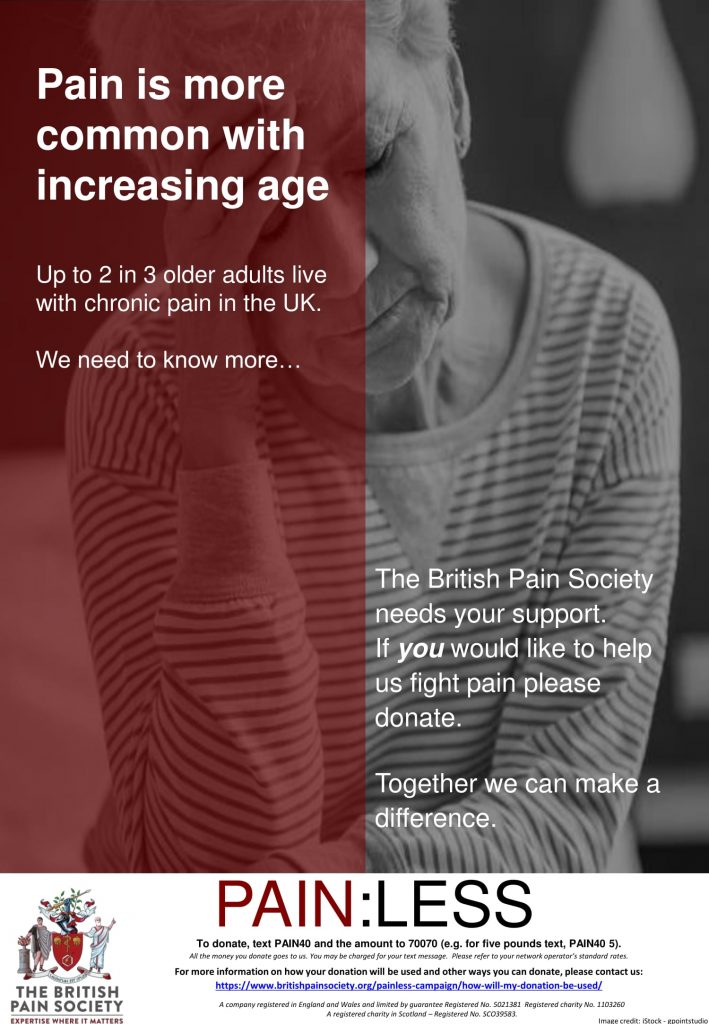
The British Pain Society has launched a new campaign; PAIN:LESS. Its goal is to raise awareness of how pain affects people in the UK, to raise visibility and to facilitate dialogues for those people who are suffering in silence, and they need your support to accomplish this. If you could donate a small amount to the BPS, it would go towards the valuable work they do year round.

For pain management in older people, there is an excellent self-help guide, Pain Management for Older Adults: A Self-Help Guide, available here.

Peer Support. Join the community

“Having chronic pain is very lonely.”

Join the community

Subscribe to Pain Matters

Everything you need to know about how to live with chronic pain

Subscribe


In pain? Don’t understand what’s happening?

“Having someone to help you prepare for your life through pain”

Our Pain Education Sessions

Fundraise for Pain Concern

Help us to help others

Fundraise


The BBC has published an article concerning the rising use of ‘potentially addictive painkillers’ in England.

You can read it here.

Peer Support. Join the community

“Having chronic pain is very lonely.”

Join the community

Subscribe to Pain Matters

Everything you need to know about how to live with chronic pain

Subscribe


In pain? Don’t understand what’s happening?

“Having someone to help you prepare for your life through pain”

Our Pain Education Sessions

Fundraise for Pain Concern

Help us to help others

Fundraise


Experts and patients discuss the causes and potential management of CRPS, and, if it can help us better understand how our bodies react to stimuli

To listen to this programme, please click here.

This programme was funded by grants from the RS MacDonald Charitable Trust and The Hospital Saturday Fund.

The first of two programmes on complex regional pain syndrome, or CRPS, which can be described as continuous and sometimes debilitating pain that can be confined to one limb, but has been known to spread to other parts of the body. CRPS is poorly understood, and no direct cause has been identified.[1]

In this edition of Airing Pain, Paul Evans speaks to Sunny Boshoff, author of CRPS Awareness: Moving Against Pain, who has had her own experiences with the syndrome, describing the agonising sensations she felt while living with CRPS.

Professor Frank Birklein, head of the Peripheral Nerve Disorders and Pain Research and Treatment at the Department of Neurology, University Medical Centre Mainz in Germany is one of the world’s leading authorities on CRPS. He explains the meaning behind the syndrome’s name, what can cause it, and how understanding of the disease has progressed.

Clinical lead for the complex regional pain syndrome service at the Royal United Hospitals in Bath, Professor Candy McCabe, speaks about her experiences of treating people suffering from the disease, how it effects their emotional wellbeing, and the psychological therapies used to help people manage their pain.

Issues covered in this programme include: CRPS: complex regional pain syndrome, chronic primary pain, inflammation, mirror therapy, visual feedback, misconceptions, numbness, nutrition, occupational therapy, the Perfetti technique, post-surgical pain, psychology, relaxation, Rheumatic Disease, swelling and visualisation.

Paul Evans: This is Airing Pain a programme brought to you by Pain Concern, the UK charity providing information and support for those of us living with pain and for healthcare professionals.

I’m Paul Evans, and this is the first in a series of programmes about complex regional pain syndrome, or CRPS. It’s funded by a grant from the RS MacDonald charitable trust.

Sunny Boshoff: If you imagine toothache in a really bad abscess or something in your tooth and the sort of intensity of that kind of pain, if you can imagine that in your whole arm day and night, for the foreseeable future, that’s the kind of pain that you’ll get with CRPS. It ranges from being incredibly hot, to freezing cold, to feeling like somebody is pouring boiling water over your skin and then holding your burnt hand in a draught. So it’s very complicated the kind of pains that you get with it. They’re layers of pain as well, you will get deep pains in your bones, in your muscles, in your tendons, and then you’ll have this pain on your skin. I kept going back to the hospital and saying my cast is too tight, I’m in agony my cast is too tight, because that’s what it felt like, and my hand was very swollen. But people kept looking at it and saying no it’s fine, it’s fine. And I was thinking it can’t be fine, everybody else is sitting around here with casts on and they’re not crying and I was in agony.

Evans: That’s an extract from an earlier edition of Airing Pain, number 23 to be exact, in which Sunny Boshoff, author of CRPS Awareness: Moving Against Pain, talks about living with complex regional pain syndrome. It’s a condition in which a person experiences persistent, severe and debilitating pain. Although most cases are triggered by an injury, the resulting pain is much more severe and longer lasting than that original pain.

The pain is usually confined to one limb, but it can sometime spread to other parts of the body. The skin of the affected body part can become so sensitive that just a slight touch, bump, or even change in temperature can provoke intense pain.

One of the world’s leading authorities on CRPS is Professor Frank Birklein. He’s head of peripheral nerve disorders and pain research and treatment at the Department of Neurology at the University Medical Centre in Mainz, Germany, and is the leading author of the German guidelines for CRPS diagnosis and treatment.

Frank Birklein: Complex regional pain disorder is just a denomination which was created because at the time when it was invented the pathology of complex regional pain syndrome was fairly unknown. In the meanwhile, we know a little bit more. So complex means that the symptomatology is complex, so the signs which can be seen in patients is complex. For instance, if you have a nerve legion then you have a pain, you have numbness in the nerve innervation territory but in CRPS a limb which is hot, other patients it’s cold, sometimes it’s sweaty, sometimes it’s not, so it’s a complex clinical sign. Nevertheless, it’s regional because it’s not confined to a nerve territory or a particular innervations territory, and it’s not all over the body, it’s confined to a limb. Sometimes it might be spreading to the other side. And pain is clear. And syndrome means it’s not a clear cut disorder, it’s a bouquet of symptoms and signs which characterise this syndrome so it’s not a disease, it’s a syndrome.

Evans: So complex, yes, the regional, where does it affect people?

Birklein: In the distal parts of the limbs, the feet or the hands. All other parts I would say it doesn’t exist, probably there’s one exception, the knee, but I would be very cautious to call pain in the hip complex regional pain syndrome, or in the ear, or the elbow, or the shoulder, or something like that.

Evans: Is it confined just to adults?

Birklein: It happens in children, it happens in adults, but the typical CRPS patient is a middle aged woman shortly after the menopause. This might have something to do with inflammation regulation, because women are more prone to develop inflammatory autoimmune diseases, and this is, in particular, true after the sexual hormones went down, because these are steroid hormones. You might have a trait, we still do not know what it is, but it could be that some patients are simply prone to get it, and we have to identify and acknowledge it early in order to help them.

Evans: Is that an issue as well, people can’t identify it?

Birklein: Yes, people ignore it I would say. If there is a surgery, then surgeons sometimes got the impression that they have done something wrong, but they did not. So this is what has been told to the physicians, that nobody is guilty if there is a CRPS coming up. It’s a trait, it can happen.

Evans: So, what causes it?

Birklein: This is the question that could fill the whole evening I would say, usually it starts with post traumatic inflammation, and this means that everyione of us gets an inflammation in a limp if he or she has a trauma. And usually this inflammation is shut down by our body within a certain timeframe, it depends on the kind of trauma you experience and so on. And in these patients the shutting down of the inflammation is delayed, or it is ineffective, so it is incomplete. And this means that you have a permanent inflammation going on in your limb, and this means that you have pain related to the inflammation, this means in particular these movements are related pain. And if you have a very fine orchestrated tool like a hand and you do not use it, and you have strong inflammation going on then you will have a loss of function. And as long as you lose your function the representation of your hand in your brain becomes smaller and smaller, as you know there is so much information that has been processed that comes from the hands and if this information is missing or is distorted by pain or something like that, then this has consequences. The other way round, so if you train a lot, you learn writing, if you have pain and you cannot move your hands or fingers intentionally anymore you lose your abilities.

Evans: I think you said the inflammation stays?

Birklein: Yes.

Evans: So is it something you see?

Birklein: Yeah you can see it, very often it’s tremendous edema, and it’s skin temperature difference and you can feel the sweating, and swelling also is a consequence of inflammation we know and have learned in the meanwhile. And the skin colour is different. So the definition of inflammation is swelling, it’s warming, the colour, the red colour, and it’s loss of function, and it’s pain. These are the five cardinal symptoms of inflammation, exactly these symptoms occur in CRPS.

Evans: So is it that the original injury has gone, but somehow the repair process, if you like, is not turned off?

Birklein: Exactly, this is it in the initial phase, and after that all these consequences about losing the ability to use the hand, contractures, rearranging the brain, all these consequences take place the longer the pain and the inflammation persists. After a certain timeframe, I cannot tell you exactly when, but approximately I would say six months, after that the inflammation becomes less and less important but the brain takes over and causes the symptoms which are then present there for movement disorder, and the numbness, and the pain.

Evans: What’s the process then for you to manage these people?

Birklein: To keep them going nevertheless, so I have to convince them that it is important to move the limb. I can give you an example, if you have children with CRPS it looks exactly the same, and you can treat them with drugs and so on, it will not work. But if you convince them to move the limbs, because there is something which is at the end of the tunnel, for instance sometimes I make negotiations with the parents that there is a pet waiting if they manage to use their right hand for writing, then you cannot imagine how intense these children work in order to use the limp more. And after half a year, or nine months the CRPS has gone away. I have some children which really go back to competitive sports and do not have any problems.

Evans: What’s the outlook for most people who have CRPS?

Birklein: Ok I think I would say two third improve.

Evans: Improve, or…

Birklein: Improve. The least get pain free, only very rarely that people get pain free. You cannot answer this question very easily, because if I’m retired and I have some problems with my left hand and I try to improve it and reduce the pain, and then the patient says ok I can cope with it because I do not have a problem to rest my left hand for half an hour if I have too much pain while using it. But if you are a hammersmith and your right hand is affected then it could be a very different situation I would say, then probably you lose your occupation and this makes a difference. So if I’m able and working in an office I can cope with the symptoms, I can cope with the pain then it’s not uncommon that the patients go back to work. And they do not need any drugs or something like that in the long run. And most of them have some kind of loss of function, like contractures, but usually they are not so important. So they cannot deliver the power which they have been before, but I think this is in a lot of diseases, so if you have surgery on your gut or something like that, you have to acknowledge that you cannot eat anything anymore, and the same with CRPS. But this has something to do with coping and something to do with adjustment to the loss of function, and for some people it’s easy and for other people it’s simply not possible. And for those which it is not possible they suffer hard and others are ok I can accept that loss of function, but this will not affect my life.

Evans: So I would guess the treatment, as in most chronic pain conditions, the psychological treatment is important.

Birklein: Also important, yes absolutely, the pharmacological treatment, and we need psychological treatment

Evans: So as Professor Frank Birklein’s experience backs up pain is not a fixed reality. This was the headline for a talk given by Professor Candy McCabe, she’s the clinical lead for the complex regional pain syndrome service at the Royal United Hospitals in Bath and I’ll be exploring that service in the next edition of Airing Pain.

Professor McCabe’s research interests lie in the mechanisms and treatments for chronic pain.

Candy McCabe: All of our treatment guidelines, British Pain Society treatment guidelines for chronic pain, for pain management, is focused around helping people to live with pain, and helping them to function despite their pain. We of course have medications, we have spinal cord stimulators, we have fantastic pain management programmes, but we know that medications and spinal cord interventions and other neuro modulation will perhaps reduce the pain a little bit, take the edge off a bit, so that people are less distracted by it, less disabled by it, and can get on with their lives. We also know that chronic pain management programmes are excellent about helping people to live life with their pain. And often in pain management we talk about trying to walk with pain beside you rather than in front of you and encompassing you. Our outcome measures for chronic pain programmes tend to be about have we improved function, have we improved quality of life, have we improved people’s self-management skills, their ability to cope, their mood and their anxiety. All of which are really, really important, but when I talk to patients in clinic and say what are your goals for treatment the very first thing they say is I want you to get rid of the pain. They don’t say I want my function better, I want you to reduce the pain a little bit, their top thing is ‘I want this pain to go’. And at the moment in chronic pain we hedge that a little bit, we say we can’t get rid of the pain but we’re going to give you ways that you can cope with it.

Evans: So that’s a barrier in itself when patients come to you, cure or self-manage, well obviously we want a cure, and the pain management techniques do reduce pain, but not cure.

McCabe: I think that’s a fair comment, I think it would be a brave clinician who said come on our programme and we’ll cure you of your chronic pain. That isn’t the message we give, that isn’t usually what we are usually able to achieve. So we’re already having to not quite do what our patients really want us to do, and perhaps we can change that perception a little bit.

Evans: How?

McCabe: There’s been a lot of publications in the non-pain field about how our bodies operate, and traditionally we used to think that our bodies sit there as receptive organs. That we wait for the environment to come to us and then we interact with that environment. And that we would learn through those interactions, so as a child you would learn how to walk and how to mimic things by interacting with that world. The assumption was always that it was very much that we’re response organs, that we did whatever happened to us, but over the years that’s changed and we now know that, actually, we see life, and we interact with life much more about how our bodies perceive that world around us rather than what may actually be there. So that’s because we run on hypotheses, we run on assumptions about what the environment will be like. So if I can give you a simple example, if you were walking into a hotel lobby you would have a rough idea about what to expect there, because you’ll have been, perhaps not exactly that hotel, but you’ll have been in other hotel lobbies. And you’ll know roughly what a reception desk should look like, and you’ll head that way. So you’re behaviour in that new setting is very much influenced by your past experience. And you will also know on the very small level, that if you’re going to walk on a carpet you would fully expect that that will be a softer sensation than if you were walking on hard floor. And so the muscles and the sensory networks, in order to interpret that information, will already be ready to accept that information, before you even do that action. So if for example you walked on a carpet that you were sure was going to be a soft pile, then you would be ready for the relevant muscles for your feet to sink into that carpet, and also if you were there in bare feet your sensory system would be ready to feel that. But if by some clever trickery that carpet wasn’t soft pile, actually it was hard, or perhaps even painful, the first reaction is surprise. It isn’t what you expected, and therefore you have to change your expectations.

So what we think happens with pain, is that for those where the pain persists, you start to get set in a network. There’s an expression in neurology that what fires together wires together. So if something has previously been working in that way, then it will continue to work in that way, because that’s the quickest route. So if I gave you an analogy of a river, you start off and if there was just a little trickle of water going across the floor, that first trickle has to go where the floor takes it, where the natural dips and rises in that floor go. But if that water ran for the next 20 years, actually the floor would be carved out in the route where that water had been and the quickest way for the water to travel is down that channel. That means that all the other bit of floor in that room is no longer accessed, and there are wastelands of potential sources of information, or floor space in this scenario, which are still there, but we don’t use.

Evans: If I have pain, the expectancy is that I will follow that path that I know that I have been before, does that make sense?

McCabe: Absolutely. So your brain will be wired to, if it’s painful to move your arm, your brain will expect that no matter what you do with that arm, it will be painful. And because you know that you can’t perhaps lift a cup or anything, then your brain will know that you will be weaker doing that, that it isn’t possible, that you’ll be clumsy. But also of course that all comes with emotional consequences. So associated with that pattern of behaviour is a level of perhaps anxiety, about ‘will I drop something’, or depression even, just frustration. So you get set in these pathways. But equally perhaps in our patients who have neuropathic pain, where if you touch the painful area it’s intensely painful, and they can only feel pain, so they’ve stopped feeling light touch, pressure, vibration, they just feel pain, so what the analogy is, is that the information sitting on those river banks is that lost information, and in order to change the course of a river takes a huge amount of work. So what we are suggesting is that if we get people to think much more about where their limit in space, what the normal sensations will be if they were doing something, so let’s go back to the example of you’ve got a really painful arm, what we want to do is to help people relearn what normal sensation feels like. So we would work with them by asking them questions on the unaffected arm and say, how does this touch feel, how do you know it feels like that, where on your arm am I touching you, whereabouts is your elbow or your hand in relation to that. We learn by questioning, we learn by having to use our brains to consider information and come up with responses. Once you’ve relearned that skill, which isn’t something you would naturally do, as children we probably explored that greatly, know about the different sensations, but as adults we have to relearn what those textures are and those sensations are. Then move to the affected side and say, ok before I touch you I want you to now be aware that I’m going to touch you, you should feel the same sensation you did before, try and find that information, try and access that information underneath the pain, because it’s there, try and find it. And it’s really extraordinary how people can suddenly find that information that they thought was lost to them, and lo and behold you start to shift the focus from pain into normal sensation.

Evans: The learned sensations, if you like, holding a cup of tea if you have a bad hand, well what I would do if I had a bad hand, if I found holding a cup of tea painful, I’d just use my other hand. Surely that’s the sensible thing to do?

McCabe: Completely, because we’re animals we have to keep ourselves safe, so all of our adaptations are about minimising risk to ourselves. The most sensible thing is to use that hand that works, but that then means that you have effectively lost a limb. So in our new therapies what we would say, ok so what we want to do is to hold that handle, now really be aware of how do you know you’re holding the handle, what’s the temperature of that handle, what’s the shape of that handle. Rather than thinking what’s my level of pain, so it’s finding all that other sensory proprioceptive information that is normally lost to us, and masked by the pain. And by working in that manner, and as you can imagine it’s a slow process, but patients absolutely understand it, and usually within a week of having really directed questions by the therapist they start to get it, and say actually now I’m going to look for those pleasant sensations, with those pleasant memories, rather than when I go to do something, looking for pain. So if pain starts to come back say actually no I want to go and find those nice sensations, those nice memories again. And you’re effectively finding the information sitting on the river banks.

Evans: I still find it a very difficult concept to get hold of, how do you persuade somebody with chronic pain that they can rethink everything that they’ve done since they’ve had the chronic pain?

McCabe: In the first instance we’d get people to think back to a memory associated with that painful part, before the pain started. So that could be that if you’ve got chronic back pain actually remembering how lovely it felt having your back massaged with sun lotion while you were lying on a warm beach. So we want people to go back to that point. We know that chronic pain involves your emotional, your behavioural, your sensory systems, so we have to use all of those systems to change it. So if you were going to remember having a massage on the top of your back, first of all you’d like the therapist to put their hand on the non-painful side, now can you remember how that felt, tell me what the sensation was like, what were the sounds, the smells of that time, how many fingers am I touching you with now, can you find that information. Now I’m going to move my hand to the other side, I want you again, before I put my hand there, to think back to those lovely memories, remember how it felt, the sun, the seagulls, now I’m putting my hand on there tell me again, how many fingers have I got, how does that feel. And it’s extraordinary how going back and finding that other associated information, you can start to unwrap all those other memories.

Evans: So does the pain go, or just the way you perceive it?

McCabe: Well, really excitingly, pain seems to go. Particularly our patients with complex regional pain syndrome where we really cannot touch their painful limb. But we’ve found that people can start to tolerate non painful touch while they are thinking about other sensations such as what direction is the sponge being laid in, how many fingers have I got. And they say, do you know I never felt pain at all. And there’s a certain concern, ‘did I make all this up’, how is it that I’ve had pain for so long if something so simple can have made that pain free. And that seems to be more of a problem, you know pain isn’t anything that anybody would wish upon themselves, or try and create. It’s a miswiring and really all we are trying to do is get the brain back to a normal expectation.

Evans: Some of it sounds a little like visualisation. That certainly works, but it’s temporary.

McCabe: Yes, and equally sometimes in some particular pain approaches, like greater exposure we would say you just need to do all those actions and just ignore the pain. And some people can do that, but they can’t do it for very long. It’s really difficult to ignore that. Visualisation can take you so far, but visualisation is quite a passive exercise, nobody’s asking you particularly, so how high were the waves that day, or how gritty was the sand at that point. You’re not really having to really draw on past experiences and answer questions, and we know that learning is really all about having to respond to questions, and having to assimilate information and respond. It’s called the neuro-cognitive approach, you need that level of inquiry within it, and have it multi-faceted really. So visualisation absolutely, direct touch, stimulus, so rehearsal of how that felt, real life experience of how that was. So it’s a package of stuff. So I’m not saying ditch pain management at all, I’m saying add this in to all the great stuff we already have.

Evans: Professor Candy McCabe.

I’ll just remind you that whilst we in Pain Concern believe the information and opinions on Airing Pain are accurate and sound based on the best judgements available, you should always consult your health professional on any matter relating to your health and wellbeing. He or she is the only person who knows you and your circumstances and therefore the appropriate action to take on your behalf.

Don’t forget that you can download all editions and transcripts of Airing Pain from Pain Concern’s website which is painconcern.org.uk. There’s also information on how to order Pain Concern’s magazine, Pain Matters.

Now, we at Pain Concern need your help. Like all charities Pain Concern rely on the generosity of individuals and funding bodies to keep us going. Don’t worry, I’m not asking you to make a donation, although we would never turn it down on our ‘Just Giving’ page. But in order to carry on making these programmes, we really need to know that what we are doing is of benefit to people living with chronic pain, your family members and supporters, and I can’t emphasis too much how important it is that we also get feedback from health care professionals on how these programmes help you help your patients. So do please go onto the Pain Concern website and click on the feedback button to take part in our short survey. Have your say, because without your views we won’t know what we’re doing well, and what needs improvement.

Now back to complex regional pain syndrome and the psychological therapy Dr Candy McCabe has been working on and enthusing about. And the big question for those that have CRPS, that therapy, where and when can I get it?

McCabe: Well, we’re very much only in the pilot stages and we have been hugely influenced and informed by a group in Italy, who are based at Santorso, and they use something called the Perfetti technique, which was perfected by Carlos Perfetti. And he had written up this proposal that actually we just need to relearn this information. But alongside Carlos Perfetti many others have been working in a very similar area, and we ourselves have been using visual illusions to trick the brain back to seeing normal. And this really just brings together lots of peoples work and this is by no means something that we ourselves have come up with, it’s very much that we are drawing on other experience and other skills to try and apply it in a practical way to our patients with chronic pain.

So we’re just starting out on this journey, it’s still very experimental, but it intuitively feels the right thing to do.

Evans: Thank you very much indeed.

McCabe: It’s really exciting, really exciting.


Contributors:

  • Sunny Boshoff, author of CRPS Awareness: Moving Against Pain
  • Frank Birklein, head of Peripheral Nerve Disorders and Pain Research and Treatment at the Department of Neurology University Medical Centre Mainz
  • Professor Candy McCabe, clinical lead for the CRPS service at the Royal Hospitals in Bath and the Florence Nightingale Foundation Chair in Clinical Nursing Practise Research at the University of West England Bristol.

More information:


[1] From CRPS UK crps-uk.org/what-is-crps/.

Peer Support. Join the community

“Having chronic pain is very lonely.”

Join the community

Subscribe to Pain Matters

Everything you need to know about how to live with chronic pain

Subscribe


In pain? Don’t understand what’s happening?

“Having someone to help you prepare for your life through pain”

Our Pain Education Sessions

Fundraise for Pain Concern

Help us to help others

Fundraise


Experts and sufferers discuss the causes and potential management of CRPS and if it can help us better understand how our bodies react to stimuli

This programme was funded by grants from the RS MacDonald Charitable Trust and The Hospital Saturday Fund.

The first of two programmes on complex regional pain syndrome, or CRPS, which can be described as continuous and sometimes debilitating pain that can be confined to one limb, but has been known to spread to other parts of the body. CRPS is poorly understood, and no direct cause has been identified.[1]

In this edition of Airing Pain, Paul Evans speaks to Sunny Boshoff, author of CRPS Awareness: Moving Against Pain, who has had her own experiences with the syndrome, describing the agonising sensations she felt while living with CRPS.

Professor Frank Birklein, head of the Peripheral Nerve Disorders and Pain Research and Treatment at the Department of Neurology, University Medical Centre Mainz in Germany is one of the world’s leading authorities on CRPS. He explains the meaning behind the syndrome’s name, what can cause it, and how understanding of the disease has progressed.

Clinical lead for the complex regional pain syndrome service at the Royal United Hospitals in Bath, Professor Candy McCabe, speaks about her experiences of treating people suffering from the disease, how it effects their emotional wellbeing, and the psychological therapies used to help people manage their pain.

Issues covered in this programme include: CRPS: complex regional pain syndrome, chronic primary pain, inflammation, mirror therapy, visual feedback, misconceptions, numbness, nutrition, occupational therapy, the Perfetti technique, post-surgical pain, psychology, relaxation, Rheumatic Disease, swelling and visualisation.


Contributors:

  • Sunny Boshoff, author of CRPS Awareness: Moving Against Pain
  • Dr Frank Birklein, Head of Peripheral Nerve Disorders and Pain Research and Treatment at the Department of Neurology, University Medical Centre Mainz
  • Professor Candy McCabe, Clinical Lead for the CRPS service at the Royal Hospitals in Bath and the Florence Nightingale Foundation Chair in Clinical Nursing Practise Research at the University of West England Bristol.

More information:


[1] From CRPS UK crps-uk.org/what-is-crps/.

Peer Support. Join the community

“Having chronic pain is very lonely.”

Join the community

Subscribe to Pain Matters

Everything you need to know about how to live with chronic pain

Subscribe


In pain? Don’t understand what’s happening?

“Having someone to help you prepare for your life through pain”

Our Pain Education Sessions

Fundraise for Pain Concern

Help us to help others

Fundraise


Pain Concern is a national charity that supports those who live with long term pain, and those who care for them, by providing information on pain and its management through a variety of media platforms. We also raise awareness about pain and the need to improve the provision of pain management services through campaigning and research.

We wish to express our concerns regarding NHS England’s proposal to restrict prescribing of certain pain medicines by general practitioners. Analysis of information from our online forum and helpline, supports national and regional audits and surveys (National Pain Audit, The Painful Truth), and confirms that many, but by no means all, who live with long term pain derive benefit from their pain medicines enabling them to have a more active and productive life and reducing the burden on healthcare services .

We recognise that long term pain is more prevalent in older people, often with co-morbidities, who are at greater risk of drug interactions and falls when taking certain analgesic and sedative medicines.

We are also aware that there is regional variation in the provision of secondary care pain clinics and fear that prescribing restrictions on General Practitioners and Independent Prescribers may create additional pressures on these services; they will require additional resources to meet demand.

Our specific comments are as follows:

  • 8% lidocaine plasters. In the treatment of localised neuropathic pain, for example post-herpetic neuralgia. These appear to offer a safer alternative to tricyclic or other antidepressants, anti epileptic drugs, and gabapentin/pregabalin, particularly in older adults, the demographic most vulnerable to neuropathic pain. A proportion of such patients have tried these oral medicines and found them to be ineffective or to have intolerable side effects, and have found relief from lidocaine plasters. Skin reactions appear to be rare, although failure of adhesion can be troublesome.
  • Oxycodone and Naloxone Combination, Targinact. A proportion of people who have been unable to control their constipation when taking oral morphine, oxycodone or other strong opioid with laxatives (often in combination) report a significant improvement when changed to Targinact. If this medicine were not available to them we would wish to see Clinical Commissioning Groups make Naloxegol prescribed in conjunction with oxycodone.
  • Co-Proximol. We recognise the risk of respiratory depression in overdose and the limited benefit of paracetamol/weak opioid combinations in the management of long term pain, so do not have concerns regarding restrictions to prescribing this medicine.
  • Tramadol with paracetamol combination tablet. No concerns if this is to be replaced by prescription of paracetamol and tramaol as separate medicines.
  • Dosulepin. Our concern here would be regarding access to this medicine for those who are intolerant of the side effects of older tricyclic antidepressants. We are aware that the dose used in pain management is lower than that for the treatment of depression yet the risk of harm has been studied in those receiving treatment for depression. We would caution against extrapolation of this data to the lower dose.
  • Trimipramine. Again it is important to remember that this drug is used for pain management at doses much lower than for depression and yet the risk data related to its use at higher dose.
  • Immediate Release Fentanyl. While recognising the value of this medicine in the control of breakthrough pain in end-of-life care, we have concerns regarding the use of immediate release strong opioids in the context of long term pain and do not promote their use. We have no concerns regarding restrictions to its prescription in primary care in this context.
  • Over the counter medicines. There is a strong association between poverty and long term pain. One quarter of those who live with long term pain will lose their jobs because of this. Despite a lack of scientific evidence for their use as sole agents in the management of long term pain, many rely on simple analgesics (paracetamol/codeine/non-steroidal anti-inflammatory drugs) to augment the benefit of stronger analgesics or to minimise their dosage. Paying for OTC medicines places another financial  burden on such people.

Long term pain degrades physical and mental health, and is a significant burden on the sufferer, their families, society and  health and care services. Many people report that it has taken years to find that combination of medicines, physiotherapy and psychological support that allows them a better quality of life, and we would not wish to see access to beneficial medicines restricted. We applaud NICE in its efforts to provide a framework for appropriate prescribing in long term pain and its recognition that this needs be tailored to the specific needs of the individual patient., and hope that NHS England will take a similar view.

Peer Support. Join the community

“Having chronic pain is very lonely.”

Join the community

Subscribe to Pain Matters

Everything you need to know about how to live with chronic pain

Subscribe


In pain? Don’t understand what’s happening?

“Having someone to help you prepare for your life through pain”

Our Pain Education Sessions

Fundraise for Pain Concern

Help us to help others

Fundraise


AP al fresco! The benefits of gardening for our physical and mental health, plus why, when it comes to green space, size isn’t everything…

This programme was funded by a grant from The D’Oyly Carte Charitable Trust.

Getting some gentle exercise tops the NHS’ list of ten self-help tips for managing pain, with distraction and communication also playing important roles. In this episode of Airing Pain we see how gardening can help with all three, and the benefit for our minds as well as our bodies.

We talk to Craig Lister and Chris Speirs from The Conservation Volunteers about their community garden project Green Gym, which brings together volunteers in shared green spaces in cities across the UK. One such space is Waterlow Park in London, where Paul chats to volunteers Maddy and Rosie about how the weekly sessions have helped them overcome difficulties including depression, anxiety and chronic pain.

A few miles away from Waterlow Park is the Rheumatology department at Whipps Cross Hospital, where clinical nurse specialist Margaretta Rooney created a garden designed specifically with the needs of patients with arthritis in mind. Raised beds allow people to sit down as they weed, reducing stress on the joints, and a patio means there’s no need for mowing or other heavy equipment.

For fifteen years, volunteers Brian and Josephine have been meeting up each week to help tend to the garden. Brian explains how, thanks to Margaretta, even with arthritis in his hands he still has green fingers and enjoys the social aspect of being out in the fresh air with his friend. Josephine describes the vital role the garden played in managing her chronic pain and depression, and the feeling of giving back to the department and hospital community.

Issues covered in this programme include: Arthritis, arts and crafts, CBT: cognitive behavioural therapy, depression, exercise, gardening, Green Gym, mental health, mindfulness, pancreatitis, Parkinson’s Disease, social therapy, alternative therapies and volunteering.


Contributors:

  • Chris Speirs, Health Development Manager The Conservation Volunteers
  • Craig Lister, Managing Director of the TCV Green Gym
  • Maria Schlatter, Project Officer at TCV Green Gym
  • Josephine Kilkenny, Whipps Cross Hospital garden volunteer
  • Brian Holmes, Whipps Cross Hospital garden volunteer
  • Margaretta Rooney, Clinical Nurse Specialist in Rheumatology at Whipps Cross University Hospital NHS Trust
  • Rosie, Green Gym volunteer
  • Maddy, Green Gym volunteer.

More information:

Peer Support. Join the community

“Having chronic pain is very lonely.”

Join the community

Subscribe to Pain Matters

Everything you need to know about how to live with chronic pain

Subscribe


In pain? Don’t understand what’s happening?

“Having someone to help you prepare for your life through pain”

Our Pain Education Sessions

Fundraise for Pain Concern

Help us to help others

Fundraise


Airing Pain al fresco: the benefits of gardening for our physical and mental health, and why, when it comes to green space, size isn’t everything…

To listen to this programme, please click here.

This programme was funded by a grant from The D’Oyly Carte Charitable Trust.

Getting some gentle exercise tops the NHS’ list of ten self-help tips for managing pain, with distraction and communication also playing important roles. In this episode of Airing Pain we see how gardening can help with all three, and the benefit for our minds as well as our bodies.

We talk to Craig Lister and Chris Speirs from The Conservation Volunteers about their community garden project Green Gym, which brings together volunteers in shared green spaces in cities across the UK. One such space is Waterlow Park in London, where Paul chats to volunteers Maddy and Rosie about how the weekly sessions have helped them overcome difficulties including depression, anxiety and chronic pain.

A few miles away from Waterlow Park is the Rheumatology department at Whipps Cross Hospital, where clinical nurse specialist Margaretta Rooney created a garden designed specifically with the needs of patients with arthritis in mind. Raised beds allow people to sit down as they weed, reducing stress on the joints, and a patio means there’s no need for mowing or other heavy equipment.

For fifteen years, volunteers Brian and Josephine have been meeting up each week to help tend to the garden. Brian explains how, thanks to Margaretta, even with arthritis in his hands he still has green fingers and enjoys the social aspect of being out in the fresh air with his friend. Josephine describes the vital role the garden played in managing her chronic pain and depression, and the feeling of giving back to the department and hospital community.

Issues covered in this programme include: Arthritis, arts and crafts, CBT: cognitive behavioural therapy, depression, exercise, gardening, Green Gym, mental health, mindfulness, pancreatitis, Parkinson’s Disease, social therapy, alternative therapies and volunteering.

Paul Evans: This is Airing Pain, a programme brought to you by Pain Concern, the UK charity providing information and support for those of us living with pain, and for health care professionals. I’m Paul Evans, and this edition has been funded by a grant from the D’Oyly Carte Charitable Trust.

Chris Speirs: Some of the greatest biodiversity in the country is actually in the city, about a third of London is covered in green space. A lot of those green spaces are filled with trees, they’re filled with hedgerows, they’re filled with ponds, they’re filled with lakes. Some of our national parks and some of the best natural spaces that we have you could say have a lot lower biodiversity value than some of spaces within a city. It’s really important to have both, and a wide range of different species, but there is so much value in urban ecology.

Paul Evans: In this edition of Airing Pain, I’m going to explore how that value can be extended to those of us living with chronic pain.

Green Gym is a nationwide programme that supports positive changes in the health of participants and the green spaces they create and maintain. It helps to transform people’s health and wellbeing through weekly participation in outdoor activities such as conservation, park management and growing food. Each Green Gym project mobilises community members to work together, and volunteers become physically active while improving their local environment.

Craig Lister is the managing director of Green Gym.

Craig Lister: The Green Gym is effectively the outdoor world, it’s specifically not the equipment you see in parks, we don’t do that. I’m an exercise physiologist by trade and I have a particular interest in evolution, how we evolved. We evolved in the outdoor world for the vast majority of our lifespan, so two or three hundred thousand years, depending on which research you look at, and we became perfectly attuned to living in the outdoors. So muscle is what we call an endocrine organ, it releases different hormones in response to physical activity, temperature changes. We typically function during the day, so the amount of light in our eyes changes brain chemistry and other chemistry. And actually we became so good at living in the outdoor world, amongst all of the species that there are, that we became the world’s dominant species, so clearly we were really, really good at that.

And Green Gym really seeks to take up back into that environment, which is the outdoor world, working in groups, we’re a pack animal and we like to work in groups. We do physical activity so it has a purpose, so we’ll plant trees, create paths, open areas for other people to enjoy. And those things in combination seem to have a very positive impact on health and wellbeing, particularly mental health, depression and anxiety, which in turn tends to have a positive impact on pain.

Maria Schlatter: My name is Maria, I’m the senior project officer for the Camden Green Gym, which is a volunteering programme run by the conservation volunteers. We organise twice weekly sessions, three hours at a time, for anyone who wants to join. It’s open to all ages, all walks of life, and volunteers work in the green spaces in Camden, in the local parks, in community gardens, urban woodlands, and we use the time to improve the biodiversity, to improve access for the public, to make sure that wildlife thrives, that green places are looked after, we pick litter. We try and help Camden Council to keep them in good condition, and in the process volunteers get active, they improve their physical and mental wellbeing and they have a nice sociable time.

Today it’s a special day, we don’t normally work on the tours, it’s a twice yearly event, but we’ve combined that with our summer barbeque, so it’s a social event today as well. Normally we tend to cut back vegetation, build insect hotels or work in the pond, build deadwood hedging, that kind of thing. Lots of different activities.

Paul Evans: Where exactly are we?

Maria Schlatter: We’re in Waterlow Park, which was donated in the 19th century to become a garden for the gardenless, so it’s a fantastic resource for North London. It’s a really beautiful park, and we work in a couple of nature reserve areas and we also at times support the friends of Waterlow Park.

Paul Evans: It must be a barbeque day because the rain is forecast.

Maria Schlatter: It is, we’ve come prepared, we have two gazebos so hopefully we won’t have to use them, but it’s fine. Our volunteer are very hard because they come out in all weather, they come out in the winter, come rain, shine. I’m still surprised by how dedicated our volunteers are because even when it’s bucketing down a group of them turn up. But the whole idea is to be outdoors, to get exercise, to be connected to nature, to be connected to other people, keep active, which of course is incredibly good for chronic pain relief. It’s very good to keep fit and just being out in nature is incredibly good for your mental wellbeing.

Paul Evans: And the great thing about the outdoors and the garden, is that it’s never finished.

Maria Schlatter: Exactly.

Paul Evans: It’s not as if the course can end after six weeks.

Maria Schlatter: Yes, there are always surprises, there are always lovely things to see. It’s nice for the volunteers to see the work they’ve achieved, and also to see the wildlife, to see the birds, see the insects and see the flowers, and experience the seasons, which is really important I think, especially for people living in cities, often if they don’t have gardens themselves it just really enhances people’s wellbeing.

Craig Lister: My research degree was on community based interventions for chronic low back pain, and there are a number of measures for that, but what I found which as a physiologist was surprising to me in my early years as a physiologist, was that a questionnaire called the fear avoidance belief questionnaire was a better predictor of pain. And that is a psychological questionnaire, and that means I’m not going to do something because I’m fearful it will hurt me, I don’t do it I become less active, I’m less able to support my spine, I’m more likely to feel pain, it’s becomes this self fulfilling prophecy. Obviously there is more to it than that, but in simple terms that’s it.

Whereas my research, and in fact Green Gym is very similar, we get people to do things that are intrinsically interesting and in a group, and so for an amount of time they forget about the pain if you like, and sometimes that’s referred to as the distraction hypothesis. So I’m doing something else that is attracting most of my conscious attention, and then you can look back on what you’ve done, and other people say what a good job you’ve done. And in fact when we were working in London this Saturday other members of the public were coming to say what are you doing, thanks for doing that. And so people think, so you know what I have done something, I do feel better about myself because of that, but actually at the same time, because we operate in a free environment, digging, cutting whatever it may be, we’re building muscle strength and muscle control that protects people from pain in the future.

Rosie Broadley: My name is Rosie Broadley.

Paul Evans: And you have chronic pain?

Rosie Broadley: I have chronic pain on a daily basis. It’s pancreatitis and liver failure, liver failure really messed my body up and I went to less than six stone.

Paul Evans: How long have you been volunteering for Green Gym?

Rosie Broadley: Not this Green Gym, but I’ve been doing it for about six months now. So it’s helping me tone my muscles up, it’s helping me stop focussing on pain the whole time every single day. And people have said that my face has changed since I’ve started, my literal face has changed, I’ve started smiling a little bit more. Feeling chronic pain you know that it’s constant, it’s there with you. The only way that you can get your head away with it is to do something else, take you mind off of it and gardening really does help, I’ve sorted out so many problems whilst I’m cutting the hazel bushes, it’s absolutely, I feel like I’ve had a full blown conversation in my head, and that is helping. Otherwise I’d just be sitting at home watching TV with my dog, and I would be probably doubled over.

This should be given to the doctors, it should be prescribed by the doctors.

Paul Evans: Six months ago if a doctor had said to you, I think you should go gardening, what would you have said?

Rosie Broadley: I’d say I wouldn’t be able to do it, no I don’t know these people, what am I supposed to do, I’ll be all embarrassed. But now it’s like water off a ducks back it’s helped me so much alleviate my pain, even just the walk to going to the Green Gym, knowing that I’m getting up and doing something alleviates it in a certain way.

Paul Evans: Listeners to Airing Pain will know that psychological wellbeing is good, and they psychological therapies, cognitive behavioural therapy, they’re good. It can often be difficult explaining to somebody that you need your head mended, or your brain mended if you like. But recommending physical work when somebody is in pain, that’s another barrier isn’t it?

Craig Lister: It can be yeah, and again that’s perception, you know that, let’s focus on back pain, that medical evidence has changed. Medical evidence used to be go back and rest now, don’t do anything. Which we now know is the worst thing that you can do, so with everything medical evidence advances. But muscle is an endocrine system, it produces lots of different chemicals, a lot of those chemicals are anti inflammatory, or pain reducing, and for a lot of pain the actual pain is caused by inflammation of muscle or tissue pressing on the nerves and that causes the pain. So if you are physically active and you produce these natural products that reduce inflammation that can be one mechanism towards reducing pain.

And another one is increasing stability in all your muscles, so people talk about core stabilisation, sometimes I think that’s a bit faddy, it doesn’t really matter. You do need a strong core, so a simple example is stepping down a step you didn’t know was there, I’m sure we’ve all done that once or twice, and you get that jarring sensation. If your core is strong, and importantly if you are able to recruit your muscles very quickly without knowing that, just doing it very quickly because you’re regularly physically active, you’re much more likely to stabilise yourself very quickly and reduce your pain there. So it may seem counterintuitive, I don’t think it is, that physical activity is good for pain reduction, I just think we’ve been told it is and now we believe that’s true, but I don’t think it ever was true. The only caveat I would put to that is that is has to be appropriate physical activity, which is the right level, and interesting.

Paul Evans: That’s Craig Lister, managing director of Green Gym.

This seems a good time to remind you that whilst we in Pain Concern believe the information and opinions on Airing Pain are accurate and sound based on the best judgements available, you should always consult your health professional on any matter relating to your health and wellbeing. He or she is the only person who knows you and your circumstances and therefore the appropriate action to take on your behalf.

Maddy: My name is Maddie and I used to be a volunteer officer for Green Gym in Camden. I was a VO for two years, I had a period of illness and it helped me get back on my feet and gave me confidence, I then left a year ago and went on to work somewhere else, paid work. So it’s been incredibly helpful for me.

Paul Evans: In what way?

Maddy: I had depression and anxiety, so it really wrecks your confidence, and you get taught here to lead groups and to do the warm up and warm down and tools talk. And it helped me gain confidence really, because I was looking after 15 volunteers. And being outside is just incredible and it’s definitely true you feel more connected if you’re working with nature. And I do feel very passionately about environmental concerns.

Paul Evans: Just explain to me how it helps depression and anxiety.

Maddy: First of all you’re working with other people, and they may also be people who have depression and anxiety, so it’s not anything like, oh god you’re mentally ill. There’s none of that, it’s just like everyone mucks in together. And then there’s also having the connection with nature and using your hands, digging and planting wild meadows and looking after the habitats that we encounter. It made me feel very peaceful, and my anxiety levels went right down.

It’s a really lovely thing to do, and also if you want a change of career and you think you need to have some time and do this, I’ve seen a lot of people come through the Green Gym who have decided that they want to change their careers and they weren’t sure what to do. And then they do go into environmental charities or gardening even.

Craig Lister: In the NHS and public health there’s a phrase which is no health without mental health. So I could be apparently well, apparently without a disease, but really in quite a poor place, and in fact if you look at the World Health Organisation’s acceptance of health and wellbeing it’s a complete state of health and wellbeing. And certainly I know many people, including my father who has parkinsons is otherwise reasonably well but sometimes can be challenged. He has processes to overcome that, and in fact is a volunteer at Hampton Court Palace, he’ll tell you that distraction of being a valued member of staff at Hampton Court Palace, and taking tours, is much better at reducing his perception of pain than his med are.

So in Green Gym actually our evidence that we can reduce anxiety, reduce depression, improve self esteem, how I feel about myself globally. And actually one of the other things is feelings of usefulness, people say they feel useful. All of those things seem to have a very strong mental impact, so now I’m more likely to be physically active, and more confident that it’s safe for me to do that. I want to be part of the group as well, so Green Gym is a group activity, we’re group animals. In public health if we are going to inoculate people we actually refer to herd immunity, so your herd. And that recognises the impact, and we know that when people come together to achieve things there’s a change to brain chemistry, so you might see changes in dopamine, which can have a positive effect on how you interpret pain signals. And actually what we are seeing, and I’ve been doing this for a long time and so have many colleagues, really promoting the medical fraternity to actually go back to its roots, from Hippocrates and Socrates, people might remember, who spoke about the benefits of physical activity, letting food be your medicine. Not discovering that but rediscovering that, there’s quite a few people who are really engaged in this process, and I’m really glad that they are because you need people within the medical fraternity to drive that medical fraternity forwards.

Paul Evans: Well, just a few miles to the east of Waterlow Park in London is Whipps Cross Hospital where you’ll find another green space, albeit on a slightly smaller scale. Margaretta Rooney is clinical nurse specialist in rheumatology at Whipps Cross Hospital.

Josephine Kilkenny: I’m Josephine Kilkenny, I am a patient of Margaretta.

Brian Halls: I’m Brian Halls, I’ve been a patient here for years. Margeretta I’ve known for years, has been treating me. Margaretta talked me into being a volunteer to this garden, which I’m very glad she has cause she’s kept me mobile.

Paul Evans: Margaretta just explain to me where we are.

Margaretta Rooney: We’re in a garden at Whipps Cross in the outpatients department, which has been designed for people with arthritis so they can carry on with their favourite hobby after they’ve had their diagnosis, it’s a model garden.

Paul Evans: It looks like a model garden, it’s very well manicured, better than I could imagine a garden being to be honest.

Margaretta Rooney: Well that’s thanks to Brian and Josephine who come in here every week and give their time to maintain the plants and keep the place clean and tidy.

Paul Evans: So how did this garden start?

Margaretta Rooney: Back in the mid nineties a patient donated a small amount of money to the consultant David Doyle at that time, and myself, in gratitude for the care that they were receiving from us. We thought what can we do that would live on forever really. This part of the hospital had just been opened and we had a blank space. Many patients are concerned about their ability to carry on their usual activities of living, and their activities of pleasure, and one of them is gardening. So we thought we could develop a garden here for people with arthritis.

Paul Evans: Brian tell me how you got involved in the first place then.

Brian Halls:  I was walking down Snakes Lane West and a young lady named Margeretta stopped me and said would you come and put some bulbs into the garden, she said I have another young lady that’s volunteered called Josephine, would you meet up together which we did do, and for 15 years we’ve been doing the garden. And because the garden is made for arthritic people, because as you see yourself there are raised beds, which was thoughtful when they organised the garden. We make sure that Josephine and myself, we don’t have to climb anywhere. We work as a team, if you want something tall she’ll pull it down with a broom, I’ll cut what I can. It’s a social event, because sometimes you’re out in the garden people come and ask you, and they realise I’ve got arthritic hands and they go, oh you could do that so could I perhaps, you know what I mean. It gets you out of bed, because if you’ve got arthritis you can lay in bed and feel sorry for yourself, and you get up and you get yourself motivated, and it’s been going ever since.

Paul Evans: Josephine how did you get involved?

Josephine Kilkenny: I had chronic arthritis, I was about 49, 50 and I also suffered with a bit of depression. And Margaretta one day she said, right I want you to take a new interest, she didn’t want me, she encouraged me. And it was the best thing that ever happened to me. It took my mind off the pain, it was giving back to the hospital, it was therapeutic, it got me up and dressed in the morning, not sitting at home as Brian says worrying about pain. And Brian and I have been great partners, we’re like friends now, I’m like the second wife I suppose.

But Margaretta played a vital role in this for me. She went over the white line, and it’s a wonderful department here, rheumatology, it’s excellent.

Paul Evans: You have arthritis?

Josephine Kilkenny: Yes.

Paul Evans: And you suffered from depression as well?

Josephine Kilkenny: Yes I did.

Paul Evans: Did the two go together?

Josephine Kilkenny: Well I was working in a very happy job, catering, I suppose it did a little bit, but the arthritis was very bad, it happened quite suddenly at work. And I think it all got down in a black hole, and it really helped me. It was better than medication, I’ve got medication and I’ve got much better now with modern medication, but the gardening played a vital role. I was learning a new skill. Catering was quite stressful, I suppose in ways, I loved it. And friendship, and people came out here socially, come out and have a bit of banter with us, and all those things make you feel good. Money isn’t everything. I find it so important to be thankful to our National Health, and our rheumatology team played this vital role. Margaretta was there for me, and I cannot think the hospital and Margaretta [enough] for this, and Brian my gardening partner, he’s played a vital role.

Paul Evans: Margaretta how did you envisage this would help people?

Margaretta Rooney: Well it’s well known that people’s ability to cope with pain depends on what else they have to think about. The more active you are, the more you are able to cope with your pain. Getting a diagnosis of arthritis is the first thing, it can be devastating. Patients in the beginning have pain and discomfort and distress, and the aim is to get patients out of pain quickly, which we do, and now with the advent of all the new treatments for arthritis, we give these treatments very early on so they don’t have the terrible outcomes that they had 20, 30 years ago. However many patients expect us to be able to give them a pill or an injection to help and to take the pain away. But that isn’t always possible. Some people expect medicine to help with every pain and ache but it’s not like that. So if you accept that this is a condition that you’ve got, whatever rheumatological condition you may have, then you have to work within the limits of that.

The aim of my role as a clinical nurse specialist, the doctor makes the diagnosis and prescribes the treatments, my role as a nurse is to help the patient to understand the diagnosis to understand the treatment and to manage their activities of living as if they didn’t have arthritis. So they have to make some adjustments, but not all the time, and that’s my role, is to discuss with them how they live with their condition. If you’re in pain and you enjoy for example dancing, well we try and encourage people to keep dancing, but the patient will perceive it as not being able to do it anymore. If you’re a pianist and you know you develop arthritis it can be devastating for that patient. People who garden always think of the heavy digging, you know the mowing the grass, the pruning all that, but this is an example of a garden where you can maintain and manage easily and that was what we put into the design. If you want to you can sit as you do your weeding because of the way the raised beds are, there’s no grass but the patio looks very nice, the area is quite calm and comforting and relaxing. There are lots of papers that have been written about gardening and arthritis, Arthritis UK have a very nice leaflet, I’ve got one of them to take away with you, that talks about gardening and arthritis and tips on how to manage their gardening. You know it’s good therapy for any of us even if we haven’t got pain or arthritis or fibromyalgia or any of the rheumataolgical conditions if you can get out in the fresh air it’s always good.

Paul Evans: Indeed it is. That’s clinical nurse specialist in rheumatology at Whipps Cross Hospital, Margaretta Rooney. And Margeretta is keen to find the next generation of volunteers to carry on with the upkeep and development of the garden. Get in touch with her at Whipps Cross Hospital rheumatology department or us at Pain Concern, and we’ll put you in touch with Margaretta.

And that Gardening and Arthritis booklet leaflet she mentioned can be ordered or downloaded from the Arthritis Research UK website which is http://www.arthritisresearchuk.org

Now back to the Green Gym. Chris Spiers works with the Conservation Volunteers organisation developing Green Gyms across the UK. Check out their website https://www.tcv.org.uk/greengym to find out if there is one near you, and if not.

Chris Speirs: We’re here to support anyone, whether that’s an individual, an organisation, a small community group, to enjoy the benefits of Green Gym, so we would be very keen to help. Our email address is greengym@tcv.org.uk if you were to get in touch we would be happy to support you to set up a group locally, make those health referral links. We have a Green Gym leadership programme which we offer out to other organisations and community groups to support them to be able to take on and run Green Gym to the same standard that we run elsewhere across the UK, and we’re working with communities and organisations all the time to do that. In the UK over 40 of the Green Gym groups that are running presently are completely independent to TCV, so many of them were established by us, but they are run by volunteers or people from the community who come together, meet once a week and they very much have the ownership to take their Green Gym, to take that forward. They do everything from the fundraising, to managing the projects, to looking after the spaces, to buying the tools, managing the first aid and everything else that needs to be done on the day.

Paul Evans: You mentioned the word referral, what do you mean by referral, who are the referrers?

Chris Speirs: We talk sometimes about self referral and referral, self referral would be if someone heard about the programme and took a decision to come along, as I did, for the health benefits of coming and participating, rather than being signposted by a health practitioner. So in order to reach a wider audience, a more diverse audience, we have for about 20 years been working very closely to proactively engage health referral partners. We work with GPs, physiotherapists, a wide range of different health professionals, not only from services within the local authorities, other charities such as mind, such as rethink, with people who might be coming out of prison looking to be rehabilitated. So really a huge range, it’s a very mainstream programme and very much open to anyone to join and we look to run the programme to have a range of activities to make it accessible for everyone.

Paul Evans: Chris Speirs. Once again the Green Gym website ishttps://www.tcv.org.uk/greengym and don’t forget to contact Margeretta Rooney at Whipps Cross Hospital Rheumatology department if you can help support their garden, or contact us at Pain Concern – our website is www.painconcern.org.uk – contact us there and we’ll pass on your details to Margaretta.

Don’t forget that you can download all editions and transcripts of Airing Pain from Pain Concern’s website which is www.painconcern.org.uk. There you’ll find information and support for those of us living with chronic pain, our families and carers, and of course for healthcare professionals. There’s also information on how to order Pain Concern’s magazine, Pain Matters.

Now, we at Pain Concern need your help. Like all charities we rely on the generosity of individuals and funding bodies to keep us going. Don’t worry, I’m not asking you to make a donation, although we would never turn it down on our ‘Just Giving’ page, although you are very welcome to do so and we would never turn it down. But in order to carry on making these Airing Pain programmes into the future, we really need to know that what we are doing is of benefit to people living with chronic pain, your family members and supporters, and yes, for health care professionals, and this is really important for us, how do the programmes help you help your patients?

So for everybody listening we need your feedback: Has listening to Airing Pain improved your day-to-day living, and if so, in what way? Have the programmes helped you manage your pain, how? And In a broader sense, has living with chronic pain or with a family member who has chronic pain become more manageable? And I can’t emphasise too much how important it is that we also get feedback from healthcare professionals on how these programmes help your patients.

So do please go onto the Pain Concern website and click on the Feedback button to take part in our short survey. Have your say, without your views we won’t know what we’re doing well, and what needs improving.

Okay I look forward to your feedback. Now back to the Green Gym. Rosie Broadley will end this edition of Airing Pain.

Rosie Broadley: My life has changed completely, I know it sounds absolutely ridiculous, there is hope out there, there is. And I’ve got somewhere to go, even if I don’t get up and do it, I have got somewhere to go. And September I start college for a whole year, Regents Park, to get my landscape degree, and this has all happened in six months since meeting Green Gym. So life has changes completely, thank you very much.


Contributors:

  • Chris Speirs, Health Development Manager The Conservation Volunteers
  • Craig Lister, Managing Director of the TCV Green Gym
  • Maria Schlatter, Project Officer at TCV Green Gym
  • Josephine, Whipps Cross Hospital garden volunteer
  • Brian, Whipps Cross Hospital garden volunteer
  • Margaretta Rooney, clinical nurse specialist in rheumatology at Whipps Cross University Hospital NHS Trust
  • Rosie, Green Gym volunteer
  • Maddy, Green Gym volunteer.

More information:

Peer Support. Join the community

“Having chronic pain is very lonely.”

Join the community

Subscribe to Pain Matters

Everything you need to know about how to live with chronic pain

Subscribe


In pain? Don’t understand what’s happening?

“Having someone to help you prepare for your life through pain”

Our Pain Education Sessions

Fundraise for Pain Concern

Help us to help others

Fundraise


Pain Concern supports the following press release from the Royal College of Anaesthetists and the Faculty of Pain Medicine:

 Response to recent news reports regarding fentanyl:

The Royal College of Anaesthetists (RCoA) and The Faculty of Pain Medicine (FPM) are concerned with misinformation included in recent news reports regarding the drug fentanyl.

The recreational use of fentanyl, often mixed with other illicit drugs, is a serious concern and we support all efforts to eliminate the misuse of this drug outside of a clinical setting.

However, we want to reassure patients of the safety of fentanyl when prescribed by their doctor or administered by an anaesthetist in a hospital.

Fentanyl is a unique and highly effective medication which is well-established in the management of complex pain problems.  Fentanyl is also commonly used in anaesthetising patients undergoing a surgical procedure and in intensive care.  Patients who have been prescribed fentanyl to manage pain or who are about to undergo surgery have no reason to be concerned.

Any person who has questions about a fentanyl prescription should speak to their doctor.

Any member of the public looking to learn more about opioids, including fentanyl, can visit our patient information site.”

Royal College of Anaesthetists and the Faculty of Pain Medicine

Peer Support. Join the community

“Having chronic pain is very lonely.”

Join the community

Subscribe to Pain Matters

Everything you need to know about how to live with chronic pain

Subscribe


In pain? Don’t understand what’s happening?

“Having someone to help you prepare for your life through pain”

Our Pain Education Sessions

Fundraise for Pain Concern

Help us to help others

Fundraise


1 24 25 26 27 28 49