Information & Resources

Find information and resources to help manage your pain.

Get Help & Support

Find the tools you need to
help you manage your pain.

Get Involved

Help make a real difference to people
in the UK living with chronic pain.

About Us

Find out about Pain Concern and how
we can help you.

Managing neuropathic pain related to diabetes, and how to adapt diet to treat the disease

This edition of Airing Pain has been supported by a grant from The Champ Trust and Foundation Scotland.

According to the most recent Scottish Diabetes Survey in 2018, there are an estimated 304,000 people living with a diagnosis of diabetes in Scotland, around 5% of the population. A long-term effect of diabetes can be the development of diabetic neuropathy. This edition of Airing Pain focuses on neuropathic pain in people with diabetes, and how the X-PERT diabetes courses helps people to deal with the complications that arise when living with diabetes.

First up, Paul Evans speaks to David Bennett, Professor of Neurology at the University of Oxford, who outlines the differences between type 1 and type 2 diabetes and how the initial treatment plan differs between the types. Professor Bennett then goes on to describe how neuropathy develops in people living with diabetes and how neuropathic pain manifests.

Paul then talks with Steve Sims, who lives with diabetic neuropathy as a result of type 2 diabetes. Paul and Steve discuss how they have adjusted their diets to deal with type 2 diabetes and how the X-PERT diabetes course has helped them to adjust to living with diabetes.

Issues covered in this programme include: Diabetes, the differences between type one and type two diabetes, diabetic neuropathy, diabetic retinopathy, nutrition, diet, insulin levels, glycemic control, risk factors of diabetes, peripheral vascular disease, foot pain, burning pain, gabapentinoids, and support groups.


Contributors:

  • Professor Dave Bennett, Professor of Neurology, Nuffield Department of Clinical Neurosciences, University of Oxford
  • Steve Sims, Secretary, Cardiff Diabetes Group.

More information:


With thanks to:

  • The British Pain Society (BPS), who facilitated the interviews at their Annual Scientific Meeting in 2019 – britishpainsociety.org
  • The International Association for the Study of Pain (IASP) – iasp-pain.org
  • Diabetes UK, a leading UK charity that involves sharing knowledge on diabetes – diabetes.org.uk/.

Peer Support. Join the community

“Having chronic pain is very lonely.”

Join the community

Subscribe to Pain Matters

Everything you need to know about how to live with chronic pain

Subscribe


In pain? Don’t understand what’s happening?

“Having someone to help you prepare for your life through pain”

Our Pain Education Sessions

Fundraise for Pain Concern

Help us to help others

Fundraise


According to the most recent Scottish Diabetes Survey in 2018, there are an estimated 304,000 people living with a diagnosis of diabetes in Scotland, around 5% of the population. A long-term effect of diabetes can be the development of diabetic neuropathy. This edition of Airing Pain focuses on neuropathic pain in people with diabetes, and how the X-PERT diabetes courses helps people to deal with the complications that arise when living with diabetes.

Watch the trailer above for more details

Contributors:

  • Professor Dave Bennett, Professor of Neurology, University of Oxford
  • Steve Sims, Secretary, Cardiff Diabetes Group.

Available to listen on our website, or download from wherever you get your podcasts.

Peer Support. Join the community

“Having chronic pain is very lonely.”

Join the community

Subscribe to Pain Matters

Everything you need to know about how to live with chronic pain

Subscribe


In pain? Don’t understand what’s happening?

“Having someone to help you prepare for your life through pain”

Our Pain Education Sessions

Fundraise for Pain Concern

Help us to help others

Fundraise


Peer Support. Join the community

“Having chronic pain is very lonely.”

Join the community

Subscribe to Pain Matters

Everything you need to know about how to live with chronic pain

Subscribe


In pain? Don’t understand what’s happening?

“Having someone to help you prepare for your life through pain”

Our Pain Education Sessions

Fundraise for Pain Concern

Help us to help others

Fundraise


Rethinking long-term pain management

To listen to this programme, please click here.

This edition of Airing Pain has been supported with a grant from Kyowa Kirin donated for this purpose. 

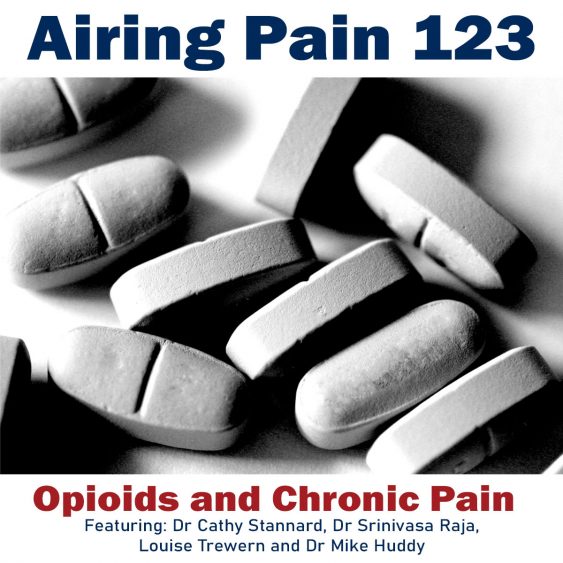
The opioid crisis reached its peak in the United States in 2017, where addiction and overprescription have led to 218,000 deaths from prescription overdoses between the years of 1999 and 2017. The side effects of opioids can affect the day-to-day activities of people managing long-term or chronic pain, yet society as a whole has yet to fully evaluate the relationship between opioids and addiction.  

In this edition of Airing Pain, producer Paul Evans talks to two leading pain specialists. First off, Paul Evans meets with Dr Srinivasa Raja, who discusses opioids effects on the body’s opioid receptors and how the human body processes pain. Dr Cathy Stannard then talks about the increase of opioid prescriptions in the UK and how the opioid crisis in the United Kingdom developed. 

In the second half of the programme, Paul speaks with Louise Trewern, a chronic pain patient and patient advocate, about opioids’ detrimental effect on her quality of life and how she was able to transition towards more effective methods of chronic pain management. 

Finally, Paul sits down with Dr Jim Huddy, a GP in Cornwall, who explains how the medical community is re-evaluating the relationship between opioids and chronic pain. 

Issues covered in this programme include: Cancer, chemotherapy, exercise, fibromyalgia, medication, neuropathic pain, opioids, painkillers, physiotherapy, prescription for pain, psychology, side effects and dosage.

Paul Evans: This is Airing Pain, a programme brought to you by Pain Concern, the UK charity providing information and support for those of us living with pain and for those who care for us. I’m Paul Evans and this edition of Airing Pain has been supported with a grant from Kyowa Kirin.

Louise Trewern: Hyperalgesia was one of my biggest problems. I couldn’t have dental treatment properly. I had to have multiple injections because they couldn’t numb me. It was gradually, over a period of months, suggested to me that the dose I was on was not helping me, it was making me worse, and that a lot of the symptoms I was suffering [from] was as a result of my opioid use.

Evans: In this edition of Airing Pain, I want to look at the use of opioid medication for the management of chronic pain. The so-called opioid crisis or opioid epidemic in America came to a head in 2017 when, contrary to the reassurances of pharmaceutical manufacturers that patients were less likely to become addicted and an aggressive marketing campaign, addiction, overdose and death rates soared.

Before we delve into how this affected people with chronic pain in the UK, I want to try and come to grips with some of the science behind the drugs and how they work. Now opiates are naturally derived from the opium poppy plant. They include morphine, codeine, heroin, and others, and have been used for medicinal and recreational purposes since prehistoric times. Opioids, on the other hand, which include tramadol, methadone, pethidine, fentanyl, and others, was originally coined to denote synthetically sourced opiate-like medicines, but confusingly to me anyway, the term opioids is now used to also include the naturally-derived opiates. So, for the sake of clarity, an opioid is a compound that acts on opioid receptors in the body. So, what’s an opioid receptor? Professor Srinivasa Raja of Johns Hopkins School of Medicine, Baltimore, in the United States is internationally recognised for his research into neuropathic pain.

Srinivasa Raja: One of the scientists and neuroscientists, Solomon Snyder, worked on this in the 60s, and he asked what now looks like a very straightforward and simple question. He knew and most of us, physicians or healthcare providers, know that drugs such as morphine work well in treating pain, particularly things like pain after surgery. So, the question he said [asked] is: ‘There must be something in the body that should be the site where these drugs are working’. And he found these receptors called opioid receptors, and he found that they were present in multiple areas not only in the brain, but [also] in the spinal cord and other sites. You know, one of the questions is ‘What is the role of these receptors?’. Are they there only for drugs given by physicians to work in the human nervous system? So, you know, the question he asked is: ‘What is the role of these receptors in the body?’. And he came to the understanding that there are endogenous pain control mechanisms, that the body has a way to control pain. And, often, the good example given is athletes who are in the middle of a game – a World Cup – and, you know, can be injured but continue to play and don’t perceive the pain till the end of the game when they find something that they hurt themselves. There was a good example of a US gymnast who did her last jump with a fractured ankle. It wasn’t found until after that. So, I think that the body, especially at times of stress, releases endorphins or these endogenous opioid peptides, which then work on these receptors to control pain. So, I think it’s a protective mechanism that fortunately most of us have.

Evans: It’s fairly common for top class athletes and football players, rugby players, whoever to go through what they call the pain barrier. Why are they more capable of doing that than say, the man or woman in the street?

Raja: Wow, that’s a challenging question. And I think the answer to that is complex in the sense that the pain experience is a very personal thing and, given the same injury, different individuals perceive the pain differently in terms of intensity and emotional aspects of it. I think [that] as far as the athletes [are concerned], there may be two reasons. One, there may be a bit of training, you know, prior experiences, saying that this injury usually lasts for a few days, I’ll be better and, you know, I need to move on. They go through these repeated injuries, maybe there is a bit of adaptation to that injury. So, they don’t experience the pain in the same way. The other aspect is, it’s interesting how people talk about motivation and the result of the pain and how you react to the pain may have some implications for an athlete. You know, if he exhibits pain, he may be pulled out of the game and maybe he doesn’t want to do that. Similarly, we noticed that given similar injuries in a developing world, people move on because what that means to them is loss of their day’s work, you know, if they don’t go to work, they don’t get paid.

Evans: They don’t have the option of giving up.

Raja: Exactly. They don’t have the option. They may be experiencing the pain, but how they react to that pain experience may be very different.

Evans: Now, there are people who don’t experience pain. Is there a relationship between that and the opioid receptors?

Raja: The most common type of absence of pain or that group of patients that have been well studied is not necessarily from opioid receptors, but more so from a specific sodium channel that signals pain. But there are mutations of the opioid receptor that have been observed and reported in humans. The implications there have been that how these patients may respond to opioid medications may be different, and their pain experience after things like surgery may also be different.

Evans: We’ve just had an interesting case in the news recently of a woman who can’t experience pain. She only knows when her hand is on the hot plate of the cooker because she can smell it burning, but also, she experiences no anxiety.

Raja: That’s an interesting observation. And it tells us that these receptor systems in the nervous system are often not having a single role. They often have multiple roles and they are multiple sites. And this is the challenging part of basic science and the translation of basic science to clinical new drug development. A very good example of that: there was a lot of work done on what’s now known as the chilli pepper or hot pepper receptor – the TRPV channels. These channels are well characterised and drugs were effective – antagonists or drugs that block these receptors are very effective in animal models of pain – so much so that it did go all the way up to clinical trials. What was observed in these clinical trials was that these animals developed hyperthermia or increase in body temperature. And this was totally unanticipated from the earlier studies in experimental animals. Subsequent studies found that not only do these TRPV-1 receptors or channels are involved in pain signalling, but they’re also involved in thermal regulation or regulation of body temperature. So, when you block these receptors, you do have effects on pain, but you also have an undesired effect on body temperature.

Evans: Professor Srinivasa Raja of Johns Hopkins School of Medicine, Baltimore, in the United States. With the American opioid crisis coming to a head in 2017, The Times newspaper warned that ‘the UK is hurtling towards a US style crisis’ where super strength painkillers have killed more than 91,000 people in the past two years. Now, to be clear, NHS guidance says that opioids are very good analgesics for acute pain and pain at the end of life, but there’s little evidence that they’re helpful for long-term pain. Despite this, they were widely prescribed for long-term or chronic pain. Opioid prescribing more than doubled in the period 1998 to 2018. Dr Cathy Stannard is a leading pain medicine specialist now working with the NHS Gloucestershire Clinical Commissioning Group. She is an internationally-recognised expert on aspects of pain management and opioid therapy in particular.

Cathy Stannard: It is a fact that pain and pain prescribing has this almost unique position where people are left on medicines even if they still have pain. So, if we treat somebody for blood pressure, and they come back and their blood pressure is still high, we do something else. If somebody is in pain, and they come back and the pain medicines aren’t working, we either put up the dose or just leave patients on it. And it’s very understandable that patients, who are taking medicines but not observing much in the way of pain relief, would make the not unrealistic assumption that if they reduce their medicines the pain would be worse. We know that’s not the case. And often people can feel better and more alert and shed side effects when they’re supported to come off medicines. But if you’re in a very short, pressured medicines use review, if you’re not reporting active adverse side effects, it’s our experience that nobody will have had a conversation as to precisely how well those medicines are doing what they say on the tin. And, actually, that’s where the results are often disappointing. So, it’s not something that can be resolved with a superficial, you know, what’s this medicine doing? What are the side effects? It is much more complex about the way that the medicines are working for that patient.

Evans: The way these things are communicated to patients is often interpreted in completely the wrong way. The opioids are being taken away from me. I’m now a drug addict. I’m criminalised. Maybe the press is at fault, maybe we’re at fault. How do you communicate these things? The problems the patients are feeling?

Stannard: I think that’s really important. And there’s been a huge frenzy of variable quality reporting, particularly around the opioid issues at the moment. And there’s an undoubted public health disaster of biblical proportions in the United States, initiated by people taking opioid medicines for pain and now moving on to various illicit substances. I think there are lots of protective factors about our own healthcare system in the UK and I think it’s unhelpful to make quick decisions on the basis of what we see at a United States population level. I think it is important to communicate, with people using these medicines, what we’re trying to achieve. And the most important message to get across is that we do not want to expose people to the harms of medicines that aren’t working,

Evans: How to get it over, you know, this isn’t doing you any good, you will be better, taking fewer drugs.

Stannard: It’s not that easy and nobody finds it easy to have that conversation. I think it’s about bringing people to that realisation themselves. So, when I assess a patient, I will spend maybe half an hour talking about the patient, what life is like for that patient living with their pain, what limitations that pain brings. Then we get onto the medicines’ history. And you know, they may be on several medicines and I kind of will say to the patient: ‘You said how difficult your pain is and you’re taking these medicines, do you think the medicines are making much difference?’ And there is a dawning realisation that it’s just like taking Smarties – is something that we commonly hear. We know that patients are fearful of reducing because of course, if your pain is bad and you’re on medicines, what if it’s worse? It’s very difficult and it depends on the individual’s perceptions and so on. But we do have evidence from a huge number of patient reports that, freed from the many burdens and side effects, people feel much more alert, able to engage with their families and engage themselves in strategies which help manage their pain. So, we know that most of the medicines that we prescribed for pain which actually stop the way that nerves talk to other nerves do have side effects which make people sleepy, sedated, giddy and so on. And all those things make it very difficult to start trying to manage people’s lives to try and mitigate the effects of long-term pain. It is more about the balance of benefits and harms and it’s more about getting people to reflect how well they think the medicines are supporting them, which is often that they’re not.

Evans: Dr Cathy Stannard. Louise Trewern has lived with pain for most of her adult life. She was prescribed opioids for over twelve years and was the first inpatient at Newton Abbot Hospital in Devon to come off them.

Trewern: The day before I went into hospital, I had clocked up something like twenty-five steps on my pedometer, probably that was from the bed to my chair, the chair to the bathroom and then back to bed. And I was touching twenty-five stones in weight, and my life was pretty non-existent by this point. I’d been on opioids for over twelve years – high dose. And it was suggested over a period of time that I needed to come off this medication because, in actual fact, it wasn’t helping me.

Evans: How was it put to you that you should stop?

Trewern: It was gradually, over a period of months, suggested to me that the dose I was on was not helping me, it was making me worse. And a lot of the symptoms I was suffering was as a result of my opioid use. And I definitely – hyperalgesia was one of my biggest problems. I couldn’t have dental treatment properly. I had to have multiple injections because it couldn’t numb me. I couldn’t have the cats walk over my legs, because the pain was intense. And then I suffered a couple of quite severe medical episodes, which meant I was an emergency   admission to hospital, which met the criteria to have me in and get me off these opioids. My initial week in hospital was where I came— they halved my dose overnight and the doctor said to me that, in the morning, your pain will not be any worse, I can guarantee that and I had to put my trust in him and it was true. It wasn’t worse. Since then, we’re talking two years now, I’ve lost seven stones in weight. I know walk up to five miles a day. I still live with pain on a daily basis, but I deal with it without medication apart from perhaps a couple of paracetamol.

Evans: Louise Trewern. Jim Huddy is a GP. He is Cornwall Clinical Commissioning Group Clinical Lead for Chronic Pain.

Huddy: Cornwall has always been a heavy prescriber of opioid analgesics for pain and that is not a good thing because we know that the higher levels of opioids in a population, then that is associated with, well to cut a long story short, higher levels of misery. So, we really wanted to bring that level down. A lot of people talk about reducing doses and it is really important to put out there that there are some people who are on the right dose for them and we really don’t want to be taking away drugs that work for people, but what we think from the medical side is that the vast proportion of people with chronic pain who are on opioid medications, those medications probably aren’t working very well. And, more importantly, if they were on a much lower dose or possibly even off the drugs, then not only would they feel better but their lives would get better. So, that’s why there is a big emphasis on this. It’s not purely a money-saving exercise although it does save a lot of money which we can then sort of put into other directions which is quite exciting, but it really, honestly, and science does back this up, but a lot of the time people don’t feel any worse or a lot of people talk about getting their lives back, and that’s particularly if they are on very high doses. The Faculty of Pain Medicine have put out what I describe as a ‘national speed limit of dose’ and that is 120mg of morphine and over this dose the science is clear that this is going to be more damaging than good for you. So, that group of patients who might be on 200, 500, maybe even up to 1000mg of morphine per day are very likely to be more harmed than benefited by that. But the problem with those drugs is that they have effects on the mind and the body that make the mind and body need their doses each day. And the idea of reducing or stopping the drug is so scary for patients that, very often, they don’t believe that that’s in their best interest. So, it’s a very interesting and challenging consultation, where sometimes the doctor and the patient have very opposing views, but we have got some expert patients that are helping us and, actually, we’ve got a video from NHS England that’s about to be released of one of our patients called Sean, and there’s a little bit of me on this video, that tells Sean’s story. It’s only a three- or four-minute little bite that could be watched in consultations and Sean’s absolutely engaging with explaining his sort of epiphany of life could be better without these strong drugs. And now he’s not on the strong drugs and he’s back on his jet-ski. It’s a great story. And that’s why we believe a lot of people out there would have better lives if they’re deprescribed their medication.

Evans: It’s a conundrum, isn’t it? The fact that people are on these higher doses of opioids prescribed by their doctors. Did that last one work? No, have a bit more, have a bit more again, have a bit more again. So, doctor has said this is good for me. And now doctor’s saying it’s not good for me?

Huddy: Yes.

Evans: How do you square that circle?

Huddy: Yes. Well, the way I explain it to patients is that, you know, medical and medical understanding, medical beliefs are an ever-changing field and for various reasons, which aren’t very sort of wholesome or particularly nice. I think over the last ten, twenty, thirty years pain specialists were led to believe by drug companies that if you give high enough doses of opioid medications, you will get people pain free, and it’s their right to be pain free. And this was when I was at medical school in the mid-90s. This is what was taught to us the WHO analgesic ladder, you keep going up the ladder until you get someone pain free. And we all believed that that was the way to go. We now don’t believe that. We now kind of know from the science that the data that that was based on was flawed, let’s put it politely. And, more recently, we’re getting research that is showing that, just as you described, when you start these medications very often there is a, there’s a temporary benefit that then wears off. So, then, you have a dose increase and there’s a temporary benefit which then wears off and, just as you described, people get on higher and higher doses and sometimes some very, very high doses. Now what’s really tricky is that when you do the reverse process, the reverse process happens. So, when you drop the dose, their pain gets worse for a bit, and then it goes back to the baseline, and then you drop the dose again, and the pain gets worse. So, we are embarking on a treatment schedule which might, you know, go on for six, nine or twelve months. It has to be done slowly and the patient has to realise that, you know, there is a bit of a storm coming, this isn’t going to be an easy ride. But the benefits at the end of it, if you talk to the patients who’ve done it, are worth that pain. But for a doctor to be suggesting a management approach for the next few months that’s going to be painful for you is quite a tricky one. That’s not what we’re trained to do. And it is a complex and quite challenging consultation that I certainly haven’t mastered. I’m, you know, trying to perfect it and some patients are more up for it than others, but they do have to believe and we do believe that having alternatives to make things easier during this process is a really important part, which is why we’re emphasising alternatives to pills at the moment.

Evans: That’s GP Jim Huddy. Louise Trewern, having been the first inpatient to come off opioids at Newton Abbot Hospital in Devon, is now working with a doctor to help her to help others reduce or give up their opioid use for the management of their chronic pain.

Trewern: I am working with the doctors that helped me come off the opioids and back twelve months after that because I needed that long to recover as it were. I’ve been working with them, and it’s a multidisciplinary group, on a committee called the Rational Use of Opioids. So, I’m helping the team make patient leaflets and videos for the website, this is in Torbay, for proper use of opioids, which will hopefully help those that don’t seek help and those that do, inpatient and outpatient leaflets. So, because the things I experienced, both before and after, are not all in the journals, they’re not, it’s not all written down. Some things they’ve heard about, but they didn’t know for sure that it was happening. And it’s not just me. There’re several patients now in Torbay that they’ve helped since and it’s just that I was the first inpatient that they did this with. So whereby certain things they thought would happen, they’re now going to put this in a warning in the leaflet. You know, if you come off opioids too quickly, this could happen. And we’ve been told this happens and not necessarily to everybody but it, it can happen, just so that people are aware of the dangers. You can’t just stop these drugs, but not everybody knows this. So, they’re taking my experience plus, putting it together with the medical side and physical therapy. All the different areas are coming together to make these leaflets that will be circulated in GP surgeries and on the website. And so yeah, it is working. And I’m sure with Torbay, it’s not just in this with opioids, it’s with other things as well. And so yeah, it’s hopeful that, that will continue and it needs to be countrywide, I think.

Evans: So rather than like the leaflets we get in all our packs of medicines and tablets, they list all the everything that could happen to you and more. These are coming from your voice. This is, this has happened to me. And this is what can happen after.

Trewern: That’s it and one of the key things that we’ve gone out of our way to make sure of is that, between the team, the language is what can be understood by the person taking those opioids.

Evans: Louise Trewern and there is information on the use and withdrawal of opioid medication at Torbay and South Devon NHS Trust Pain Services website. I just entered the words ‘Devon’, ‘pain’ and ‘service’ into my search engine to get me there. In neighbouring Cornwall, where Jim Huddy is a GP, the overprescribing of opioids has come down by 18% in three years.

Huddy: An 18% reduction is a much bigger reduction than most of the CCGs in the UK and we assume that a large part of that is because of the work that we’ve done.

Evans: So, what has brought that down?

Huddy: Some of this is assumption and some of this is hope. But we also think that some of it is logical, that a lot of our work has been based around GP education, and GP education that the way to deal with someone who’s got chronic pain is not to just reach straight for the prescription pad, which is our tendency as doctors because that’s kind of how we’re trained. We decided to write some information for patients and write information for doctors, and we did that, and it was all brilliant, and we published it on one of our websites, and no one read it because it was long-winded and everyone’s busy. At that point, we thought, okay, we need to rethink this. So, we decided to move in a direction of video education. So, we’ve now made three videos, mainly for prescribers, really, we’re going to move on from that in time. But the videos that we’ve got, one is about sort of safe opioid prescribing, one is about safe deprescribing of opioids. It’s quite a sort of chunky thing. It’s about half hour of like me narrating a PowerPoint presentation about identifying what patients might be right for deprescribing and how to engage them and how to do it safely and how to support them during it and also consultation skills and practice-based strategies. How to make yourself more robust against patients that might be quite keen on continuing their doses, let’s say. Then the third video that we’ve done more recently is entitled ‘If I don’t prescribe, what do I do?’, which starts introducing ideas of how to talk about self-management as a strategy for chronic pain, moving away from pills and tools, the alternatives. We split up the rest of the video into twelve mini-sections because if you suffer from chronic pain, Frances Cole’s work has suggested to us that there are twelve consequences of chronic pain, you’re very likely to be suffering from one or maybe all of them – things like physical inactivity, social isolation, sleeplessness, emotional problems, relationship problems, work-related problems, and there are twelve of these things. So, we’ve split up the rest of the video just going through each of those one by one and giving the doctors ideas of what can be done and, more crucially, on our website, we’ve got written information for patients which is in electronic format. It’s kind of crude because our website is kind of crude and basic, and that’s something that we want to work on. We slightly sort of grandiosely called it ‘Chronic Pain – The Answers’ and it goes through each of these twelve consequences of pain and gives the reader just things that we’ve cobbled together from online stuff and Cornwall-based stuff of what would be relevant to sleep for example, or to emotional stuff or ‘boom and bust’ stuff, the stuff that you, you know all about, but trying to bring it all together into one place.

Evans: Jim Huddy, Cornwall Clinical Commissioning Group Clinical Lead for Chronic Pain. Now the website address for those resources is a bit of a mouthful. So, I suggest you put ‘opioid prescribing for chronic pain Cornwall’ into your search engine. It’s well worth a visit. As always, I’ll just remind you that, whilst we in Pain Concern believe the information and opinions on Airing Pain are accurate and sound, based on the best judgments available, you should always consult your health professional on any matter relating to your health and well-being. He or she is the only person who knows you and your circumstances and therefore the appropriate action to take on your behalf. You can find all the resources to support the management of chronic pain including details of our helpline, videos, leaflets, all editions of Airing Pain and Pain Matters magazine at painconcern.org.uk. Now, last words of this edition of Airing Pain to Louise Trewern about her journey with opioids,

Trewern: I’m choosing not to be upset about it, because I think the doctors at the time that prescribed it were working with the information they had at the time. Now, of course, we know that long-term use of opioids doesn’t help chronic pain conditions at all. And so, I’m trying to get the message out there that there are other ways of coping with your pain other than just taking painkillers.


Contributors:

  • Dr Srinivasa Raja, Professor of Anaesthesiology and Critical Care Medicine and Neurology at the Johns Hopkins University School of Medicine, Maryland, USA  
  • Dr Cathy Stannard, Consultant in Pain Medicine and Pain Transformation Programme Clinical Lead for NHS Gloucestershire Clinical Commissioning Group 
  • Louise Trewern, Vice Chair of the Patient Voice Committee at the British Pain Society 
  • Dr Jim Huddy, Cornwall GP and Clinical Lead for Chronic Pain at NHS Kernow Clinical Commissioning Group. 

More information:


With thanks to:

  • The British Pain Society (BPS), who facilitated the interviews at their Annual Scientific Meeting in 2019 – britishpainsociety.org
  • The International Association for the Study of Pain (IASP) iasp-pain.org.

Transcription by Nathalie Johnstone

Peer Support. Join the community

“Having chronic pain is very lonely.”

Join the community

Subscribe to Pain Matters

Everything you need to know about how to live with chronic pain

Subscribe


In pain? Don’t understand what’s happening?

“Having someone to help you prepare for your life through pain”

Our Pain Education Sessions

Fundraise for Pain Concern

Help us to help others

Fundraise


Rethinking long-term pain management

This edition of Airing Pain has been supported with a grant from Kyowa Kirin donated for this purpose. 

The opioid crisis reached its peak in the United States in 2017, where addiction and overprescription have led to 218,000 deaths from prescription overdoses between the years of 1999 and 2017. The side effects of opioids can affect the day-to-day activities of people managing long-term or chronic pain, yet society as a whole has yet to fully evaluate the relationship between opioids and addiction.  

In this edition of Airing Pain, producer Paul Evans talks to two leading pain specialists. First off, Paul Evans meets with Dr Srinivasa Raja, who discusses opioids effects on the body’s opioid receptors and how the human body processes pain. Dr Cathy Stannard then talks about the increase of opioid prescriptions in the UK and how the opioid crisis in the United Kingdom developed. 

In the second half of the programmePaul speaks with Louise Trewern, a chronic pain patient and patient advocateabout opioids detrimental effect on her quality of life and how she was able to transition towards more effective methods of chronic pain management. 

Finally, Paul sits down with Dr Jim Huddy, a GP in Cornwall, who explains how the medical community is re-evaluating the relationship between opioids and chronic pain. 

Issues covered in this programme include: Cancer, chemotherapy, exercise, fibromyalgia, medication, neuropathic pain, opioids, painkillers, physiotherapy, prescription for pain, psychology, side effects and dosage.


Contributors:

  • Dr Srinivasa Raja, Professor of Anaesthesiology and Critical Care Medicine and Neurology at the Johns Hopkins University School of Medicine, Maryland, USA  
  • Dr Cathy Stannard, Consultant in Pain Medicine and Pain Transformation Programme Clinical Lead for NHS Gloucestershire Clinical Commissioning Group 
  • Louise Trewern, Vice Chair of the Patient Voice Committee at the British Pain Society 
  • Dr Jim Huddy, Cornwall GP and Clinical Lead for Chronic Pain at NHS Kernow Clinical Commissioning Group. 

More information:


With thanks to:

  • The British Pain Society (BPS), who facilitated the interviews at their Annual Scientific Meeting in 2019 – britishpainsociety.org
  • The International Association for the Study of Pain (IASP) iasp-pain.org.

Peer Support. Join the community

“Having chronic pain is very lonely.”

Join the community

Subscribe to Pain Matters

Everything you need to know about how to live with chronic pain

Subscribe


In pain? Don’t understand what’s happening?

“Having someone to help you prepare for your life through pain”

Our Pain Education Sessions

Fundraise for Pain Concern

Help us to help others

Fundraise


On Tuesday 7 July 2020, Airing Pain returns, with producer Paul Evans looking into opioid medication for chronic pain. Tune in as he speaks to two world-reknowned pain specialists, a GP and a chronic pain patient who maganged to reduce her medication, looking into the opioid addiction crisis, the rates of prescribing and how effective these drugs really are for dealing with chronic pain.

Watch the trailer above for more details

Contributors:

  • Dr Srinivasa Raja, Professor of Anaesthesiology and Critical Care Medicine and Neurology at the Johns Hopkins University School of Medicine, Maryland, USA
  • Dr Cathy Stannard, Consultant in Pain Medicine and Pain Transformation Programme Clinical Lead for NHS Gloucestershire Clinical Commissioning Group
  • Louise Trewern, Vice Chair of the Patient Voice Committee at the British Pain Society
  • Dr Jim Huddy, Cornwall GP and Clinical Lead for Chronic Pain at NHS Kernow Clinical Commissioning Group.

Available to listen on our website, or download from wherever you get your podcasts.

Peer Support. Join the community

“Having chronic pain is very lonely.”

Join the community

Subscribe to Pain Matters

Everything you need to know about how to live with chronic pain

Subscribe


In pain? Don’t understand what’s happening?

“Having someone to help you prepare for your life through pain”

Our Pain Education Sessions

Fundraise for Pain Concern

Help us to help others

Fundraise


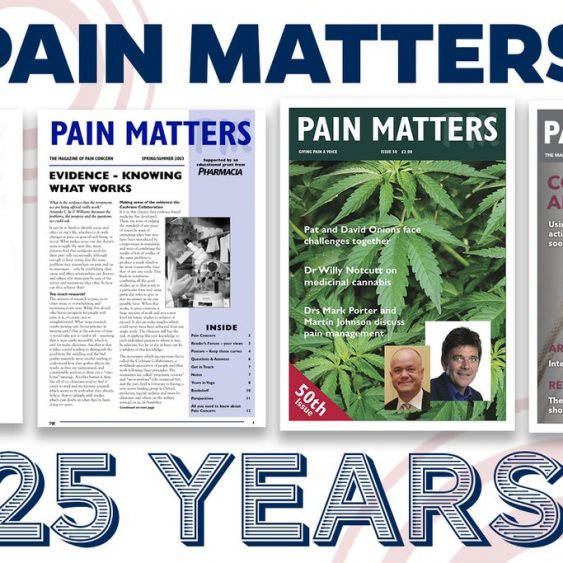
In Spring of 1995, the first Newsletter of the Pain Concern (UK) Lothian Group was issued. The newsletter was printed at a volunteer’s house on ordinary copy paper and had articles from clinicians and patients. Demand grew and by Issue 22 (Autumn 2000) it was Pain Concern News and had contributions from around the UK. Issue 26 (December 2001) was the first to be professionally laid out and printed using our partners, Creative Link, in North Berwick. Glossy paper and a touch of colour on the front page warranted a rebrand and the title Pain Matters was born. Issue 41 was the first in full colour with an article by regular contributor Margaret Graham on how visualising colours affect mood. Issue 50 was a landmark with a then radical article on medicinal cannabis and a brazen close-up of a cannabis plant on the front cover. We now regularly invite clinical teams to guest-edit their own edition, so readers get news direct from the coalface of pain management. There is a digital edition, an email supplement and hardcopies are distributed to pain clinics across the UK. It has come a long way from a volunteer printing a few dozen copies in their house. Thank you for reading and supporting Pain Matters!

Peer Support. Join the community

“Having chronic pain is very lonely.”

Join the community

Subscribe to Pain Matters

Everything you need to know about how to live with chronic pain

Subscribe


In pain? Don’t understand what’s happening?

“Having someone to help you prepare for your life through pain”

Our Pain Education Sessions

Fundraise for Pain Concern

Help us to help others

Fundraise


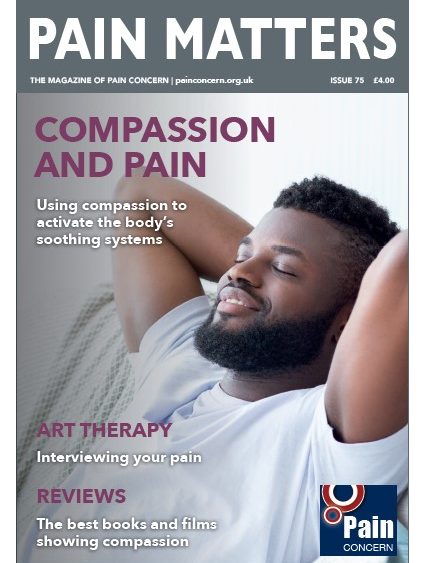
Our new issue, Pain Matters 75, is due to come out on Monday 25 May. As this issue marks the twenty-fifth anniversary of the very first Pain Concern (UK) Lothian Group newsletter, later to become the Pain Matters we know today, we have gone back to where it all started. The Lothian Group was a patient support group set up by members of the Astley Ainslie Hospital pain management programme, so it seems appropriate that this issue is being guest-edited by the Chronic Pain Management Service from NHS Lothian, based at the same hospital.

This issue’s theme is compassion-focused therapy, with the team showing the different ways they use compassion as part of a holistic pain management approach. A lot has changed in the world since our last issue, and here at Pain Concern, we think that compassion is something which we could all use more of at the moment.

Buy or subscribe at painconcern.org.uk/product-category/pain-matters.

Or why not try our digital version, available at pocketmags.com/pain-matters-magazine.

Also, our Pocketmags sale is still running, so if you buy an annual subscription by midnight on the 25th May, you will also be able to choose any 4 back issues. In total, that is 8 magazines for the price of a one year’s subscription – only £6.99!

Peer Support. Join the community

“Having chronic pain is very lonely.”

Join the community

Subscribe to Pain Matters

Everything you need to know about how to live with chronic pain

Subscribe


In pain? Don’t understand what’s happening?

“Having someone to help you prepare for your life through pain”

Our Pain Education Sessions

Fundraise for Pain Concern

Help us to help others

Fundraise


Inside issue 75: The twenty-fifth anniversary issue of Pain Matters sees us return to the hospital where it all started, as NHS Lothian take the helm. This issue’s theme is compassion-focused therapy, with the team showing the different ways they use compassion as part of a holistic pain management approach.


This issue of Pain Matters was guest-edited by the NHS Lothian Chronic Pain Management Service, based at Astley Ainslie Hospital, Edinburgh.


View Pain Matters Subscription Options

Buy or subscribe at painconcern.org.uk/product-category/pain-matters/.

Or why not try our digital version, available at pocketmags.com/pain-matters-magazine.

Peer Support. Join the community

“Having chronic pain is very lonely.”

Join the community

Subscribe to Pain Matters

Everything you need to know about how to live with chronic pain

Subscribe


In pain? Don’t understand what’s happening?

“Having someone to help you prepare for your life through pain”

Our Pain Education Sessions

Fundraise for Pain Concern

Help us to help others

Fundraise


Visiting the forefront of research into pain conditions

As research for a Covid-19 vaccine is a priority for the scientific community, this edition of Airing Pain focuses on the roles of researchers, and in particular the many disciplines that come together to increase the understanding, and therefore the management of chronic pain.

Available to listen to from 5 May 2020 here or download from wherever you get your podcasts.

Watch the trailer below:

Peer Support. Join the community

“Having chronic pain is very lonely.”

Join the community

Subscribe to Pain Matters

Everything you need to know about how to live with chronic pain

Subscribe


In pain? Don’t understand what’s happening?

“Having someone to help you prepare for your life through pain”

Our Pain Education Sessions

Fundraise for Pain Concern

Help us to help others

Fundraise


Visiting the forefront of research into pain conditions

To listen to the programme, please click here.

This edition of Airing Pain has been supported with a grant from The Mirianog Trust donated for this purpose. It was recorded at the end of April 2020, the second month of the UK’s Covid-19 lockdown. All interviews were recorded prior to the crisis.

As research for a Covid-19 vaccine is a priority for the scientific community, this edition of Airing Pain focuses on the roles of researchers, and in particular the many disciplines that come together to increase the understanding, and therefore the management of chronic pain.

First up, Paul Evans speaks to neurologist Claudia Sommer, whose research into fibromyalgia opens debate as to whether the condition should be treated as neuropathic pain.

Physiotherapist David Easton then talks about the research-led ESCAPE PAIN rehabilitation exercise programme for people with osteoarthritis in their hips or knees.

And finally, Paul visits the University of Bristol, where neuroscientist Bridget Lumb talks of the need for further research into the link between familiar contact and social interaction with chronic pain – particularly relevant at a time of social distancing – and social anthropologist Rachael Gooberman-Hill explains the role of the anthropologist in health and pain research.

Issues covered in this programme include: Fibromyalgia, arthritic pain, neuropathic pain, nociceptive pain, loss of nerve fibres, anthropology, societal and behavioural aspects of pain treatment, qualitative research, acute pain, exercise, and joint pain.


Paul Evans: This is Airing Pain, a programme brought to you by Pain Concern, the UK charity providing information and support for those of us living with pain, and for those who care for us. I’m Paul Evans, and this edition of Airing Pain has been supported with a grant from the Mirianog Trust.

Bridget Lumb: It’s well recognised that pain can be alleviated by familiar contact with people. I’ve put in an application to actually try and look at the mechanisms that will underlie social interactions and relief from pain.

Evans: We’re making this programme in week five of the COVID-19 lockdown, that’s at the end of April 2020, at a time when research for a vaccine, diagnostic and antibody tests are at the forefront of the scientific community. So whilst all these interviews were conducted before the present crisis, I want to focus on the role of research, and in particular, the many – sometimes surprising to me, at least – disciplines that come together to make living with chronic pain more manageable.

According to Versus Arthritis, fibromyalgia affects about 5% of the UK population. The name means pain in the muscles and fibrous connective tissues, the ligaments and tendons, but it’s not actually a joint condition, but a syndrome with a set of signs and symptoms that include moderate to severe fatigue or lack of energy, sleep disturbances, headaches, decreased endurance for exercise, widespread muscle aches, and much, much more. As such, many people are treated under the rheumatology umbrella, a rheumatologist being a doctor who specialises in diagnosing and treating arthritis and related conditions. A neurologist, on the other hand, specialises in treating diseases of the nervous system. Download or read online Pain Concern’s excellent leaflet on Neuropathic Pain to find out more about that. So if fibromyalgia is a rheumatic condition, what interest does it have for a neurologist?

Dr Claudia Sommer is Professor of Neurology at the University of Würzberg in Germany. And one of her research interests is fibromyalgia.

Claudia Sommer: A colleague of mine, an anaesthesiologist, [the] head of the pain clinic next door who had many fibromyalgia patients, one day he asked me, ‘We must find out something about the cause of fibromyalgia’. And indeed, we were thinking of rheumatological causes, and he had some hypotheses along these lines. So with him, I started to look at cytokines, which are immune products – how do I say it, pro-inflammatory products of the body. And we had the hypothesis that these were increased in the fibromyalgia patients. This came only partially true. In the end, like, like all the hypotheses, they may be true for part of the patients. But after I had started this research, I became very intrigued because it’s such a – I know it’s a devastating disorder, but it’s also a fascinating disorder, because it has so many aspects. There are so many open questions. This is what intrigued me to dig into this.

Evans: So is fibromyalgia a neuropathic condition?

Sommer: That’s a question we cannot answer yet. What we can say is that it shares a number of features with other neuropathic conditions. For example, loss of nerve fibres in the skin; disturbed function of nerve fibres and their tracts; and changes in brain structure and function. But that can also happen in non-neuropathic conditions.

Evans: I’m confused, what do you mean by loss of nerve fibres in the skin? I mean, what my knowledge, as small as it is, is that fibromyalgia is just a brain condition. It’s just a misbalance of chemicals or something.

Sommer: This is what most people thought, until a few years ago. But then we and others examined groups of fibromyalgia patients very closely. And we found that indeed, these patients have reduced nerve fibres in their skin and the remaining fibres obviously don’t function as well as they did. And when we first published it, some people didn’t believe it, of course, [and] others said, ‘Oh, what a great finding, finally somebody is showing something for fibromyalgia’. And then we were very happy that several other groups from different parts of the world – so we’re in Germany – but then a group from Italy, from Spain, Greece, from the US, they all had very similar findings in a very short time. So I think the time was just ripe for this finding that there is, at least in a subgroup of patients with fibromyalgia, a peripheral nerve basis to this syndrome.

Evans: So do you think that’s the cause of fibromyalgia or the result of having fibromyalgia?

Sommer: Again, I don’t know, as in human research, it’s very difficult to see cause-result, because you only describe something. I find it difficult to see it as the result, which doesn’t mean that this cannot be. But it’s difficult to imagine how a pain syndrome that initiates in the brain would lead to loss of nerve fibres in the skin. For me, it’s easier to understand it the other way around; that there is some defect – it may be genetic, it may be of the environment, it may be immunological – that damages nociceptors. And that this, together with other factors, triggers this whole syndrome.

Evans: You’re going to have to explain to me now, what you mean by nociceptors. What is nociceptive pain, as opposed to neuropathic pain?

Sommer: [They are] two different things. A nociceptor is the word that we use for a peripheral nerve and its nerve cell, so the neuron that signals pain. And we have two types of them, we call them C fibres and A-delta fibres, and they serve different functions, but they both signal pain. So when we activate them, you notice pain, and we call them nociceptors. The term nociceptive pain means pain induced by activation of a nociceptor. So, for example, if I put my hand on a hot plate, this will activate my nociceptors and I will feel pain.

Neuropathic pain, by contrast, is pain caused by an injury disease somewhere in the nervous system. So, if I injure a nerve, for example, by having an accident, and then these nerve fibres are hyper-excitable, I can have pain without any stimulus from the outside. And this is what we call neuropathic pain.

Evans: Okay, going back to the nociceptors and fibromyalgia – is what you’re saying that an injury to somebody, say, hand or leg or limb or anywhere else, may have started the fibromyalgia?

Sommer: We have no evidence for this. And in fact, this has been looked at, there have been large statistics on whether there is a connection between accidents and fibromyalgia and the connection was negative. What has been shown some time ago, was a connection between numerous myofascial pains and fibromyalgia. So myofascial pain is, for example, the usual neck pain you get when you sit for too long or type too long. So it seems that people who have these kinds of pain, which we would generally consider nociceptive, because we don’t move properly and we stimulate our muscle nociceptors the wrong way. So people who have these kinds of pain they have a higher risk of developing fibromyalgia.

Evans: Dr Claudia Sommer, Professor of Neurology at the University of Würzberg, in Germany.

For many people living with chronic or persistent pain conditions, myself included, we are aware of current treatments, that is, what we’re using now to manage our conditions. But we’re ignorant of the work researchers and scientists are doing away from the public glare, and also of the many different disciplines involved, including, to my surprise, anthropology. If like me, in my ignorance, you associate anthropologists with archaeologists and pre-historians in television series about the origins and ascent of man, you may be surprised to know that they can work very much in the present. Dr Rachael Gooberman-Hill is Professor of Health and Anthropology at Bristol University, where she’s also Director of the Elizabeth Blackwell Institute for Health Research. And she’s a social anthropologist.

Dr Rachael Gooberman-Hill: We look at what people do in their everyday lives, and that might be their everyday lives in their homes, or their everyday lives working in a hospital, or their everyday lives, for instance, in living with pain. So what we as anthropologists would do is bring the research techniques that we would use in all of anthropology, and apply them into a pain and healthcare context. So we do things like chat with people, have conversations with people about how they live with their pain, and their history of their pain. We do that in interviews, and we do that in focus groups. We also do research that involves a researcher spending time, maybe in a clinic or a hospital, watching what people do and how decisions are made about care, and all that kind of thing.

Evans: That sounds a bit like time and motion to me, almost.

Gooberman-Hill: It is a bit because when we’re collecting that kind of information, the researcher will write down what they see. And we’ll look at that information and bring it all together to explain why people do what they do and how people do what they do. And when we get it published, that means that decision makers and people who write guidance about care will take that research on board, and look at it and see how it can best inform guidelines for healthcare provision. For instance, National Institute for Health and Care Excellence looks at qualitative research, some of which will be anthropological in an approach, and uses that to inform the guidelines that they write. So largely, what we’d do when we’d apply for funding is we’d get together quite a big group of researchers, usually people with different backgrounds. And we’d work together, because we’ve identified that there’s a gap in the research evidence. And when we work together and find that there’s a gap, we then have to design a research project. And we work for many months, usually, to design a research project and the kind of people we would involve would be statisticians, health psychologists, sociologists, anthropologists, pain doctors, surgeons, etc., etc. And we all come together as a group. And we then write a proposal for research.

As I said, that will take many months, what we do then is we’ll submit that to an organisation like the National Institute for Health Research. They then have a committee of experts who drill down on that research plan, and look at whether it’s needed, whether it’s robust, whether it’s appropriate, and provide comments and feedback to us. And then we go through a long process in which the funder makes a decision about whether or not they would fund our proposed research project. So it takes a long time from deciding that there’s a gap in knowledge, to actually starting a research project with funding.

Evans So how do you find those gaps in knowledge?

Gooberman-Hill: That’s a really good question. We do something called systematic literature review. And we have experts in pulling together existing published literature into one place so that we know whether there’s gaps in the existing knowledge or not. And only when we know that there is a gap, and there’s a need for more knowledge, should we really then be thinking about doing more research.

Evans: Just explain to me what qualitative research means.

Gooberman-Hill: Qualitative research is research that usually happens on a small scale. It’s interested in understanding why people do what they do or think what they think, and how people do what they do and think what they think. So a qualitative researcher is interested not in numbers, but usually in words. And that means that a qualitative researcher usually has a privilege of inviting people to come to interviews and focus groups and talking with them. And for instance, in pain, we would hold focus groups to talk with people about their experience of living with pain, and their experience of finding healthcare for that pain, or what they’ve done in their family to live with pain and those kinds of questions. And that’s what qualitative research essentially is, in a nutshell.

Evans: Why is it called qualitative research? Because asking opinions to me is not non-qualitative, but equally as important as numbers.

Gooberman-Hill: So we call it qualitative because it’s different to quantitative. Quantitative research is about numbers. So in a clinical trial, where we ask people to fill in questionnaires and, you know, assign scores of one to ten, or one to five against certain things, that generates number information. But qualitative research gives us information that isn’t about numbers. It’s about thoughts and feelings and words.

Evans: It’s about what we feel, how we live.

Gooberman-Hill: How we feel, and as you said, opinions as well, but also, what we do and why we do those things. So when we’re doing qualitative research, we’re asking people to talk with us in some depth, and that’s a great privilege. It can take a couple of hours to do a qualitative research interview. And we’re not judging those people in any way, we’re simply asking them what their life is like and how they live and what their healthcare has been like. We also do research with people who provide healthcare. So we’ve done research with surgeons, and we’ve done research with GPs, for instance. So, a particularly interesting piece of research we did a few years ago was to find out why GPs prescribed, or did not prescribe, opioid medication for people living with joint pain. And so we interviewed twenty-seven practising GPs – general practitioners – and we asked them about the kind of medication they prescribed and why they prescribed it.

We spoke with them about the patients that they saw. And we spoke with them about their background and their training and their experience. And this was great because the GPs, were really willing to talk with us, and that was a great privilege. The thing which we found really interesting from that project was that some previous research had suggested that GPs were reluctant to prescribe certain kinds of opioid medication, because they were worried about addiction, tolerance and diversion of those medications. And so we explored that in interviews, and what we found was that GPs were thinking about those issues in some detail, but actually, what influenced their prescribing most was their own professional experience of prescribing opioid medication; for instance, whether they’d had experience in the past of working with groups who prescribe that kind of medication or not. So we then publish that kind of finding in an academic journal, and an academic publication, it sounds like it’s something that’s going to be very dense and difficult to read. But we try to write these things as clearly as possible. And that’s published in the journal so that other scientists can read our work, and know that we’ve done it in a robust research-y way. It’s gone through peer review, the people who read it can then know that what we’ve done is actually a decent piece of research. And then it’s up to the outside world to decide what they do with that research finding. The peer-review process in research means that research that’s out there in the public realm is trustworthy.

Evans: Dr Rachael Gooberman-Hill, Professor of Health and Anthropology, and Director of the Elizabeth Blackwell Institute for Health Research at the University of Bristol.

So, from the study of what people do in their everyday lives, I like to think of it as the macro, to the micro, the study of what happens within people’s brains and nervous systems. Dr Bridget Lumb is a Professor of Neuroscience at the University of Bristol, she’s president of the Physiological Society, and her particular interest is in the understanding of the basic mechanisms of pain, in particular, how we make the transition from acute pain to chronic pain.

Lumb: Acute pain is that immediate pain of putting your hand too close to the fire. It’s about the severity of the pain, and it’s time-caused chronic pain. It’s classified by the International Association for the Study of Pain [as] pain that lasts for more than three months. And a huge proportion of people will suffer from chronic pain at some point in their lives, it’s about 40% of the population.

Evans: That’s astounding. So, three months after the initial injury that caused the acute pain where that injury has healed or should have healed, pain carries on.

Lumb: Pain carries on. A process that was set up by that initial acute pain – the damage, the injury – has set up changes in the brain, which means that the brain no longer reacts normally to pain. There is no noxious stimulus, there is no injury, it can have resolved, but the individual might still be feeling ongoing pain, which could last for years.

Evans: So what’s going on there, then?

Lumb: Well, if you answered that question, you’d probably win the Nobel Prize. We know that, when I say noxious stimulus, this is an input from the body in response to an injury. [It] arrives in the spinal cord as its first point of contact. And then that information is transmitted up to the brain. That initial process, whereby the injury, the signal from an injury, enters the spinal cord, begins to set up a process that we call sensitisation. And it’s that that can continue once the injury has actually resolved.

Evans: So the brain is actually reading what’s happened in the wrong way.

Lumb: In the wrong way. There are interesting parallels – and I think this is an area that will become a focus of attention – is that the way the brain learns, it has an experience and it then has an expectation. So when the stimulus arrives again, it expects to experience it in a particular way. In most people, if there’s a mismatch between the stimulus and what they experience, they resolve it, relearn it, they say, ‘Ah, so when this happens, I now feel this. I don’t feel my previous expectation’.

Evans: Is that a pain centre? If you could look inside my brain, my mind, and I’m in pain, where will that be?

Lumb: We don’t know. If one looks in imaging studies in humans, for example, there is a network which classically lights up in painful situations. But that same network lights up if you apply a novel stimulus. So is it a pain matrix? Or is it a salience network? Is it something that detects the unexpected? Pain is a hugely complex experience. It’s not just about the sensory experience is not just about ‘ouch’; it has emotional context, it triggers learning and memory, it triggers release of hormones, it makes changes in your blood pressure [and] of the heart rate, and it has an emotional context. One can map the pain pathway, for example, from the periphery, from the hand, let’s say, into the spinal cord up to the brain, it will go to the thalamus, it will go to the somatosensory cortex. If you delete parts of the somatosensory cortex, you don’t remove pain, chronic pain. So as far as we know, there is no pain centre. And it probably relies on interaction between different centres within the brain.

And context can change it so much. I mean, social context can change it so much. I mean, I’ve just put in an application, for example, to actually try and look at the mechanisms that will underlie social interactions and relief from pain. Because if we can understand the mechanisms for that, we can perhaps tap into that. I mean, it’s well recognised that pain can be alleviated by familiar contact with people. How does the brain do that? The brain’s got to be doing it.

Evans: Professor Bridget Lumb. Well, familiar contact with people – social interaction or lack of it – during the COVID-19 lockdown, could have serious repercussions, mental and physical. For those not just with chronic pain, but the population at large. Going back to an earlier edition of Airing Pain, number 109, which is still available to download along with all editions from the Pain Concern website. We focused on the European League against Rheumatism’s revised recommendations for the management of fibromyalgia, and the role of exercise in the management of all arthritis-related conditions. In that edition, we explored the walk with ease programme developed by Versus Arthritis, the Arthritis Foundation, and Aberdeen University. Just put ‘Walk with Ease UK’ into your search engine to find out more.

Now the ESCAPE-pain rehabilitation programme is another UK-wide evidence-based programme for people affected with osteoarthritis in the hips or knees. David Easton is a physiotherapist based in Cardigan in West Wales, working for the Hywel Dda University Health Board, where he’s Clinical Champion for ESCAPE-pain.

David Easton: So ESCAPE-pain is an acronym. It’s a bit of a mouthful, and it stands for enabling self-management and coping with arthritic pain through exercise. It’s really giving people some knowledge and some skills about how best to adapt to the condition to minimise the impact, enabling them to become more active, reduce [the impact of pain] and improve their quality of life.

Evans: Well, the one thing about quality of life and exercise is, we all know, at least I think I know, that exercise is good for me. But exercise is not thrashing yourself in the gym.

Easton: No, it’s not. And I think this is where a lot of people with chronic joint pain struggle. They sometimes hear this advice and think, ‘Right, I’ll get all my energies together, and I’m going to give it a go, and I’m going to try my hardest’. But if you take that approach, people tend to overdo it too quickly, they won’t understand their current ability and compare themselves to how they used to be before the problem. And what ESCAPE-pain does, is it gives them the opportunity to change that perspective and use exercise as a strategy to reduce their stiffness, improve their mobility, and over time, improve their function, and their overall exercise tolerance. It may not necessarily be to the level that they used to be, or where they’d like it to be in an ideal world, but it’s a better place. And there’s a real skill to be able to exercise when you’ve got persisting pain, and that takes time and practice. When you use exercise as a as a strategy for joint pain. It’s about choosing when to do it, how much to do of it, and to keep it up on a frequent basis. It’s not always choosing to do it just because you feel like it. It’s knowing how to do that and for me – certainly, listening to people [about] how they have used exercise and the skills on the ESCAPE-pain programme – they learn how to use that effectively, and that’s a process.

Evans: How do you get through to somebody who knows, ‘Historically, exercise has hurt me’.

Easton: I think that’s what’s so great about the programme and why I’m a strong advocate. Because as a physiotherapist I meet a lot of people on a one-to-one basis, and I have these conversations. And sometimes I can see their face and [see] the screen come up and think, ‘Yeah, I haven’t really reached them’. Sometimes it takes a little bit of time. And it’s not always what I say or what I do, [rather] it’s the group environment, where people can see other people coming at it from a different perspective, and sharing that perspective, and thinking, ‘Okay, well, maybe I’ll give it a go’, and learning how to then, over the six weeks, refine that. So sometimes they’ll come along quite well, and they’ll have negative experience. But I don’t see that negative experience in terms of an increase in their symptoms as negative. It’s actually a learning opportunity to think at the moment, that’s too much. So how can I do that differently?

Evans: I know you’re going to say it’s a successful scheme, but is it?

Easton: Why it’s become so prominent, and [why it’s become] a national programme, and won an award within NHS England, is because the research base is very, very strong. It was a randomised control trial that had 418 people, comparing people with usual primary care and the ESCAPE-pain programme. And the outcomes were recorded six months, twelve months, eighteen months and thirty months following the programme. And under those conditions, they were able to demonstrate that there were sustained benefits for people that attended the programme.

Evans: Physiotherapist David Easton, of Hywel Dda University Health Board. Well, whilst walking in groups may be a great way of getting and enjoying your daily exercise, as we’re making this addition of Airing Pain at the end of April 2020, during the COVID-19 lockdown, UK Government guidance stipulates just one form of exercise a day. For example, a run, walk or cycle, alone or with members of your household. Now of course, all this will change, it may even have changed by the time you’re listening to this edition of Airing Pain, so please do check with your own national assembly or government guidelines. However, whilst ESCAPE-pain’s 290-plus class programmes around the UK are currently suspended, there’s an online version and plenty of resources at escape-pain.org/escape-pain-online. The Walk with Ease programme, whilst it recognises that walking can be done in groups and with company, it can also be done on your own. In fact, they’re currently producing an audiobook for people to listen to as they walk. I’ll just remind you that whilst we in Pain Concern believe the information and opinions on Airing Pain are accurate and sound based on the best judgments available, you should always consult your health professional on any matter relating to your health and wellbeing. He or she is the only person who knows you and your circumstances and, therefore, the appropriate action to take on your behalf. You can find all the resources to support the management of chronic pain including details or videos, leaflets, all editions of Airing Pain, and Pain Matters magazine, and the links mentioned in this programme at painconcern.org.uk.

Well, I want to return to the subject of fibromyalgia to end this edition of Airing Pain. Professor Claudia Sommer tantalisingly left us with who might be of higher risk of developing fibromyalgia. But I can’t leave without asking the one question that people with the condition really want asked. Will her research lead the way to better management or even a cure for fibromyalgia?

Sommer: At the moment? All this gives us is a better explanation why – the few drugs that we have for fibromyalgia pain – why they work. Because these are drugs we use in neuropathic pain, like amitriptyline, pregabalin, duloxetine. These are the drugs that have been shown to have some effect in the big clinical trials, and they come from neuropathic pain. So, that fibromyalgia has a neuropathic component https://painconcern.org.uk/airing-pain-109-fibromyalgia/ makes sense, when we know that these drugs that are used to treat neuropathic pain also work to some extent, in fibromyalgia. But the more important question would be, can we in some way reverse these findings? So can we make the nerve degeneration stop or even induce regeneration? People are working on it, and there might be drugs out in the next five to ten years.


Contributors:

  • Dr Claudia Sommer, Professor of Neurology at the University of Würzburg in Germany and President-Elect of the International Association for the Study of Pain
  • David Easton, Physiotherapist at the Hywel Dda University Health Board in West Wales
  • Dr Bridget Lumb, Professor of Neuroscience at the University of Bristol
  • Dr Rachael Gooberman-Hill, Professor of Health and Anthropology and Director of the Elizabeth Blackwell Institute for Health Research at the University of Bristol.

More information:


With thanks to:

  • The British Pain Society (BPS), who facilitated the interviews at their Annual Scientific Meeting in 2019 – britishpainsociety.org
  • The International Association for the Study of Pain (IASP) iasp-pain.org.

Peer Support. Join the community

“Having chronic pain is very lonely.”

Join the community

Subscribe to Pain Matters

Everything you need to know about how to live with chronic pain

Subscribe


In pain? Don’t understand what’s happening?

“Having someone to help you prepare for your life through pain”

Our Pain Education Sessions

Fundraise for Pain Concern

Help us to help others

Fundraise


Visiting the forefront of research into pain conditions

This edition of Airing Pain has been supported with a grant from The Mirianog Trust donated for this purpose. It was recorded at the end of April 2020, the second month of the UK’s Covid-19 lockdown. All interviews were recorded prior to the crisis.

As research for a Covid-19 vaccine is a priority for the scientific community, this edition of Airing Pain focuses on the roles of researchers, and in particular the many disciplines that come together to increase the understanding, and therefore the management of chronic pain.

First up, Paul Evans speaks to neurologist Claudia Sommer, whose research into fibromyalgia opens debate as to whether the condition should be treated as neuropathic pain.

Physiotherapist David Easton then talks about the research-led ESCAPE PAIN rehabilitation exercise programme for people with osteoarthritis in their hips or knees.

And finally, Paul visits the University of Bristol, where neuroscientist Bridget Lumb talks of the need for further research into the link between familiar contact and social interaction with chronic pain – particularly relevant at a time of social distancing – and social anthropologist Rachael Gooberman-Hill explains the role of the anthropologist in health and pain research.

Issues covered in this programme include: Fibromyalgia, arthritic pain, neuropathic pain, nociceptive pain, loss of nerve fibres, anthropology, societal and behavioural aspects of pain treatment, qualitative research, acute pain, exercise, and joint pain.


Contributors:

  • Dr Claudia Sommer, Professor of Neurology at the University of Würzburg in Germany and President-Elect of the International Association for the Study of Pain
  • David Easton, Physiotherapist at the Hywel Dda University Health Board in West Wales
  • Dr Bridget Lumb, Professor of Neuroscience at the University of Bristol
  • Dr Rachael Gooberman-Hill, Professor of Health and Anthropology and Director of the Elizabeth Blackwell Institute for Health Research at the University of Bristol.

More information:


With thanks to:

  • The British Pain Society (BPS), who facilitated the interviews at their Annual Scientific Meeting in 2019 – britishpainsociety.org
  • The International Association for the Study of Pain (IASP) iasp-pain.org.

Peer Support. Join the community

“Having chronic pain is very lonely.”

Join the community

Subscribe to Pain Matters

Everything you need to know about how to live with chronic pain

Subscribe


In pain? Don’t understand what’s happening?

“Having someone to help you prepare for your life through pain”

Our Pain Education Sessions

Fundraise for Pain Concern

Help us to help others

Fundraise


1 15 16 17 18 19 49