Information & Resources

Find information and resources to help manage your pain.

Get Help & Support

Find the tools you need to
help you manage your pain.

Get Involved

Help make a real difference to people
in the UK living with chronic pain.

About Us

Find out about Pain Concern and how
we can help you.

More pain, less sleep; less sleep, more pain – The relationship is a complex one, but what are the mechanisms behind the link between sleep and pain?

This edition of Airing Pain is funded by the Constance Travis Charitable Trust and the Isabella Memorial Trust.

Sleep can be a sanctuary from life; a way for the brain to decompress and begin restorative processes, but for those living with chronic pain, the pain/sleep cycle can become a vicious one.

In this edition of Airing Pain, Paul speaks to clinical and health psychologist Dr Nicola Tang about how polysomnography, a method of measuring the biophysiological changes that occur during sleep, can suggest aspects of brain functioning during sleep cycles.

Dr Tang explains how the deeper stages of sleep, like Rapid Eye Movement, are linked to pain sensation and emotional processing, and when you are deprived of these particular stages of sleep there is evidence of increased levels of pain sensitivity.

Paul also speaks to Dr Sue Peacock, consultant health psychologist and author of Sleeping with Pain (2016), about how she found sleep to be one of the major issues among pain clinic patients and her non-pharmacological approaches. Dr Peacock discusses how focusing on restructuring sleep patterns resulted in nearly all patients having improved quality of sleep.

Issues covered in this programme include: CBT: cognitive behavioural therapy, dementia, exercise, family and relationships, fatigue, fibromyalgia, habit, insomnia, polysomnography, psychological approaches to pain management, relaxation, residential pain management programmes and worry.


Contributors:

  • Dr Nicole Tang, Clinical and Health Psychologist, University of Warwick, Chartered Psychologist with the British Psychological Society.
  • Dr Sue Peacock, Consultant Health Psychologist, Associate Fellow of The British Psychological Society and author of Sleeping with Pain: Strategies for a restful night from a pain management expert.

More information:

Peer Support. Join the community

“Having chronic pain is very lonely.”

Join the community

Subscribe to Pain Matters

Everything you need to know about how to live with chronic pain

Subscribe


In pain? Don’t understand what’s happening?

“Having someone to help you prepare for your life through pain”

Our Pain Education Sessions

Fundraise for Pain Concern

Help us to help others

Fundraise


More pain, less sleep. Less sleep, more pain. The relationship is a complex one, but what are the mechanisms behind the link between sleep and pain?

To listen to this programme, please click here.

This edition is funded by the Constance Travis Charitable Trust and the Isabella Memorial Trust.

Sleep can be a sanctuary from life; a way for the brain to decompress and begin restorative processes, but for those living with chronic pain, the pain/sleep cycle can become a vicious one.

In this edition of Airing Pain, Paul speaks to clinical and health psychologist Dr Nicole Tang about how polysomnography, a method of measuring the biophysiological changes that occur during sleep, can suggest aspects of brain functioning during sleep cycles.

Dr Tang explains how the deeper stages of sleep, like Rapid Eye Movement, are linked to pain sensation and emotional processing, and when you are deprived of these particular stages of sleep there is evidence of increased levels of pain sensitivity.

Paul also speaks to Dr Sue Peacock, consultant health psychologist and author of Sleeping with Pain (2016), about how she found sleep to be one of the major issues among pain clinic patients and her non-pharmacological approaches. Dr Peacock discusses how focusing on restructuring sleep patterns resulted in nearly all patients having improved quality of sleep.

Issues covered in this programme include: CBT: cognitive behavioural therapy, dementia, exercise, family and relationships, fatigue, fibromyalgia, habit, insomnia, polysomnography, psychological approaches to pain management, relaxation, residential pain management programmes and worry.

Paul Evans: This is Airing Pain, a programme brought to you by Pain Concern, the UK charity providing information and support for those of us living with pain and for healthcare professionals. I’m Paul Evans and this edition has been funded by the Constance Travis Charitable Trust and the Isabella Memorial Trust.

Sue Peacock: Because you’ve had so many sleepless nights, you expect to go to bed and you’re not going to be able to sleep.  So, you don’t sleep because it’s another vicious circle which is the whole of pain management isn’t it, breaking up vicious cycles?

Evans: Getting a good night’s sleep should be the most natural thing in the world, shouldn’t it? Well, many people with chronic pain might disagree.  Here’s the conundrum.  Poor sleep can make the pain worse, but the more we worry about our sleep, those negative thoughts can make getting a good night’s sleep difficult. Pain and poor sleep each feeding into the other in a downward spiral and that’s the vicious cycle of pain which needs to be broken. So, what’s going on, or what should be going on in our brains while we sleep?

The University of Warwick’s Sleep and Pain Laboratory is home to some of the leading research into the science and clinical aspects of sleep and pain and Dr Nicole Tang is Associate Professor of Clinical and Health Psychology there.

Nicole Tang: When you are sleeping, your brain is still very active to a certain extent.  It’s just that the functions that you thought would be very active during the day; they would turn down a little bit. But during the night, there are a separate set of functions happening, helping you to process information that you’ve learned during the day.  There has been some scientific evidence showing that during the night, potentially, the biology will work in such a way that it helps you to clear out the toxic substances in the brain that could potentially be linked to the development of dementia, further down the line. So there is stuff that the brain is doing like reorganizing information, helping you to process some difficult emotions; lots of things that we do when we’re sleeping.

Evans:  One of your research interests is the relationship between sleep and chronic pain.

Tang: It’s my current obsession [laughs]

Evans: I have fibromyalgia. People have said, and I tend to agree with them, that if I were to give somebody the gift or the non-gift of fibromyalgia just for a day or two, what they would need to do is be deprived of sleep, for a week.

Tang: So it’s a fairly complex idea, a gift and a non-gift …

Evans: A curse.

Tang: [laughs] …would be to deprive you of sleep. Actually, it’s true, it’s almost like double torture. So, when you are already in pain and you can’t go to sleep, it’s almost like the last resort of peace and restoration is taken away from you. So, lots of people in similar situations as yours would describe it as a double torture, because you know that severe prolonged sleep deprivation is a form of torture. Pain is commonly used as a means of torture, so if you were experiencing both at the same time, that could be a real curse.

Evans: So, what is going on when somebody hits the pillow to go to sleep and they become drowsy, this, that and the other?  What are the processes going on within the brain, the sleep mechanisms, if you like, between going to bed or falling asleep and waking up in the morning?

Tang: Well, it’s hard to put it into words because the brain certainly doesn’t have a manual with the different words to say ‘well this is what I’m doing, this is what I’m doing’. But there is a way that we can tap into electrical activities in the brain to suggest what sort of functioning, or what sort of mechanisms the brain is undergoing when you were sleeping. So, one technology that we use is polysomnography.   It’s almost like a lie detector but it’s a technology that gives you an array of physiological information, so it has EEG (Electroencephalography) [where] you have electrodes stuck onto your head to tap into the electrical activity from the scalp and then it has EOG (Electrooculography) to measure your eye muscle movement, so we can check the eye movement while you are sleeping.

We also have EMG (Electromyogram) to measure your muscle activity. So, combining all of that together with your breathing, your heart rate etc., we can actually check what stage of sleep you are in.  Using that kind of physiological information, we know that there are different stages of sleep, so by the time you drift off to go to sleep,  you probably start from a very light stage of sleep,  so it will take a while to fall asleep.  Sleep is not like an instantaneous process. Sometimes people refer to it ‘as soon as my head hits the pillow’, then they’ll fall asleep.  You will be lucky if that happens!  It could be also pathological if that happens during the day, but usually for an ordinary person it will take a while, slowly to get into sleep.  We will start with the lighter stages of sleep first, which we call ‘Stage 1’ and ‘Stage 2’ sleep and then, only for a small proportion of time during the night, we will have the deeper stages of sleep, which we call ‘Stage 3’ sleep, so every night we will cycle through these different stages of sleep, maybe 4 or 5 cycles.   If there’s no disruption to your sleep pattern whatsoever, then we just go in a cyclical manner letting different brain processes happen.

Evans: So what are the functions of those different stages?

Tang: As far as we understand right now, different stages of sleep have different functions, particularly for the deeper stages of sleep, which we call ‘slow-wave’ sleep. They are associated with the hypothesis that it is restorative. It helps you to feel the sleep quality, it helps you to feel better. This stage of sleep is also closely linked to your pain sensation.  REM (rapid eye movement) sleep, has been associated with emotional processing [and] learning etc. Different stages of sleep could have different functions, but they are all inferred functions, so it’s really hard to say for sure that this is exactly what it does.   But we have learned from different experimental studies knowing that when you deprive someone of this particular stage of sleep, it is particularly linked with an increased level of pain sensitivity or disrupted emotional functioning etc.

Evans: Some people with chronic pain will identify with feeling they’ve had a poor night’s sleep, even though their partner might say ‘no, you’ve slept all night’.   I’m speaking personally.  In the morning, I will say to my wife, if she’d asked me how I’ve slept, and I’d say ‘well I’ve had a terrible sleep.  I’ve been awake most of the night’ she’d say ‘no you’ve been snoring most of the night’.

Tang: [laughs]

Evans: So how can we have such differing views of my sleep?

Tang: Yeah, it’s really interesting I mean in fact,  my doctoral research is all about this discrepancy between people’s experience of sleep and also what we can measure from polysomnography (that I’ve just talked about), actigraphy measurements that check your movement, then estimate your sleep parameters, and also partners’ reports.  [Laughs] It is well known that there are discrepancies, systematic discrepancies, between what other people report on your sleep and how you experience your sleep.  So that suggests that the way we perceive sleep quality is much more complicated than just a few parameters that are being picked up by our existing measurements.

Lots of other things could go how we judge our sleep quality – for example, your mood [and] your physiological sensations at the time when you’re thinking about your sleep.  But what we found from experiment[s] is that it’s the level of cognitive arousal, so your thoughts, your worries, what you were thinking at the time, could affect your judgment quite a bit. The level of anxiety could also affect the way you see your sleep.  Your memory and biases that we tend to have in terms of what we pay attention to, would also affect how we report our sleep quality.  From a clinical point of view, it is really useful to understand that discrepancy, because let’s say if a patient comes along and says ‘I’ve got really terrible sleep quality’ and then when you send them to the sleep clinic to have a sleep study, the reports come back completely normal, so what would be the implication? Some people misinterpret that as ‘oh the patient is just exaggerating etc’ and then that could build into a lack of trust in subsequent consultations.  But for us, what we are trying to do, is to understand the intricate psychological factors or physiological factors that would affect the way [in which] people perceive sleep quality by better understanding what caused the complaint, what caused the perception of poor sleep quality – we can treat them accordingly, not necessarily through drugs, but it could be through non pharmacological treatment.

Evans: That’s Doctor Nicole Tang from the University of Warwick’s Sleep and Pain Laboratory.  Well, based on a non-pharmacological approach, the book ‘Sleeping with Pain’ offers strategies for a restful night’s sleep. Its author is Dr Sue Peacock. She’s a consultant health psychologist with two decades’ of pain management experience within the NHS and now works in an independent practice.

Peacock: Having worked in the pain clinic for so many years with chronic pain patients, you notice that sleep is one of the big issues that comes along with it. Nobody seemed to be doing anything about it, so possibly about three years ago, I designed a program specifically for chronic pain patients who had sleep problems. Before that, we just did one session on the pain management program that was just about sleep, but that wasn’t really enough.  So, we developed this sleep program that looked at challenging unhelpful sleeping patterns, challenging unhelpful thoughts about things, dealing with racing minds, relaxation strategies and keeping sleep diaries and all that kind of stuff.   Then using that information to reschedule sleep patterns, which isn’t easy, but because we had the support of the psychology staff, we could help our patients move that forward and so we could help them change their sleep pattern. As a result of the 6-week program, we found that nearly all of them reduced the length of time it took them to get to sleep and improved their quality of sleep.  So the reason I wrote the book was because access to pain clinics is actually quite difficult for so many people.  I thought we need to get the word out because this is a huge problem – to get the best night’s sleep it’s very much about doing the basics of sleep hygiene, which is always such a strange word I think.  It’s basically looking at your sleeping environment, so is your bed comfortable?  Is your room dark enough?  Is it warm or cool enough, depending on what you need? Have you got rid of all the mobile technology and TV and all that kind of stuff – are you comfortable basically? So there’s those kind of things but then also prior to getting into bed, I think it’s important about getting a good routine. So do you do the same things every night? For example, for me, I probably watch the 10 o’clock news, put the dog out and go and clean my teeth, then go to bed.  So it’s usually the same kind of pattern and I think having that pattern helps because it gets you into that routine that you’re preparing to go to bed.  Then, when you get in bed, you turn the light out and go to sleep and that’s the way to start it.  I think it’s also worth spending some time before you perhaps get to bed, say you get to bed at 10:30 or whatever, say [at] about 8 o’clock, write down what kind of things you need to remember for the next day or what you need to do for the next day, so your brain’s not constantly trying to remember stuff while you’re lying there awake, tossing and turning.

Evans: But aren’t you reinforcing that business where ‘I have to prepare to go to sleep now’? At 8 o’clock, I have to start writing a list so I can clear my mind later, surely that’s reinforcing it?

Peacock: Well, I think you’re right. I think if writing it down helps you remember what you need to do, because quite often when you’re lying there in bed trying to remember, it’s the fact that you’re trying to remember everything that’s racing around.  So if you know that it’s written down, you don’t have to worry about thinking about it because it’s already done for you.  It’s also about thinking about what’s happened in the day, do I need to reflect on the day, what’s gone right,  what’s not gone so right,  what would I need to do that’ll change it – all those kinds of things to try and clear your mind. Not saying you can clear your mind completely, but if you can clear your mind a little bit then that reduces the brain’s need to keep saying ‘you need to remember this, you need to remember this,  you need to remember this’ kind of thing as you’re trying to sleep.

It’s also useful [laughs] to turn your clock away from you because sometimes [laughs] when you lie there, it feels like you’ve been asleep for absolutely ages and you look at your clock again,  it’s five minutes [later] and then you just get stressed, cross, anxious and irritated with yourself and that’s not going to be conducive to a good night’s sleep.

I also think, whilst you’re trying to reschedule your sleep pattern, that if you can’t sleep and you’re lying there for 15-20 minutes, you might as well get up because you’re just going to lie there and get crosser and crosser and more uptight, so less likely to sleep.  So I think it’s important to prepare things that you can do in the middle of the night, or two o’clock in the morning, whenever you get up, so you’ve got soothing activities that you can do. Nothing too stimulating – if I said ‘go and watch a film’, I don’t mean some kind of action-packed thriller, [laughs] just a nice film kind of thing [laughs] that’s quite gentle. Or if I said ‘listen to some music’ it’s not some kind of hip-hop, dance kind of stuff …

Evans: It wouldn’t be!

Peacock: [laughs] It’s more gentle music that can help you get back into that relaxation set of mind. Then, when you feel sleepy tired again, sleepy tired is when your eyes feel as if they’re really heavy and dropping off,  you kind of feel yourself nodding.  Rather than thinking ‘right, it’s time to go to bed now’ whether you’re tired or not – it’s got to be sleepy tired when you head to bed.

Evans: The middle of the night sometimes can be when one has one’s most creative thoughts.

Peacock: Yes.

Evans: I have a friend who combats this by having a writing pad by the bed and rather than festering over it for goodness knows how long, writes down the thought and it’s gone.

Peacock: I think it’s a really good idea, I used to do that when I was writing my PhD.

Both: [laugh]

Peacock: Yes, I always say to my patients, if you can, have a notebook or a bit of paper by your bed because if you think of something, if you’ve written it down, you know it’s written down. Whether you can read your writing or not in the morning’s another issue [laughs], but you better make it enough [that] you’ll be able to make sense of it enough to know what you what you were thinking about in the middle of the night.

Evans: There are apps for smart phones and things like that, I think Sleepio is one, based on cognitive behavioural therapy techniques. What do you make of those?

Peacock: Some of my patients like them and some of them don’t.  The course that I ran and subsequently my book, is very much based on CBT approaches with a little bit of hypnotherapy [laughs] in there as well and a little bit of mindfulness.  I think probably for younger people, and I don’t mean to sound ageist about this, but a lot of younger people like and embrace more technology than older people.  We are getting younger and younger people into pain clinics, so I think there’s a place for both, I think it’s about preference.  The most important thing about it is that you do it, record it and stick to the program because if you stick to the program, then you’re more like to get success – be it the book, be it apps.

Evans: I found the explanations and worksheet approach in Dr Sue Peacock’s book ‘Sleeping with Pain’ very readable, practical and it’s attractively priced.  You can buy it online, just put the title into a search engine or you can get details from Sue’s own website which is apaininthemind.co.uk.  You’ll also find on the website some useful information and resources about living with chronic pain.

Now, as I always do in these Airing Pain programmes I’ll just remind you of the small print and that is that whilst we in Pain Concern believe the information and opinions on Airing Pain are accurate and sound based on the best judgments available, you should always consult your health professional on any matter relating to your health and well-being. He or she’s the only person who knows you and your circumstances and therefore the appropriate action to take on your behalf.

We’ve been talking about sleep hygiene as a component of cognitive behavioural therapy, or CBT, for insomnia, but as Dr Nicole Tang of the University of Warwick Sleep and Pain Lab explains, it’s not the only component.

Tang:  From research, we know that actually, poor sleepers and good sleepers do not differ that much in terms of their sleep practices.  In fact, lots of people with problems sleeping couldn’t have better sleep hygiene or [a] much more regimented routine that they would follow and they have meticulous bedroom settings that should be very facilitative of sleep. So in CBT for insomnia, mainly what we’re trying to tackle is, first of all, some of the behaviour that we know would contribute to a persistent disrupted sleep pattern.  For example, one of the common responses to pain would be to lie down, to not do too much during the day, trying to make sure that the pain doesn’t get aggravated and also at the same time, they get enough rest.  Probably, it’s just the vicious circle that you and I would be very familiar with because when you are in pain, you don’t want to move and then you lie down, sometimes you have a nap and to see if you can catch up on the sleep that you lost [laughs] the night before.

Evans: You’ve been spying on me!

Tang: [laughs] I haven’t been!  But it’s just a very common experience and it’s totally understandable why people make certain decisions because of what’s happened before.  So, this vicious circle, you can understand why people got into it.  It’s not  particularly helpful in terms of protecting sleep in the long term, particularly for sleep quality that you were talking about earlier –  because the longer you lie in bed to get the amount of sleep that you need, means that you are essentially lowering sleep quality.  For all of us, we’ve only got a certain quota of sleep that we could obtain – if you spend more hours in bed, you are still sleeping the same amount so that means that you’re not that efficient in terms of your sleeping.  For the rest of time when you’re not sleeping, but were still in bed, probably you’ll be either experiencing it in the form of awakening or the long beginning process of falling asleep or you’ve woken up in bed and then you don’t want to get out of bed.  Those would be the times potentially be filled with worries and frustration, anxiety and depression, because of the lack of ability of going to sleep.

Evans: I didn’t sleep last night. I will go to bed at half-past nine and the anxiety involved in ‘will I get to sleep, will I get to sleep, will I get to sleep’ and, of course, you don’t get to sleep.

Tang: Yeah, exactly because you get so worked up, you’re anticipating sleep to come and you’re forcing it to come along. It actually just makes it harder to happen.

Evans: I can remember thinking as a teenager ‘I don’t know how to go to sleep; I don’t know how to do it’.

Tang: Well, sleep is easy when it comes naturally, but when you’re forcing it to happen, it doesn’t come.  I remember one sleep researcher put it as an analogy, it’s almost like a butterfly or a dove in your hand, so as long as you allow it to happen, it happens naturally.  When your body wants to claim the sleep, it will, but when you try to grab it, control it, it will just fly away.

Evans: Another sleep issue that some people have is that they go to sleep okay, but they will wake up at two o’clock in the morning and have trouble getting back to sleep then. What’s going on there?

Tang: There could be many, many reasons why people wake up at a certain time, certainly, sleep is a habit. What’s happening, potentially, is because they don’t have enough sleep pressure to drive them through the whole night of sleep.  So that’s one possibility that is linked to what I talked about before.  When you have been spending your sleep pressure during the day in the form of an afternoon nap, in the night, you won’t have the same amount of sleep pressure to drive you into deeper stages of sleep and for the long period of time that you hope you would be sleeping for.

Evans: So, by sleep pressure, you mean you only need a certain amount of sleep? If you’re using that up in the day before you really should be going to sleep in the night, then the pressure’s gone and you didn’t need that sleep in the first place?

Tang:  Yes, it will make it harder for you to plunge into deeper stages of sleep and to maintain your sleep for a long period of time in the evening, so that’s one possibility.

Evans: We sort of glossed over pharmacological help for sleep.  A lot of people with chronic pain take tablets for it.

Tang: Mm-hmm

Evans: One of the benefits of some of those tablets is that they get good sleep after it, which in itself is a benefit, as far as I’m concerned anyway.

Tang: Mm-hmm

Evans: Is there a role for CBT psychological approaches alongside those pharmacological approaches?

Tang: Well, definitely I mean, if the tablets are working for the patient, that’s really good news but I think the sad reality is that it doesn’t work for everybody.  [With] quite a lot of the patients that I’ve seen in clinic and also from different research reports, although they do get longer periods of sleep, the sleep quality, after taking a sleep[ing] tablet is not so good because the tablets change the sleep’s architecture. That affects the kind of sleep that they get and they’re not necessarily benefiting from it from that particular point of view. Also, taking tablets would have side effects and you know about that, so it’s about choosing what you want – the side effects of the tablets and also the drug interactions that they [patients] have to worry about. So that’s why, in current guidelines, it is not recommended for people with sleep problems to take sleeping tablets for the long term – the type of sleep problems that chronic pain patients do experience is the long-term type of sleep problem. So in a way, tablets, while they work, they may work beautifully for the short-term for some people, but for quite a lot of people, they do have difficulties taking all these tablets with side effects and also not necessarily the effects they are looking for in terms of sleep outcome. So, we have to be very careful with the use of medication.

Evans: You mention exercise and sleep – I mean, is there a correlation between exercise and sleep and chronic pain?

Tang:  If you think of sleep as an activity, you can see a continuation of sleep and physical activity during the day. The more you do during the day, that would help you to build up sleep pressure and that sleep pressure eventually would help you to plunge into deeper stages of sleep, to have faster sleep onset and a deeper quality of sleep. So, if you look at it that way, physical activity should be linked with sleep quality. However, as with everything, [it] is not as simple as that and to try to detect that relationship is quite complicated.  There have been some studies suggesting that, by offering people exercise intervention, it may help with sleep.  The kind of activity that has been introduced for people with arthritis would be some sort of mild aerobic exercise, like Tai Chi and Tai Chi Chung.  In the States, there has been a group of researchers looking into that for older patients with osteoarthritis – it seems to show quite a lot of benefits, in terms of both sleep and all the quality of life outcomes, also inflammatory markers – they have demonstrated some positive changes in those two, so that is quite encouraging. But for some people, if they don’t manage the physical activity carefully, they could have overdone it and in the short term exercise could induce more pain and that could affect their sleep in a negative way. So, it depends on how you manage your physical activity level in such a way that you are getting the best from both worlds.

One of our studies is actually showing the very interesting association between sleep and next day pain.  What happens is that when you measure people’s sleep and physical activity over a period of time, we found that on days when people are sleeping better, I mean chronic pain individuals, on days when they’re sleeping better, they tend to have a very different physical activity pattern the following day, compared to days when they have had a poor night’s sleep the night before. So, that means that without any intervention, if you manage to sleep better, you will have a slightly higher level of physical activity in general, following a good night of sleep.  So that seems to suggest the therapeutic power of sleep in itself as an overnight therapy – it can boost your physical activity the next day.  But the interesting thing is that when we also looked at the people’s pain rating, while having a good night’s sleep could reduce your level of pain in the morning up till sometime in the afternoon, but by the time in the evening when you measure the pain again, it could go up in the opposite direction.  Combining the data between pain rating and physical activity level, it seems to suggest that if people don’t manage their physical activity carefully after they think ‘I’ve got a good night’s sleep and I have to do this, I have to do that, I have to make up for lost time’ [laughs].

Evans: I was going to say, can I hazard a guess at that and that is, if you have a good night’s sleep and you’re feeling good in the morning, then you really go for it…

Tang: Yeah

Evans: …and you suffer later.

Tang: Yea, you put it eloquently. Yeah if you don’t manage it well and if you suddenly are tempted to do a lot, take on a lot more than what you can physically do, it could be not a blessing.

Evans: That’s Dr. Nicole Tang, Associate Professor of Clinical and Health Psychology at the University of Warwick’s Sleep and Pain Laboratory. Don’t forget that you can download all editions of Airing Pain from Pain Concern’s website which is painconcern.org.uk, from Pain Concern’s YouTube channel, just put Pain Concern and YouTube into your search engine, and from Able Radio which is at ableradio.com.  The book ‘Sleeping with Pain’ is by Dr Sue Peacock and her information and resources website is apaininthemind.co.uk. She can have the last words on this edition of Airing Pain.

Peacock: You’ve had so many sleepless nights, you expect to go to bed and you’re not going to be able to sleep.  So, you don’t sleep because it’s another vicious circle, which is the whole of pain management isn’t it, breaking up vicious cycles?   So I think it’s about trying to break that vicious circle and trying to reframe the way you think about your bed and that association with bed and sleep. It’s about the basic sleep hygiene things of not doing anything, using bed for sleep and sex and that’s it, so don’t have your TV in, don’t have your iPods out or your mobile phones, all that kind of stuff – it’s just very much for those two things. Then you can start to change your thought patterns and change that negative way of thinking, ‘what’s the point of going to bed because I’m not actually going go to sleep’.  Once you start changing your sleep pattern and you start noticing change, you notice that you are getting to sleep and it’s a little bit longer than you thought it was going to be when you’re recording in your diary and think ‘oh that’s okay’, so it gives you more confidence that you will be able to sleep.  Eventually your sleep pattern improves and the time that it takes you to get to sleep in the first place or if you wake up in the night, it gets less.


Contributors:

  • Dr Nicole Tang – Clinical and Health Psychologist, University of Warwick, Chartered Psychologist with the British Psychological Society
  • Dr Sue Peacock – Consultant Health Psychologist, Associate Fellow of The British Psychological Society and author of “Sleeping with Pain: Strategies for a restful night from a pain management expert”.

Peer Support. Join the community

“Having chronic pain is very lonely.”

Join the community

Subscribe to Pain Matters

Everything you need to know about how to live with chronic pain

Subscribe


In pain? Don’t understand what’s happening?

“Having someone to help you prepare for your life through pain”

Our Pain Education Sessions

Fundraise for Pain Concern

Help us to help others

Fundraise


How pain’s unpredictability can affect interpersonal relationships, and recognising help when it appears

To listen to this programme, please click here.

This edition of Airing Pain is funded by the JTH Charitable Trust and the Persula Foundation.

With between one third and one half of people living with chronic pain in the UK alone, the number of people experiencing the effects of pain explodes when considering family and friendships.*  For some of these people, life can become a cycle of hospital visits, blood tests, and scans. So, what can be done to ease these relationships?

In this edition of Airing Pain, Paul Evans and eminent psychotherapist Dr Barry Mason speak about their personal experiences with fibromyalgia and ankylosing spondylitis.

With many chronic pain conditions being “invisible”, explaining your pain may seem impossible, and as the family’s “uninvited guest”, it can cause people to close up to those looking to help. Dr Mason explains that not speaking about this uncomfortable topic can lead to further issues, and how opening up can lead to better family teamwork.

Issues covered in this programme include: Ankylosing spondylitis, cancer, children and young people, chronic primary pain, chronic pain as a condition in its own right, communicating pain, couple’s therapy, explaining pain to children, family therapy, fibromyalgia, friends and relationships.

http://bmjopen.bmj.comcontent/6/6/e010364

Paul Evans: This is Airing Pain, a programme brought to you by Pain Concern, the UK charity providing information and support for those of us living with pain, and for health care professionals. I’m Paul Evans, and this edition’s been funded by the JTH Charitable Trust  and the Persula Foundation.

Dr Barry Mason: When people are in pain I make a distinction between a primary relationship with pain, and a secondary relationship with pain. A primary relationship with pain is where pain tends to dominate your life. But it’s not just that it may dominate the life of the person with the condition, it can also dominate the lives of those you are closest to. Pain is therefore in the foreground of their lives, and getting on with life tends to then be in the background. A secondary relationship with pain would be where getting on with life, for those with the condition and others close to you getting on with life is in the foreground of your life, and the pain, although there, you manage to keep in the background.

Evans: In a lecture to the Institute of Family Therapy in 2016, the eminent family psychotherapist Dr. Barry Mason talked about his research into the effect of chronic pain on significant relationships and conversely, the effect of those relationships on chronic pain. His recent research is on the management of fibromyalgia but in 1972 he was diagnosed with ankylosing spondylitis, that’s an inflammatory condition that affects the joints of the spine. Now, it’s important to say that in the interest of confidentiality certain clinical details have been changed in our conversation that follows, but it was his diagnosis of AS that inspired his initial research.

Mason: What I was told at that time, that it was a chronic condition–it would develop over time—that the impact it had on me was beyond just me. It was about, I’ll lose my job, and of course it was affecting not only me, but it was having an impact on my personal relationships, how I was, and sometimes I dealt with it by going into myself, which is not unusual with people with chronic pain conditions. That was the way you coped with difficult times. And so I was very aware, not just of what was going on with me, but also about how other people were relating to me, and that in itself affected how I managed my condition.

Evans: Because they talk about pain as the uninvited, unwelcome guest into the family, don’t they? It impacts on absolutely everybody, all relationships.

Mason: Yes, close relationships you have, work relationships. Coping, keeping going. And sometimes you have bad episodes and the pain is worse than other times. One of the words I think fits very well for chronic pain conditions is that it’s unpredictable, that it’s there sometimes, then all of a sudden it’s not.

I always remember for quite a while having continuous pain, and then I had a remission, and I remember thinking I always knew there was a state of being pain free, but I’ve only just  re-experienced the distinction between being pain free and having pain. And of course then you think, perhaps it’s over, perhaps that’s it. And of course it wasn’t, it comes back.

And I started also to, as a way of people not asking me too much about, how’s your back Barry?, because after a while it can actually get a bit boring, but they were concerned, and then to help people not get into that I actually found myself wearing suits and looking smarter in the hope that people would, this is pathetic in a way—I laugh at it now, that people would think, oh, he looks good. And it was all about the physical appearance, because you know, you show it in your face at times, as you know. And you try to not do that, but it’s very hard at times.

Evans: In my own experience, I have fibromyalgia, one of the worst things that people can say to you is, how are you today?

Mason: The danger is, on the one hand there is a wish for them to be concerned, genuinely concerned, but it rather fixes you as a person with a condition. It feels at times as though you are the condition, rather than a person with a condition. I remember saying, it’s like I’m not Barry, I’m Barry the back.

Also, I’ll stress that people are genuinely very concerned about you, so how do you manage that concern without getting fed up with the concern, if you see what I mean, does that make sense?

Evans: It does, but many people feel that if they tell the truth all the time about their pain, people will stop asking. We don’t want to come across as miseries.

Mason: Yes, well that’s the difficulty, that they would say how’s your back? And I would say it’s fine, when it wasn’t. But then they might pick up that it probably wasn’t fine, and be left with, should I take this further or not. It’s almost like it was a pattern, they were trying to be concerned and you were trying to deflect.

Evans: And the other thing about that, it might be cynical of me to say it, is that when somebody says how are you, they don’t really want an answer, it’s a politeness.

Mason: It’s a politeness yes, and like you’d say to anybody.

Evans: So how did your relationship change when the ankylosing spondylitis started?

Mason: This was 1972. I came out when I was told by the rheumatologist, and I sat outside the consulting room, and I got really down, and I said this is terrible. And I went away to the library and got a book, and it said, well you can just bend over and sometimes it can kill you. Rather dramatically I thought, oh well I’ll probably last till I’m 35. It was all rather dramatic. And the other thing was, that well I’ll just have to get on with it, as that’s how I dealt with things anyway.

And my relationships in some ways didn’t change that much, because being a person who got on with things was how people knew me to be. But at times of course the pain was quite bad.

Evans: How did your wife’s relationship with you change? You have the pain, but she has to deal with a different you in many ways.

Mason: Yes, the fact that I’m an individual with a pain condition, but that pain condition has particular effects on me. The pain draws you in, if you withdraw, what do people close to you do? And that’s one of the things also that people often don’t get into. Certainly in my research around people with fibromyalgia one of the issues that came up was  people not being sure, let’s say there’s a person with fibromyalgia, the partner, say, wasn’t very sure about, well, should I ask you whether you want help, or should I wait for you to ask me. Because the person with the condition usually wants to maintain their independence. For some people with the condition, maintaining independence means I will ask you if I need help. Other people would see it in a different way, and say I would prefer you to ask if you think I need help. What I found was that, that never gets talked about. So when I’ve seen people I’ve checked out with them: when you need help do you want your partner or family member to volunteer, or would you prefer them to wait and you ask them? That can be very difficult; if you get it wrong it can create tension.

Evans: It’s quite interesting because me, and possible other people with fibromyalgia and other long term conditions, we want to be in control of it ourselves, but actually we do want somebody to be passive, passively look after us, although we’re in control.

Mason: Yes. One of the questions I do ask people who have a chronic pain condition is, how easy or difficult is it for you to not do things as well as you used to do them, because sometimes people force themselves to be like they were before, of course that can be worse. And then I might ask somebody in the family, how difficult is it for you to say to your partner, or your father, or whoever: look you’re overdoing it. And are those things talked about, or are they thought, well they’re almost not conscious of those issues that might be useful for discussion.

Evans: What quite often happens with me and my wife is that I will be going downhill, and getting more and more difficult to live with. And she will say, Paul you’re in trouble now, stop. And it’s like there’s a traffic light saying you can stop and start again, we know where we are, we’ve flagged up where you are and we can start again.

Mason: What’s interesting to me is then, what’s the story of how she felt able to do that with you, and you being able to find that useful. So there must have been something that was around, either because you know each other, as to, at that point she said, well I’m going to come in here and you finding that useful.

Evans: Often it’s an argument, and you had to draw the line and say, this is why we’re arguing, it’s because you don’t feel very well.

Mason: And then it depends, to some extent, on the history of your relationship just doesn’t exist in isolation. You are presumably acknowledging that your wife has some expertise in helping you.

Evans: Absolutely, she can see me better than I can see myself.

Mason: Because you know you can’t see the forest for the trees, and when you have a bad episode it’s like you’re on a zoom lens and you can’t take it out onto a wide angle lens and see the broader picture.

But it is about being, are we open to being challenged about how we’re coping with our condition. You have to have that idea of, I’ve got my own views about how I should handle this, but I also need to be open to that idea that somebody else could come up with a useful idea about how I should handle this at this point.

Evans: You’re not an island, you are a unit, that works as a unit.

Mason: Although I think it’s also important to add that you get people who have a chronic pain condition who are on their own, they live on their own, but they have friends. So it’s still ‘family’, it’s relationships: how do our relationships help us, or constrain us, in how we manage our condition.

I think that what I try to do is help people talk about what they haven’t been talking about. So I can remember a situation where I worked with a couple, and they were in their sixties. The woman had a long standing chronic pain condition, about 25 years, had been to a pain management clinic. The husband was very supportive in concrete ways, but she said that he wasn’t very good in terms of talking about how she was feeling. And he came with her to the appointment, and he was a bit reluctant to get into it, he was there for her.

Anyway as their session went along I thought there was an elephant in the room, and the elephant, because she’d also had a triple heart bypass, the elephant was his fear of her dying. And I thought for about ten minutes, should I go into this or not, it’s the first session. Anyway I decided to take the risk of doing it, and I rather overdid it, it’s rather embarrassing to say. But I said to him, do you have a worry that your wife is going to have another heart attack, stop breathing, drop dead. It was rather over the top, and he didn’t bat an eyelid, he said no, I think about it all the time. It was the first time he’d said it, and it went on, and I said at one point, how come you haven’t said this, and he said, well, if you say it to somebody else you give it to somebody else. And I thought that’s very interesting.

And when we went into it, when he was growing up he had a three year old brother that died when he was four. His father died a few years later, and he had a sister who died a few years after that. He’d grown up with this idea that how you cope with difficult times in life, is you just get on with it. She’d grown up in a family where you talk about things. So what they’d begun to see was that there was a logic as to how each of them behaved, based on their experiences from a fairly early age. She saw the logic of why he didn’t want to talk about things, and he saw the logic of why she did want to talk about things. This came out after about 40 years together, never said it before, never realised it.

When the work finished, they got on much better after this, and I saw them for about six, seven sessions, and at the end of the work I said, what’s come out of this for you? And he said– it was like a language of another generation– he said, I’ve realised one thing, the women, they like you to talk. It was a sort of beautiful moment, and I saw out the corner of my eyes his wife beaming.

But it was also based on a question I ask of people, which is related to the work I do as a therapist, try and get a picture of what was happening when they were growing up, about the messages they picked up about how to cope with difficult times. Because all of us grow up and I think we pick up messages; in my family I picked up that you just get on with things. So I ask this question: when we’re growing up in our families, communities, we pick up messages about how to cope with difficult times in life. What were the messages you picked up when you were growing up? And he said well, you’ve just got to get on with things, and she said well, talk about things. And then people can see there is a logic to their differences, not an illogicality. And it’s a question you don’t get normally asked, you don’t go to the supermarket, and you see a friend, and you go over to the friend by the vegetables, and you say how have things been, they don’t tend to say, well you know I’ve been thinking about my patterns in coping with adversity. And you’re probably unlikely to say, you know I’ve been thinking the same thing. My job is to come at things from a different angle, and how do I help take people off autopilot, so they become curious about their own process that they’re going through.

Evans: I presume in a situation like that, he who keeps everything to himself, and she who wants to talk about everything, do you come to a point in the middle or do they skew to one side?

Mason: I take the view that there are different ways of seeing things, that’s what we do. So people come and they may have a fixed view, that this is how I see it, and it may be that they think there is no other way of seeing it except this. So what I try to do is not to force a view on them, but to try and work with them in such a way so they, in a way, start to think there are other ways of seeing this. Because the act of speaking is the act of hearing yourself speak, you speak and you have a relationship with what you hear yourself say.

Like I said to that man when he clearly said, I’ve never said this before, I said to him, what’s it like hearing yourself say that? And he said it’s a relief, I’m glad I said it in front of my wife. When I asked her, what’s it like for you hearing this? She indicated it was really good. I remember her saying, I didn’t know he cared. So she had the idea that he cared, it wasn’t that he didn’t care, it’s just that his view of how he should cope with difficult times clashed with hers. But then it came out, and then they could see.

Evans: In my own background, my mother refused to let pain get in the way of everything. Even to the point of her having lung cancer, and being in excruciating pain, she was fine. Now I think that had a tremendous effect on me and the children. First it was very damaging that she wouldn’t tell us she was ill in the first place. But I never use the word ‘pain’ with my doctors. Are you in pain? No, no, I ache. Well, aching is pain. But it does have a really, sort of, what you’re brought up to think about pain…

Mason: Yes, you put a meaning to it. And that’s what people do. It’s like when you say, what level of pain are you in, on a scale of naught to ten. And people will say, oh nine, well one person’s nine is another person’s six. It’s very subjective.

But what you’ve just said then, is it’s logical, that’s the point. That what you said to the doctors was logical based on the story that you developed about yourself in relation to your mother. It may seem illogical, but I’m thinking about is, in what way is there a logical story to this view that this person has.

Evans: So why do people with chronic pain come to you in the first place? Surely that must be some sort of indication that they’re accepting that there may be issues in the relationship.

Mason: What that question reminds me of is that for hundreds of years, in the history of managing or dealing with pain, it was just physiological. It was only in the 1960s that people started to see, based on a particular paper at that time, in 1965, that psychological as well as physiological, and how we dealt with pain was also to do with our relationship with it on an emotional level. From that you started to get psychologists involved, psychotherapists and other people. So one of the questions I usually ask and explore is, what’s their view about coming to see someone like me.

I remember one person saying, I didn’t want to come because they’re obviously sending me to you because they think I’m mad. And I said no, I don’t take that position. It’s just that when people are in pain it has an effect not only on how they are physically, but how it effects on relationships. And sometimes talking about things may help.

There’s a family I dealt with where the mother had severe chronic pain, and her way of coping with it was to grit her teeth and keep going, keep going. But what came out was–because I asked about what’s the effect on your children?– there’s a 15 year old daughter and they don’t really talk about it, do they not talk about it because they’re not worried about anything, or is that their way of dealing with it. And what happened was that eventually the daughter came out and said she was worried about the mother committing suicide. The mother said to her, how long have you been thinking that? And it turned out that it was five years she’d been thinking that, but kept it to herself. And the mother said, oh my god, you’ve been thinking that for five years and you’ve never said anything? And I said to the daughter, what’s it like for you, saying that here? And she said, it’s brilliant, brilliant.

So that’s the effect that somebody’s individual condition can have on the way pain, or whatever it is, is managed. So it all goes back to the relationships. Like with fibromyalgia, people not believing me, that I’ve got this condition. One, it helps to have a diagnosis, and two, people find it difficult with a condition like that to really explain to others what it is. I’ve had people say to me, it drives me mad, I don’t know how to explain this. And I think that one of the things that is important is that professionals in the field, whatever they are, medics, psychologists, psychiatrists, psychotherapists, whatever, should help people with a condition like that to be able to talk about it and explain it to others. Because I think that by doing that, people are less likely to think that they are just putting it on. It frustrates people when they can’t say, this is what my condition is. So people just need some help. So here I’d say, OK a person at work asks you what it is, so how are you going to explain it, it’s practising.

Evans: I want to go back to the mother and the 15 year old daughter, and the relief of the daughter being able to say openly, ‘I’m afraid of you dying’. Did that stay just in the room, or did the openness carry on beyond the consultancy?

Mason: Yes, it was almost like it became less powerful, it wasn’t so big. It was like if you wrote it on a piece of paper, ‘Will my mum commit suicide’, it was like a big S on a piece of paper, and what happened was it became a small s.

I suppose one of the things with the further work I did with them is just that taking the chance, talking about difficult things could be helpful. On the one hand, this mother, her way of dealing with things was to just get on with it. Now that can be very helpful, but it also at times can be not very helpful. And it reached a point where it tipped over into not being very helpful. So this coming out not only changed the relationship in terms of the mother and the daughter, it changed the relationship about talking about things in general, that when things were difficult it was OK to talk about it.

Actually the daughter, after the work finished, dropped me a postcard every so often, and said still ok, still ok. When that kind of thing happens you also get better teamwork, and teamwork is very important. So if there is the teamwork in the family, or the couple, and there’s also the teamwork with the professionals. And that the person with the condition is part of that team, not separate from it. And in fact I still do it, and I encourage people to do it, when you go into a medical appointment write down on a piece of paper what you want to say and give it to them to read in front of you. Because you go there sometimes and you feel pressured because of time, you’re anxious and then you forget what you want to say. And I still do it myself every appointment with my rheumatologist, I write something. It’s a message that I’m part of  the team.

The other thing that came out of my research is that medication is an individual issue, but it’s also a relationship matter. We often have various medications we may be taking, and of course all these medications have side effects. Sometimes it’ll be my stomach, and sometimes my fuzzy head. That then affects relationships, because if you are a bit fuzzy, the people who are close to you, do they know whether you’re not with it because you’re just not being very communicative, or do they know whether it’s likely to be the medication? So it’s really important from a relational point of view that people who you live with are aware of the medication and what they may have to expect. It’s not just the individual taking the pill.

Evans: That’s family psychotherapist Dr. Barry Mason. And of course, as we said earlier, in the interest of confidentiality certain clinical details we talked about have been changed. And don’t forget that whilst we in Pain Concern believe the information and opinions on Airing Pain are accurate and sound, based on the best judgments available, you should always consult your health professional on any matter relating to your health and wellbeing. He or she is the only person who knows you,  your circumstances and therefore the appropriate action to take on your behalf.

Dr Barry Mason.

Mason: There’s a lovely saying by the writer Hannah Arendt in a book she wrote in 1968. She called illness and difficult things, she called it an unbearable sequence of sheer happenings, where the weight of what you have to deal with almost prevents you from doing things. And I though about that in relation to what people have to deal with when they have an illness. Bood tests, hospitals, scans, GP visits, the weariness of that, and often that gets forgotten. For some people it’s like their social life is visiting the hospital. It’s just taking that into account, that people are tired sometimes. Not just because of the effects of the medication, but just the weariness of dealing with it all.

Evans: Ground down by the process.

Mason: Yeah, ground down by the process.

Evans: It’s fascinating that you talk about, a relationship not just with people. Everything in life is a relationship.

Mason: Exactly, spot on. If I see a chair, I don’t just see a chair, I have a relationship with that chair, because I think, is that a good chair to sit on or not. So I’m having a relationship with it. Yeah, that’s a perfect way of putting it, everything is a relationship.


Contributors:

  • Dr Barry Mason – Family Psychotherapist, Member of UK Council for Psychotherapy.

Peer Support. Join the community

“Having chronic pain is very lonely.”

Join the community

Subscribe to Pain Matters

Everything you need to know about how to live with chronic pain

Subscribe


In pain? Don’t understand what’s happening?

“Having someone to help you prepare for your life through pain”

Our Pain Education Sessions

Fundraise for Pain Concern

Help us to help others

Fundraise


How pain’s unpredictability can affect interpersonal relationships, and recognising help when it appears

This edition of Airing Pain is funded by the JTH Charitable Trust and the Persula Foundation.

With between one third and one half of people living with chronic pain in the UK alone, the number of people experiencing the effects of pain explodes when considering family and friendships. For some of these people, life can become a cycle of hospital visits, blood tests, and scans. So, what can be done to ease these relationships?

In this edition of Airing Pain, Paul Evans and eminent psychotherapist Dr Barry Mason speak about their personal experiences with fibromyalgia and ankylosing spondylitis.

With many chronic pain conditions being “invisible”, explaining your pain may seem impossible, and as the family’s “uninvited guest”, it can cause people to close up to those looking to help. Dr Mason explains that not speaking about this uncomfortable topic can lead to further issues, and how opening up can lead to better family teamwork.

Issues covered in this programme include: Ankylosing spondylitis, cancer, children and young people, chronic primary pain, chronic pain as a condition in its own right, communicating pain, couple’s therapy, explaining pain to children, family therapy, fibromyalgia, friends and relationships.


Contributors:

  • Dr Barry Mason, Family Psychotherapist, Member of UK Council for Psychotherapy.

Peer Support. Join the community

“Having chronic pain is very lonely.”

Join the community

Subscribe to Pain Matters

Everything you need to know about how to live with chronic pain

Subscribe


In pain? Don’t understand what’s happening?

“Having someone to help you prepare for your life through pain”

Our Pain Education Sessions

Fundraise for Pain Concern

Help us to help others

Fundraise


What can be done for athletes at the highest level in the context of chronic pain, and how one man with a spinal injury found himself “in the zone” through cycling

To listen to this programme, please click here.

This edition is funded by a grant from the Stafford Trust.

For top-level athletes, chronic pain can very quickly end careers. What preparations can be done to combat pain, and how important is patient engagement in rehabilitation? In this edition of Airing Pain, Paul speaks to chronic pain psychologist Dr Greg Clarke about how acute pain can turn chronic in the context of sport, and how the resilience of young athletes can sometimes be a hindrance.

Ten years ago, Ade suffered a debilitating spinal injury. Four operations later, he was told by a surgeon that there was nothing they could do. Paul talks to Ade about his decision to attend a pain management programme to educate himself about his pain, and how cycling helped him take control of his situation.

Ade has also set up a fund raising campaign, the 21 Days of Pain, to raise money for Pain Concern. He plans to cycle 100km every day for 21 days (2,100km!). You can find his website and read about his story here: http://21daysofpain.org.uk/

Issues covered in this programme include: Activity-rest cycle, antidepressants, back pain, exercise, fundraising, meditation, pacing, physiotherapy, psychological approaches to pain, rehabilitation, spinal injury, sports injury, employment, visualization and young people.

Paul Evans: This is Airing Pain, a programme brought to you by Pain Concern, the UK charity providing information and support for those of us living with pain, and health care professionals. I am Paul Evans, and this edition’s been funded by the Stafford Trust.

Adrian Hart:  I have heard professional sports people talk about being in the zone, your mind is being distracted in such a way that you are not really aware of what’s going on in your own body. You are so focused on what you are doing that’s you are unaware of the fact that your legs are burning or you’re physically exhausted.

Dr. Greg Clarke: There are people that I have worked with within the club that I believe if they were outside of a sporting environment would have chronic pain.

Adrian Hart: Just because somebody is able to do an activity or sport that keeps them physically fit it does not mean that they’re not ill or they don’t live with pain.

Paul Evans: Resilience is the ability to stay on track of something that is very important to you in spite of adversity that gets in the way. Within a chronic pain context, obviously pain is the adversity, and it can create barriers to all sorts of social and mental functioning. Now I know from personal experience that first to go when chronic pain strikes, are often the things that we enjoy doing the most and let’s face it, which make life worth living – the hobbies, socializing, exercise, sport  and in particular, sport at the highest level, is what I want to focus on in this edition of Airing Pain.  Dr. Greg Clarke is a Clinical Psychologist working in pain, and he also has a role working within a professional football club. Now, to me, that’s an interesting mix of two extremes, I speak for myself of course but there are the physically unfit at one end, and the super fit at the other. Another difference that occurs to me is that top sportsmen and women suffer multiple injuries through their careers, but the level and speed of treatment is exceptional. So are there lessons to be learned from the way injuries to elite athletes are managed, that could be applied to the general population?

Dr. Greg Clarke: It’s a very different environment certainly from an injury perspective. It’s unbelievable the level of input that they do get but obviously they are seen as a financial asset to the organization, so again you know the investment is obviously done for that purpose as much as anything.  I’m not so sure in sport this might be controversial, but I’m not so sure it’s about the person’s well-being as opposed to their value of being back on the pitch, and again I think in social support that a lot of these guys get as well is very good.  You know a lot of support and I think that that’s where when you look at chronic pain you know you look at the social aspects to that.  I think that’s where there’s not always a great support for people at times

Paul Evans: Are we really talking about acute pain in sport as opposed to chronic pain?

Dr. Greg Clarke: In general we are, you know we are talking about acute injuries that there is a process that goes through that allows the healing.  I would say there is a slight difference however in that though in the sense that there are people that I have worked with within the club that I believe if they were outside of a sporting environment would have chronic pain.  So again it’s similar interactions that go on between the professional and the player or the professional, the client, the patient, when actually you know I’ll get physios coming up to me and the medics coming up to me saying that there’s nothing wrong with this guy you know.   We have done the scans this there’s no problem.  I’m then probably working with somebody more on a chronic pain level and again when you then tap into some of those cognitive you know behavioural processes you kind of recognize that there’s probably something going on.  Certainly levels of engagement in the rehabilitation process but you also learn there are secondary gains as well within sports are being injured you know a lot of these guys are fearful of being released. Well if I don’t play you can’t judge me and if I then get released it’s because of my injury rather than my ability as an example within a social context for chronic pain.  If the reason for me not being able to engage in work is pain what happens then if we’re saying well actually we’ll take the pain away and then you can engage in work, but certainly within sport I think there are secondary gains to injury we do know from a social perspective, there can also be secondary gains you know in terms of physical health conditions as well.

Paul Evans: So you are coming from the world of pain management going into that world of sport, one of your roles would be to stop an injury developing into chronic pain?

Dr. Greg Clarke: Absolutely, and for me I think that that’s maybe where we miss a little trick within the medical profession, all chronic pain was originally an acute pain and I struggle with this differentiation between the two because I think chronic pain is maybe a representation of a different reaction to an acute pain. For me as a psychologist I believe we should be doing more in the acute world.  I give a bit of personal experience, I’ve had lots of operations from my sporting days, and about three years ago I had a an operation quite severe one on my knee, and I remember sitting in the recovery afterwards in pain, quite significant levels of pain, particularly as I then thought I’d be a really good psychologist and avoid using any of the opioids and be mindful about my pain which was achievable, but I always remember from the experience in two older gentlemen opposite me who had had hip replacements and were clearly in pain, and when they requested support the first port of call was medication.  You know to help relieve that pain and always remember thinking maybe that could have been an opportunity even pre-op to provide people with those skills or techniques is probably a better word of being able to just manage that pain in a slightly different way, and I guess for me that’s where I always had this thought are we are we helping those people who are at an acute level, because maybe we could be making a difference and I think in the rehabilitation side of things you can get to different people with the same operation and actually somebody that I worked with their level of catastrophizing around the pain and about how their leg felt sent them down a more chronic path because they didn’t engage in the rehabilitation, because of the pain whereas somebody else who I know who still experienced the same levels of pain but their perception was this pain is indicative of progress it’s not necessarily indicative that I’m getting worse and I think that’s where we could really help out more in an acute sense.

Paul Evans: I guess in the world of sport you are dealing with people up to the age of 30.  So how do you get over to these young people, well young as far as I am concerned young people who want to get onto the field but I that there could be trouble ahead if you don’t do it my way?

Dr. Greg Clarke: I think that’s probably the biggest challenge because you have young individuals you know, and as we all know when we are young you know, I always say when I was 16 I knew everything and then you get to 20 and you realize actually I didn’t know what I know now, and then as you get older you realize I still don’t know anything.  So we’re working with individuals that are quite rigid in their approach in the first place.  They are very determined individuals you know and as we know with a lot of teenagers they generally think they’re right.  Sounding really old now because I was one of these people that knew I was right at that time and I think that the big challenge is getting them to identify there are going to be challenges along the line, but I think going back to the mentality of sports and elite sportsmen they are quite unique individuals, their level and if we’re going to use the word resilience or determination is abnormal you know they go beyond why I think most people would go through in terms of the level of criticism, the level of barriers that come up and actually the more I work with those elite athletes there, their mentality, their psychology is so flexible, so adaptable and I think that that’s what makes the difference is their ability to do that so what we’re trying to do.   I also work with some of the younger players that might be a little bit more rigid in their approach or defensive, so we teach them how to sit with some of that discomfort sometimes to enable them too still move forward in their career.

Paul Evens: So what do you take from the world of sport into the world of pain management for normal people like me?

Dr. Greg Clarke: I have yet to meet a normal person, I must say exactly is that I mean when we define normality I said I think what I’ve learnt and certainly kind of synthesizing the two of the world of sport and health is that we are actually going back to each saying we are all normal human beings, and actually irrespective of the environment the context we’re in or the arena that we do things, we all react psychologically not the same but as a process and I think what I’ve realized is having worked with in the sporting environment and seeing people that whether we term it very resilient I think we also see that within the pain world as well actually we probably see 10% of the chronic pain population because there are 90% of people for example out there with pain that we don’t hear about for me. From a personal level as well going back to my example it’s being able to provide people with ways of managing pain that’s just with you all the time and that’s with you know having certainly worked with these people with chronic pain. It must be the most draining thing you can imagine you know I haven’t had pain myself for a period of time, draining I think is a word that I quite like because it just wipes everything out and I think that that’s where it’s so difficult and I think if there’s something that we can do to help people to change that pain to change the experience of pain so that it impacts less on them that can only be a good thing.

Paul Evans: That’s clinical psychologist, Dr. Greg Clarke.

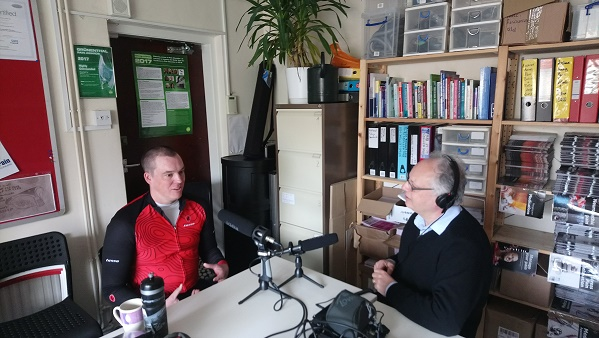
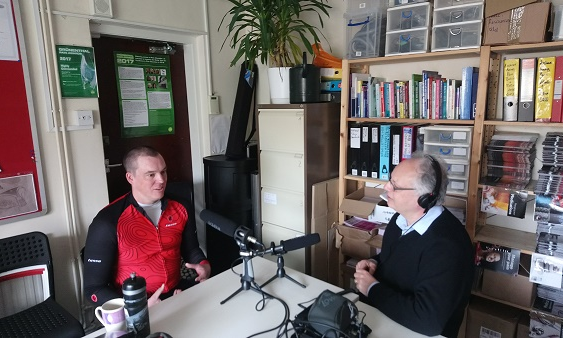
Now I want to introduce you to Ade. He has severe chronic pain following a spinal injury ten years ago. He lives with constant back and leg pain and, although he can walk, it was obvious when he came into Pain Concern’s office, that it is with extreme pain. So, unable to work, he is now a stay at home dad to his eight-year-old daughter. Another thing that’s worth mentioning in passing when he called into Pain Concern’s office  he was dressed in full cycling kit!

Adrian Hart: I’d had my fourth surgery and I saw the neurosurgeons who’d done the surgery and I was repeatedly asking them what can they do now what the next steps are. It wasn’t quite as bluntly put but a more or less said I’m really sorry there’s nothing more I can do for you, however we have a multidisciplinary team who I can discuss your case with and we can see what happens.  From there I was referred to pain consultants who reviewed my medication and reviewed my situation and said that because I tried so many different medications there was no other options that they had for me. This was something that’s I was just going to have to live with probably for the rest of my life, that’s when it really hit home I remember saying to the pain consultant well I’m not going to give up, you know I’m gonna keep hope that you know even in the future somebody will come up with a solution to take the pain away and I think in the end ended up doing that as best I could for myself rather than relying on more medication or more treatment.  I think it was shortly after that that I was referred to the 12-week pain management programme at the Astley Ainslie Hospital where they taught me more about managing the pain.  I think the course was a turning point in terms of me realizing that I’ve got to find my own ways and that was a very good starting point in finding my own ways to manage my own pain.

Paul Evans: Let me just go back a bit the Astley Ainslie that you mentioned that’s a hospital in Edinburgh?

Adrian Hart: Yes that’s right, they have a very good unit which deals with head injuries and the staff that work in the pain management program are actually working in the same unit as the people that work with people that suffered head injuries. I guess it’s almost works hand in hand in a lot of ways, you’re the rehabilitation of head injuries in terms of psychological hurdles to get over.

Paul Evans: I guess its teaching people to live with their condition

Adrian Hart: Yes they did a really good job, there’s a lot of the techniques that we’ve talked about in previous episodes of the podcast about you know pacing and using meditative techniques, and that kind of thing to find ways to almost distract yourself.

Paul Evans: How were you referred in the first place the pain management program?

Adrian Hart: I had been to see the pain consultant and went back to my GP a few days later to actually discuss antidepressants, he then said we could talk about that another time but in the meantime I want to refer you on to the pain management course because I’ve heard really good things about it and I think you’re a prime candidate.

Paul Evans: Why did you think that antidepressants were the answer?

Adrian Hart: It wasn’t so much pain related, I think it was just because the way I was feeling at that time I didn’t think I could get myself into a position where I was going to be able to try and find some kind of normality because of the really low moods and being quite uncommunicative with my family and things, and I found that the side effects were actually worse than the pain that I was trying to treat, so my wife said you need to go back and ask your GP for something else because you barely spoken to me for four days.

Paul Evans: It’s interesting that your wife was saying this isn’t working for you, the support of a partner is very important.

Adrian Hart: Oh yeah much so, being a very lucky in that respect that not just my wife but my whole family are very supportive, being a stay-at-home dad you know if I’m having a flare-up or something like that and I physically can’t look after my daughter whatever, then I can always phone somebody, and if I’m feeling low or you know there’s always people that I can phone and family is fantastic for that, and my wife is amazing, she goes to work five days a week often works late and still comes home, and I have not done the dishes or cleaned up or whatever and not cooked dinner because I’m struggling that day or whatever, and she still comes home and cooks and cleans and yeah she’s amazing.

Paul Evans: OK so your GP very forward-thinking sent you into a pain management program, you know just explain to me what a pain management program is?

Adrian Hart: It was 12 weeks of half-day sessions which was a mixture of education about what pain is, the actual physical reactions that happen in your body which cause pain, or your mind and the triggers can either cause pain or influence how much pain you feel, and there was education on how to manage pain using various techniques, such as meditation, pacing, mindfulness and basic stretching techniques, and then there was a lot of kind of discussion about how to manage your life on a day to day basis, you know simple tasks such as you know doing the washing up or cooking a meal or cleaning the house, or day to day things which everyone takes for granted, but when you’re living with pain you can’t do day-to-day tasks in one go, so things like breaking up doing the washing up into 15-minute segments and do a little bit go and lie down and watch a bit of telly, listen to the radio and then go back, and you know do some more just little things like that which almost sound too obvious but it makes such a huge difference in how we live our lives and when you’re dealing with pain.

Paul Evans: But you have an eight-year-old daughter I mean sometimes kids don’t follow the rules

Adrian Hart: No, I don’t even know if there are any rules to be honest, but yeah my daughter is more perceptive I think than I realize possibly because she’s almost grown up with it, now you know it’s always been there for her you know, dad’s always you know walks with a stick or needs a mobility scooter or whatever you know, so for her it’s that just who I am as part of my identity, she’s good it at understanding that if I need a rest, I need a rest and I’ve regularly find myself lying on the living room floor doing a jigsaw with an ice pack on my back. and so you find ways to manage it.

Paul Evans: One thing about chronic pain and other long-term conditions is that it’s not visible you’ve come in in full cycling kit, how am I supposed to work out that you have chronic pain if you can cycle like that

Adrian Hart: That’s a good question actually that is something that I worry about.  I worry that people make the assumption that I’m doing some kind of benefit scam or I’m just kind of whinging about having a sore back, or a sore leg, or whatever. I do get nervous especially when I meet people when I’m a cyclist and it’s like well you don’t look ill, just because somebody is able to do an activity or sport that keeps them physically fit it doesn’t mean that they’re not ill or they don’t live with pain.

Paul Evans: he can’t be in pain because he rides a bike, let’s put this into perspective, you’re not just wearing cycle clips with a basket on the front the bike this is the proper job, the road cycling job so how do you equate that with your illness?

Adrian Hart: The whole using cycling to manage pain.  I almost discovered it by accident it came about as a way of getting myself out of the house and going to the GP, or round the park with my daughter it was a way that I could take control of the situation, and for a while I was almost house bound because I was waiting for a Motability car, the car that we had I couldn’t drive because the seating position was too low, nearest bus stop was too far away for me to walk to, so I dug my old bike out the garage and I discovered almost by accident that actually after I’ve been for a bike ride the pain levels would wouldn’t go away, but were a lot less can kind of decreased for two or three hours afterwards, so once I realized this I thought well if the more I cycle the less I’m gonna be in pain, so I then started riding for longer and longer periods at a time. until I was going out all day, riding a hundred miles, and once you find something that helps you ease the pain you can latch on to it you know it was doing more than the pain medication.

Paul Evans: You see when you told me this originally I thought all right it’s a disc injury in the back obviously, he’s sitting down in the injuries below like so there’s no pressure on it, such a purely physical thing, but what your saying is that it’s a mental thing as well?

Adrian Hart: Yeah it seems to be a mixture of the actual physical movement, the kind of rocking the pelvis when you are cycling is quite a gentle movement, and that seems to be really good for easing the back pain.

Paul Evans: So there is a physical element?

Adrian Hart:  There is a physical element, and also it strengthens your core muscles, which adds more support to the lower back. The mental side is an interesting one, I heard an expression about being in the zone where your mind is being distracted in such a way that you’re not really aware of what’s going on in your own body. I’ve heard professional sports people talk about where you’re so focused on what you’re doing that’s you’re unaware of the fact that your legs are burning or you’re physically exhausted, or whatever, so when I’m cycling I’m concentrating on other vehicles on the road, other road users, and thinking about the route that I’m taking, where I need to turn, I need to eat you know every twenty to thirty minutes, otherwise I’m gonna run out of energy, where is the next good coffee shop, and there’s so much going on in my mind that I forget that the pains there, and it always feels like the pain is gone, but it hasn’t really, I’m just not thinking about it.   It reminds me of one of the techniques that we were talking about at the pain management programme, and you mentioned visualization and meditation, it’s another way of distracting yourself so you’re not thinking about the pain, and cycling is you know it takes up quite a lot of your brain.

Paul Evans: All your senses are involved?

Adrian Hart: Yeah absolutely but also it’s almost like you are swapping one pain for another, when you come to a really steep hill, it goes on right to the you know, off into the distance you know, uh you know and your breathing becomes something that occupies your brain or the you know the burning muscles and sometimes just plain exhaustion, but then that’s just something else that distracts you from the pain.  What was a really big surprise to me was the fact that if I go out and cycle a hundred miles I can then have one or two days where the pain levels almost disappear.

Paul Evans: Well that’s interesting because my next question was going to be the after-effects?

Adrian Hart: Yeah it’s something that I’ve never been able to work out, and I don’t know if it’s to do with brain chemicals or the physiological effects, so if I had a busy few days and feel the pain levels going up and up, and then I go out and do a long cycle it kind of nullifies the effects of having done too much activity or different kinds of activities for the previous few days, because of that I try and cycle as much as I can, pain medication only does half the job and I tried increasing the amount of pain medication that I take to the point where I almost overdosed myself, when you get to the point where the side effects become worse than the actual pain itself, but the pain isn’t going away well what do I do if I can reduce my pain medication by cycling every day, and that’s you know that’s a huge bonus and I’m doing what I love it’s great.

Paul Evans: Now starting on the 30th of April 2018 of course that may well be in the past depending when you’re listening to this, Ade took up a personal challenge to help others share in the substantial benefits he gets from cycling, and the good news is that you don’t even have to have a bike or even leave the comfort of your armchair to share in those benefits, he’s donating the charitable proceeds of a mammoth bicycle ride to us in Pain Concern to carry on supporting people like himself and me for that matter who live with chronic pain, check out his website it’s 21 that’s the numbers not the words 21 days of pain.org.uk no gaps 21 days of pain.org.uk and this is what it’s all about.

Adrian Hart: The aim is to cycle 60 miles every day for 21 consecutive days, so that’s about 1,300 miles in three weeks. I realized the other day that before this – two days before I’m scheduled to start I’ve signed up for an event where I’ll be cycling 300 kilometers, which is 180 miles in one day, and then a week after finished the 21 days, I’ll be cycling 600 miles in three days. so I’m gonna be pretty tired I think after that.

Paul Evans: Going back a little bit to what we talked about it earlier somebody who can do that and maintain they have a chronic pain condition. that must be very difficult?

Adrian Hart: It is, and it’s something that I think a lot of people will probably have difficulty to get their ahead around, especially when the benefits that I receive are based on the fact that I can’t walk properly, but that’s physically two different things, and cycling is completely different motion, your legs are kind of going up and down, whereas walking legs are going forwards and back, and because of the nerve damage in my legs every step I take is stretching damaged nerves which is extremely painful. It’s almost like their damaged nerves are being dragged through rough scar tissue which i think the kind of mental picture is bad enough, but it it’s a difficult thing to prove especially with pain being invisible, but when you have to spend you know several hours a day lying down just to relieve the pain that builds up on a daily basis, that’s what people don’t see the fact that I have to lie down and rotate heat packs and ice packs every 20 minutes to bring inflammation down after of been out for a dinner or whatever.

Paul Evans: Now of course not everyone will be able to cycle 60 miles six miles or even six feet in one go, or even at all to be honest so as always I want to remind you that whilst we at Pain concern believe the information and opinions on Airing Pain are accurate and sound based on the best judgments available you should always consult your health professional on any matter relating to your health and well-being he or she is the only person who knows you and your circumstances and therefore the appropriate action to take on your behalf and don’t forget that you can download all editions airing pain from pain concerns website and YouTube as well I’ll give the last words of this edition of Airing Pain to Ade and don’t forget this website it’s 21 days of pain.org.uk.

Adrian Hart: The big reason why I’m doing this challenge is, it’s not just a fundraising thing this is a way of showing people that by doing something physical you can manage your own pain, you don’t need to ride 60 miles a day, just going out and finding something that you can do which doesn’t aggravate your condition can be enough to relieve your own pain, and doing something that you can do yourself without relying on doctors or medical professionals.

Paul Evans: It can be as simple as opening a window and listening to a birdsong, anything that makes you feel good will help, and it’s learning what those things are that maybe the pain management program taught you.

Adrian Hart: That’s a really good point actually, it’s for me because it’s a physical activity that’s what helps me, but yeah whatever you enjoy, listening to music or playing music can be enough to distract yourself,  just finds something that releases that chemical in your brain which takes the pain or even just for half an hour it’s a great thing


Contributors:

  • Dr Gregg Clarke: Clinical Psychologist specialising in Chronic Pain, Neurorehabilitation and Sport Psychology
  • Ade: Cyclist and Pain Concern supporter, living with chronic pain.

Peer Support. Join the community

“Having chronic pain is very lonely.”

Join the community

Subscribe to Pain Matters

Everything you need to know about how to live with chronic pain

Subscribe


In pain? Don’t understand what’s happening?

“Having someone to help you prepare for your life through pain”

Our Pain Education Sessions

Fundraise for Pain Concern

Help us to help others

Fundraise


Exploring what can be done for high-level athletes in the context of chronic pain, and how one man with a spinal injury found himself “in the zone” through cycling

This edition is funded by a grant from the Stafford Trust.

For top-level athletes, chronic pain can very quickly end careers. What preparations can be done to combat pain, and how important is patient engagement in rehabilitation? In this edition of Airing Pain, Paul speaks to chronic pain psychologist Dr Greg Clarke about how acute pain can turn chronic in the context of sport, and how the resilience of young athletes can sometimes be a hindrance.

Ten years ago, Ade suffered a debilitating spinal injury. Four operations later, he was told by a surgeon that there was nothing they could do. Paul talks to Ade about his decision to attend a pain management programme to educate himself about his pain, and how cycling helped him take control of his situation.

Ade has also set up a fund raising campaign, the 21 Days of Pain, to raise money for Pain Concern. He plans to cycle 100km every day for 21 days (2,100km!). You can find his website and read about his story here: http://21daysofpain.org.uk/.

Issues covered in this programme include: Activity-rest cycle, antidepressants, back pain, exercise, fundraising, meditation, pacing, physiotherapy, psychological approaches to pain, rehabilitation, spinal injury, sports injury, employment, visualization and young people.


Contributors:

  • Dr Gregg Clarke, Clinical Psychologist specialising in Chronic Pain, Neurorehabilitation and Sport Psychology
  • Ade, Cyclist and Pain Concern supporter, living with chronic pain.

Ade and Paul Evans

Peer Support. Join the community

“Having chronic pain is very lonely.”

Join the community

Subscribe to Pain Matters

Everything you need to know about how to live with chronic pain

Subscribe


In pain? Don’t understand what’s happening?

“Having someone to help you prepare for your life through pain”

Our Pain Education Sessions

Fundraise for Pain Concern

Help us to help others

Fundraise


Dinah Milsom, poet and supporter of Pain Concern, has written a poem expressing her experiences with pain.

She asked us to post this on our website so other people in pain may read it.

 Pain

 The light glows
 The heart knows
 This pain endures
 And so I make a life within how it can be
 And see
 A bigger world

 Dinah Milsom, 2018 

Peer Support. Join the community

“Having chronic pain is very lonely.”

Join the community

Subscribe to Pain Matters

Everything you need to know about how to live with chronic pain

Subscribe


In pain? Don’t understand what’s happening?

“Having someone to help you prepare for your life through pain”

Our Pain Education Sessions

Fundraise for Pain Concern

Help us to help others

Fundraise


How cancer survivors can experience post-operative pain, and confronting the national issue of post-cancer treatment

This edition is funded by The Agnes Hunter Trust.

An ever-increasing cancer survivor rate means chronic pain associated with the condition and its treatment is growing. In the UK alone, cancer survivor rates have doubled in the last 40 years, from 24% to 50%.[1]

In this edition of Airing Pain, Paul Evans speaks to Dr Paul Farquhar-Smith, consultant in anaesthesia and pain medicine at The Royal Marsden Hospital in London, and co-author of Pain in Cancer Survivors; filling in the gaps.

Dr Farquhar-Smith explains how post-surgical pain in cancer survivors can be caused by damage to the nervous system, what cancer treatments may be associated with this pain, and what pre-surgery steps can be taken to reduce it.

Issues covered in this programme include: Availability of pain services, cancer, chemotherapy, educating healthcare professionals, funding of pain services, gabapentin and pregabalin, gastro-intestinal tract, GP, head surgery, lung surgery, medication, neck surgery, nervous system, neuropathic pain, physiotherapy, policy, post-surgical pain, psychology, radiotherapy, risk factors, thoracotomy and transitional patients.


Contributors:

  • Dr Paul Farquhar-Smith, Consultant in Anaesthersia at the Royal Marsden Hospital London, and co-author, with Dr Mathew Brown, of Pain in Cancer Survivors; filling in the gaps.

More information:


[1] http://www.cancerresearchuk.org/health-professional/cancer-statistics/survival.

Peer Support. Join the community

“Having chronic pain is very lonely.”

Join the community

Subscribe to Pain Matters

Everything you need to know about how to live with chronic pain

Subscribe


In pain? Don’t understand what’s happening?

“Having someone to help you prepare for your life through pain”

Our Pain Education Sessions

Fundraise for Pain Concern

Help us to help others

Fundraise


Anxiety and expectations, how “fear circuitry” affects self-management, and the importance of social prescribing

To listen to this programme, please click here.

This edition is funded by The Agnes Hunter Trust.

An ever-increasing cancer survivor rate means chronic pain associated with the condition and its treatment is growing. In the UK alone, cancer survivor rates have doubled in the last 40 years, from 24 percent to 50 percent.[1]

In this edition of Airing Pain, Paul Evans speaks to Dr Paul Farquhar-Smith, consultant in anaesthesia and pain medicine at The Royal Marsden Hospital in London, and co-author of Pain in Cancer Survivors; filling in the gaps.

Dr Farquhar-Smith explains how post-surgical pain in cancer survivors can be caused by damage to the nervous system, what cancer treatments may be associated with this pain, and what pre-surgery steps can be taken to reduce it.

Issues covered in this programme include: Availability of pain services, cancer, chemotherapy, educating healthcare professionals, funding of pain services, gabapentin and pregabalin, gastro-intestinal tract, GP, head surgery, lung surgery, medication, neck surgery, nervous system, neuropathic pain, physiotherapy, policy, post-surgical pain, psychology, radiotherapy, risk factors, thoracotomy and transitional patients.

Paul Evans: This is Airing Pain, a programme brought to you by Pain Concern, the UK charity providing information and support for those of us living with pain, and for health care professionals. I’m Paul Evans, and this edition’s been funded by the Agnes Hunter Trust.

Paul Farrquahar-Smith: What people quite often think is, because they had pain when they had the cancer, they now have pain after surgery: that must mean I’ve got the cancer come back. Now, in most cases we do not need to have the cancer coming back to explain this pain. The teams will investigate as they see fit, and they will decide whether or not, oncologically, there’s an issue. But I say: look, it doesn’t have to be an oncological issue. Ninety-nine times out of 100 these sorts of pains are not from recurrence. Going through and explaining what it is and what it is not, people say, ‘thank you for that, because I didn’t know.’

And people are saying to me, ‘how can you have pain two years after surgery? You should be back on your feet, back to work, and everything should be rosy.’ What we do though is [that when] you look at people who’ve had head and neck surgery – had major neck dissection after head and neck surgery – two years after, 75 percent of people have not gone back to work, because of symptoms from many things, including pain.

Evans: One of the consequences of our ever-increasing cancer survival rate is that the number of people who experience long-term pain as a result of the cancer or its treatment is growing. A recent review, ‘Pain in Cancer Survivors – Filling in the Gaps’ by doctors Paul Farrquahar-Smith and Matthew Brown states that, clearly, cancer treatments – new and established – can be associated with a significant long-term pain burden, and that time and resources must be invested into understanding and consequently treating what is a growing pain epidemic.

Dr Paul Farrquahar-Smith, one of the authors of that report, is a consultant in anesthesia and pain medicine at the UK’s leading tertiary cancer centre, the Royal Marsden Hospital in London. He treats both in-patients and out-patients, where he sees, predominantly, cancer survivors who live with long-term pain.

Now, this might be a silly question, but rather naively I would have thought that the word ‘survivor’ in this context is someone who’s had cancer, been treated successfully, and is therefore better. So how does he define survivor?

Farrquahar-Smith: Well, our working definition is that [a survivor is] anybody who’s been diagnosed with cancer and is still alive. Now, that pools in a number of different populations: those who are actively going through current treatment; those who have recently stopped treatment, and those who maybe had treatment years ago, and yet are still having issues with some of the symptoms from the treatments, or other things.

Evans: The word survivor conjures up a very small number of people who survive with disaster. Cancer isn’t a disaster anymore.

Farrquahar-Smith: Yeah, there’s been discussion about the use of the term ‘cancer survivor’ and whether or not it has negative connotations because of the use of survivorship. I think it sort of works to a degree, but that doesn’t mean we should allow it to carry on – maybe if there’s a better term somebody can come with, then great. But, for me, I think people do like the fact that they have survived; they have vanquished something; they have succeeded. Although we’ve got to be careful not to say that people who don’t survive are failures or – what do people say? – ‘you’ve lost your battle.’ It’s not about battles, it’s about surviving the best we can. And I think, at the moment, it does encompass the group of patients we see, and most people do refer to themselves as a survivor – as I’ve said, with that caveat that there probably are better terms if we thought about it. But it’s still commonly accepted as being the term to use.

Evans: But the title of your research paper, ‘Pain in Cancer Survivors’ – survivor doesn’t mean that the treatment is over?

Farrquahar-Smith: No, not necessarily. Again, it does depend on what definition you look at. But the working definition is that anybody who’s been diagnosed with cancer and is still alive, to me, is a survivor. And also it reflects that we do see people at different stages in their cancer journey; it doesn’t mean that we’re only dealing with people who’ve ad their treatment and are now in remission or cured. No. Although that is a group of patients that we see, we include everybody else in that because we treat those people. For example, if people with procedure pain – acute pain that they have [which is] associated with the treatments they have, which are surgery, chemotherapy and radiotherapy.

Evans: Well, I was going to ask you: what are the causes? One might assume that following treatment for cancer – successful treatment for cancer – one might assume that there would be no pain there. So what does cause that?

Farrquahar-Smith: The main avenues of treatment are surgical, radiotherapy and chemotherapy. Now, each of those treatments have symptoms. The one we see a lot of is post- or after-surgery persistent pain. Now this is a very strange concept to people who don’t know – and even to some practitioners – because this is where pain persists, even though the surgery may be healed and, to all intents and purposes, done and dusted.

However, there is a significant proportion of patients who get significant pain after their surgery for reason that aren’t apparent if you don’t know them. And they are what happens to the underlying nervous system. Damage to the nervous system somehow creates a situation where it maintains the pain itself without having to have the damage to maintain it. So this is this persistent post-surgical pain that you can get after any sort of surgery – not just surgery after cancer, but any sort of surgery – and it’s a very common problem nationally. We see that a lot especially after breast surgery, especially after head and neck surgery, especially after thoracotomy, which is cutting the chest for certain procedures: some lung procedures and some gastro-intestinal tract tumour procedures.

Evans: Just explain what’s going on there – the affected part has been removed, and the cancer hs been removed, if you like, but the pain – or a different sort of pain – persists?

Farrquahar-Smith: Yeah, so what happens is people get an acute pain, a pain around the time of surgery, which we understand, we know we can do things about, and is generally pretty well done. What happens is, because of a change in the nervous system, the pain sensing system gets set up so normally when pain is caused it’s caused by tissue damage. But then this pain takes over and the pain is the problem in itself, and it’s not caused by tissue damage – although that would originally have been set up, we think, by damage to nerves you can’t see at the time of surgery. So it’s like, the collateral damage is unavoidable to get rid of the tumour, but then that sets up changes in the nervous system that then causes this pain that can carry on without any external influence.

And this is this persistent post-surgical pain which is very problematic and difficult conceptually, because people say, ‘look, how can I have pain when everything’s healed up and everything’s gone?’ And this is this change in the nervous system that is set up that then causes the maintenance and perpetuation of the pain.

Evans: So is that what they call neuropathic pain?

Farrquahar-Smith: It is thought to be a type of neuropathic pain. So neuropathic pain just says that it’s pain probably from damage or a problem with the nervous system. That’s quite a broad spectrum. But this pain is thought to be one of the sub-types, if you like, of neuropathic pain – or predominantly neuropathic.

Now, without getting too complicated, there are definitely some patients with this persistent post-surgical pain that don’t seem to have very many neuropathic elements – the pain doesn’t sound, isn’t described in the ways neuropathic pain normally is. However, we do think that predominantly it is neuropathic-y, or neuropathic-like in certain cases, and therefore the current treatments do tend to be based around our current treatments for neuropathic pain.

Evans: Which are?

Farrquahar-Smith: Well, there’s many. There’s the non-pharmacological: supportive care is also very important; psychology, physiotherapy; all these are very important things. We tend to also sort of use pharmacology and then the pharmacological ways of addressing neuropathic pain, which are many different types of drug, which include those medicines which were previously known as anti-depressants and anti-convulsants. Now these are a bit of a misnomer, because these medications are not being given or depression nor are they being given for epilepsy. However, the mechanism that they work or used to work – or drugs like them used to work – for depression and epilepsy are the same mechanisms that are important to try and reduce the pain in neuropathic pain. But it is a misnomer and they probably shouldn’t be called that; but that’s how they’re commonly known.

Evans: The best way I’ve heard them described is [that] they calm down the nervous system; is that right?

Farrquahar-Smith: Again, without getting too technical, the anti-depressants are thought to reduce this pathway which is the descending excitation. So the way the pain goes from the periphery into the spinal cord into the brain, it has several points at which that pain signal is modulatable. And one of the modulations comes from the brain: so the brain has these descending pathways, both excitatory – i.e. switching on – and inhibitory pathways – switching off. What the anti-depressants do is affect those descending pathways. One way of doing that is reducing the descending excitation and the other way is increasing the descending inhibition. And it’s thought that it does a combination of these things.

The anti-convulsants tend to have a slightly mechanistic way of operating, in that the ones that are most commonly used, which are the gabapentinoids, which are gabapentin and pregabalin, they act by reducing the activity at the level of the spinal cord. So they directly reduce that transmission, if you like, the electrical signal, by reducing the effect of the normal transmitters on the normal system. So it calms the system down. Now, that’s how we think it works but there are other things that can be useful.

With these medications are secondary effects. For example, with pregabalin, it has an effect on anxiety and therefore – again, not saying that the pain is from the anxiety per se – but we do know the psychological effect of pain is very important, and we can’t treat the pain in isolation. So if you’re also getting somebody who’s got anxiety issues as well as pain then you can get a secondary effect from the pregabalin, for example.

Evans: Now, the gabapentinoids, if they reduce anxiety – and I’m thinking of things like amitriptyline, which is an anti-depressant – I know from experience [that] one of the great effects, so far as I’m concerned, is sleep.

Farrquahar-Smith: The anti-depressants, and specifically meaning medicines such as amitriptyline and nortriptyline, which is a close cousin of amitriptyline – those effects on the neuropathic pain are independent of the effects on depression. There’s no evidence that, at the doses they use for neuropathic pain, they have any effect on depression.

However, there is a suggestion that they do have a beneficial effect on sleep. The only problem with that – with the amitriptyline and nortriptyline – is that it doesn’t seem to improve the quality of sleep. It may be, say, that people are sleeping longer, but if you look at the quality indicators of sleep like REM sleep, etc., it’s not necessarily that good. So it is a slight issue with that, and with the use of them just to try and help sleep. Now, is some low-quality sleep better than no high-quality sleep? I don’t know, but it just has to be borne in mind that it’s, you know, they’re not perfect. But, again, when we use these medications, the anti-depressant medications, we’re using them primarily for the anti-neuropathic pain effect.

Now, we have got millions of years of conditioning to say, ‘pain means damage.’ Because that’s originally what it was there for. What we’ve had a growing awareness and understanding of in the past 15-20 years is that we don’t need a cause for pain. Sometimes the pain is in the primary sensing system itself. And actually the new ICD [International Classification of Diseases] classification codes have taken that into consideration. Before it was always, ‘pain is secondary to something else: pain caused by this; pain caused by that.’ Now you can have a diagnosis of pain without any need for secondary consideration. So why have you got chronic pain? ‘Because I’ve got chronic pain. My chronic pain is the problem. My chronic pain is the fact that there’s an issue with my primary sensing system, and that has gone off kilter.’ And that is why you have chronic pain.

Now, that’s not for all chronic pains, but it accepts that there is an entity where pain is the issue. And that goes back to people saying, ‘my pain is worrisome and serious because I think it’s indicative of damage processes going on.’ Now, in many chronic or persistent pains there is no damage process going on. For example, if you do MRI scans on 100 people, you will find a significant number of people wit degenerative disease. You can do that on a hundred people who have no pain and you will find the same number. Just because you’ve got somebody with pain, you do an MRI scan and say, ‘Ah! You’ve got a degenerative disease: that’s why you’ve got pain’ – that correlation is very, very tenuous and not really there, because you don’t need it to be there.

When I see people and you look at their MRI and think, ‘that looks horrible, you know, everything’s falling apart,’ and [yet] they have no pain. And see others where the damage may be trivial and they’ve got intractable, serious, very difficult pain to treat. So this cause and effect isn’t clear for persistent pain.

Now this slightly – persistent pain and chronic pain, there are lots of different types, and that does change slightly depending on what you think the cause is: is the cause actually persistent pain or is there – for example, in this hospital – is it because you’ve got a tumour growing into your spine that is very clearly affecting the nerve and very clearly causing the problem? But even in our patients here you will see scans where you think, ‘that’s just terrible, they must have huge amounts of pain,’ and they don’t; and other people where you think those changes are modest and [yet they] have huge amounts of pain.

Pain is not always discernable by scans. And this is one of the things patients always say – ‘people don’t believe I’ve got pain, or don’t understand how I could have pain, because I’ve been treated. I had my surgery two years ago; how can I have any pain after that?’ And this is all part of that persistent, post-surgical pain that is set up and causes pain without any obvious reasons for it apart from what we know, and we have quite a lot of science background now to understand some of the mechanisms that are going on to cause this pain.

Evans: Well, on that subject: who is at risk?

Farrquahar-Smith: There are risk factors that are associated with these persistent post-surgical pains, and, again, I know we’re concentrating on surgery, but we mustn’t forget the chemotherapy, which, again, is our area of specialty in this hospital, and also, to a lesser degree but also important, radiotherapy.

But, to go back to people who are at risk: depending on the surgery there are different risk factors. So these are people who, if you have these risk factors, you’re more likely to then develop this persistent pain. One of the things is if you have pain at the time of surgery – so that’s quite interesting because that’s something we can do something about. If we can reduce the pain around the time of surgery we can reduce the likelihood that that pain will then generate into the persistent pain.

Other factors that are, again, slightly different depending on the type of surgery people have are age and female sex or male sex – again, depending on the type of surgery – and also things like anxiety and depression around the time of surgery. Also chemotherapy is a risk factor; having surgery as well as chemotherapy, that’s a risk factor. And there are several other, less important risk factors. But we can, to some degree, predict those people who are [at] higher risk of developing this persistent post-surgical pain. And some centres – and we’re doing it to a degree – to try and single out and make sure we follow-up these patients.

We also follow-up every single patient that has been treated with pain relief medicine to, sort of, make sure they’re not lost to the system – they don’t get put on pain relief medicine in perpetuity. So we see these so-called transitional patients to make sure somebody follows them up after their surgery when we know they’ve had some kind of persistent pain, and see whether or not that pain will continue after a three-month point. Three months is arbitrary – people can get pain from surgery all the way up to three months – but it just shows that we know that there is a proportion of patients that will have pain, and that will dissipate to that three-month period. And then there is a subset [where pain] will persist more than three months. And then they can persist for any length of time.

Evans: So for people who have that pain before surgery, do you have the time and space, if you like, to treat that pain with all the psychological therapies and whatever?

Farrquahar-Smith: Yeah, it is challenging, but I think we are lucky enough to have the resources to do that, and we’re lucky enough that hopefully it gets flagged up and we can do it. Now, it’s not clear whether the pre-operative pain is a risk factor; if you treat it then it becomes less of a [factor]. What are the factors that are responsible for having that pre-operative pain, then also the factors that will make a higher risk of developing the persistent pain? It’s difficult to know. It’s not been clearly shown that if you treat the pain pre-operatively it actively helps; that doesn’t mean we shouldn’t; doesn’t mean people won’t get [a] benefit from that, because we’re hopefully reducing their pain burden before they have to go through their operation.

And there’s the psychology – again, we try and access that when we can. Now, obviously we won’t see everybody in enough time before they have their surgery because of the nature of cancer surgery being, sort of, fairly quick. But we do try and flag up anybody who has pain issues beforehand to then deal with them in the perioperative period – i.e. around the time of the surgery – and then if there’s any issues to follow up with them afterwards.

Evans: In the post-surgery pain, how severe is it? What sort of pain are we really talking about?

Farrquahar-Smith: Well, again, the severity is difficult to measure and we use imperfect tools but ones that are reproducible and sort of have meaning, and that’s the numerical scoring. The numbers suggest that up to about 50 percent of patients can get some sort of chronic or persistent post-surgical pain, and about – again, slightly dependent on what papers you read, and what definitions you use – probably about ten percent will get a pain that is above five on that numerical rating score of 0-10. So that’s about ten percent – and that estimation may be conservative in some people’s eyes and excessive in other people’s eyes; it’s ballpark – that number of patients are getting severe (defined by over five on that 0-10 scale) pain persistently after surgery.

It’s usually in the area where you’ve had the surgery, although it can be, sort of, referred in some areas as well. It’s usually, again, mostly – but with that caveat I said that not everybody has neuropathic-type pain – that neuropathic-type pain which is said to be more bang for you buck; i.e. it seems to be more painful even at a given level and more intrusive and more interfering in everyday activities and quality of life. So they’re the features of the pain from this post-surgical aspect.

Evans: So, what long-term management do people with pain after cancer surgery or cancer treatment have? Is it a long-term thing?

Farrquahar-Smith: Yeah, well it usually is a long-term thing. Now, the natural history of how the pain goes is very difficult to piece together, but it does seem that over time things can improve; albeit [they] take a long time. The treatment is multi-disciplinary: you cannot treat pain is isolation, you have to look at all the psychology, the occupational therapy, and all theses sorts of things. Which, again, we do especially in chemotherapy-induced pain, which is a bit different from the surgical-induced pain; it is even more neuropathic, as you might expect, because the nerves are being damaged by the chemotherapy. So we have all of these allied, non-pharmacological things working on a sort of holistic basis, if you like, and dealing with daily living, quality of life, etc.

And then we also have pharmacology, so the medicines and tablets. And we use a lot of topological approaches, i.e. putting things directly where the pain is – and the idea is that you can concentrate the effect locally without risking the medicines being absorbed around the body and causing adverse effects.

Evans: That’s Dr Paul Farquhar-Smith, consultant in anesthesia and pain medicine at the Royal Marsden Hospital in London. As always, I want to remind you that whilst we in Pain Concern believe the information and opinions on Airing Pain are accurate and sound based on the best judgements available, you should always consult your health professional on any matter relating to your health and wellbeing. He or she is the only person who knows you and your circumstances and therefore the appropriate action to take on your behalf.

Don’t forget that you can download all editions of Airing Pain from Pain Concern’s website which is www.painconcern.org.uk , and there you’ll also find Pain Concern’s extensive resources to support living with chronic pain.

Well in this edition of Airing Pain we’re looking at issues surrounding persistent post-surgical pain. Here’s Dr Paul Farquhar-Smith to finish this edition of Airing Pain.

Farrquahar-Smith: Even though the awareness of this issue has increased over the years, and now people are much more understanding – indeed, on our consent forms it actually has persistent post-surgical pain as a risk of the surgery they’re having, so it’s acknowledging that this is a real entity. But people still don’t understand, and understandably don’t understand: how can you have pain when everything’s healed? And part of what we do and I think is beneficial – and we get feedback from the patients saying, ‘thank you for telling me that, because now I don’t feel alone, I have some idea of what’s going on’ – is explaining the concept of this post-surgical pain; what it is, and what it is not.

What people quite often think is, because they had pain when they had the cancer, they now have pain after surgery: that must mean I’ve got the cancer come back. Now, in most cases we do not need to have the cancer coming back to explain this pain. The teams will investigate as they see fit, and they will decide whether or not, oncologically, there’s an issue. But I say: look, it doesn’t have to be an oncological issue. Ninety-nine times out of 100 these sorts of pains are not from recurrence. Going through and explaining what it is and what it is not, people say, ‘thank you for that, because I didn’t know.’

And people are saying to me, ‘how can you have pain two years after surgery? You should be back on your feet, back to work, and everything should be rosy.’ What we do though is [that when] you look at people who’ve had head and neck surgery – had major neck dissection after head and neck surgery – two years after, 75 percent of people have not gone back to work, because of symptoms from many things, including pain.

Evans: I know I was speaking to a relative of mine a few months ago who had a throat cancer, and his wife, who is a health professional, was saying, ‘the procedure to get rid of the cancer was excellent; nobody warned us about the recovery after it.’

Farrquahar-Smith: I can’t comment, obviously, on that case, but I can say that that would be very unusual to happen in our establishment, because – as I said – already that consent [form] has that in in our surgeries. And people are aware of it, partly because I’ve been banging on about it for years, and people do understand it; they know that it’s an issue. So, hopefully, that would not happen in our hospital because we’d be aware of it and people are coached and counselled.

Now what it is not easy to quantify is the fact that at the time you’re having your surgery, you’ve been given your cancer diagnosis: your head is not really with it. And you can be told a whole ream of information that you do not recall. We have to understand, and it’s beholden on the practitioners to make sure at the most difficult time, when they [i.e. the patients] are not processing information in the way that they normally would because of the huge impact the diagnosis has had on them, that we make sure we get over to them: ‘look, surgery is one step; the journey is longer. We will support you through that journey, but it will be a long journey; it won’t be a few weeks after and you’re feeling back and rosy’ – although that’s what we’re aspiring to – but we have to be aware that for many people the journey will be longer. But as long as we can support and get people through it, and to some extent identify those people who are going to have an issue, then we can get onto it quicker and safer, and hopefully get people sorted out better.

But there is a definable issue that was highlighted by the government a few years ago, is that who is looking after these cancer survivors? Now I’m moving into the group that had been cured or in remission that aren’t really being seen regularly by the oncologist because there’s no need for it, because the cancer’s in remission, yet still have significant symptom burden. Who is looking after those patients? And we know that the cancer survivorship population is increasing, and increasing hugely, and will be many, many millions of patients in the next 10-15 years. So there’s a growing number of patients that we expect will have symptom burden for long-term after their treatments. And it’s not clearly who exactly is going to give them support.

Now, we obviously are doing our best, being a cancer specialist centre. However, that’s not going to be the case nation-wide. So where are these patients going to get support and benefit from? The government did write a paper about ten years ago that had a very nice way of dealing with it in the community, having that pyramid thing where you can self-refer; however, as far as I understand, there’s no clear structure where that can happen, or who can supply that, because it’s going to put a large burden on primary care. And unless we recognize that it is going to increase and have a plan going forward, it’s going to perhaps become more difficult to deal with.

Evans: So patients and their supporters and their family need to know about these concerns at the start of their cancer journey?

Farrquahar-Smith: Yeah, and I think – certainly in my experience – the information is much more widely out there, the patients are being coached a lot more about these long-term issues and how they can get support, and what things we can do about it. My role, if you like, in this establishment in the past 20 years has been doing that. And people with chemotherapy and radiotherapy, it’s not incurable. We can symptom control; we don’t do anything about the underlying nerve recovery, but we can try and help the symptoms until the nerves, maybe months, years down the line, start improving. And, again, in the past 20 years that’s improved exponentially.

So now we’re seeing nearly everybody who I think has these issues. Is that so well done in other hospitals? I can’t say, but given the education that we’ve had to do here – the things we’ve been doing both in publishing and in meetings and conferences – is try and highlight the problem. Not only to the public, but to practitioners. Many years ago I would get referrals saying, ‘this patient’s got pain, everything’s healed up after surgery, I don’t understand why.’ And you go, ‘well you should know why, because it’s persistent post-surgical pain.’ And now I don’t get those messages anymore; I get the referrals, saying: ‘I think this is post-surgical pain.’


Contributors:

  • Dr Paul Farquhar-Smith – Consultant in Anaesthersia at the Royal Marsden Hospital London, and co-author, with Dr Mathew Brown, of Pain in Cancer Survivors; filling in the gaps.

More information:


[1] http://www.cancerresearchuk.org/health-professional/cancer-statistics/survival.

Peer Support. Join the community

“Having chronic pain is very lonely.”

Join the community

Subscribe to Pain Matters

Everything you need to know about how to live with chronic pain

Subscribe


In pain? Don’t understand what’s happening?

“Having someone to help you prepare for your life through pain”

Our Pain Education Sessions

Fundraise for Pain Concern

Help us to help others

Fundraise


Investigators find adolescents with chronic pain may be more likely to experience alexithymia, a condition in which one lacks emotional self-awareness.

Article from Clinical Pain Advisor

Airing Pain 99: Transition Services for Adolescents with Chronic Pain

Peer Support. Join the community

“Having chronic pain is very lonely.”

Join the community

Subscribe to Pain Matters

Everything you need to know about how to live with chronic pain

Subscribe


In pain? Don’t understand what’s happening?

“Having someone to help you prepare for your life through pain”

Our Pain Education Sessions

Fundraise for Pain Concern

Help us to help others

Fundraise


Airing Pain’s centenary! In this landmark edition Paul Evans explores the origins of Airing Pain with founder Heather Wallace, and visits one of Pain Concern’s informative pain education sessions

In 2010, Airing Pain was conceived as a way for those with chronic pain, unable to leave their homes and attend support meetings, to easily access vital resources.

Heather knew that this undertaking would require a skilled and experienced producer, so she reached out to Paul Evans. In this edition Paul reminisces about the first phone call they had together, his eye-opening experience of realising just how large the pool of knowledge on pain was, and how the pain education sessions came to be.

Paul then heads to Eastwood in the south of Glasgow to sit in on one of our sessions. He speaks to both pain education trainers and participants about their experiences how their relationship with pain has changed as a result.

Issues covered in this programme include: chronic fatigue, chronic primary pain, educating healthcare professionals, endometriosis, flare-up, insomnia, neck pain, pace, pacing, pelvic pain, psychological effects of pain, radio programme, rehabilitation programme, science of pain, sleep, stiffness, support group and workshops.


Contributors:

  • Heather Wallace, Founder of Pain Concern
  • Angela O’Neil, Pain Education Session Trainer Volunteer for NHS and Pain Concern
  • Georgina McDonald, Pain Education Session Trainer Volunteer
  • Britney, Pain Education Session Attendee
  • Claire Mitchell, Clinical Health Psychology Student at Strathclyde University and Pain Education Session Trainer Volunteer
  • Esther McFarlane, Pain Education Session Attendee and Ex Pain Management Nurse
  • Lyn Watson, Clinical Nurse Specialist in Pain Management Programme for NHS Greater Glasgow and Clyde.

More information:

Peer Support. Join the community

“Having chronic pain is very lonely.”

Join the community

Subscribe to Pain Matters

Everything you need to know about how to live with chronic pain

Subscribe


In pain? Don’t understand what’s happening?

“Having someone to help you prepare for your life through pain”

Our Pain Education Sessions

Fundraise for Pain Concern

Help us to help others

Fundraise


In this 100th edition of Airing Pain, Paul Evans speaks to Heather Wallace, creator and driving force behind the Airing Pain radio programmes, who discusses the inspiration that led to the programme and its continued importance for Pain Concern and the chronic pain community

To listen to this programme, please click here.

Paul also attends a Glasgow Pain Education Session and meets Angela O’Neil and Georgina McDonald, two Pain Education Session Trainer Volunteers, as well as a number of attendees to the Pain Education Sessions, and finds how regular, community-based education sessions can help sufferers of chronic pain deal with pacing and self-management.

Lyn Watson, a Clinical Nurse Specialist in Pain Management Programmes for NHS Greater Glasgow and Clyde, discusses the role healthcare professionals can play in encouraging chronic pain sufferers to attend community education sessions like the ones in Glasgow.

Claire Mitchell, a Clinical Health Psychology Student at Strathclyde University, and a Pain Education Session Trainer Volunteer, explains how time management and good sleep practice has helped with her own chronic pain.

Issues covered in this programme include: Chronic fatigue, chronic primary pain, educating healthcare professionals, endometriosis, flare-up, insomnia, neck pain, pace, pacing, pelvic pain, psychological effects of pain, radio programme, rehabilitation programme, science of pain, sleep, stiffness, support group and workshops.

Paul Evans: This is Airing Pain, a programme brought to you by Pain Concern, the UK charity providing information and support for those of us living with pain, and for health care professionals. I’m Paul Evans, and this is a special edition – a landmark edition of Airing Pain because we’ve reached our century. Yes, this is the 100th programme since it was launched way back in 2010!

And like everything that’s been achieved over the years by Pain Concern, it owes its success to a brainwave, but also the dogged persistence, conviction and the tireless, selfless hard work of Heather Wallace.

Heather Wallace: Pain Concern started as a support group for people who had done a 12-week pain management rehabilitation programme. The people knew how to manage their pain, what they had to do in their lives – the changes they had to make – to manage their pain well. And we were asked to run a support group to help them maintain these skills and keep them motivated.

And we very quickly realised that it was very hard for people to get to support group meetings when they were dealing with pain. Either they were housebound with their pain or if they were trying to go to work they were coming home so tired that they had no energy to go out yet again to a support group. So one of the things that led us to think about doing a radio programme was, ‘how do we make it easier for people to get to support, given that so few were managing to make the support group meetings?’ Although the feedback we got from them was, ‘please, do it!’

And then it got the point that people were asking us to record the meetings because they couldn’t come to them. So at that point we started to think that maybe, if we used media, we could reach more people. And we won first prize in the NAPS awards for chronic pain for the concept of a radio programme – and that allowed us to start to look for a professional producer who could help us do that, and introductions via a pain consultant who knew somebody who was working with the BBC, who knew you, Paul – and that’s how you and I eventually had our very first phone call discussing this concept.

Evans: Well I can remember that very first phone call. I had just left the BBC because my own long-term condition had made doing my job very, very difficult. The last thing I wanted was to make another radio programme. So when I had this phone call from this mad woman in Edinburgh [laughter] who wanted to start making radio programmes about chronic pain I did not know how to react. I thought, ‘well, OK, we’ll give this a go for two or three [episodes] and then she will realise that it’s just too difficult to do. But that didn’t happen.’

Wallace: It’s interesting because you didn’t tell me you were thinking that. But from people who had any experience in radio [we were told] ‘you won’t really know what you’re doing and you’re going to find it’s far more difficult than you think.’ But you were really instrumental in making it a success. You’ve flung everything into making really good quality radio programmes and that was the inspiration to keep them going. That, and the fact that the majority of pain is managed in primary care by doctors and nurses and other health care professionals who have very little training in chronic pain, who don’t understand it – who don’t understand how people need to self-manage their pain, to manage flare-ups, and so on.

So, you know, one of the visions behind it was to allow people who couldn’t get access to specialist care to hear from top specialists about how to manage that pain, and also patients who were benefitting from specialist care, and were managing to put things into practice. So you took that on.

Evans: But the eye-opener to me was that once I’d started doing this, and once you’d introduced me to all these specialists and people who genuinely knew about chronic pain and could help people, it was an absolute eye-opener that all this information as there. And having been managed for a good 15-20 years plus, this information was there, but nobody had told me anything about it.

Wallace: That’s right. I mean, for the first 11 years of my life with pain – and I was very disabled by my pain – I had no help at all. And what made me really motivated to drive it forward as much as I could was the difference that actual access to a pain specialist had made to my life, and the turnaround. And then realising with excitement that there was a whole pool of knowledge there that could help people in this very difficult situation – dealing with this very difficult condition.

You know, it really was almost criminal that this wasn’t better known to the many, many people whose lives were blighted every day by experience of pain. Once we opened that door it was really hard to close it again, I think.

Evans: Lots of the stuff is not rocket science. The self-management approach: that may have been suggested to me, but put over in the way that, ‘listen, there’s nothing we can do for you: get on with it by yourself. Self-manage yourself.’

Wallace: That’s right. ‘Go away and don’t bother us in the surgery any more because, you know, you’ve had as many medications as we can give you, they’re not helping your pain, you’ll just have to go and live with it.’ And the key to that is being able to tell people, ‘well, this is how you live with it.’ There is a way of managing this effectively that will let you have a life – not without pain, but at least where the pain isn’t dominating every minute of your day and influencing all the choices you make. People talk about getting their life back.

Evans: When I asked you what we should be doing for this hundredth programme, you immediately said, ‘the Glasgow Pain Education Sessions: that is what we are proud of.’

Wallace: Yes. The clinical psychologist in charge of the pain management programme in Glasgow, Martin Dunbar, is a very smart guy, and he runs a really good team of people. And they had a discussion about the future direction they should take: should it be in, sort of, getting involved in highly specialised pain management services, which help just a small handful of people; or should it be much more about getting pain management into the community? And let’s face it, it’s about preventing people’s families from breaking up because of pain; helping people stay at work. So they made the decision to widen access in the community, and they did a pilot search project in West Dunbartonshire looking at the role the pharmacist could play in helping people manage their pain and also these pain education sessions.

So he and his team are the brains behind this, and they invited Pain Concern to be involved because they felt that we also were sympathetic to that approach.

Evans: That’s Heather Wallace, the driving force and human dynamo behind Pain Concern.

So, the Glasgow Community Pain Education sessions are currently run across six venues across Glasgow. They’re for anyone who has had pain for more than 12 weeks, and the aim is to give a better understanding of pain and how to manage it more effectively in the long term. The two-hour sessions are delivered, not by healthcare professionals, but by trainers who have chronic pain themselves. The sessions cover the science of pain, how to manage activity, stress, sleep and flare-ups of pain. So, they’re an introduction to help people develop ways of dealing with pain, to be able to do more and to enjoy life more.

The session I attended was in Eastwood and that’s to the south of Glasgow.

Angela O’Neil [leading an education session]: …My name’s Angela O’Neil and I’ve got chronic pain. I’m a volunteer for the NHS and for Pain Concern, which is a charity. This is just a one-off, two-hour session, and I take it you’ve all had pain for longer than 12 weeks. A lot longer? Yeah, this is what we usually find – it might be a lot of years. So we’ll get on because we’ve got a very busy session, we’ve got a lot of information to impart. I’m not here to advise you, just to give you information about pain and what pain is.

So, Pain Concern’s a UK charity. It started in Edinburgh as a self-help group but it’s gone on now to education, it’s very much into education people what pain is – not just patients, but the medical profession as well. Because people don’t understand pain, I don’t know if you’ve found that when you’ve gone to the GP and things – that that little 10-minute window you’ve got with them, it doesn’t always cover what you want to say about your pain and they don’t always appreciate the full impact that pain has on your life, would you say? It impinges on everything, doesn’t it? …

O’Neil [in conversation with Evans]: I had 11 operations in a year; they didn’t really know what was wrong and why I wasn’t getting any better, and eventually they ruled everything out and said that it was chronic pain, and there was nothing they could do. And that was 12 years ago.

Evans: How did you feel when they said, ‘there’s nothing more that we can do?’

O’Neil: I was absolutely devastated. I didn’t believe it, I was still looking for a cure. I couldn’t accept that there was nothing more that they could do. I was on the internet looking for information; I was trying to find different cures; I was talking to different people, asking questions about different drugs. I really could not accept that there was nothing they could do for me.

And I think I now accept that there’s no cure available. I wouldn’t ever lose hope that one day somebody would take my pain away, but now I do much more myself to put my pain in perspective and live as normal a life as I can.

Evans: Explain that – what do you mean by ‘putting pain into perspective’?

O’Neil: I’ve learnt to accept that my pain’s there, but there are things that I can do to make my pain easier. I’ve got lots of strategies in my bag now – or in my toolbox – to use when my pain’s at its worst, and to carry on doing the things that I should do every day. And I’m much more positive in my outlook on life. And I’m now helping others to use these tools and learn about the strategies and educating people in pain, and that also helps me with my pain as it gets me out – doing things, meeting people.

Evans: What are some of the strategies that you use?

O’Neil: Pace has been exceptionally good for me. There were things that I thought I’d never be able to do again and by pacing I’ve managed to be able to swim again, which I never thought I could do. I now walk – I pace my walking up and I can now walk 10 kilometers, and I couldn’t walk to the end of the street two years ago. I’ve paced my reading; paced my concentration; paced my ability to sit and concentrate for longer.

I think people that come along to the sessions, and seeing that we actually suffer pain and hearing our stories and similarities between them and us, that it gets the message home a lot better.

Georgina McDonald [leading an education session]: …If anyone needs to stand up and stretch please feel free to do so, you’ll find often go walk about – not out the door for a coffee [laughter] – but we do try to move about.

I often say that when you see these two words together they don’t really go together, do they: pain and activity? And you, probably, like me, will have reduced your activity…’

McDonald [in conversation with Evans]: My name is Georgina McDonald and I suffer with chronic pain, but I am a pain trainer with Pain Concern, working alongside our colleagues and other pain trainers who have been trained to deliver the information evenings.

Evans: So what did the training [needed] to deliver one of these sessions involve?

McDonald: Well, originally, because I had chronic pain I was referred to the pain management team and underwent a 10-week course of pain management. I had had an accident a number of years ago and after years of chronic pain I was offered this resource which I found to be particularly helpful in my situation. At the end of the 10-week course I was asked if I was interested I becoming a pain trainer, which was still in its early stages at that point, and I then underwent training with the pain management team – two-day intensive training – then was monitored and helped by them before we were let loose with patients and people who came to the information evening.

Evans: I presume part of the training was keeping you on-message?

McDonald: Yes, very much so. We have very strict guidelines as to the fact that we’re giving information and not advice. We’re giving out how we have been helped by the pain management strategies which we are giving information about, and we’re also letting those who have come to the sessions know how helpful we have found different aspects of that course – and especially things like pacing, which I had never really heard about before or hadn’t taken on board. That’s one of the things I find most helpful and we do stress that in the two-hour session we do here.

Evans: Pacing is one of the easiest things to explain and one of the hardest things to do.

McDonald: The whole concept of pacing is that you build up your activity to the point where you don’t have extra pain, or don’t have the pain increasing, in your activities. So anybody with chronic pain has background pain which is there all the time – and I certainly have a lot of sensitization in my legs, so therefore I can have additional pain from that. But when you’re building up and you’re using pacing then you start getting to a level which is comfortable for you, and if you start to feel additional pain then you know that you have to go back to that comfortable level and try increasing the activity again perhaps the next day or the next week.

Evans: But the games the mind plays – when you’ve come to that comfortable level, the mind sometimes will say, ‘maybe I’ll do a bit more.’

McDonald: Yes, and I think that’s human nature, that you try to push on. And I think that’s on of the things I think we try to get over through these sessions is that you have this either boom-and-bust or you have this ‘pushing on’ scenario where, on good days, you want to do so much – whether it be the garden, golfing, cleaning, whatever – or pushing on, which I tended to do when I was working. I tried to dismiss the fact that I was really not able to do the level of activity that I was undertaking at that time and so was incurring further pain, which, perhaps if I had known about pacing at the time, it might have prevented even having to stop work when I did.

My GP is exceptionally good and she’s very helpful and supportive, but what I’ve learnt through the pain management course has helped me to structure my life and to get my life back together again.

Evans: Had you been to one of these sessions that you’re running tonight at the very beginning, how different do you think your pain journey would have been?

McDonald: My pain journey would have been totally different. I do have to say that. I’ve spoken to my GP about this and she has referred people to these sessions because she knows, I think, and I know that I would have benefitted so greatly from this at the beginning. The activity planning, the pacing, the knowing when to stop, when to be more active, how to address your medication – I think I would have had a far better understanding of my body and the pain journey, although there’s still lots to learn. I would have had a better understanding.

Britney: I’m Britney, I’m 24 and I deal with chronic neck pain mostly. I’ve also been going through surgeries for endometriosis and chronic pelvic pains – kind of a mixed bag of the high and the low [laughs].

Evans: You’ve got the works? You’ve got the whole lot!

Britney: Yes [laughs]. Yeah, I guess it’s kind of learning to – one of them is an older thing to deal with and one of them is new, so trying to find the right balance of things that worked with me with my neck and things that now can help me with the pelvic pain; I’ve been trying to find a good balance.

Evans: So why have you come here today?

Britney: I guess to kind of work on that, exactly: to just kind of find out what would be the most beneficial way to keep moving forward with work and school and getting married soon and, you know, just trying to maintain healthy relationships and a health life while, you know, not letting the pain bog me down or put me on bed rest too much.

Evans: So far, what have you learnt?

Britney: So far I’ve learnt the pacing method – I’ve been able to not take on everything at once. I have a tendency to stockpile my weekdays during business hours and then it makes for a pretty awful evening [laughs], awful weekends. So I’m trying to make sure that I can enjoy time with friends and things as well as my work.

Evans: I was quite interested in what Georgina was saying about if you are planning for some big event, don’t plan not to do that, but take the day after as a recovery day.

Britney: I think that that’s a really good strategy, because what I’ve run into is sometimes I’ll have multiple events booked out day after day after day, but then if I have a flare-up then all of a sudden it’s like my entire week’s plans have just gone out the window. I’m leading up to a few big events so if I can now plan to take it gradually, leading up to that, rather than just trying to pack everything in then that may work better than what I’ve been doing.

Evans: If there’s just one message you’d take out of today – there’s more messages to come, I know that just one message, pacing – which I find very difficult, actually, but very worthwhile. That’s a great thing to take away.

Britney: Yes, absolutely. Pacing definitely so far has been what stands out and what I’ll take away.

Claire Mitchell: My name’s Claire Mitchell, I’m a student at Strathclyde University and I help to deliver these sessions for Pain Concern as part of my placement for my clinical health psychology masters.

Evans: And what part are you going to deliver?

Mitchell: The ‘stress and pain’ talk and ‘pain and sleep.’ And I also suffer from chronic pain as well.

Evans: Can you tell me something about your chronic pain?

Mitchell: Well I have ME so it’s chronic fatigue and also pain in all my muscles.

Evans: How does that affect you?

Mitchell: It affects my mobility and it cognitively – my thinking, you know, you forget your words [laughs]. Your brain just does not function at the same capacity as it usually would. Concentration is low, you get stiff, you have to move around a lot.

Evans: When did you start having your ME?

Mitchell: When I started university, so five years ago.

Evans: So how did you cope with university and ME?

Mitchell: It’s mostly about time management and working with what you can, and accepting that you have limits and you have to stick to them. You have to manage your time affectively.

Evans: It’s a form of pacing, isn’t it?

Mitchell: Yeah, it is, I guess.

Evans: So how does taking part in these classes help with your condition?

Mitchell: For me particularly the information on sleep really helped me, because you’re kept up at night from your pain. And for me I would spend a lot of time just lying in bed, I haven’t slept, and I cant do anything so I’m just going to stay in bed anyway and try and catch up on sleep. But, really, what’s important is establishing a routine and not lying in bed all the time [laughs] because you can’t catch up on your sleep – you know, it’s not like a bank.

Esther McFarlane: I’m Esther McFarlane, retired for the last 10 years, nurse for 40 years. As my pain began to increase I began to shift my job.

Evans: So what brought you to this pain education class tonight?

McFarlane: It’s really interesting to know the changes that have taken place in pain management and pain education and pain knowledge since I taught it about 20 years ago or something.

Evans: Ah, so you taught it pain management? So how has it changed?

McFarlane: I mean, most of the things have changed but what’s got me is the fact that now they accept that chronic pain is [actually] there, and that it’s different to acute pain. Because chronic pain used to be, ‘oh it’s just neurotic,’ you know? And it used to frustrate me, that idea; people would say that about folk.

Evans: It’s all up there in the head?

McFarlane: Yeah. Aye, that used to really frustrate me. And it’s quite good to hear that there is evidence to show that persistent pain is different from acute pain, and it’s not just something that’s in your head; it’s to do with neuroreceptors and things like that, which is really quite interesting. It’s great for folk that are, you know, stepping out on that road of having chronic pain, it’s good to know that people are going to listen to them now.

Evans: But is there stuff you’re learning today – learning about in this session – that will help you with your pain?

McFarlane: Yes. So many times you’re really not good to yourself. So many times you start to think, ‘maybe I am making this up.’ What I’ve learnt tonight is that, no, it is there. You deal with it, you know – I suppose it’s acceptance. Acceptance that you have it, and deal with it in a sensible way, instead of sort of pushing your own boundaries all the time.

Lyn Watson: My name is Lyn Watson and I’m a clinical nurse specialist who works within the pain management programme in Greater Glasgow and Clyde.

Evans: This is bringing pain education into the community, rather than taking the community into the hospitals, if you like?

Watson: Absolutely. What we discovered within Glasgow, in line with the Scottish Service Model for [Chronic] Pain, [was that] we were quite well served within Glasgow at some of the levels for education within the service, but that’s what we call level 1 service, which was education and information for people within the community. There wasn’t really any service available at that time, and so as part of the pilot that was what we looked at.

Evans: And what’s the take-up like of these sessions?

Watson: [In] some areas the take-up has been really good; however, some of the areas it’s perhaps still not as well-attended as we would like. And I think that can be for various reasons. We’re certainly looking within the service and, more importantly, though Pain Concern, at how we can allow it to become more accessible for people; that people know about it; that people are encouraged to attend, perhaps by the professionals that they might see in relation to their pain.

Evans: It’s one thing to advertise them; it’s another thing to convince people that this is the sort of thing that will help them.

Watson: Absolutely, and I think there is certainly a role for us, as professionals, to play in that. I certainly think that it is given more validity if, say, a person’s GP, practice nurse, physiotherapist et cetera is encouraging people to go along to it, then I think that makes it more valid – that the information they’re getting is going to be suitable for them, it’s going to be appropriate for them.

Evans: But the primary care, I guess the GPs have to buy into the scheme?

Watson: Yes, and that has probably been a struggle. There are huge pressures on all primary care services. Obviously I work at the other end of people’s pain journey – that sort of level 4 commitment, which is a pain management programme, and what people time and time again say to us within that service is, ‘I wish I had known this before.’ And that was something we were hearing regularly.

And I think it is invaluable to give people that confidence to realise that there are things that they can do themselves, and manage themselves, and empower them to make choices themselves.

McDonald: I think, certainly in the west of Scotland, we’ve been brought up with that almost Calvinistic attitude that you don’t matter, that we have to think about everybody else and that we aren’t really important. But actually, you are important, and you have to – as Angela said – pat yourself on the back when you achieve something, and you have to do what is good for you. And so in self-managing, as well as the medication, it means that you take control of some aspects of your chronic pain to try and help yourself, so that you’re not relying on absolutely everybody else.

And I think Angela said at the very beginning of today: one in six people have chronic pain, so we are not alone. Lots of people have chronic pain, and we hope that this evening have been a help to you on your journey.

Evans: You can find out more about the Glasgow Community Education Sessions from Pain Concern’s website which is www.painconcern.org.uk. As always, I have to read you the small print that whilst we in Pain Concern believe the information and opinions on Airing Pain are accurate and sound based on the best judgements available, you should always consult your health professional on any matter relating to your health and wellbeing. He or she is the only person who knows you and your circumstances and therefore the appropriate action to take on your behalf.

Don’t forget that you can download all 100 editions of Airing Pain for Pain Concern’s website which is once again www.painconcern.org.uk. And you’ll also find on the website Pain Concern’s extensive resources to support living with chronic pain.

Well this 100th edition of Airing Pain – or the previous 99 – would not have happened without the vision and dogged persistence of Heather Wallace, so she can have the last words.

Wallace: There’s no doubt when we’ve done evaluations of Airing Pain that for some people it has had a major role in their getting their life back. The other thing is, I mean, why do we keep doing it? Why don’t we just a set of videos or radio programmes explaining self-management and then cut people loose to just get on with it? It is about the role of support groups – people need constant reminders. Because you have to do this every single day of your life: that’s tough, and people get demotivated. Incidents in their life come into play – maybe a family crisis or something – and they forget about their self-management skills and then they get a flare-up.

So it’s about keeping people motivated, keeping people on-track. And if they get flare-ups, realising ‘oh yeah, I understand why this has happened; let’s get back to managing the pain better.’ And I think having a regular source of support like Airing Pain does help people do that.

Evans: So from that very, very strange phone conversation from seven or eight years ago, there are now 50 hours of broadcasts about pain and self-management and how to live with conditions. And all I can do is thank you for how it’s helped me and thousands and thousands of other people.

Wallace: And I would say it’s helped me too. You know, there’s always new knowledge to learn about how to refine the way you’re managing your pain; there’s new science coming forward. So I hope that in another few years’ time we will be sitting down celebrating the 200th radio programme. Yeah.

Evans: I’ll take you up on that.

Wallace: Ok, good!


Contributors:

  • Heather Wallace – Founder of Pain Concern
  • Angela O’Neil – Pain Education Session Trainer Volunteer for NHS and Pain Concern
  • Georgina McDonald – Pain Education Session Trainer Volunteer
  • Britney – Pain Education Session Attendee
  • Claire Mitchell – Clinical Health Psychology Student at Strathclyde University and Pain Education Session Trainer Volunteer
  • Esther McFarlane – Pain Education Session Attendee and Ex Pain Management Nurse
  • Lyn Watson – Clinical Nurse Specialist in Pain Management Programme for NHS Greater Glasgow and Clyde.

More information:

Peer Support. Join the community

“Having chronic pain is very lonely.”

Join the community

Subscribe to Pain Matters

Everything you need to know about how to live with chronic pain

Subscribe


In pain? Don’t understand what’s happening?

“Having someone to help you prepare for your life through pain”

Our Pain Education Sessions

Fundraise for Pain Concern

Help us to help others

Fundraise


1 22 23 24 25 26 49