

Why self-management isn’t working and what we can do about it
To listen to this programme, please click here.
We know that supported self-management reduces the impact of chronic pain on daily life, but many people in pain feel that they are not getting that support from their GPs. Pain Concern’s research shows how simple things like short appointment times and long waiting lists for pain management services combine with more complex problems of communication and culture to hamper self-management.
And it’s not only people in pain who are frustrated with the system – GP Dr Graham Kramer outlines the problems with a medical approach that tries to fix problems that can’t be fixed. That means a difficult journey towards acceptance for people with pain and a transformation in the way doctors interact with patients from being ‘parent’ to ‘coach’.
Issues covered in this programme include: Primary and secondary care, accessibility to health services, patient voice, patient experience, educating healthcare professionals, raising awareness, culture, policy, waiting time, GP, community healthcare, support group, focus group and communicating pain.
Paul Evans: This is Airing Pain, the programme brought to you by Pain Concern, a UK charity providing information and support for people living with pain, their families, friends and healthcare professionals through campaigns, these programmes, literature, research projects and its helpline.
Now, it’s accepted that supported self-management is a powerful tool to help reduce the impact of chronic pain on daily life but a substantial number of calls to our helpline speak of difficult relations with their GP and a perceived ignorance of the benefits and techniques of self-management. With this in mind, Pain Concern obtained funding from the Health and Social Care Alliance and the Edinburgh and Lothian’s Health Foundation to undertake a two-year project into the barriers to self-management of chronic pain in primary care.
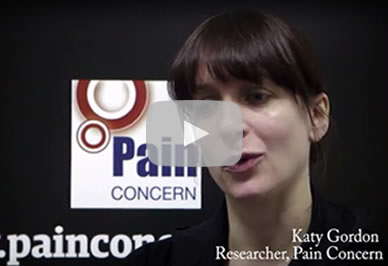
The first phase of the project – that is, gathering the data, the evidence that there is indeed a problem and the extent of it, is now complete. So, this edition of Airing Pain will look into the background and findings of the research. Katy Gordon is Pain Concern’s researcher for the project:
Katy Gordon: We basically found four main categories of barrier and then under each one of those categories, there were various sub-themes.
So the four categories were… the first one was the Patient-Healthcare Professional Consultation, so things that happened as part of that consultation that maybe become a barrier to self-management, that was the first kind of main category.
The second one was called ‘Patient Experience’, so their sort of experience of pain and the emotions which might be attached to having chronic pain might be one barrier.
The third category was called ‘Limited Treatment Options’, so that kind of covered the tendency for people – doctors and patients – to expect their pain would be treated with medication and nothing else, so they didn’t really look into some self-management strategies that they might want to use.
The fourth category was ‘Organisational Constraints’, so the sort of thing like really short appointment times, very long waiting lists… that makes it harder for people to do self-management.
Evans: How have you devised the subjects, the topics that you will study?
Gordon: We had the sort of anecdotal evidence that something was happening in primary care that was making it difficult for people to self-manage. Some anecdotal evidence from the helpline and that sort of sowed the seed to get the ball rolling. We then presented the idea to some advisors who we have got for Pain Concern, who are GPs and psychologists and they thought it would be a really interesting topic to look into. We gathered momentum with it that way and refined what we should look into.
We had two different sets of focus groups. We had patient focus groups or healthcare professional focus groups. Overall we had 18 focus groups and spoke to 101 participants: 38 healthcare professionals – that was mostly GPs and physiotherapists, some practice nurses, some occupational therapists, one community pharmacist; and then it was 59 patients and carers as well.
Evans: That’s Katy Gordon, the project researcher. One of those advisors that she mentioned is psychologist Martin Dunbar, he is Clinical Lead of the Glasgow Pain Management Programme.
Martin Dunbar: It partly came out of my experience of seeing the patients who come through the pain management programme here and them talking about the difficulties they have had, for example, in exercising and the help that they might have had in primary care. A frequent comment from patients is that they ‘wish they had known all this stuff years ago’. They will often say that they tried physiotherapy and have been encouraged to exercise more – but, frequently, their experience was that they were being asked to do too much and that was flaring up their pain. As a consequence, it wouldn’t be surprising if people rejected exercise then, as being too dangerous or too sore or too difficult.
Certainly, that was one of the things that got me thinking. And I think because it is a medically managed problem at most stages of somebody’s ‘pain career’, if you like, the emphasis is always on the medical approaches and they are frequently limited. There is a limit to the number of analgesic medicines there are and they frequently come with their own difficulties as well of side effects and so on. I think it was thinking about what might help people earlier and why aren’t they being helped earlier. I was aware that that wasn’t working very well and rather than just diving in with a solution, I think we thought we need to know a lot more about this.
Evans: Martin Dunbar. The NHS in Scotland recommends supported self-management for chronic pain in their guidelines for patients and healthcare professionals. So what does self-management really mean? Dr Graham Kramer is a GP in Montrose. He is seconded to the Scottish Government as national Clinical Lead for Self-Management and Health Literacy.
Kramer: Self-management really is health and well-being, the way people live their lives when they are away from a healthcare professional which actually is 24/7 and their contact with a healthcare professional is just a very tiny fraction of that time. I suppose their contact with the healthcare professional is very much about what the healthcare professional can do to support that person to self-manage, to live all the other times they are not with the healthcare professional as well and as productively that they can, in a way that they wish.
Evans: You work for the Scottish Government. Why does the Scottish Government see this as an important point?
Kramer: One of the main reasons is that we know that people who are enabled to be in the driving seat of their care tend to not only live better, live healthily; they often have less exacerbations of their chronic condition and they often require less medication; they often require less hospital utilisation and, fundamentally, in a health economics term – it saves money. If you can invest in supporting self-management, not only do you have improved personal outcomes, you get improved medical outcomes as well – so it’s a win-win – you also get a much healthier functioning health economy.
Evans: It seems to be a no brainer [Kramer: yeah]. Why do we need somebody like you to push it, to emphasise it.
Kramer: It is a very good question and I think one of the main reasons is that healthcare has evolved ever since the earlier part of the twentieth century from huge successes in the advance of medical science and it has been fundamentally fantastic at curing acute illnesses that people would have died from previously (with the invention of antibiotics, anaesthesia, immunisation programmes), we’ve managed to save huge amounts of life.
A by-product of that is that, although we are saving lives, people are living with chronic conditions. The whole healthcare system has been designed around the acute model, the acute curative model and trying to look after people and support people living with long-term conditions, is incredibly difficult – almost impossible – to do well in that acute model.
So what we are needing to see, is a transformation to what I call ‘the curative compliant model’ of healthcare, that we currently work in to one which is focused on empowerment and enablement. That is a fundamental change. It challenges a huge amount of values and attitudes of healthcare professionals. We are all trained in being doctors – or I’m certainly trained as being a doctor [laughing] – I haven’t been trained in being more of a coach, an enabler, a healer and that requires an entirely different skillset as well.
Evans: That was Graham Kramer. Here’s researcher Katy Gordon again:
Gordon: Doctors and physios as well – quite a few said that they didn’t really feel like they got that much training in chronic pain or self-management techniques as well. The groups that we ran in Edinburgh, those physio-therapists had done some kind of extra, specific chronic pain training, felt like that they had really benefited from it and felt much more confident dealing with the patients they had. So training was one that came under Limited Treatment Options.
So the fourth one was Organisational Constraints, which I think would apply to any condition not just chronic pain. So, appointment time, specifically, for the doctor – maybe 8/10 minutes – and even the doctors who had really bought into self-management said that they actually don’t have time to talk about chronic pain in the detail it needs – ‘I don’t have time to talk about self-management, so at the end of an appointment, I give a prescription.’
Long waiting lists as well, particularly, physiotherapy and psychology – so patients are waiting a long, long time and in that time, their pain is probably getting worse. The professionals that would be able to help teach them about self-management – they are not seeing them for such a long period of time, they can’t get started with self-management while they are waiting nine months to see their physiotherapist.
The third one in that category was Inconsistency – so possibly different doctors giving different messages about self-management depending on their own kind of opinions on it and patients just feeling that they would get sent somewhere for a scan and they wouldn’t find any problem in the specific thing they were looking for, so you would get sent back to the GP who would refer you somewhere else and then they didn’t find anything specific. Each specialist looked at one single thing, ruled it out, sent you back.
So, it’s that real kind of search for a diagnosis first of all and then search for a cure. And a lot of the time there is not really a cure, so that makes it worse. So every time you get sent somewhere, you get a little bit of hope – ‘maybe they are going to find out what is wrong with me, maybe they are going to find a cure’ – nothing happens so you feel a little bit lower again. And just a kind of ongoing cycle of being sent round and no one actually being able to find a cure and at that point you have to say, ‘we are probably never going to find a cure but we can manage this as best, we can’.
Kramer: I think one of the difficult conversations I have with my patients is getting them to some sort of acceptance that I don’t particularly have a solution but trying to be very positive, that I think there is a lot that we can do to help and that we can help by working through this problem together. And I think that I want to emphasise that I see myself… often the patients I have, we have a very strong, positive relationship anyway, so we can begin to use that and build on it, to try and work through the quite intolerable suffering that they are experiencing so that we can find ways of reducing that suffering and allowing them to move forward and live their life as fully as they possibly can, within the limitations that they have.
Evans: That was GP, Dr Graham Kramer. Now what the research indicates is that yes, patients in our sample are frustrated at primary care level but so are the GPs. Martin Dunbar again:
Dunbar: Time is part of that frustration, I think. But, I think, it is not knowing what to do – how to move people on, I think, is probably one of the things that would be most helpful. If that is done clumsily and I am sure that is done clumsily sometimes, then those consultations can become difficult and GP’s experiences can then be coloured by a few difficult consultations and it puts them off, I guess.
Evans: What advice would you give to GPs in those situations?
Dunbar: Well I do think GPs know a lot of this already. Certainly, the whole field of motivational interviewing can be really helpful here. It is putting these things in a certain way to people, putting the onus on them, letting them provide the answers to their problems, rather than, dictating to people, who already in their own mind – they are aware of the difficulties of making changes in their own life, so somebody suggesting that they should go swimming three times a week when, people may have tried that in the past.
I think if you use kind of motivational interviewing approaches, you will understand that that has been a difficulty and get people to think about what things might help them to get around those problems. I think GPs are often trained in using motivational interviewing approaches – more and more these days – but I think it is something that you need refreshers in, you need to keep on top of – I think, a couple of days training in how to encourage patients to make behavioural change isn’t probably enough.
Gordon: What we find a lot of, in all of the healthcare professionals is ‘we really want to help, that is why we went into this as a profession’, but there is only so much they can do in 10 minutes and with chronic pain, they are probably never ever going to be really able to find a cure.
And, yeah, that was quite interesting – the effect that the patient had on the healthcare professional’s emotions was something that I hadn’t really thought about before, but quite often, they say well, ‘I feel like I am letting the patient down because we haven’t been able to find that cure’ and all those sort of emotions that are attached with them. They are also thinking ‘well I’m the doctor, so I should be able to fix this’. Sometimes, they talked about chronic pain patients being quite, perhaps a difficult group to deal with and that was one of the reasons why, because they are not able to do the sort of job that they really feel they should be able to do.
Evans: Is one of the barriers to self-management, the fact that as you are saying, you didn’t have that training; you don’t have the time in a 10-minute appointment to look at everything in the patient’s life. Is that a barrier to self-management?
Kramer: It is huge, a huge barrier. As I say, the system does not cater for it at the moment. I think there needs to be a fundamental change and one of the reasons that I have gone into this job is – it has come about from an interest in looking after people with long term conditions within primary care. And all we have been able to focus on is the medical management of people with long term conditions and it is very, very limited. I think it is creating a huge burden of complexity in terms of multiple medications and things for people. The evidence suggests that it is socialising our patients into being passive recipients of care almost sub-socialising them into being in a relationship of learnt helplessness on the healthcare system.
Evans: By that you mean – patients go to the doctor to be fixed?
Kramer: Yes, absolutely, absolutely. And of course there is frustration on both sides when we are faced with an unfixable problem and we can end up doing more harm than good, trying to fix unfixable problems with our current medical approaches. It requires more than medicine and I don’t think that the current system is able to cater for those additional things that people with chronic conditions need.
Gordon: It was really, really common for people to say ‘I was made to feel it was all in my head’. People saying that they felt like if they had gone for a scan and they didn’t find a lump or something then, it was basically ‘well there’s nothing wrong with you, kind of go away’ that sort of thing, that was really common.
But then on the flipside the doctors said that they often found it quite difficult to talk to patients, perhaps because maybe there is not necessarily a specific medical reason that they can pinpoint for having their pain – so if the doctor started exploring wider aspects of their life and some of the psychological aspects, that was a very difficult conversation to have with a patient, because as soon as you start talking about that sort of thing, the patient would be like ‘he doesn’t believe me, he said it is all in my brain’.
So, quite an interesting kind of contrast between the two sets of focus groups that we ran. So the doctors saying ‘we can understand why patients think that is what we are saying, but it is actually not what we are saying, but we do need to explore the kind of wider psychological aspects of pain’.
Kramer: I’ve certainly never encountered a healthcare professional who says ‘I think you are making this up or malingering’. I don’t think they do that. And often people turn around and say that, you know, ‘the doctor’s turned round to me and said it is all in your head’. And I don’t think doctors do turn around and say that it is all in your head, but I think that is often what people hear. And so it becomes really, really complex and then people begin to think that they are not being heard or understood and I think it ultimately can easily slide into a very dysfunctional relationship and a dysfunctional experience of frustration and anger with the healthcare system that they can’t be fixed.
And that is a real, real challenge. And it is how you begin to move people on and you begin to discuss with them, that they may have a problem that we can’t fix, that they may have to live with for the rest of their days, that may affect them and is going to completely fundamentally change the way they see themselves, their lives and their relationships and their work and everything else. It can be quite a devastating conversation to have but at the same time, it is a conversation where you want to also convey to the person in front of you that there is also a huge amount that can be done, that can be gained through supported self-management, helping people address all the other aspects in their life as well so that they can achieve what they want to achieve.
Dunbar: Those consultations can become difficult and I think when people have had pain for a long time and they have only had limited benefit from medical management, they can become a bit cynical and a bit wary and a bit concerned that they may be being fobbed off. So it is a bit of a two-way street and I think managing those difficult conversations is maybe something that people, like myself, secondary care pain specialists could help with.
Evans: One of the comments from the research was ‘some patients want to please their doctors’.
Dunbar: That is true. They want to convey that they are compliant with the instructions that the doctor is giving them; they don’t want to report difficulties; they don’t want to be seen as difficult – as somebody who is not trying. I think that is true, across lots of aspects of self-management in pain conditions – that self-management is difficult – they have been given a simple clear instruction to exercise more, why haven’t they been able to do it? They will maybe blame themselves. They don’t want to be seen as somebody who is not trying.
Evans: Martin Dunbar, Clinical Lead of the Glasgow Pain Management Programme. Graham Kramer again:
Kramer: It is a two-way street as I say, it is a fundamental shift in the relationship – it requires I suppose, healthcare professionals to be less what I call ‘parental’ in their approach to their patients and it is a fundamental sea-change for the role that the patient traditionally sees them as playing and that can be as challenging, if not more challenging, I think, for some people. But it seems to be when you can get that transformational shift in both the healthcare professional and the patient, the person with the chronic condition – that is when, the potential of self-management is released and that is when we see the best results.
Evans: So how do you do that? How do you bring the two sides together?
Kramer: Many ways, there is no simple answer. But, I think that for healthcare professionals, we need to have space to reflect on our own values and what we are doing. I think we need to have more training in having these different types of conversations with our patients.
I went to a workshop recently – a group of very experienced GPs and we were looking at changing the approach to the management of people with diabetes. The doctors found it very, very hard to change from their traditional role of being in control and they were trying not to be and they couldn’t help leaping in at certain times and taking control, asking closed questions for instance, trying to set the agenda rather than encouraging the person to set their own agenda and that’s years of training, year of medical enculturation, if you like – that’s the way we’ve done it.
For people, how you increase their activation – not sure I like that word – but how they become engaged in this new side of the relationship. I think some of the wins are around peer support, I think that is very enabling when people see people like them, taking on that new role – so peer support. Structured education is important, but I would advocate that peer-delivered structured education is probably much more effective than professional-delivered structured education.
Evans: And that is where voluntary or third sector charitable organisations like Pain Concern, in fact, can have such a valuable role. But what the research shows, is that some GPs still need convincing.
Gordon: Our patient groups really, really valued third sector support groups and the healthcare professionals were sometimes a little bit more wary about referring – well, not referring, but signposting patients to these groups – because of a whole host of reasons: they didn’t really know what the groups covered; because they are often run by charities, they could never be sure that they were an ongoing thing…
Evans: I guess some people don’t go to support groups because they don’t want to – for want of a better word – wallow in their pain with other miserable people?
Gordon: Well, yeah, that’s right and that was one of the things that the healthcare professionals did have some concern about – are they signposting people to groups that almost collude and then agree that ‘Oh, I don’t want to do that because of my pain’ and then somebody else saying ‘yeah, you shouldn’t do that, because of your pain’. So that kind of collusion against things that they maybe not do. But having been to the support groups, I didn’t really see any kind of evidence of that. The support groups were really positive and, actually, I think were, a good vehicle for getting people to self-manage, because they share tips about ‘Oh, well that worked for me and that worked for me’ that sort of thing. It was quite a good contrast between the patients’ groups and the healthcare professional groups in that respect.
Evans: One of the responses from the survey was that some GPs are very, very loathe to get their patients involved with third sector organisations because it is losing control. They don’t know what advice the patient is going to come back with – ‘well doctor, I want it done this way’.
Kramer: Yeah… I don’t think we need to be worried about what people may be told or any false expectations that they may get outwith the health service because they will get that anyway. And I think giving people information so that they have exactly the same information about them that their healthcare professional has, so it completely levels the playing field. Now some of that information may need to be presented in a more person-friendly understandable format, you know, the information I have about someone would be meaningless to them, it would be gobbledygook. But if we can present the same information in more meaningful ways, I think that would go a long way to levelling the playing field.
And another key thing is that before people are prepared to see themselves in that role, they will need to have a lot of perhaps emotional and psychological support as well and I think that is a very important fundamental need for a lot of people. I think there needs to be a period of acceptance that they actually have a long term problem, for which there isn’t a cure that they are going to have to live with for the rest of their life which can be, a huge ask for a lot of people, because people are wanting to get back to the life they previously had. The whole narrative of their life has fundamentally changed. So I suppose what it involves is some sort of support to get them off that narrative of wanting to go back to where they were to a narrative of acceptance of where they currently are and begin to look at meaning. And I think that is a very important thing that we need to do – to help people find meaning in how they are and how they can begin to move forward.
Evans: The business of someone accepting a long term, a chronic condition – that needs expert communication skills from the GP, the healthcare professional. You are talking about not letting the patient see the notes, but translating the notes – that has to be done very expertly not to spook a patient.
Kramer: And it is really difficult. I have been interested in this for 20 years or so and I wouldn’t begin to think that I am any good at it. I think it is incredibly difficult as a healthcare professional. In my training, six years at medical school, I have learnt an entirely new language which has now become my first language almost. They say that the average medical student learns more new words than the average French language student would learn. It is a whole new language.
And I have probably spent the next 20 years after graduating from medical school trying to unlearn that language and begin to understand and use the language that people most commonly speak in. The only way of learning that language is by listening to the voice of people, the patients and I think one of the things that is missing in our medical education and there needs to be more of is the input of people living with the lived experience of long-term conditions and us hearing their language.
Evans: That’s Dr Graham Kramer – the Scottish Government’s National Clinical Lead for Self-Management and Health Literacy. I’ll just remind you that whist we at Pain Concern, believe the information and opinions on Airing Pain are accurate and sound, based on the best judgements available, you should always consult your health professional on any matter relating to your health and wellbeing. He or she is the only person who knows you and your circumstances and therefore the appropriate action to take on your behalf.
So that is the background to our barriers to self-management in primary care project. As part of the project, we have produced a series of six supporting videos, each one featuring an issue raised in the research. So, patients and leading healthcare professionals in the field of pain share their experiences and offer advice on self-management, coping with the emotional impact of pain, medical management of your condition, GP consultations and pain management programmes. All these and links to resources and of course the research itself are on our website which is painconern.org.uk.
Last words to project researcher, Katy Gordon:
Gordon: I actually got a really nice email from one of the physios, who participated in a focus group. And she said ‘Off the back of your report, I have changed my practice and I am just trying to work a little bit harder and listen a little bit more’. So that was really nice and I was really pleased with that. And if nothing else, if one physio is perhaps listening more than she used to, I think that is a pretty good result.
But, we’re trying to send it out to as many people as possible and just raise awareness for one thing and help, and hopefully use that to change practice. We got another email from someone who participated and said she’s hoping to set up community pain groups in Rothesay and she thinks the report will give her a good backing to do that – she will be able to say, these are some of the reasons, we should be doing this.
Evans: So the evidence is there [Gordon: yes]. It is up to people to use it.
Gordon: Yeah, so I always think that knowledge of what the barriers might be, has to be the first step to overcoming some of those barriers. Hopefully, the report will give the people the knowledge and they might be able to use it to work on the barriers.
Contributors:
- Katy Gordon, Researcher, Pain Concern
- Martin Dunbar, Clinical Lead, Glasgow Pain Management Programme
- Graham Kramer, Scottish Government Clinical Lead for Self-management and Health Literacy.