Patient volunteers and healthcare professionals on working together in pain management programmes
To listen to the programme, please click here.
This edition of Airing Pain has been supported by a grant from the Plum Trust.
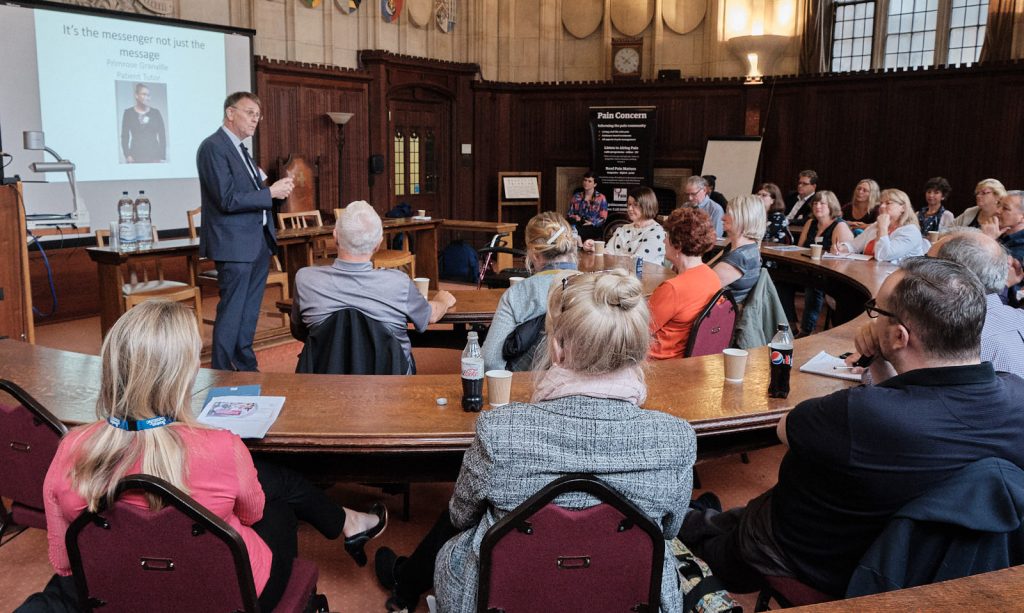
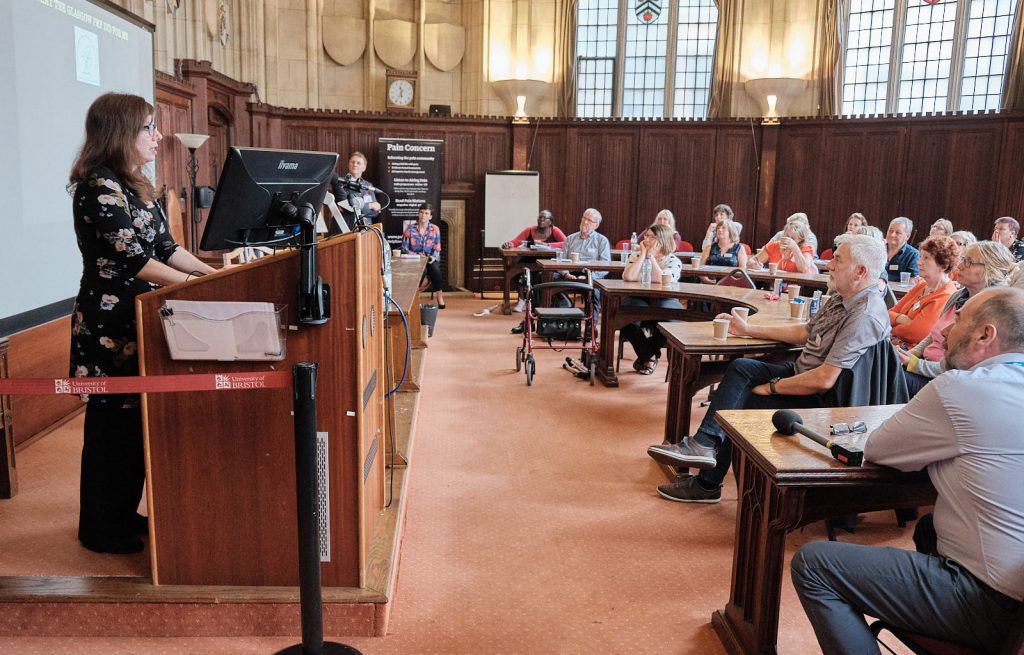
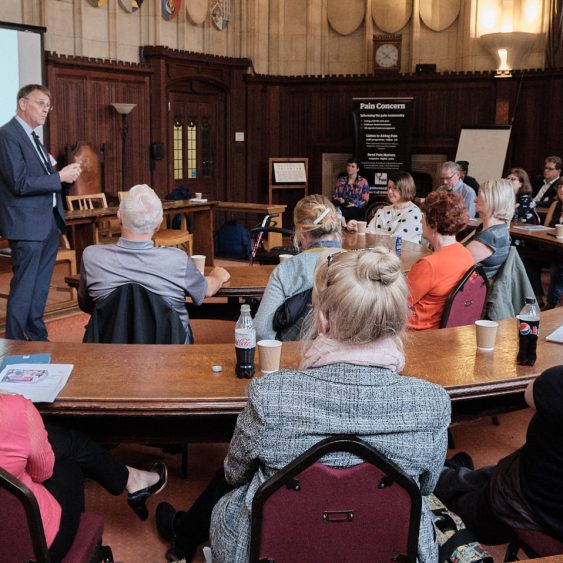
In September, the British Pain Society’s special interest group on pain management programmes held their annual conference. A workshop entitled ‘Experts by Experience – Working Together in Pain Management Programmes’ was run in parallel to this. The symposium brought together patient-volunteers and healthcare professionals from four pain management centres around the UK to share their experience of working together.
Dr Nick Ambler, Consultant Clinical Psychologist of the North Bristol NHS Trust’s Pain Management Programme (PMP), facilitated the workshop; chairing an uplifting, frank and empowering discussion on the psychological benefit to patients and the professional value to healthcare trusts of patient-volunteers working within pain management programmes. This special extended edition of Airing Pain comes to you live from the conference, letting you sit in on the discussion.
Patient-volunteer Primrose Granville opens by giving a funny, relatable and inspiring testimony of how volunteering with her PMP has transformed and empowered her life and experience of pain.
Dr Debbie Joy, Clinical Psychologist and Clinical Lead of Pain Services for NHS Solent Trust, addresses some of the initial anxieties she had around the introduction of patient-volunteers to a clinical setting, but ultimately asserts that they are ‘definitely stronger with experts by experience by their side’.
Pain coaches for NHS Dorset – Penny and Debbie – offer constructive advice for professionals and volunteers on how you pain coach and engage with people living with pain effectively and sympathetically.
The founder of Glasgow Community Pain Education Sessions – John Bremner, talks about how this model of expert by experience in action works, and how they run it ethically and effectively. Lindsay talks about how rewarding an experience it has been, volunteering as a pain trainer for this initiative, encouraging others to get involved.
The symposium ends with the group sharing their experiences and insights in an open floor discussion.
Contact your GP or relevant pain management programme if you are interested in volunteering.
Issues covered in this programme include: Peer support, communicating pain, community healthcare, confidence, employment, gabapentin, laughing yoga, osteoarthritis, patient volunteer, Scottish parliament, support group, training course, volunteering and workshops.
Paul Evans: This is an extended edition of Airing Pain, a programme brought to you by Pain Concern, the UK charity providing information and support for those of us living with pain and for those who care for us. This edition of Airing Pain is being supported by a grant from the Plum Trust. I’m Paul Evans.
In September 2019 the pain management programme special interest group, The British Pain Society, held its 17th National Conference in Bristol. Running in parallel to this event was a workshop in which patients and practitioners from four different pain management centres around the UK shared their experience of working together. The workshop, Experts by Experience – Working together in Pain Management Programmes was facilitated by Consultant Clinical psychologist Dr Nick Ambler of the North Bristol NHS Trust’s Pain Management Programme.
Dr Nick Ambler: Thank you so much for coming along today. This event is intended to be helpful to people who are thinking about getting involved in services. It’s meant to be helpful to pain professionals who really should be thinking about greater, deeper levels of involvement with service users and because our experience, and others in the room, has been such a fabulous one really. We just want to encourage others and I am mystified about why that doesn’t happen more often than it does. So, the purpose was to present four examples of where it’s kind of vibrant, it’s really up and running, and we will be beginning with one from Primrose, Primrose Granville who works with us here. This process is following a plan of something that I have been doing in hospitals, with hospital teams, for some time now. They call it a Schwartz Round but the idea of it is that, when you are looking for inspiration, and trying to find new directions in a thing, do a presentation that sparks off an informed audience, which is you by the way, to get them thinking, to get it to trigger off memories and recollections of their personal experiences, to begin a single conversation at the end of it which generates ideas and that’s what we are trying to capture.
OK, without more ado can I introduce Primrose Granville.
[Applause].
Primrose Granville: Good morning everyone and if I said I wasn’t nervous I would be lying. I am here to share with you my story, my journey, why I am a Pain Management, I’m going to say PMP, because we all know what that is don’t we, a PMP volunteer, why I have been doing it for six years, why I never make any appointments for a Wednesday morning – it doesn’t matter whether or not there is a course going on – I just don’t. It’s just become second nature to me.
So, I have been on two pain management courses. So, I went to one in the ‘old days’. That course didn’t do anything for me. It was purely instructional. I felt like I was in High School again being forced to do Maths which I hate. So, I went because I am a good patient and I listen to the doctors and I go and I don’t want anybody rapping me on the wrists so I just go. And I got nothing from it. Absolutely nothing.
Fast forward a couple of years. Anyone know Dr Greenslade? Yes. So, he convinced me to go on a second one and we had a really long conversation. It ranged from articles in The Guardian to articles in The Sun where he was actually trying to convince me to go on a second course and I was like, ‘Uh uh, no I am not doing that. Give me the magical pill and I’ll be fine. Give me surgery. Give me anything’. And he’s like no. ‘You have had the surgery – you do need to go on another pain management course. I promise you it’s different’. I didn’t believe him. And I turned up Week One, Two and then in Week Three that gentleman there who is trying to hide, Rob, who you all know, changed my life with five simple words. ‘I still live with pain’. Those were the five simple words that literally changed my entire life. And then he started talking about all kinds of things that he did and I’m like, ‘I was stuck on ‘I still live with pain’. And I remember leaving the room with my pain friend, and we used to give a lot of trouble in the course yeah, we were the talkative ones. And we were sitting in my car, because I was taking her home that evening, and we were like ‘so we can do stuff with this pain’ – because the pain was controlling my life. And one of the things I wanted to do – my only god daughter lived 146 miles up the M4 and the A13 in deep Essex. Why her parents choose to live there I don’t know. And I wanted to be able to get in my car and do the journey from beginning to end and just not stop. And he spoke about going down the M5 to Cornwell and how he had to stop several times. And I thought ‘oh my god – stop several times. Who does that’. But I heard him out and it was like ‘wow’. So, he changed my life with his examples but he got me with those five words and I thought, ‘hmn’. So you know at the end when they give you that that wonderful questionnaire that we all love to fill out – the big long one that looks like an epistle – and you got to that last question which said ‘Do you think you could volunteer here’ or something like that, and I consulted with my friend and she said ‘Oh it’s too much’ and I said ‘I’m going to try’. And I ticked the box and they phoned me the following week and I was like ‘they don’t hang about’.
[Laughter]
So, I kind of wanted to see what it was like from the other side, how I could impact somebody else the way Rob had impacted me with his simple example, his simple words, his ‘I still live in pain but I actually have a life that I enjoy’.
You know I used to be an early years’ teacher but they took my job they said my job was too dangerous for me, or I was a danger to the job – it was one of those ways, I can’t remember but I remember being very depressed about it like, ‘You know how long I went to college for this stuff, I’ve been teaching for 12 years – what do you mean I am dangerous to the job or the children are dangerous to me’. And I remember I had a son at the time who was round about the same age as my children and I remember that I was off work for a lot and I thought ‘I wonder how I would feel if Mrs Barwell was not in school two days out of every week’. I put myself in my son’s shoes and then I thought actually Bristol City Council is not that horrible. You know they’ve not kicked me out because they think I am useless. They’ve kicked me out because – they’ve not even kicked me out – they’re trying to save me, the person. I am sure a lot of you in this room will understand the impact of being told you can’t work anymore, you’re not employable. You know unemployment is one thing but not being employable is a totally other story. It’s a case of ‘You are useless’ and this happened round about the same time when our lovely former Prime Minister, David Cameron, came up with the word ‘scroungers’. And here I was, on benefits – a scrounger. Yeah all I needed was a hoodie and I’d be the hooded scrounger. But I hate hoodies.
[Laughter].
So it was a dark time and I’m glad I met Rob, because I’m glad I volunteered because I felt valuable. I was turning up on Wednesday and when I wasn’t well they missed me. And that’s my ‘why’ – I feel like I am doing something that’s worthwhile to someone else. And that is why I turn up. It was only last week that I thought I could actually claim my expenses for my petrol because I didn’t even know. Because I don’t turn up for anything but to give of myself and to strengthen somebody else’s life, you know, make you feel better about yourself. I don’t know if any of you have patient-volunteers in your room but it really made my experience different and I can say that with certainty because the first course had none.
So that’s why I know it’s different. And that’s why I know the value of a patient-volunteer. I probably don’t know my own value but I know that when I turn up there it’s because I want to improve somebody else’s outlook. I want somebody to take on the toolbox that I got.
But let’s get back to the training. The training is very important. So, I was terrified when I heard the words ‘training to be a pain management volunteer’. I thought they were going to train me to be a doctor [laughter], and I don’t like science. So, I didn’t want to learn all the science bits. So, I thought I was going to go and do this great big course on being a doctor or a physiotherapist or a psychologist and I was like ‘Oh God it’s going to be so …, it’s going to be so hard and complicated’ and it wasn’t. It was a training about my experience impacting someone else just like me.
Are there any patient-volunteers in here? Have you had the training with Bev and Maz? It’s cool isn’t it! It really is cool. But I did that training and I enjoyed it and the morning of the first course anybody here who is a patient-volunteer arrived at that course thinking ‘I’m leaving, I’m chipping from this room within the first half an hour’ [laughter] Did anybody feel like that? That’s how I felt. There was no way I was going to go in to that room and be anything good. I was going to be a nervous wreck. I was going to say the wrong thing. I was going to upset someone. But none of it happened and it hasn’t happened in five and half years because they keep inviting me back so I can’t have done it that badly. You know when I turn up at Pain Management classes I don’t just turn up as a tutor. I actually turn up, I learn something every day. Every single day is a school day.
You know healthcare professionals and patient volunteers are the same humans but they are very different. I hope I won’t offend any healthcare professionals – they can be very intimidating, and they deliver a message that, as a patient, you feel you have to take it. So the doctor says to you you need to take Gabapentin. You take the Gabepentin because it is going to get rid of the pain. A pain volunteer says to you ‘Yeah take the Gapapentin but when you’re going to Exeter, or wherever you’re going, stop three times on the drive down’. A doctor won’t say that to you because they don’t understand that experience. And that’s the difference. That’s where it comes from – it’s the messenger – it’s who delivers it to you as far I was concerned.
When I first saw Rob in the room I thought he was another doctor and I couldn’t wait for him to talk. You know this pain patient waiting to be delivered, to be forcefed this, you know dripfed this thing, like Pavlov’s dogs. You know. You’re going to get it and you’re going to get better and everything’s going to be perfect. Because in the back of your head you still want that magic cure. But that magic cure is going to come from another human being, not a dose of drug.
So, one of the joys of being a pain management tutor is I feel like part of this team, you know, this amazing team. I don’t feel like a doctor but I feel like a consultant kind of way, you know [laughter], I’m a lay consultant kind of thing. People come and say to me ‘So Primrose – how do you do this’ and I’m like ‘Oh yeah’. You know you don’t tell patients what to do but you share with them your own story. And I’ll say to them ‘Oh I went up to London the other day. The whole journey up took me three and a half hours’ and they’ll be like ‘Why?’ ‘Oh I stopped four times’. And those are the things that make a difference to somebody else who is going through a journey that you might not know their particular journey but you know what a pain journey is and you know that they don’t want to hear the perfect version of events. They don’t want to hear that doing your hair takes three hours longer than somebody else because you can’t sit up long enough for the hairdresser to do it. You might have to really plan – it might be the only thing you do for the day. It’s the little things that you do and you’ve all been through PMP so you’ve got that toolbox as well. So, here’s another toolbox that you might have and don’t even know it. You could be the breaking moment in somebody who is living with pain’s life. You could just be that person and it could be the simplest of statements. The most mundane thing that you think doesn’t mean a thing – who would have thought the words ‘I still live with pain’ would mean anything to anyone. I didn’t think it would mean anything to me but it does now because it was the moment that I decided ‘I’m going to live with this for the rest of my life, but I’m going to have a nice life’. After that I just do things differently and that’s what pain management has done for me. The best part though is being on the team. You feel so valued. You feel so valued it’s a case of ‘somebody wants you there’. For me being that messenger is a lot more important than the message.
[Applause].
Ambler: Can I introduce my colleague Debbie Joy from Southampton. And Debbie if you’d like to introduce your co-presenter.
Debbie Joy: Primrose I loved your talk. Thank you.
So, I’ve come from a service – I’m a clinical lead and I’m also a clinical psychologist and I’m kind of the head of three pain services. We’ve got Southampton City, Portsmouth City and South East Hampshire and Gosport so there’s quite a few services there. And Nick’s asked me to talk about my journey into having volunteers in the service. And I would say it’s been quite a long one and I took a little bit of convincing. So, I think that’s why Nick thought it might be interesting to hear about why that was and what the issues were for me and what I had to think about and perhaps, to some extent, overcome, in order to get what we’ve got going now started.
Putting it bluntly I had quite a lot of worries about it. I’m going to take you on a bit of a tour on what was inside my head a few years ago. There were quite a few things when I unpacked it. I listed them all out like a good psychologist – all of my thoughts – and I was able to put them into about five different categories. The things that concerned me about having volunteers in the service.
The first one, and this was quite a big one, was about control. Specifically, how do you control volunteers? I had thoughts like ‘What might they say, they could say the wrong thing, would they take over, I mean I’m running a pain management programme – I’ve got a lot to get through – I haven’t got much time for other stuff’. I was a bit worried about them doing or saying the wrong thing –being inappropriate even – could that go wrong and what would I do.
We did have a little go at getting volunteers involved in our programmes at one point and to be honest I don’t think we did it very well, looking back, and we were kind of hoping to get some of these wonderful effects where people share their experiences that Primrose spoke about and kind of it had a big impact on people. But unfortunately, it wasn’t exactly on message on one occasion and it just didn’t go down well and I think that was enough for us to stop at that point.
I also wondered how you manage these volunteers. Again, where is the control.
Another, again big area, was around resources. I mean I was always taught that there’s no such thing as a free lunch and I kind of think well a volunteer it sounds free but actually what are the resource costs of having volunteers in your service and a big one is time and I was like ‘Gosh will it make more work?’ I really can’t take much more work.’ so that was quite a barrier for me.
Another one was money. I know we say volunteer and it does sound like that’s free but is that ethical? I wasn’t sure that was ok. Can we just not pay people to do something that helps us? I mean we get paid to do our jobs as healthcare professionals so I felt quite uncomfortable about having people coming along and helping who we weren’t paying. I didn’t want to be taking advance of people.
My fourth kind of area of concern was around permission. I didn’t know if it was a bit naughty to get people in for free and to ask them to help. I didn’t know what the Trust thought about it because in the NHS, as I’m sure you are aware, we have Governance, there are issues around safety. There’s the safety of patients, there’s the safety of you as a worker, as a volunteer. There’s lots to think about there and we have our structures and ways of doing it and when someone’s a paid employee well that’ all kind of sorted out isn’t it. So, I wasn’t quite sure how it fitted with our organisation. And also, you know, we have these things called service specifications. The Commissioners are buying something from our Trust. They are buying a particular service and volunteers aren’t mentioned in there. So, it kind of, it didn’t look completely obvious how to do that easily.
Lastly, if I’m completely honest, I think I felt quite insecure about it. It’s like ‘Will they do us out of a job’. I mean this is self-management isn’t it. This is kind of what you do in your lives and it’s like well you know what that’s like don’t you. You’ve learned how to do it and it’s like well ‘Will you need us?’. As you probably learnt if you had any psychology on the programmes you did when we get anxious the thing to do is avoid it isn’t it. So that’s what I did.
However, I went on a leadership course and in that course I had to read something called the Five Year Forward View – it’s an NHS document – it was the 2014 version – there’s a new one out now. And that was trying to answer the question of how we make the NHS sustainable. So how are we going to deal with all this increasing need that’s out there, particularly with long-term conditions. And this document really focused on ideas around that and it talked about empowering patients, including the voluntary sector more, by working in partnership with people and the patient voice and I knew other pain services were doing things with volunteers and it was starting to sound a little bit trendy. And some of them are doing it on quite a big scale but I didn’t know how they’d solved all of those problems that I had foreseen. And thinking about our service, where we do lots of pain management programmes but we have to say goodbye to patients at the end, it just seemed like a no brainer. I really couldn’t avoid this any longer.
I will say it did involve work and it did involve resources so I was right about that but, luckily you know, I had some great people who were prepared to work extra hours and were able to, who were able to really get things going in our service and get us our lovely volunteers – I’ve got three of them with me today. And my experience so far of this has been that the volunteers bring so much energy and passion and commitment. They care about it, you know, they want to help, they’re really supportive. It’s a really nice thing to be around actually. I definitely say we are stronger with experts by experience at our side. I’ve managed to wheel some volunteers along with me. Nick can I just ask how do you think it’s going?
Ambler: Well we were just discussing this driving up – the three of us – and Kevin and Julie there. We are learning and changing things and I think each day that you do something you learn more. We did it because, well in my case I was rung up by my psychologist, Rhona McKirk, and she said would I volunteer and I felt that before I started this, as many volunteers who have been on there, I was in a very dark place. The pain controlled me, I didn’t go out by myself. After the course I now go out by myself, the pain doesn’t control me anymore. I live with the pain. I feel so much better so the course it did me so much good that I wanted to do something back. I had absolutely no idea what a volunteer did when I was asked. We will still learn and we have a supervisory meeting every two months and we learn from that things are explained to us and to help us.
Kevin: For me I am pretty similar to Primrose. I retired at 42 due to ill health and felt lost and when the offer was made to volunteer I felt I had a chance to have a place back in society, have a reason to get out of bed and it’s really made a difference in my life – massively. And it’s helped me manage my pain – better than even the pain management programme itself did. Because I learned from other people when we go to their pain management programmes, their stories give us ideas and we can use those and we use examples all the time and just build and build and build – and I talk too much apparently.
[Laughter]
Ambler: Julie’s job is to kick him when he starts talking too much. She always does. But there is part of the pleasure that we get out of it and Julie will corroborate this.
We went to one in Southampton and there was a very young girl there that didn’t say a word. She was sitting there curled up in a little ball on a seat. Didn’t say a thing and then the psychologist in charge put them into groups to talk to each other about what they had done good and what had been bad and this sort of thing – just to get them to talk and – again, she never said a word. When they came round to their group to explain – nothing – absolutely zilch. And we had to go to a follow-on group, we had to leave early because there was a follow-on group we had to go to and, by that stage, after the break, she had moved up the back and she was trying to move around but still not a word out of her. And as we were going we just said to her ‘I hope you get on well and good luck with it’ and she said ‘Thank you ever so much – that was lovely’ and neither of us thought we’d see her when we went back at the penultimate meeting but when we were back there there she was. Maybe we had a little bit to do with why she stayed. Because the first time she had spoken was to us and so she must have got something from our stories of what we’d got on and that. So yeah we get a great thing out of it and we see, more than the clinicians, the change because we go on week one when they are all there and everyone is sort of sitting like this and folded up. And when we go back on week nine or week eight, depending on which it is, you see the change in them and it’s a huge change from people – the only way you know they are in pain then is looking in their eyes. And you can still see the pain but the pain there it’s not visible. I always say it’s taken the pain from here to here. It’s behind me now. I’ve worked with my pain, worked at it, and that’s what we can add and if we have done something to help then that’s good.
Julie: And I think we do present ourselves as we should do. We don’t step out of line. We know we are not clinicians. And we will always say to the people we cannot have a one to one with you. You know if you want to talk to someone you need to talk to your doctor or clinician or whoever because it’s not our place to do that. But all we can do is support and that’s what we do and that’s what we get so much out. It’s incredibly powerful. I think Primrose used that word too ‘powerful’.
Ambler: Can I introduce Penny and Debbie from Dorset. But I can’t remember your titles so I’m sorry.
Debbie: That’s fine. My name’s Debbie and I’m a pain coach. I also do a steering group. Penny does ..
Penny: I just do the pain coaching and we’ve also worked with the REC – the Recovery and Education Centre alongside the Dorset Pain Management team, worked together to set up a course for the introduction of pain management so you are bringing the mental and the physical together so that’s an ongoing thing. In fact we’ve just updated the course haven’t we so that’s done four times a year? Three times a year?
Debbie: For the Steering Group what we do is we get together and the staff and the volunteers that are on the Steering Group we discuss what’s working and what’s not working, what would be beneficial, what wouldn’t be.
I have had MS for 24 years so I know what it’s like to be isolated and not to have anybody to talk to and the living with pain and so on and so forth. When we did the pain coaching we had to do training and you have to learn the boundaries, confidentiality, you know, how not to upset somebody basically. How to behave around people. And it basically gave you how you could help somebody in a good, positive way and not overstep, which is really important, because you can’t sit and say to somebody ‘you should do this’ or ‘you can do that’ or anything like that. You have to listen to them and that’s the whole point. It’s about listening and hearing their concerns, their worries, their fears. Sometimes you have to gently – you know they’ve done the course and they’ve forgotten things so you can think well, you know, actually pacing which is my biggest thing is, you know, if you pace yourself if you do things so you are gently encouraging them to remember what they’ve been taught because we all forget, we all do and it’s helpful for them to have somebody to actually come along and go well, you know, ‘what about’ or ‘maybe you could try that’ or ‘if you are feeling really bad’ you know ‘maybe going back to the pain service’, ‘making a phone call’, you know so you are always encouraging them to sort of help themselves, but in a gentle way.
Penny: And when somebody first comes to the service well they will have been approached, they will have done a course possibly or they will be seeing a clinician on a one to one and maybe they’ve suggested they’d like a pain coach or whatever it is we’re being called nowadays. That very first meeting, the meeting is set up between us the clinician and the person who’s possibly wanting some more support and, within that meeting, we obviously discuss confidentiality and whatever they say to us we do not pass on to anyone else unless we feel that person is going to be a danger to themselves or to someone else. That is the only time we would possibly go above their heads. But otherwise anything, they have got to feel safe in talking to us.
Debbie: You are helping them feel that they actually are a member of society. You are helping them remember that they are a person and that, you know, that pain is there and it’s not going to go away. We can’t help you that way but we can listen and we can understand how difficult it is to go to the shop, go visit a friend, go to the pictures. Just things that everybody takes for granted. Normally people take all that for granted. For somebody who has been stuck in their house living with pain for years that is like Mission Impossible. It really is like Mission Impossible. So, you know, if you want to talk to me on the phone, talk to me on the phone, if you want to email me brilliant. But would you like to meet in a coffee shop, we can go for a cup of coffee, we can talk over coffee, and you’re getting them to come back out of themselves in a nice way. And you know if they say like, you know, for example my lady for example, she’ll be like ‘I used to love doing this Debbie’. Well let’s look at that. Let’s see if we can do something like that. OK we’re in a 65 year-old Stretch and Flex group but we enjoy it because it helps and it’s about being in a group of people who don’t all look at you and think, you know. And we stand in the back and we do our best, you know, and she enjoys it and she enjoys going and I get something out of it because actually I need to do the Stretch and Flex as well.
Penny: And I think that’s something that’s quite helpful for us because although we are all very good at telling other people how they can help themselves or whatever but we do forget about ourselves sometimes so if you are helping somebody else you are reminding yourself as well aren’t you that actually ‘I should do that’ or yeah let’s do that with you so we both benefit. I think it works both ways definitely. And I think it’s very important for everybody, for all of us here to remember, that yes we live with the pain but it doesn’t define who we are. It’s just this thing that sits on our shoulder and we have to adapt and learn to manage it but we are still us, we are not pain.
Debbie: We decided that, in our area, there wasn’t a lot of things for people to come and do socially so we, Penny, I, and there’s a gentleman set up a support group, and it’s a coffee morning really to be honest. And we just, every third Friday we all get together and we go have a cup of coffee. And anybody that lives with pain can come along, sit down and actually feel normal. You know, if they are a bit ‘oh oh oh’ getting in the seat yeah ‘You alright?’ ‘Aye fine’ and, you know, they’re just normal and it’s nice for them to be able to just go out and say ‘Well I’m having a bad time and this this and this’ and we can go well we’re not going to sit there and counsel them.
Penny: They don’t have to explain themselves Debbie. I think it’s this whole acceptance, whatever you’re dealing with on that day you can just be here and relax.
Debbie: Basically if you want to be a pain coach it’s really, really rewarding it really is and it does work.
Penny: And if you just help one person it’s so worthwhile. I had a lady and she was in such distress and anxiousness when I first met her and all she wanted was someone to listen to her and feel validated that her pain is real. It really is there. And it was a slow process but to see her very, very gradually make steps forward. She gradually became to accept – ‘oh gosh I am going to have to live with this forever’. And then with acceptance you can then start working on the management side. And it’s so rewarding if you see someone who was down here to suddenly be in a better place. It’s worth it just for that one person.
[Applause].
Ambler: Thank you both. Can I introduce two colleagues from Glasgow – John Bremner first and Lindsay second to complete the set of examples of set-ups with different volunteers from around the country. So, I think over to you to take things forward from here, John, so thanks.
John Bremner: Good morning ladies and gentlemen and thanks Nick for the invitation.
What I’d like to talk to you about today is an initiative that was developed in Greater Glasgow & Clyde Health Board to improve the information that gets to patients and to try and get to the patients earlier and I’ll also talk about my own experiences and failings in volunteering in that programme. But first a bit of an introduction.
I suffer from osteoarthritis and have done for about 15 years and been in chronic pain for ten years so I was enrolled in the Pain Management Programme in Glasgow in November 2015. A date that sticks well in my mind. I was in a bad place as many of you were at that time and that set me on the road to recovery. But not only did it set me on the road to recovery it became the stimulus to me volunteering with the Pain Service. I had so many benefits from that programme that I just wanted to give something back and I’ll tell you the story of how we did that. So that became my stimulus to volunteer the road back to recovery.
The feedback the team had been getting persistently was ‘if only I had had some of this information earlier in my pain journey. Why didn’t I get this earlier? I might not have been here, in this state, if I had had information earlier’. But limited resources, huge numbers, large numbers of people waiting for places on courses, that was the dilemma the team faced. The solution was to actually develop a short information session and Martin Dunbar is the leader of the team that developed this programme. They are basically groups of up to ten and they are led by a patient volunteer. There is no clinician in the room. We are supported by Masters students, psychology students, from Strathclyde University who are on placement with the service but none of the team are in the room with us when we do the sessions. And they last for about two hours. And the idea of the group session is that people can learn from each other’s experience.
Patients self-refer to the course. They hear about it from their GP, various places, but they self-refer so there is no waiting list. We cover six centres across Glasgow and Clyde and we have, to do that, five trainers who deliver those courses – so we deliver about six sessions a month right across the region. We get excellent training and support and we are carefully checked before we are allowed to fly solo. But once we fly solo we have ongoing supervision sessions – about every two months – we all get together, the students and the pain trainers. We exchange our experiences, we learn from each other, we think about how we might deal with difficult situations better. So, it’s an ongoing process of learning so we’re not left alone and that, I think, is crucially important because not only does it maintain standards it helps you build your confidence.
I was actually quite scared of doing this. Now in my work I had given talks at scientific conferences, I’d spoken to business groups – some thousands of people at a time – and suddenly here I was absolutely terrified of the notion of being asked to give presentations. And I think partly that was because what we were dealing with was a group of vulnerable people whose wellbeing, partly, was in our hands for that couple of hours and that was quite daunting. I was really outside my comfort zone so that’s where the importance of the support team comes in. To make sure that you’re completely confident, completely comfortable about going and doing this, what I think, is a very important job. And that ongoing support that we have is crucially important.
Now just some experiences – it’s what I call the ‘moment of change’. It’s that moment where the group comes in and starts to assemble and you can see they are all nervous and the eyes are down and the arms are folded and they are wary and you can just read the thoughts. You know ‘Am I in the right place?’, ‘Is this going to be of any use to me at all?’ and very early on what you see is that beginning of the arms unfolding, just a glint in the eye of nodding, people starting to say ‘yeah I get that’ and that’s a tremendous transformation. Not everybody in the room does it but by far the majority of people that’s the reaction and it’s absolutely fantastic.
One of the bits that always gives me a real thrill, and it happens most times, is that somebody says ‘This is absolutely fantastic, great just to hear this stuff from somebody who suffers like me and knows and understands how I feel’. And I think that’s a crucial part of volunteering involvement in any of these programmes. It’s an exhilarating experience. That’s not an exaggeration. It ticks every single box for me. I get something from the sessions every time. I get renewed.
I’d just like to touch, before I finish, on something else that we are now trying to do which is widening the net. We want to make sure that we are getting to as many different kinds of groups as possible. We use GPs and pharmacies in Scotland. We have the ability to drop information leaflets to every GP in the area. But we’ve also contacted pharmacists and they’re a great source of referrals too. But we are also speaking to charities and organisations that are beginning to advocate patient involvement in care. We also talk to patient groups because often a symptom of a lot of problems and diseases is chronic pain and lastly – I think one of the most surprising ones for me – was the Department of Work and Pensions. We went along to a showcase that they had about helping people who are out of work. We went along, Lindsay and I went along, to put up our stall and we sat there. What we found was that there were a lot of people out of work. One of the reasons was that they were suffering from chronic pain and they couldn’t get back to work. And they were desperate to get back to work. And it was great, from our point of view, to speak to people like that and then a few weeks later to find or see them on the courses that we were delivering.
Thank you for your time.
[Applause]
Lindsay: OK so hello and thank you for having me here. My name’s Lindsay. I have chronic widespread pain and fatigue. I’ve had that for about nine years now due to osteoarthritis in my spine. I graduated from the Glasgow Pain Management Programme about seven years ago. But before I joined the PMP I’d already tried many investigations, medications, treatments with varying or no level of success. And, at my worst, I was having to use a self-propelled wheelchair and, at my best, I still had widespread pain, reduced mobility and I was extremely heavily reliant on crutches.
Well don’t worry, I’m not here to tell my pain story. I know that everyone in the room has their own. I just felt I had no hope for the future. I’d just turned 30 at this point and all I had was expectations of a restricted life with pain. I just didn’t know how to control it or manage it. So, what the Glasgow PMP did for me – well aside from changing my life with a structured self-management approach – they introduced me to a support base. Such as a wider pain community, locations and places that I could access for support and advice and organisations that I could check out that I didn’t even know existed. Like Pain Concern, The Glasgow Disability Alliance … They also showed me how to look towards the future without fear. They showed me that I wasn’t alone and they also showed me that anything is possible – don’t underestimate what you can achieve. Because I once considered climbing the stairs of a lighthouse the best I could hope for. Whereas now I consider my possibilities limitless. And, if I’m honest, for me my sense of purpose returned when I discovered pain training and, I didn’t know that then, but by doing that I would eventually – that would take me all the way to the Scottish Parliament.
So, after graduating the PMP I was given the opportunity to volunteer as a pain trainer, and I won’t lie, I questioned my own capability. That was more to do with self-doubt and anxiety but I really wanted to give back. The PMP had changed my life and, especially after having to leave work because of my pain, I just felt so aimless and directionless really. But during the initial training to become a pain trainer I actually had to withdraw. I was still kind of navigating my own pain and my life. There were a lot of personal issues, there was a lot going on in my life and I just felt completely overwhelmed. But it really upset me. I was so angry and disappointed at myself and I honestly thought I’d blown my one chance to be involved in something really important.
But, one year later, I got a very friendly, supportive and welcoming query just inviting me back to retry. And, I won’t lie I was still feeling very fragile but it did help. My confidence kind of grew a bit just by being remotely considered capable enough to try again. And I realised as well I had to manage my expectations of myself a little better. I wasn’t just a heavily medicated amateur, I was somebody of value with ground floor experience that could actually be put to good use. And I was terrified that my anxiety would limit my ability but honestly my anxiety has improved as a result. Mostly through the participation and delivering the sessions and I’m finding that I’m able to speak a completely different way. Just facing that fear head on is actually just helped me so much.
Even though I felt quite vulnerable and a little out of my depth at the beginning I found that I was talking about a subject I actually know quite a lot about. And it does help to remember that there is a shared experience of pain with everybody that I meet at the session and that really does help too. And as for the PMP team itself I’ve been fully supported each step of the way. There was never any pressure to present till I was ready so I just observed for as long as I needed to. I was introduced to the other PMP graduates who then went on to become pain trainers and, I have to say, I am honoured to be part of a team so dedicated to promoting pain education.
And again we had this shared experience of pain and that does lead to a very supportive dynamic. We regularly get in touch through emails and, if by chance, where one of us is unable to cover a session it’s not a problem – there’s always somebody else on the team that’s ‘oh no no, that’s fine I can cover it’.
Now I would not have believed it at the start of my pain journey and I probably wouldn’t have believed it after I became a pain trainer but so many doors started opening for me.
In September of last year I was invited to speak at The Rheumatology Cross Party Group at the Scottish Parliament and this was in front of MSPs, Press and other professionals and people, perhaps, not so informed about pain and, I must admit, there was a ‘wow’ moment. My personal pain journey had made its way here and I was extremely honoured to be given that opportunity to help bring pain to the attention of those in politics.
Now I know that we have some volunteers who are here with us today but to those who are considering volunteering I wholeheartedly encourage you to get involved. It is so rewarding and so fulfilling and there are so many ways, different ways, to do it – it’s not just about public speaking. And you will discover as well, like I did, that you are vital part of an extremely supportive larger community and, even if you stumble with it at first like I did, try to remember that’s not failing. That’s just part of learning.
So, my advice would be just take it a step at a time. Very best of luck to you all and please remember to be kind to yourself.
Thank you so much for listening.
[Applause]
Ambler: Thank you as well Lindsay. This has kicked off many thoughts for me. The place I would like to start is to throw this out to you that surely must have kicked off some emotional reactions and I just wondered if there is anything off the top of your head really that you would like to say in reaction to what you’ve heard this morning.
Participant 1: I’d like to say thank you very much for all that you’ve said to us today. You’ve inspired me to think that I am doing a good job with what I am trying to do. I’m a new volunteer and somebody mentioned about being paid, that you felt guilty that we weren’t being paid, but you are more than paying us back for allowing us to be a volunteer and paying us back with knowledge. And you can’t put a price on that so thank you.
Kevin: The phrase that we use ‘the selfish altruism’ is so true. We do get so much from every opportunity we get to engage with other people and that can be whether it’s us meeting as volunteers or whether it’s us meeting with patients as a volunteer.
Primrose made the very point about this gentleman having encouraged her by using that term ‘I live with pain’. And we do, it’s not dominating us. We are dominating it and we can move forward.
Ambler: Can I throw it back following on from that. Primrose talked about those five words which sounded so tame but they had such an impact on her. I just wondered if there are any others in the room, I know many of you are volunteers, but everybody who has done a programme. Has a volunteer got in your head at that stage in a similar kind of way?
Participant 2: The lady that was on my course, Jackie, goes all over the world on holiday with complete strangers and I’d wanted to go to a local café that was open, a community café, and I was too nervous to walk in on my own because I won’t go out the house etc etc. And she had just been to Peru. So she’d been all the way to Gatwick, got on a plane, flown to Peru with a group of total strangers and had a lovely holiday and she does this three or four times a year and I thought, ‘What is wrong with me if I can’t even go out the house and walk into a café?’. So, she completely inspired me so, yeah, she was my inspiration and that’s why I volunteered.
Julie: I just wanted to say I find being a volunteer quite empowering because it’s such a leveller. Because the people we deal with are exactly the same as us. The people we are helping are the same as us. I work for the Home Office and I only work three days a week. They are absolutely happy for me to have time off to do this, to come along to the Conference today, to do the Pain Management programme, to support the groups. It’s very important to them as well that I’m getting a lot from it and that it’s helping me. And that we’re helping other people. The main thing is that we are all in the same position, every one of us here that’s a volunteer. We’ve been there, we know it. The last lady was saying that we just, you know, you just take so much from the people that you are working with or helping, it’s just so important to us that we can just be giving but we are still receiving in such a high way as well.
Ambler: I am struck by the line of conversation here about altruism and reaching out to others and that’s obviously a theme of all the presentations this morning. One of the things that we haven’t presented, which was very tempting I have to admit, is something we have been up to in Bristol. Which is the way in which people reach out to each other where it’s mutual altruism rather than the selfish thoughts. And it’s something we’ve been doing in Bristol since about 2011/12 which you could broadly say is called, Let’s Stick Together. And that’s to encourage courses to stay strong with each other to keep in touch with each other. In the room today we have, of those I’ve been involved in, the very first one, and the most recent one, are strongly represented in the room. And I just wondered if any of the participants in those two, so you know who you are at the back and you certainly know who you are in the middle there. Any reflections on that, either the recency of it, hearing this, or how enduring it’s been for those of you that have been getting together for years?
Participant 3: I’ve been on three pain management courses and this is the only one that’s really like said try and stay in your group afterwards because they can give you so much more support than the actual course can give at the end. Because you are like a little community in your own little right. So, you can, they are there for us, for me, if I am struggling for something and they just, like, support you. So and that’s what I think the other two courses like missed out on, almost, is that ‘Keep in Touch’ afterwards.
Ambler: How many times have your group met together since?
Participant 4: Only once but …
Participant 5: … we are always talking on WhatsApp. You know you are there, if you’ve got something going on, you can just reach out to each other.
Ambler: And it may even have been a breath of fresh air but it’s been fine since you’ve got rid of the therapist hasn’t it?
[General agreement and laughter]
Participant 6: One of the things which I think failed partly in my group – the participants were drawn from locations which were too far away and it was physically very difficult to meet. I do think it might be of value to try and look at postcodes where people actually are before they attend these groups. In my course I had a flare up. It was one of those days where I felt like ‘I can’t really make it’ and then I forced myself to get dressed, forced myself to get there. I put my cheery face on and the automatic door opened and there were three people in the waiting room and they looked at me and they said ‘Do you need a hug? You are really rough?’ My husband didn’t notice, my daughter didn’t notice, nobody else noticed actually how much effort it took me and I thought ‘Yes, I’ve well hidden where I am. Nobody needs to know that the pain controls me’ but the fellow sufferers actually knew that I was just being a very good actor.
Participant: In our groups it’s the same. You are the experts in your pain. We understand what you are going through but we can’t know your pain. Only you can do that and one of the things that we tend to say in our bit at the beginning is most people, when they go to a session, worry about the whole group, you’ve gone, suddenly there’s 12 people there and you’re going to talk about your pain in front of 12 people which, I got very emotional when it was mine, and even now telling the story we can get emotional because it takes you back to when you were in a black place. But I always say no more need to be alone surrounded by people that don’t understand you. These 12 people all understand you in this room. They might have all different types of chronic pain but they’ve got chronic pain.
Ambler: When one hears the accounts that people have given about the experience of volunteering because that extends the sense of being involved in pain management that the point is that in the health professionals heads it’s often a short story. We hear about what’s gone before and then we’re really focused on two or three months of contact and then we move on. But actually the story, when you hear it back from somebody that benefited from doing this, is a much longer story. And within that there is still so much that health professionals have got to learn. We should be helping both lay the foundations for this longer story and also, although we can’t get directly involved, we should be somehow offering some support beyond the end of our face-to-face contact which holds this stuff together. We are trying, in Bristol, to learn about this.
Do you have any thoughts about what the main messages are for us because this will transfer to health professionals? I’m feeding back to them tomorrow about what we’ve covered in this meeting. And what would you like the professionals to pay particular attention to now? I mean we know what we’re doing with Pain Management Programmes, we think, but what else should we be adding in?
Participant 7: Well our group just completely fizzled out after this eight weeks and I think the follow up session only three of us turned up out of about 15 that started the course, the tutor was late, the room wasn’t ready, we ended up with about 40 minutes together and most of that was taken up with filling in that huge questionnaire and it all just felt like a bit pointless really. And I personally, would have thought like a proper follow up. I know you can’t put on a whole other course but once I started doing the volunteering so much of what I had learned on my course was reinforced. So much I had forgotten that I hadn’t even realised I’d forgotten until I started volunteering myself. So somehow, I don’t know how, some sort of follow up maybe a few months down the line – but not just an hour’s session. Almost like a short refresher, yeah, if you could condense it in to two or three sessions maybe.
Bremner: It may be worthwhile sharing what we do in Glasgow. Every year we have a conference – so a one day where we have some sessions available, laughing, yoga, all sorts of things. But it’s really just an excuse to get everybody from different courses, or give them the opportunity, to come back together and share experiences and see how they have got on. So that’s one mechanism. But what I’m hearing is that we really need to do some work on groups after this.
Ambler: That’s why you’re here John.
Bremner: That’s why, yeah, exactly -to learn – so I’d like to talk to you afterwards. My personal experience is that our group just dissolved at the end and I’m so jealous of the other groups that meet regularly, but I don’t.
Lindsay: John and I actually we’ve spoken to other people involved with the Glasgow PMP, whether it’s the residential – we’ve a residential one up there for people that are more spread out – and there does seem to be a kind of desire for that – as soon as the course is coming to the end there’s this kind of panicked feeling. But again, as John is saying, the conference is really good for that but we also find that the sessions, we kind of encourage people to come back to the sessions as well because, again, it’s that shared experience so the sessions aren’t just for people that are waiting to go on the course or waiting to get treatment but again as a refresher for the former graduates of the PMP and also families and buddies, to get that understanding to create a kind of wider support base outwith the PMP as well.
Participant 7: I think the groups where they’ve got somebody who’s good at organising things are the ones that tend to stay together, like the ladies were saying, they organised a room and they contacted people. But if you’ve got nobody within that group who’s good at that sort of thing, helping them along to start it off I think would be really good.
Kevin: So that comes with the facilitation and we ask if we are ok to be on the WhatsApp group for a short period of time and we will verbally encourage ‘Well done, it’s been really good hearing all of your supporting comments, have you thought about meeting up yet, where are you likely to go, can we help, we’ll be there’. We did one in Southampton that finished last week and they are looking at a couple of weeks’ time on a Saturday morning because a lot of them work.
Dunbar: Well speaking as a health professional I know one of the barriers to volunteering for people is often the distance and the physical limitations that are involved. I am also involved with Pain Concern who are here recording these sessions. We live in a digital world don’t we? You don’t have to all go 30 miles to meet people in order to support them so Pain Concern have a telephone helpline and they also have internet forums as well to offer help to people and they are very keen to train volunteers. So if there’s anybody here going ‘I quite fancy doing some of that but the physical barriers are too restrictive for me’, get in touch with Pain Concern and investigate some ideas there because they’d be delighted to hear from you. And they have very good support and training.
[Laughter]
[End of Conference]
Evans: Indeed we do and thanks to Consultant Clinical Psychologist, Dr Martin Dunbar, who is Clinical Lead for the Glasgow & Clyde Pain Management Programme for the reminder.
So, you can make contact with Pain Concern at their website which is Painconcern.org.uk from where you will also be able to listen to all editions of Airing Pain, get details of how to subscribe to Pain Matters magazine and tap in to the resources, videos, leaflets and much more on how to manage your chronic pain.
As always, I have to remind you of the small print that whilst we in Pain Concern believe the information and opinions on Airing Pain are accurate and sound, based on the best judgements available, you should always consult your health professional on any matter relating to your health and well-being. He or she is the only person who knows you and your circumstances and, therefore, the appropriate action to take on your behalf.
So, to end this extended edition of Airing Pain at the ‘Experts by Experience – Working together in Pain Management Programmes’ Workshop, Consultant Clinical Psychologist Dr Nick Ambler, who facilitated the event.
Ambler: The purpose of this meeting was to lay down some points for others to listen to and I think we’ve heard some inspirational examples of the way in which – the diverse ways in which -volunteers have been working with health professionals in pain services. We’ve heard about how this has a huge impact on the people taking part in programmes and they are the same people. It’s something we all have in common. Don’t forget we are patients too and the health professionals should be involved in this as service users as well as being responsible for evolving and taking things forward in pain management.
One of the phrases that stuck in my head from all of the presentations was something that Lindsay said which is that ‘doors started opening’. I forget if that was the exact phrase but that really neat way of expressing the evolution that’s happened for her as an individual but the way in which life started kicking off again. And I think there have been many examples of that, from my personal knowledge of talking to you and others who have been involved in this, and I do think that it provides a platform for people to kick on.
I was asking for messages a minute ago to take to the professionals and certainly I’ll be on the case of that tomorrow at this meeting. The one, really, that I think most comes out loud and clear is this, it’s ‘Listen’, because if we stop listening to this then we’re not doing our jobs properly and, what you’ve said collectively and your presence here, is a very strong message about the power of volunteering and the influence it has on pain services. And for those of us that have been directly involved in it there’s no turning back. You can’t go back on this once you’ve got started.
In ten years, roughly, since we began doing this we’ve trained at least 50 patient tutors who, in a variety of ways, have been helping us along. And just to complete the point about how doors open 25 are still active with us. Rob, over there, is the longest standing, and still standing, patient [laughter] who is with us from the very beginning. And 25 have moved in other directions and I was looking at the list the other day of the different things they’ve done. Some stop because of not being well, that’s perfectly ok to put a bit of time in and pull out, that seems normal to me, but it’s fascinating how many others have kicked on into other areas, got jobs, got involved in other things, done different forms of volunteering. And, in that sense as well, I hope what you’ve said, what you’ve contributed today will inspire others to do so.
So, thank you very much for taking part, thank you very much to those who’ve gone to so much trouble to get here, to present their examples – we really appreciate it. And Good Luck for those of you going forward in this.
Thank you again
[Applause]
Contributors
- Dr Nick Ambler, Consultant Clinical Psychologist for the North Bristol NHS Trust’s Pain Management Programme
- Primrose Granville, person living with pain and patient volunteer with the North Bristol NHS Trust’s Pain Management Programme
- Dr Deborah Joy, Clinical Psychologist and Clinical Lead of Pain Services for the NHS Solent Trust
- Penny and Debbie, pain coaches for the Dorset NHS Trust
- John Bremner, person living with pain, pain trainer and founder of Glasgow Community Pain Education Sessions
- Lindsay, person living with pain and pain trainer for Glasgow Community Pain Education Sessions
- Dr Martin Dunbar, Clinical Lead and Consultant Psychologist for NHS Greater Glasgow and Clyde
More information
Contact:
- Pain Concern, Unit 1-3, 62-66 Newcraighall Road, Fort Kinnaird, Edinburgh, EH15 3HS
Telephone: 0300 102 0162
Email: info@painconcern.org.uk
www.facebook.com/painconcern
www.twitter.com/PainConcern
www.vimeo.com/painconcern
www.youtube.com/painconcern