Information & Resources

Find information and resources to help manage your pain.

Get Help & Support

Find the tools you need to
help you manage your pain.

Get Involved

Help make a real difference to people
in the UK living with chronic pain.

About Us

Find out about Pain Concern and how
we can help you.

From nerve-blocks to spinal cord stimulators: how interventional approaches can help

To listen to this programme, please click here.

Physiotherapy, exercise, medications and clinical psychology all play an important role in pain management, but what happens if these treatments don’t give people the relief they need to get their lives back on track?

For some patients, more invasive treatments can make a big difference, but there are often difficult decisions to be faced, as Paul Evans discovers from sitting in on one of specialist in interventional pain management Dr Ron Cooper’s clinics in Causeway Hospital, Coleraine.

We hear from patients who have often waited years before being referred to the clinic where they will be considered for interventional treatments such as spinal cord stimulation, nerve-blocking injections and radio frequency treatment. Dr Cooper explains why interventional treatments are more appropriate for some patients than for others, how they are thought to work and why it’s important to see them as part of a broader pain management strategy.

Issues covered in this programme include: Nerve blocking, spinal cord stimulators, medical intervention, invasive treatment, radio frequency treatment, neuropathic pain, risk, side effects, operation, surgery, hernia, burning pain, back pain, complex regional pain syndrome, pelvic pain, nerve pain, physiotherapy, medication, multidisciplinary approach and scoliosis.

Dr Ron Cooper: Seventy per cent of the patients that are referred to me have back pain: lumbosacral pain. About 10 to 15 per cent of the patients have neck pain and then the rest are a mixed bag. The mixed bag are the ones with the things like trigeminal neuralgia, which can be effectively treated at the pain clinic by intervention, or post-traumatic pain, or people with neuropathic pains, which are more difficult to treat.

Neuropathic pains can range anywhere in the body, as can post-surgical pain, but back pain is the biggest feature here, there’s no doubt about that. A significant number of these patients really are here because they just want reassurance, and often they’re doing a scan, and we’ll reassure them that the scan is fully harmless, that can be done, and the examination will exclude any red flags. That’s what you want to look out for. Very few of them will have significant pathology, and that’s a fact, but you have to see them to know.

Paul Evans: Dr Ron Cooper. Now, he and some of the dozen patients he saw at one of his clinics in Causeway Hospital, Coleraine, were willing for me to sit in on and record their consultations.

But before we join them, don’t forget Pain Concern’s usual words of caution that whilst we believe the information and opinions on Airing Pain are accurate and sound, based on the best judgements available, you should always consult your health professional on any matter relating to your health and wellbeing. He or she is the only person who knows you and your circumstances and therefore the appropriate action to take on your behalf.

Dr Cooper’s first patient was suffering from neck pain.

Patient 1: The pains come from the spine, from about the very top of my neck, down to probably my bra strap area. The pain to me, when I’m just actually walking or sitting, feels like it’s grinding, or like a hack saw, and then it seems to annoy the muscles and then it flares up. And I think when they flare up, it’s putting pressure on my head, because I’ve had a CT scan of my head then, because of the vomiting and the whatever, and it’s come back absolutely clear. So we’re trying to rule out other things that are causing the headache – it’s not headache, it’s pain in the head – but I think it still seems to be coming back to the muscles in the neck.

Cooper: Yeah. Ok, can I just check your neck again to see, because that’s important? And does it go into the shoulder as well?

Patient 1: It goes into these muscles.

Cooper: Yeah, but not down the arm?

Patient 1: No, not down the arm.

Cooper: And is it mainly on the right side?

Patient 1: Both sides.

Cooper: Both sides, yeah, but the right’s the worst? [Pause] There? Is it sore there?

Patient 1: Yeah.

Cooper: And you’ve never hurt your neck at all, no?

Patient 1: No, they just say it’s wear and tear. And I think the first x-ray I had for it was about 20 years ago.

Cooper: So about there?

Patient 1: Yeah.

Cooper: And there? Your muscles are quite tense.

Patient 1: Yeah. But that’s nothing, I mean, today’s a good day! [Laughs]

Cooper: Well yes, today’s a good day – no, I can see that! Ok. Well, what I’d said to you was that we would try the tablets to see, and if the tablets didn’t work then we could try some injections to see if that could identify any cause of the pain. It’s possible you’ve got what’s called ‘cervicogenic headache’. That just means your headache, we think is coming from the neck. Cervicogenic is the cause of it, we think.

Now, in order to try and see if that’s right and to try and help that, we can do what’s called diagnostic injections in the neck, to see if that affects it. And that’s done in the theatre, with the x-rays, with some care taken and precise needle location to try and find it out. There is, however, some risk with it, you should understand. There’s a risk of flaring up the pain, in other words, which can happen any time. There’s a risk of producing some numbness in your neck.

Patient 1: Right.

Cooper: There’s a risk of injury – permanent injury – so if something goes wrong you could either have a fit or a convulsion. That’s very rare, but I think it’s something that you have to bear in mind. I think it’s a reasonable thing to do and I think it’s obviously worth a try. And if it does help it then it may allow us to do some other treatments. If the injections don’t help it, and are not likely to improve that, then it may be a case of trying to work at relaxing the tension by doing the injections in the muscle – such as, Botox – with physiotherapy, with stretch exercising which may help it, that’s a possibility. Is there a cure for it? Probably not, but hopefully we can make it easier. So how do you feel about that?

Patient 1: Yes, well it’s getting to the stage where you are the last port of call, if you can’t help me, I might as well, you know… that’s…

Cooper: Oh no! I wouldn’t say that, I wouldn’t say that! I think it’s worth a try.

Patient 1: Yeah, I think you’re…

Cooper: Can you come up tomorrow to have it done?

Patient 1: Tomorrow is…

Cooper: Afternoon, Friday?

Patient 1: Yeah, yeah.

Cooper: Any questions?

Patient 1: No, I’m absolutely fine just to let you have your go. [Laughs]

Cooper: Right, there are no guarantees with this, but it’s worth a try to see.

Patient 1: Well yeah that’s understandable.

Cooper: It’s more of a diagnostic thing than a treatment.

Patient 1: Ok.

Cooper: OK? See you tomorrow then. Half past one, day procedure ward.

Evans: Twenty years is a long time to have pain like that, and she said now: ‘This is the last chance saloon,’ if you like. How do you feel about that?

Cooper: I don’t think that’s quite true. I think she’s probably told the other doctors she saw that as well. I think she is searching for a cause too much. I think that, you know, at some point she may need to have some multidisciplinary approach where she has some help with trying to cope with her symptoms, deal with them and hopefully stretch, relaxation will manage that. But I think before I would like to see if I can just exclude a cause in her neck, because if it is cervicogenic headache, it can be easily helped by some radio frequency treatment.

But yes, it’s a long time, but that’s often the nature of people with chronic pain, with no physical findings as such. And often the search for a cause can be a theme, really, and sometimes they just need to be able to say ‘no, there’s nothing we can find’, or ‘we’ll have to manage it differently’. And I mean she’s not a suicidal person, she’s not somebody like that, and she’s well-adjusted and not overly depressed either. I just think that she’s not been able to identify it.

[Rustling of papers; people sitting down]

Cooper: Ok, so, is that the stomach area?

Patient 2: No it’s down here, is it not?

Cooper: Right. Oh, down here, yes. Have you had an operation?

Patient 2: I had a double hernia done.

Cooper: When was that done?

Patient 2: …2010, I think?

Cooper: And when you say double do you mean both sides or two sides in one?

Patient 2: Uh-huh. I had both sides done.

Cooper: Right and left? Oh right, together?

Patient 2: Uh huh.

Cooper: That’s unusual

Patient 2: [Laughs]

Cooper: You just wanted to get it over with in one go?

Patient 2: Aye. [Laughs]

Cooper: Were you asleep for the operation?

Patient 2: Oh aye. [Laughs heartily]

Cooper: Did they do it with mesh?

Patient 2: Yes.

Cooper: Mesh.

Patient 2: After out there, I started getting this pain down… near the groin.

Cooper: The left groin?

Patient 2: Uh huh. It was like the pain that started with the hernia. So then my own doctor, I told him about it and he says: ‘I’ll get you in to see a specialist. And he says: ‘No, the mess and all…’

Cooper: Worried in case it was the hernia again?

Patient 2: Yes, I thought it was that. And then I kind of got worried in case it was something else. They’d taken me out and…

Cooper: To check out the testes and the scrotum.

Patient 2: Yes.

Cooper: No lumps or bumps?

Patient 2: No lumps or bumps. And there was nothing cancerous or anything like that

Cooper: Because you were obviously worried about that.

Patient 2: I thought there would be prostrate [cancer] or something.

Cooper: Yeah, you saw the TV campaigns and things.

Patient 2: Uh huh, you know, it was scary.

Cooper: Right

Patient 2: So they put it down to… that this pain here was coming out of my back.

Cooper: You’ve had a bad back for a number of years.

Patient 2: [Knowingly] Ohhh. So that’s why I’m referred back to you. [Laughs]

Cooper: Have you still got the pain in the groin?

Patient 2: Uh-huh.

Cooper: Can you tell me a bit about it? What, is it there all the time or…what’s it like?

Patient 2: Like a burning thing and, you know, it would be there all the time and it’s really…

Cooper: I’m trying to work it out – what would it be, like, shooting pain as well, or sore to touch or do your clothes, underpants make it sore if you touched it gently?

Patient 2: No.

Cooper: You don’t bother it?

Patient 2: No…

Cooper: So really burning’s the main thing?

Patient 2: Burning and… if you pushed, you know…

Cooper: Where the scar tissue is?

Patient 2: Yes. And the lower back’s very sore.

Cooper: Right. Is this pain different than the pain you had before you had the operation?

Patient 2: No, it wasn’t burning before, no, it wasn’t, no.

Cooper: OK. So it’s a different sort of pain.

Patient 2: Aye.

Cooper: And when you pass water does it affect it?

Patient 2: Sometimes.

Cooper: Does anything else you do affect it – make it worse or make it easier?

Patient 2: No.

Cooper: Ok, now you say you have back trouble as well?

Patient 2: Uh-huh.

Cooper: Do you get the back pain when you get that as well?

Patient 2: Ah, I have back pain most of the time.

Cooper: Yeah I know. It’s been there for years – I’ve done many treatments with you.

Patient 2: Uh huh, it’s still…

Cooper: Still trouble?

Patient 2: Still trouble.

Cooper: OK, let’s have a look at your back and then we’ll have a look down below, OK?

Patient 2: No problem.

Cooper: Can you just slip off your jacket there? [Sound of movement, standing up, etc.] So who’s there in addition now… who’s at home with you?

Patient 2: Aah, uh, the other half! [Laughs]

Cooper: Ok. No problem. How’s things at home?

Patient 2: Aye, just… normal. Don’t do very much, you know.

Cooper: There’s a big scar down the back there, is it from the surgery? Now I’m gonna… it’s the left side mainly, is that correct?

Patient 2: [In pain] Arghh, yeah.

Cooper: Sorry.

Patient 2: [Slightly quieter] Arghh.

Cooper: Sorry about that. You’ve had treatment for the shoulder, is that right?

Patient 2: Uh huh.

Cooper: And physiotherapy?

Patient 2: I’m going now to the…. [hesitantly] pain something…

Cooper: …management clinic?

Patient 2: That’s it.

Cooper: That’s right. Did your doctor get you sent there?

Patient 2: Uh huh.

Cooper: I think I actually suggested to your doctor a few years ago about the pain management programme, I think he got round to sending you to it now. I think that’s the best thing for you to help manage the pain.

Patient 2: Uh huh.

Cooper: The pain you’re describing is likely to be nerve pain.

Patient 2: Nerve pain?

Cooper: Yeah, which could well be coming from the back, but you’ve had back pain now for 10, 12, 15 years, and that’s never going to go away, you know that?

Patient 2: Oh aye.

Cooper: The injections could manage it for a good while.

Patient 2: Yes.

Cooper: And help it. I just think that the way things are at the minute, I don’t think that’s the best thing for you. You know, I’m not saying we’ll never do it, I’m saying it’s not the best thing at the minute. I think the best thing to do is to… the medication you’re on, probably stay on what you’re on, but I’ll write to your doctor about that, rather than… so don’t change anything yet.

Patient 2: Uh huh.

Cooper: I think the best thing is the pain management programme and I’d recommend you go there. It’s not going to be a cure, but it’ll hopefully help you manage it, because you’re very stiff at the minute, generally, and you need to get loosened up a bit. That’ll come.

Evans: One thing I noticed, Ron, was his movement.

Cooper: He’s exhibiting a lot of what we call ‘pain behaviour’. A lot of it is really to, if you like, demonstrate to others that he has pain. He has pain, but he has got a lot of pain behaviour. His movement was – it’s not a pathological movement – it’s… some laymen would say it’s putting on things, but what he’s doing is he’s emphasising how he feels: it’s kind of attention seeking behaviour. And you’ll find that a lot of patients who have a large psychological component to their pain, as opposed to a physical component, actually do exhibit this.

He’s got multiple visits to his GP, and the other specialists, and he really is going to the best place: a pain management programme. That’s not going to cure him, by any means, but hopefully it will help him identify how he is and see how things are and he’ll cope with his pain and try a lot of self help where that needs to be helped. And he needs a lot of psychological help.

He’s not mad by any means, he’s a sensible person, but he’s in this situation where he’s one of these patients that’s susceptible to any sort of pain. He gets pain particularly after any operation he’s had and he’s had multiple operations in the past, by surgeons and people, and always getting problems. And often there is some non-physical problem at the root of this. But I can’t address that in my clinic: I’m an interventional pain physician mainly and so the important thing for me is not to stick needles in and not to change drugs drastically where I think that won’t help – I’ve got to be honest with patients.

Evans: Dr Ron Cooper’s next patient at Causeway Hospital in Coleraine has had back and leg pain for some years. She’s had various interventional treatments, including nerve blocks, and more recently a spinal cord stimulator. This works by sending small electrical pulses to the spinal cord from a battery-powered device which is implanted in the buttock or abdomen.

Cooper: You have what’s called a scoliosis in your spin, a twist in your spine. You can see it there in your x-ray and you can see the stimulator in place – there’s the wire there in your back, you see?

Patient 3: Yes, uh huh.

Cooper: So there’s the stimulator and there’s eight electrodes there. And you would say that that has helped the leg pain, but not the back pain and that’s always been the case.

Patient 3: Yeah.

Cooper: And it helps the leg pain by a good, you reckon, about sixty per cent.

Patient 3: Yeah.

Cooper: Better than it was?

Patient 3: Yeah.

Cooper: So you’d miss it if it wasn’t there?

Patient 3: Aye, aye, I would, aye.

Cooper: Because you remember we talked about turning it off to see and we tried that and you found it did help. So really, this is what you’ve got in your back, OK? [Sound of picking up a device] In there, it’s slightly bigger.

Patient 3: It feels bigger.

Cooper: How long has it been in there, how many years?

Patient 3: It was in three years ago, it’s just passed.

Cooper: That’s good and it’s giving you stimulation in there and that’s under the skin. It’s about the size of a cigarette box, it’s a bigger one. Now, we have different ones that can go in. So basically, it’s working satisfactorily and it’s doing what it can do, but at the time when we put it in, remember, we said that it won’t take away the pain totally and it probably won’t help with the back, and I think that was true, but at least it’s helping some of it which is better than nothing, would you agree?

Patient 3: Yeah.

Cooper: The medication – I think you still will require it. I think it’s important to keep doing the activities you do, keep as active as you can, and basically whenever the battery would stop working, when it wears out, then we can replace it. And we can maybe replace it with one of the rechargeable ones, because the less operations you have the better, you understand?

Patient 3: Because I’m actually already getting my gall bladder out as well! [Laughs]

Cooper: Ohhh dear, they’re doing the telescopic surgery… in Derry?

Patient 3: Well that affects the back…

Cooper: Yeah, you’ll need to tell them, they don’t know.

Patient 3: I told them, you see…

Cooper: Yeah, but what you need to do is, you need to tell them and in fact what I will do is I will write to your doctor and I will write a letter to you to take to the surgeon. Because what it means is you need two things: when you go into the hospital to have the gall bladder out, they’ll need to know, because you need to have antibiotics, which you’ll get anyway from the surgery, you’ll get that.

But you’ll also need to know, there’s a special thing they use called diathermy, which is a thing they use to stop any bleeding when they do the operation, so if they cut the blood vessels, they have to stop the bleeding, and they put electric currents through them. There’s a certain type of diathermy that they should not use, they need to know this before they do it and most of the surgeons know that, but I will send a letter to you, to take with you when you go in to say look and show that to the surgeon and anaesthetist to make sure they know that. Otherwise if they use the wrong one it could wipe out the stimulator and it would stop working.

If your stimulator changes after the surgery – sometimes you need a reset after the surgery – so what you should do is, when you go into the hospital, switch it off, when you’re in the hospital. You can use it after the surgery, OK, after the operation, but before the surgery it’s best to switch it off in case you forget to switch it off, because if you switch it off then it’s much safer. But really, people have had big operations with stimulators and no bother, as long as you remember those two things. And you can take the thing in with you, but switch it off before you go to theatre, alright, that’s my advice.

And if you have problems with it after you come out, contact Joyce again and we’ll see you again and readjust it. Maybe about two out of ten people might need to readjust it, but we’ll just have to wait and see. Anyway, good luck anyway!

Patient 3: Great, thanks very much, then! Bye!

Cooper: You’re very welcome. Bye bye!

Evans: What’s the principal behind the…

Cooper: Spinal cord stimulation? Well the basic answer is no one knows how it works, but the initial theory was that… it worked on the Gate Theory, where you stimulated the spine, and you blocked out the impulses coming from the painful leg, and it blocked them out, and that was a simple theory at first, but for about a millisecond we all… it’s not thought to be the case now, it’s thought to work on chemicals in the blood, chemicals produced in the spinal cord, which go to the brain. And endorphins are affected and inflammations affected, sympathetic activities and in fact inhibitory… no one knows, but we know it has complex effects, and we know that it can help certain types of pain and neuropathic pain. And the patient can turn it on and turn it off as necessary.

But it’s a system that we have the benefit of doing a trial to see if it’s going to work, because if it’s not going to work then we shouldn’t do it. And by putting in a temporary lead that come out through the body, and the patient tries it, for anything from a week to four weeks, then they’ll know if it’s working in their home environment; this is done and they go home. And if it helps significantly and I am convinced that it helps them, then we go ahead and do an implant. If the patient’s not convinced or doesn’t want to be bothered with it and I’m not sure, then we take it out. If there’s any doubt, we don’t do it.

And those that it works for, it works well. It works very well for pain in the leg – a single leg, a single arm, a single limb – and it works for other types of pain, more complex pain, where they have CRPS (Complex Regional Pain Syndrome), which is sort of a swelling of the leg. It’s also useful for amputation stump pain, but not phantom limb pain. It’s useful for pain after angina, which hasn’t responded to cardiac surgery, or failed back surgery. It’s used for conditions such as abdominal pain, conditions such as pelvic pain. It’s also used for painful bladder syndrome, where it can also control the urgency and the frequency of running to the toilet. It can also be used to control faecal incontinence, in certain cases, for the older or for the sick, so it’s got a lot of uses.

[Sound of walking in high heels; people sitting down]

Cooper: Hi, I’m Dr Cooper, and the physiotherapist asked me to see you, because you had back pain – is that right? For, what, a year or so?

Patient 4: Yep.

Cooper: And you’d been to your doctor, and he’d got you to go to the ICATS (Integrated Clinical Assessment and Treatment Services) physiotherapist – that’s a specialist physiotherapist who decides if you need to have an operation or not.

Patient 4: Mmm, hmm.

Cooper: And they did a scan of your back

Patient 4: Yep.

Cooper: And have you seen the scan?

Patient 4: No

Cooper: Ok, we’ll have a look at the pictures there, so you can you see it. That’s your bones in the spine, we call it the vertebrae, There’s the discs, those little black things – the shock absorbers ­– and there’s the spinal cord, where the nerves are, OK? And if you look down there, that’s nice and healthy. The first thing they tell you is you don’t need an operation.

Patient 4: That’s good.

Cooper: You understand that?

Patient 4: Yep.

Cooper: And that’s good, I’m glad that you said that. If you look down here, you see where it’s a little bit whiter, that shows that there’s some inflammation there, and that’s possibly where the pain is, down in that level, possibly. Now, the discs are starting to bulge a little bit, you can see a little bulge, you see there? That’s ok – a lot of people have bulging disks and it doesn’t mean anything. If the disk was to go right out and get prolapsed, then you’d need an operation. Anybody could need that, but you don’t need that. At the back of the spine – we’re looking at the muscles there – and the muscles are a wee bit thin there. You know, because the pain’s bad, you probably haven’t been doing too much.

Patient 4: No, because I can’t.

Cooper: Do you know the way when you go into a plaster of Paris, your muscles go weak? That’s the muscles in the back getting thin there. That’s the normal muscle and that’s the muscles getting thin. And that’s why it gets into a vicious circle. There’s the joints in the back there – see there? We call those the facet joints and that’s those joints. And do you see the way they’re thickened there, and they’re black? That shows that there’s some wear and tear there, or hypertrophy. It’s not a disease. It’s really just possibly – and the word to use is possibly – possibly a source of pain. It’s not definitely because we can’t tell from scans if the structure’s causing pain or not. We can just say it may be. It’s difficult to know the exact source of the pain without doing any more tests.

The ways to manage this are – you can obviously take painkillers, you can rest and exercise and do those things that you’ve been doing. I think because you’ve had it for so long – a couple of years now – and it’s not improved, the reasonable thing to do would be to try some form of injection to see if we can find exactly where the pain is coming from. It might be that the pain is coming from some of these joints down here that we saw on the scan and that are tender when I examine over them.

But the only way to find that out is to do what’s called a nerve block, where you put in needles into the back here – into where the nerves are, the facet joints – round there and you freeze it. A bit like a dentist looking for a bad tooth – try and find out which one’s sore. We think it’s down here somewhere. See if that helps it and give an indication if the pain comes from there. That may help it for a short time, or it may help it longer, or it may not help it at all. If it doesn’t help it at all and it’s been done right, then we can assume the pain’s not come from here.

If it’s not come from here, then there are other causes we can look at. But that’s the simplest thing. And if we do find that it’s come from there, there is some treatment that we might be able do to help it. We can do radio frequency treatment which may benefit it.

The idea in this treatment is not to cure the pain, but to relieve it – to allow you to get more active, to get the muscles built up again, to do exercise and get the weight down and just get more fit again. So it shouldn’t be seen as a treatment on its own, but should be seen in conjunction with – we call it rehab – it’s really just more activities and targeted therapy.

The one I would do would be done fairly precisely in the theatre, where you go to the day theatre and you lie on the operating table and we take x-rays of your back and we try and find where the structures are. We can’t see the nerves but we use the x-rays to help us guide the little fine needle to where the nerve should be at the joint. And then we usually put two or three injections with you awake to tell us what you feel, to test it, and then see if that helps it or not. It’s a very tiny amount of anaesthetic used in a controlled manner to see if that can precisely find if the pain’s coming from there or not. And if it is, then there might be something we can do to help it.

Patient 4: Well that’s great. As long as I can get release, that’s great.

Cooper: Any questions?

Patient 4: No that would be great.

Cooper: Ok, so that’s fine.

Patient 4: Let’s get to the bottom of it at long last.

Cooper: Well, hopefully we’ll get some benefit.

Patient 4: That’s great. Thanks very much.

Cooper: Ok then, bye bye. Ok, that’s good.

Evans: The nerve block injections – they are there purely to identify?

Cooper: Purely diagnostic. They do sometimes have a therapeutic benefit. We’re not sure why they have a prolonged benefit, but it could be because they are reducing the vicious circle – reducing the pain, reducing the spasms and allowing the patient to do more – and that could be what it is. It’s unlikely, however. But the point is that I do them in a controlled manner: patient goes to theatre, they have it done with periscope guidance to identify the targets and the bone where the nerve should be and a small tiny precise amount of anaesthetic – usually about 0.5ml, a tiny drop – is placed were the nerve should be.

And if that helps it, then we consider it a positive result. If it doesn’t, it’s a negative result. And then we will repeat that sometimes – repeat it to see if it gets a different result with a different type of anaesthetic. And if that helps, then we can say to the patient ‘we’re fairly sure – not 100% – fairly sure this is where your pain’s coming from’. And if it’s coming from there, the fact that we’ve identified it as a source of pain will help a lot of people. But, then we can offer another treatment – often we do radio frequency where we simply reablate the nerve, or cauterize or burn the nerve with radio frequency treatment in the same manner. And that should give a longer term result.

However, it’s important that the patient realises that this is part of a rehabilitation strategy, where you don’t get through the procedure and go away. They have to work at it, they have to improve their function and build up their muscles and change their lifestyle a bit – lose weight, build up the muscle tone at the front of their abdomen and hopefully reduce their analgesics and keep more active. And that’s important to get that emphasis on. People call them facet joint injections but they’re called precisely ‘medial branch nerve blocks’. The joint injection’s not something we normally do.

Evans: And back pain is a major problem.

Cooper: A major problem. In all age groups.

Evans: But you’re seeing extreme cases.

Cooper: Yes, yes, I must emphasise that: I’m seeing patients who have had pain for at least a year and some cases much longer. I generally do not see patients that have had pain less than six… several months – that would be the exception. Invariably all of them have treatment elsewhere, they’ve all seen their GP, had physiotherapy treatment – the majority have physiotherapy treatment – they’ve all had some sort of exercise programme and they’ve had several analgesics and maybe seen others specialists as well.

I do think, however, that we probably should be seeing patients earlier to try and prevent some of this kind of chronicity by doing earlier intervention: whether that be in the form of more active physiotherapy or more active rehabilitation or more earlier interventions – diagnostic interventions, treatments to do that. I think that we probably should be seeing them earlier. But you’re right; I’m seeing the tip of the iceberg.

Evans: But it’s important for people with back pain – including me, including just about everybody I know – not to get on your list and get operated on.

Cooper: I agree entirely, because I don’t want to be doing procedures on patients. I want patients to manage their pain, to get better themselves without this. But, you know, they have tried that. I do encourage them to try again before they do this and if there’s any doubt I’ll not do an intervention. The risks of the interventions are very low depending on what we do, but obviously it’s better not to interfere if you don’t have to.

Evans: Dr Ron Cooper’s final patient has had back pain following a car crash.

Cooper: We did radio frequency treatment where we did nerve blocks and burned the nerves and did you find that helpful?

Patient 5: It is absolutely fantastic, that’s exactly what I was looking for. Absolutely perfect.

Cooper: Ok, good. [Laughs] Because you had actually come looking for this treatment anyway.

Patient 5: I’d done my own research on the internet – Google’s brilliant – and was speaking to a person who said to me – I think the general safety guarantee’s like a year. But he was well into his fifth, sixth year and knew somebody else who was in their eighth year – pain free, spasm free.

Cooper: Tell us about how you found the procedure in terms of discomfort? The actual doing of the procedure.

Patient 5: The procedure – I don’t know… from the girls’ faces and that feedback there at the time – a big bear hug… at the time. It was, like I said, an hour, an hour and a half of pain and discomfort, but it’s going to save me, hopefully, any amount of it.

Cooper: Was it worse than the dentist or much the same as the dentist?

Patient 5: Then dentist doesn’t really bother me at all. I have quite a good pain threshold, you know, but it’s just if someone’s sticking a needle into the sorest part of your body…

Cooper: Do you understand that we had to find the sore bit to treat it?

Patient 5: Oh yeah, I fully understand the whole thing. But it’s the fact that I got six nerves done. Is that…?

Cooper: You’re unusual in that you had both sides done at once. Normally I would only do one side. And the reason I’d do one side is because it is uncomfortable. But you wanted to get it over with in one go and you did that and you’re away. How soon after did you notice pain relief?

Patient 5: Pain relief? Instantly… well, I suppose I was still under the effects of the anaesthetic and stuff, but from there on out, straight away. I was out in the waiting room for sort of like an hour and a half, two hours and I was very wary of getting down to put on my socks and shoes, which has given me bother for the last five years and it was absolutely pain free from that moment, right on.

Cooper: Painkillers – have you taken any?

Patient 5: I try not to take any tablets.

Cooper: But you do know – I’ve explained to you – it’s important to keep active. And you’re an active person anyway and you keep yourself fit and in good shape and it’s important to maintain that.

Patient 5: Yes.

Cooper: Over the years to maintain it – because I never to say to anybody ‘this is the treatment, that’s it’. You have to try and work it out yourself. But anyway, good luck with your stuff.

Patient 5: Thank you.

Cooper: Bye-bye now.

Patient 5: Cheers, bye.

Evans: You’ve seen about a dozen patients today and I’ve been privileged to sit in on it. There have been some very, very good results and some that perhaps need a little more help.

Cooper: You have to realise in this field that you will not help all of the patients all of the time and you will help some of the patients some of the time. And you really have to be prepared to accept your own treatment, if you like, failures. But try and always offer the patient knowledge or refer them elsewhere for a different approach. And just remember that you shouldn’t use the same thing on everybody and just because you can’t do that doesn’t mean it can’t be done – patients should be referred on as well and there are other ways to tackle problems. My advice for intervention is always use the least invasive, least risky procedure first, after other interventions have been tried. And it’s not the be all and end all, but it does help some patients fantastically well.

Evans: My thanks to Dr Ron Cooper, Consultant in Pain Medicine and Anaesthesia in Causeway Hospital, Coleraine, and to his patients for allowing me to it in on their consultations. Don’t forget that you can still download all the previous editions of Airing Pain or obtain CD copies direct from Pain Concern. If you would like to put a question to Pain Concern’s panel of experts or just make a comment about these programmes then please do so via our blog, message board, email, Facebook, Twitter or pen and paper. All the contact details are at our website, which is painconcern.org.uk. The last thought to Dr Ron Cooper on the interventional approach to pain management as opposed to the non-interventional approach.

Cooper: Some people seem to think that the only ways to treat conditions are by using needles or injections or burning or frying nerves and the others seem to think that there’s no role for that at all and it is only for psychology: it’s all in the mind – behaviour, exercise, rehab.

Most people that I know are somewhere in between and that one can’t really exist without the other. And all the patients I intervene on, I tell them that they must have some form of rehabilitation, some other way to back it up. And I think there’s room and in fact it’s essential that we work together. And the British Pain Society, while it has all it’s different special interest groups, namely, the interventional pain society, which I was the past chairman of, there are the psychology group – they are a multi-disciplinary society and we must have multi-disciplinary working and that’s essential. Regardless of how much intervention we do, we all have a role to play and we need more joined-up working.


Contributors:

  • Dr Ron Cooper, Consultant in Anaesthesia & Pain Relief, Causeway Hospital, Coleraine.
Peer Support. Join the community

“Having chronic pain is very lonely.”

Join the community

Subscribe to Pain Matters

Everything you need to know about how to live with chronic pain

Subscribe


In pain? Don’t understand what’s happening?

“Having someone to help you prepare for your life through pain”

Our Pain Education Sessions

Fundraise for Pain Concern

Help us to help others

Fundraise


Airing Pain, the popular digital radio programme for people living with chronic pain, is returning for a brand new series.

Tune in to Able Radio for the first episode on Tuesday 3February at 8pm!

 Since 2010, Airing Pain has brought together people with chronic pain and top specialists to talk about strategies and developments in pain care and living life to the full with pain. A unique service, Airing Pain has become an invaluable resource to people in pain, their families, carers and healthcare professionals. In 2014, over 134,000 people tuned into Airing Pain.

The first programme of the new series takes a look at interventional pain management. Dr Ron Cooper, a consultant in pain management and anaesthesia, talks to patients at his specialist pain clinic in Causeway Hospital, Coleraine about the use of invasive techniques or operations. Often used to treat back pain, these can include radio frequency procedures, neuromodulation treatment of neuralgia and spinal cord stimulators.

Other programmes in the series include women coping with the physical and emotional impact of on-going pain after female genital mutilation (FGM), and young people who support a family member with chronic pain. Top experts at the British Pain Society Annual Scientific Meeting in Manchester and also at the latest Societal Impact of Pain Symposium in Brussels, talk to Airing Pain about better education on pain care for healthcare professionals and politicians, cultural barriers to pain management and the need to develop unified action and policies across Europe for improved pain management.

Programmes are broadcast twice weekly, every Tuesday and Sunday evening at 8pm, on the digital station Able Radio and will be available to listen or download on painconcern.org.uk, alongside all 62 previous editions of Airing Pain.

Broadcasts are produced by Sony Award winning BBC producer Paul Evans. For Paul, working on Airing Pain has had a ‘life-changing’ impact on his knowledge and understanding of his own chronic pain, and his experiences are shared by many others. 80% of listeners surveyed say they find Airing Pain programmes helpful and 90% say they would recommend them to others.

‘When I’m having a bad day, I listen to Airing Pain. I find it extremely soothing. It helps me focus while I work’. Michelle B.

At Pain Concern, we believe Airing Pain is a vital service for people living in pain. However, we rely on funding to keep this resource going. If you like our programmes and would like to make a donation to Airing Pain, please visit painconcern.org.uk/get-involved/donate.

Peer Support. Join the community

“Having chronic pain is very lonely.”

Join the community

Subscribe to Pain Matters

Everything you need to know about how to live with chronic pain

Subscribe


In pain? Don’t understand what’s happening?

“Having someone to help you prepare for your life through pain”

Our Pain Education Sessions

Fundraise for Pain Concern

Help us to help others

Fundraise


As a survey of UK drug use reveals a ‘significant increase in misuse’ of two of the most important drugs for chronic pain, pregabalin and gabapentin, Pain Concern is urging prescribers to ensure that these often life-changing treatments remain available to people living with pain.

The charity behind the survey, DrugScope, say that this worrying trend has developed mainly among those already misusing opioids and in prison populations. The drugs are being used to enhance the effects of other drugs, including alcohol and heroin, and are cited by drug workers as being responsible for an increase in risky behaviours and overdose among drug misusers.

However, when used as prescribed for neuropathic pain, pregabalin and gabapentin are regarded as safe drugs with a low risk of serious side effects. They are highlighted as ‘front line’ treatments for people with neuropathic pain in the official guidance issued by NICE to healthcare professionals working in primary care. Neuropathic pain is often difficult to treat so it is important that GPs and other healthcare professionals are not afraid to make use of one of the key tools available to them. Heather Wallace, Chair of Pain Concern, said: ‘While we recognise that there is a problem of misusing these drugs among a small section of the population, this should not mean that thousands of people are left to face neuropathic pain – already an underdiagnosed and undertreated condition – without the treatment that can help them to lead a full life.’

Heather also stresses the importance of continuing to provide effective pain management to people in prison and those with a history of drug addiction: ‘Everyone has the right to pain relief.’

Peer Support. Join the community

“Having chronic pain is very lonely.”

Join the community

Subscribe to Pain Matters

Everything you need to know about how to live with chronic pain

Subscribe


In pain? Don’t understand what’s happening?

“Having someone to help you prepare for your life through pain”

Our Pain Education Sessions

Fundraise for Pain Concern

Help us to help others

Fundraise


Join us every Tuesday and Sunday at 8pm on Able Radio as we repeat some of Airing Pain’s best programmes!

Tune in next week on Tuesday 18th November for the first of five weekly programmes in our repeat series looking at reducing pain without drugs. Each programme provides information and practical tips on drug-free tools and techniques that can help to reduce pain, whether through acupuncture needles or knitting needles, TENS machines or the power of your own mind.

Following this, listen to six of our best programmes on self-management for advice on how you can get active without flare ups and communicate better with friends, family and healthcare professionals.

See below for the full programme schedule!

Since 2010, Airing Pain has provided a unique service for people living in pain, bringing together people with chronic pain and top specialists to talk about the resources which can help. In 2013 over 203,000 people listened to Airing Pain radio programmes.

Airing Pain is produced and presented by Sony Award winning producer Paul Evans. For Paul who also has chronic pain, Airing Pain has been ‘life-changing’. Paul’s experiences are shared by many others, with 80% of listeners’ surveyed saying they find the radio programmes helpful and 90% saying they would recommend them to others.

The programmes are broadcast twice weekly, every Tuesday and Sunday at 8pm, on the digital radio station Able Radio. All 62 editions of Airing Pain are also available to listen or download at painconcern.org.uk .

Listen out for our brand new series of Airing Pain airing in February next year!  

Airing Pain Repeat Series

Schedule 2014/2015 

Reducing Pain Without Drugs

8pm Able Radio


Programme


18/11/2014

23/11/2014

48

Nursing Beyond Drugs How nurses can use relaxation therapy, massage, acupuncture and empathy to help people manage their pain

25/11/2014

30/11/2014

47

The Power of the Mind
Investigating ancient and futuristic techniques to reduce pain using the power of the mind: from mindfulness to neuro-engineering.

02/12/2014

07/12/2014

11

Music and KnittingPaul Evans learns to knit, and how music can be used for pain relief.

09/12/2014

14/12/2014


9

Relieving pain: TENS and acupunctureHow acupuncture and TENS can help relieve pain, plus, a new web service aiming to educate health professionals about pain.

16/12/2014

21/12/2014

4

Diet, CBT and mindfulnessHow diet can help manage pain, the benefits of mindfulness, CBT and exercise, and a Q&A with pain specialist Mark Turtle.

Self-Management

8pm Able Radio

Programme


23/12/2014

28/12/2014

5

Learning to live with painLearning how to live with pain and living with people in pain, and what pain management programmes do.

30/11/2014

04/01/2015

24

Exercise and managing painHow swimming can help manage pain, and a Q&A session with physiotherapist Paul Cameron.

06/01/2015

11/01/2015

6

Pacing and arthritisHow pacing can help people with pain regain control, plus arthritis myth-busting, the future of pain management in the UK and a Q&A session on pain relief.

13/01/2015

18/01/2015


27

Arthritis – challenging perceptionsSetting the record straight on arthritis, and practical tips on living with the condition.

20/01/2015

25/01/2015


28

Self-management: pacing and communicationLearning to manage pain with Arthritis Care’s self-management programme.

27/01/2015

01/02/2015


58

The Pain ToolkitLearning to live with it: a toolkit for self-management.

Peer Support. Join the community

“Having chronic pain is very lonely.”

Join the community

Subscribe to Pain Matters

Everything you need to know about how to live with chronic pain

Subscribe


In pain? Don’t understand what’s happening?

“Having someone to help you prepare for your life through pain”

Our Pain Education Sessions

Fundraise for Pain Concern

Help us to help others

Fundraise


How to get support in regaining independence and the physical and mental health benefits of social exercise

To listen to this programme, please click here.

How can people left disabled and housebound by chronic pain be supported to live independently? Producer Paul Evans visits two Edinburgh-based organisations with different approaches to transforming the lives of people in pain.

Issues covered in this programme include: Independence, social exercise, exercise, mental health, isolation, welfare reform, disability benefits, depression, flare-up, back pain, fibromyalgia, social care, community healthcare, lifestyle course and peer support.

The Lothian Centre for Inclusive Living (LCIL) is run by disabled people for disabled people with the aim, as its name suggests, of helping people to live full lives despite their condition.

A key part of their service is supporting people as they apply for the benefits to which they are entitled in an often confusing and frustrating system. Jacqueline Todd recalls her struggle to be recognised as eligible for the Personal Independence Payment (PIP) and the freedom she has gained from adaptations to her home.

At the Thistle Foundation Paul speaks to members and staff about how their exercise and lifestyle classes bring people ‘out of the darkness’ of social isolation and pain. John Cunningham found the ‘supremely fit’ people at his local gym intimidating, but the welcoming and supportive environment has ‘changed [his] life dramatically’. Course leader Linda Douglas talks about the importance of finding a ‘safe space’ where people can focus on their strengths and find out what works for them.

Paul Evans: You’re listening to Airing Pain, a programme bought to you by Pain Concern, a UK based charity working to help, support and inform people living with pain and healthcare professionals. This edition has been funded by a grant from the Moffatt Charitable Trust.

Margaret Hendry: It’s not good for you to sit in the house, seven days a week, 24 hours a day, and speak to no-one and not see anyone.

Jacqueline Todd: Independent living – is everyone living the same? People with disabilities are able to have the same quality of life as people who are able-bodied. It’s our human right.

Evans: Chronic pain reduces the quality of life more than almost any other condition. One in four of us diagnosed with it will go on to lose our jobs and in just over one in five cases chronic pain leads to depression. It was the second most common reason given for claiming the old Incapacity Benefit. In this addition of Airing Pain I want to look at what help is available for those whose chronic pain has robbed them of their independence. The Lothian Centre for Inclusive Living – LCIL – is, as its name might suggest, in Edinburgh. Kirsty Henderson is its Information and Communications Officer.

Kirsty Henderson: It was set up by a group of disabled people who came together, who decided that they wanted to use direct payments as a means of having choice and control over their care and support. That was a relatively new thing that was happening at the time, direct payments. It was very much rooted in their experience and the organisation is still a user-led organisation. We’re a part of the independent living movement in Scotland, we work closely with other disabled people’s organisations to make sure that the voices of disabled people are heard at a national level, but we also provide a range of independent living services to support people to live independently in communities of their choice, regardless of their impairments as well.

My main role is co-ordinating the information service that we run called Grapevine. Grapevine is the Lothian Centre for Inclusive Living’s disability information and advice service – we’re the only specialist disability information and advice service in Edinburgh – we cover mid-Lothian and East Lothian as well. We were set up in response to the information needs that disabled people have – there’s so much information out there and disabled people found that actually trying to pick up what’s relevant, find stuff that’s relevant and accessible to them was very difficult.

Therefore, Grapevine was set up on the basis that it would respond to their needs, it would recognise their needs, and we very much work on the principles of empowering and enabling disabled people, and their supporters, so they can get in touch with us to find out what their rights might be, what their entitlements might be, speak to somebody who is completely independent and will give them that information on a free and confidential basis as well.

We provide information in a range of formats, so we have our disability information line; we provide – more so these days – information and advice online via email; we also go out and do outreach talks – talks in the community – and that’s quite an important way of actually informing people of their rights to certain entitlements: benefits, services and a way of getting people into LCIL services as well. But we work with from people from the point of view of them as an individual and finding out from them what their needs are.

Evans: What are the burning issues that people contact you about?

Henderson: In Grapevine, about 40% of our enquiries – and our enquiries have risen in this area over the last few years – have been in relation to welfare reform and benefit changes. People are concerned about what’s happening with some of the changes; people want to know what their rights are to claim these benefits; some people – and we’re really lucky that we have got some really good partnership work happening with some professionals who will actively encourage people to contact us and say you need to speak to LCIL about what you might actually be entitled to. So in Grapevine we can actually find out where people are coming from, what their needs are and say ‘Okay’… do a bit of a check to see that they are getting the help that they are entitled to…

And predominantly 40% of our enquiries are in relation to benefits. The main benefit we assess people with was Disability Living Allowance, but with that being phased out and the replacement benefit Personal Independence Payment, or PIP, as some people have called it, is now taking over from that, we’ve been helping individuals who have perhaps recently been diagnosed with a long-term health condition, or have recently been informed about our services and they’ve said, you know, get in touch with the service they can help you claim what you’re going to be entitled to – so we used to help people with their Disability Living Allowance claims, now we’re helping people with their PIP claims.

That’s been quite a challenge, I mean, as a service we’ve had to learn a whole new benefit, a new assessment as part of that benefit. Like the DLA forms the PIP forms are huge – they can take up to three hours actually to fill in – which is quite a long time, but our advisors, we are, kinda trained up and skilled in being able to ensure that we get all the information we need from people in order for them to make a successful claim and get what they’re actually entitled to.

Evans: Kirsty Henderson. Jaqueline Todd is a service user, champion and Grapevine volunteer for the Lothian Centre for Inclusive Living. She has fibromyalgia, arthritis and hypermobility syndrome. She told me how these conditions affect her life.

Jaqueline Todd: I lost my life, I didn’t have a life, in pain 24/7, couldn’t walk, I was practically bedridden – the depression that comes with that because your life has changed. I lost my partner of four years because he couldn’t handle my illness. Fibromyalgia has so many symptoms, but I think the worst one is chronic pain. It’s very difficult for people to understand, because it can be a hidden disability. I don’t want to say I look normal, because that’s not right [laughs]…

Evans: …I was going to say you look absolutely fine to me…

Todd: …picture of health!

Evans: How am I supposed to know that you’re ill?

Todd: You wouldn’t. Nobody would. But, you know, people should be treating others as equals and not just taking things for granted. There’s so many illnesses, people with impairments that are with chronic pain and are also… look there’s so many hidden things, and there’s no facts and figures to show, you know there’s lots of facts and figures to say, ‘so many people are in wheelchairs’ and ‘so many are this, that and the next thing’ – nothing for invisible disabilities. Which I think is a disgrace really. I don’t know how many times my GP has said to me, ‘you’re depressed’.

Well, yeah, I think you probably would be a bit depressed, I keep saying to my GP, ‘I’m not depressed. I’m hacked off and I’m hacked off because I want to do everything that I could do before. I don’t want to stay in the house. I want to go out.’

Now that social workers, etc. are involved, it’s a case of, ‘well, you’re only allowed your Community Amount to get you outside for eight hours a week’. Where’s the independence there? If I said that to them, you’re getting out of your house for eight hours in any one week – that’s awful.

Things have got to change. You know, if you can have a shower or a bath once every three days – do they only wash once every three days? People don’t understand and I think especially with people who are in services which are meant to help us – if they don’t understand, then…I don’t know. It’s just, disgusting. Absolutely disgusting. You have to meet the criteria; they don’t tell you what the criteria is; they tell you about the indicative budget – I looked it up in the Dictionary – it doesn’t make any sense to me, at all.

Evans: Indicative budget?

Todd: Yes. They’re not sure if there’s enough funds because of the indicative budget. Still don’t understand it. Now the SDS, self-directed support, has come into play, helping us all, wonderful thing. The champions have been helping to train the people who are training those in the council – social workers, Social Care Direct, but they’ve still not got the right answers. What does that say? I was told I would have to wait until next May before I could be reassessed. Why?

Henderson: You know, we can’t live on fresh air, people have got bills to pay, rent to pay, mortgages to pay and often that’s the priority for that individual when they first come into contact with us, so we can help them with that and get things in place for them so they can pay their bills and whatnot and then, if need be, if they have other requirements, we can refer them on to the likes of the Independent Living team who support people with care and support needs, can help them set up packages of care and support to use Self-Directed Support to enable them to live the lives they want to lead.

I should say, we’ve got quite a big training service within the Lothian Centre for Inclusive Living. All our trainers are actually disabled people themselves, so they have the experience; they have the insight of knowing what it’s actually like to live with a long-term health condition or impairment. So that’s quite unique. We train disabled people on how to become an employer of personal assistants so that they know what’s expected of them in their role. We also train personal assistants as well, so people who are employed by a disabled person as a PA can come on training to find out about the social model of disability; how to ensure that they follow the ethos of what independent living is about so that that they can enable that individual to live as independent a life as possible with their assistance.

Todd: I practically begged and pleaded at the tribunal. I told them they were very unjust and unfair. I told the GP that was interrogating me exactly what I thought of him and that he shouldn’t be a health worker at all, before I went out of the room in a dreadful state. And I shouldn’t have had to have went through that – no-one should. It’s disgusting. It’s a disgrace. People who have an impairment, like mine anyway, they don’t have the strength to fight. The people here at LCIL they were like ‘you’ve got to. You’ve got to go through it, it’s your right’. So I thought, right I will, y’know. And I did. But it wasn’t a nice experience, it was awful.

Evans: What support and advice do people need before going into an assessment?

Todd: They need to know what’s going to be expected of them. They need to know exactly what’s going to happen. Because you’re frightened. It took me maybe – after I’d had help here – it took me maybe three months before I actually had the guts to phone up – I wish I’d done it a lot sooner, but my Independent Living Officer kept saying to me ‘Go for it Jaqueline, you’re entitled to this’, you know? ‘You need the help, so ask for the help.’

Evans: For people who don’t live in Edinburgh who might be listening to Airing Pain, what advice would you give them?

Todd: If at all possible I would ask them to contact the nearest Centre for Inclusive Living, if there is one and get advice from there. Failing that, if there’s not, contact Social Care Direct, and be honest. You have to explain what’s wrong. A social worker then telephones you and you have to explain what’s wrong again. And then someone comes out to visit you and you basically tell them your life story and how you’re affected by things now. Then I had an OT, and Occupational Therapist, coming out to see me who was wonderful. I’ve got all these gadgets now: I’ve got grab rails in the bathroom; I’ve got a raised toilet seat; I’ve got a bed guard; I’ve got a perching stool in the kitchen; I’ve got a community alarm, so if I have a fall I can get in touch with them right away. Just having those appliances in the house has made a huge difference.

Evans: And that’s independent living?

Todd: Well it is yes, yes. Not sending the Re-enablement Team out to shower me and help me to make breakfast for an hour in the morning and then in the afternoon come and help me make lunch for half an hour – that’s not being independent, that’s being looked after. And I felt, you know, as though they felt sorry for me.

Evans: That could feel like being a burden.

Todd: Yes, very much so. You feel kind of unworthy in society and second best and the, sort of, lowest of classes.

Evans: That was Jaqueline Todd and you can find more details for the Lothian Centre for Inclusive Living on their website which is www.lothiancil.org.uk. The support she receives and gives there is practical and is key to managing the nuts and bolts, if you like, of living independently in what is, essentially, a bureaucratic society.

The Thistle Foundation, also in Edinburgh, supports people with long-term illnesses or disability to help them cope and regain some control back into their lives but from a different perspective. Linda Douglas is part of their Health and Wellbeing team.

Linda Douglas: We run lifestyle management courses for people with long-term health problems, or living in difficult situations. We also do one-to-one sessions for people. We have a gym and exercise classes and we can support people in the gym as well. We also run mindfulness courses.

Evans: And who uses it?

Douglas: Anybody who feels that it would be helpful to come here. People come with all sorts of different conditions and illnesses. I guess we mostly see people who live locally in Craigmiller, but we also see people from all round Edinburgh and, further afield, we run courses – in fact two of our team have just come back from running a course near Inverness for veterans.

Evans: And do service users have to qualify in some way?

Douglas: Not at all no. If they feel that this service is going to be helpful for them – and we usually meet them before they decide on what they’ll access here and talk about what’s available and a bit about our approach and the way we work. If they feel that something here would be helpful for them, then its open doors for them, yes.

John Cunningham: I’m John Cunningham. I come here for general fitness. When I first came here I could hardly walk, I was using a Zimmer. The one to one with a physiotherapist called Diana, who had me under her wing for nearly nine weeks before I was allowed anywhere near the gym, taking me through basic steps getting me back to walking. Honestly, I never thought I would get back to walking again without a Zimmer. Now I’m walking with a stick, the difference it’s made to my life is absolutely unbelievable and this place has been a bit of a god-send for me.

Evans: And what stopped you walking in the first place?

Cunningham: I used to be a postman and I was knocked down with a motorbike while I was on delivery. A young lad came down the pavement as I was coming out of a garden and ran into me and things just went downhill, I ended up being medically retired. I had a couple of people out from Leith medical centre, physiotherapists, and they were massaging my legs, feet, and suggested the Thistle Foundation would be a good idea.

I was a bit dubious about coming here to be honest, because I had tried a gym up in my local area up in Gracemount and it was people who were supremely fit and I felt totally out of place. I just didn’t like the idea of being there while these people were running, doing everything I wanted to do but I couldn’t so, and I felt a bit out of sorts about that. And when I came here I was a bit surprised at how easy everything was, how welcoming it was, how people treated you, made you feel welcome.

Evans: Gyms can be very, very intimidating places, for people who’ve never been to a gym – the thought of all those Lycra clad very, very fit muscular bodies and certainly for people like me that is intimidating.

Cunningham: It was very intimidating for me, the fact that I was on a treadmill at very, very low speed and getting a tap on the shoulder to basically say, ‘are you finished, can I go on that?’ And I just felt out of place there. It didn’t matter what I was trying to do, it was always people were supremely fit, physically fit and I just felt very, very intimidated by it and I just stopped going. And as I say, when I came here I was a bit apprehensive, thinking it would probably be along the same lines and I was totally surprised how different it was, how welcoming it was, how people went out of their way to help you. As I say, I’ve been coming here for five, six years now and the difference it has made to me is absolutely outstanding. My life’s changed dramatically since I came here.

Evans: In what way?

Cunningham: The fact now that I can get out, I socialise. I found before when I was stuck in the house I had nobody to talk to, it was just me and my wife and it came to a thing where we had nothing to talk about because we were seeing each other all day and basically, conversation just seemed to dry up. Now, it’s totally different, you’re going home with stories, people you’ve sat beside, they tell you things about what’s happening with their families and it’s a totally amazing place to come to. I mean people go out of their way, as I say, to make you feel welcome.

Evans: You mentioned the gym – it sounds to me as if the social side and the support side is as important as the physical side.

Cunningham: Oh it’s very important, yeah. You’ve been at work before, where you socialise with your friends and when I was retired that was all taken away from me. And the fact that I had to stop work that I couldn’t get out, I really thought my life was over. Depression was something that I’d never heard of, but when all this happened, I felt a kind of depression, and it was unbelievable how everything just seemed to get on top of you, whereas now, completely different.

Hendry: I’m Margaret Hendry and I’m a volunteer at Thistle Foundation.

Evans: So, why did you come here in the first place as a client?

Hendry: I came here to, what was called at that time a ‘back class’, because I’ve got chronic problems with my back. And anyway, I went through the class and then I went away and I decided, no, I can do all that myself at home, so I just didn’t bother. And then eventually I did come and started coming to classes that other people where in – I did the lifestyle courses, the gym-based ones and I did ‘Branching Out’.

Evans: What’s a lifestyle course, what is lifestyle?

Hendry: It’s a different way of looking at the way you’re leading your life and looking to see the changes you can make. It’s showing you a different level, if you like, of what you can gain from life.

Evans: Can you give me an example, from things you might have learned?

Hendry: Things I learnt – it’s not good for you to sit in a house, seven days a week, 24 hours a day and speak to no-one and not see anyone. It helps you to come into a group and just come and sit among other people – if you don’t want to speak, that’s fine, don’t speak – just come and sit.

It shows you that you’re not on your own, that no matter how you feel there is always someone there who can help you get a wee bit better. And it won’t happen overnight; it won’t happen maybe in a week, but it will eventually happen, and those people are there and bring you out of the darkness. Because that’s all it is, it’s just a big, dark hole, and the further you go down that dark hole, the harder it is to get out of it. But come to Thistle Foundation and someone will help you get out of that hole. And that’s what I did.

Evans: One thing that occurs to me about being in a group of people with similar conditions – that it could degenerate into moaning sessions.

Cunningham: That was a thing that never happened. People wouldn’t say, ‘this has happened to me’; ‘this has happened to me, why’s this happened to me?’ We never actually had anything like that. Someone would always say ‘well, what happened to you?’ And you told them your story and they’d be, ‘Oh, I’m sorry to hear that’, things like that and then they’d maybe tell you a wee bit about themselves.

But it was like everything else, nobody opens up right away and tells you everything that’s happened to them, you get wee bits and pieces and as the group goes on you do form a social group, you start talking about things, everyday things, and then family life comes into it, but I’ve not heard anybody saying, ‘Oh God, I wish I hadn’t come here’ or ‘this is boring me, or that is boring me’… I’ve honestly never experienced that in any of the groups I’ve been in.

Hendry: I found, when I started coming in here exercising, it took away the pain. It didn’t add to the pain, it actually took it away. You actually went out as if you were bouncing – you’d maybe come in really, ‘urrrrggghhhh’, but by the time you’d exercised, you’d met different people, you’d taken the time to have coffee, a blether, whatever, you actually floated out, you float out on air. And the exercise gets an awful lot easier and your pains get an awful lot better. They never go away, but they’re easy enough forgotten.

Evans: And the advantage of a place like the Thistle Foundation is that with a pain management course or therapy – it stops. This continues.

Hendry: As long as you want to be a member here, yeah.

Cunningham: See, I’ve found in the groups that I’m in as well, everybody enjoys being here; they actually look forward to being here. And if they’re ill, they miss this place, they’re desperate to get back and that is something that’s totally amazing, that people are like that where they’re into a thing that they thoroughly enjoy. And if they do miss it, they come in and they say, ‘Oh my God I’ve missed this’, or they’ve been on holiday, they say, ‘I’m glad to be back, I’m glad to be back in the group’. And it’s an amazing experience, the fact that people from all different walks of life are coming here.

Evans: Lots of our listeners will not be in Edinburgh, they’ll be throughout the UK and throughout the world, what advice would you give them to find a place like this?

Hendry: I wonder if I described our approach, the way we work, if that might help people to source the right kind of help, because everybody’s different. As Margaret says, we have a non-expert approach, which means that we don’t believe that we’re expert in other people’s live, so we don’t advise or tell people what they should do or changes they should make, but I guess, rather we create a space where people can find that out for themselves. We do focus on things people are already doing that’s helpful, that’s working, so they can build on that, or if times are particularly difficult, how they are getting through it, how they’re coping with it. And so really we’re focusing on people’s strengths and their resilience I guess.

If people find the ways they’re coping are not helpful, which is sometimes the case, then perhaps they might want to do something different and that’s where, on the lifestyle courses anyway, we explore different lifestyles skills, self-management skills, if you like. Maybe that’s where they will find something that’s more helpful, that they can put in its place. So our focus is on what’s working – if it’s working, do more of it – if it’s not working, do something different.

Evans: How important is it that people with chronic pain, your clients, seek medical advice before jumping into the gym?

Hendry: We’re not medically based and so, as with any gym, if they’re going to join the gym, do a basic health questionnaire and if there’s any information we need further, or advice from their GP, then people are encouraged to do that. But we really encourage people to pace themselves and listen to their body and it’s important not to push through pain barriers when you’re exercising, so underdoing it initially is probably a good way to start and building up slowly from there so you don’t exacerbate the pain.

Evans: That’s easier said than done.

Hendry: I know. We never said it would be easy and I guess that’s one of the topics we look at in the lifestyle management courses – pacing.

Cunningham: Pacing is a thing I find very hard. It’s a small word, but it’s a very, very hard to get your head round. I used to have a lot of problems with flare-ups. I used to go every month, bad flare ups, couldn’t move, everything would seize. GPs had to come out and give me injections, muscle relaxants, to help me get back into a routine.

Over the last four years, I’ve not had one flare-up through the gym work, just coming here and the difference that’s made to my life is amazing, to my family life, even my family notice the difference. It just shows you that putting in a wee bit of work and effort, it does help you in the long run. You’re doing the treadmill, the exercise bike, a wee bit of weights and it’s amazing how a bit of exercise can make your life so easy.

Evans: John Cunningham. And I just have time to remind you that whilst Pain Concern believe the information and opinions on Airing Pain are accurate and sound, based on the best judgements available, you should always consult your health professional on any matter relating to your health and wellbeing. He or she is the only person that knows you, and your circumstances, and therefore the appropriate action to take on your behalf.

Don’t forget that you can still download all editions of Airing Pain from our website, its painconcern.org.uk, or you can obtain CD copies direct from Pain Concern, and the website for The Thistle Foundation is www.thistle.org.uk.

Last words to Margaret Hendry at The Thistle Foundation…

Hendry: You don’t have to pay hundreds of pounds for a pair of trainers; you can get the cheapest sand shoes, whatever. You don’t have to spend pounds and pounds on Lycra and you come in and wear what you’re comfortable wearing, as long as you’ve got really good, decent footwear that’s all you need. You’re not only helping the pains in your body, it’s like bringing the whole person out. You’re not just getting rid of feelings that you can actually feel; it’s your mental health as well as your physical health. And this is the most wonderful little nest egg. And if I start talking about Thistle Foundation I go on for hours and hours and hours so I’m gonna stop now, because I’m just so passionate about this place.


Contributors:

  • Kirsty Henderson, Information and Communications Officer, LCIL
  • Jacqueline Todd, service user and volunteer, LCIL
  • Linda Douglas, lifestyle management course leader, Thistle Foundation
  • John Cunningham, member, Thistle Foundation
  • Margaret Hendry, volunteer and member, Thistle Foundation.

More information:

Peer Support. Join the community

“Having chronic pain is very lonely.”

Join the community

Subscribe to Pain Matters

Everything you need to know about how to live with chronic pain

Subscribe


In pain? Don’t understand what’s happening?

“Having someone to help you prepare for your life through pain”

Our Pain Education Sessions

Fundraise for Pain Concern

Help us to help others

Fundraise


The 2014-2015 Global Year Against Neuropathic Pain has launched! Sponsored by the International Association for the Study of Pain (IASP), The Global Year Against Pain is a yearlong initiative designed to raise international awareness of pain. Each year, the campaign focuses on a different aspect of pain that has global implications.

Neuropathic pain is defined by IASP as pain arising as a direct consequence of a lesion or disease affecting the somatosensory system. It develops as a result of damage to, or dysfunction of, the nervous system. The pain may be constant or intermittent, and it is typically described as shooting, stabbing, burning, tingling, numb, prickling, or itching.

IASP offers a series of fact sheets for clinicians and health care professionals that cover specific topics related to neuropathic pain. These fact sheets have been translated into multiple languages and available for free download on the IASP website. Also available is a page of resources including links and free posters promoting the Global Year and information about supporting events and initiatives. For these links and more information, visit: www.iasp‐pain.org/GlobalYear/neuropathicpain

Pain Concern’s Chair, Heather Wallace, who travelled to Buenos Aires for IASP’s 15th World Congress on Pain this year, states, ‘It was a privilege to meet such diverse and fascinating clinicians from around the world. I am really glad IASP have chosen to raise awareness of Neuropathic Pain this year. It will bring much needed attention to a condition which causes a lot suffering and disability’.

Look out for Pain Concern’s leaflet on neuropathic pain to be released soon!

Peer Support. Join the community

“Having chronic pain is very lonely.”

Join the community

Subscribe to Pain Matters

Everything you need to know about how to live with chronic pain

Subscribe


In pain? Don’t understand what’s happening?

“Having someone to help you prepare for your life through pain”

Our Pain Education Sessions

Fundraise for Pain Concern

Help us to help others

Fundraise


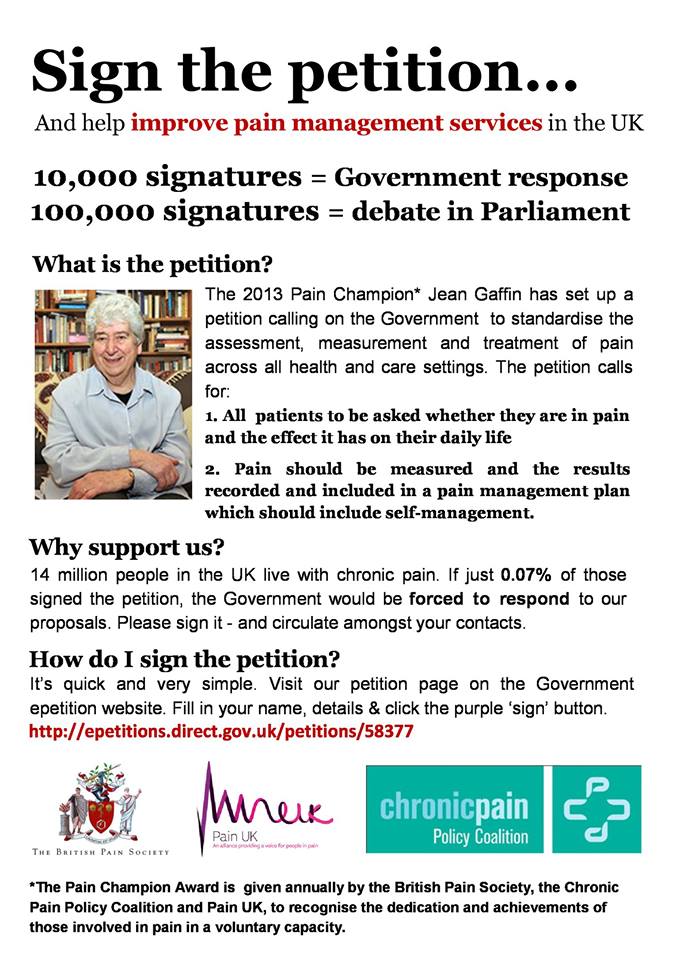
photo of the petition on pain leaflet
#PainPetition campaign leaflet

I am never asked how my pain is by my GP even if I go about my pain. When I see my surgeon it is usually because I am suffering and he asks me where the pain is and what type of pain but there is no pain measurement and he rarely touches me which I find surprising!

Chronic pain patient

Is this something you experience when you visit your doctor?

How would you feel if next time you go to see your first-contact doctor they ask whether you are in pain and what effect this has on your daily life? Would you feel more assured that your pain is managed and treated more effectively if your pain was measured regularly and the results recorded and included in a pain management plan? Do you feel asking about pain should be as routine as taking a temperature or blood pressure?

Jean Gaffin, Pain UK’s Pain Champion for 2013, thinks each of these questions should be answered YES. Jean has started an online petition calling for the UK Department of Health, along with organisations responsible for setting standards of care, to improve the way people in pain are treated.

You can sign the e-petition by visiting the following link: http://epetitions.direct.gov.uk/petitions/58377

Follow up the campaign on Twitter using hashtag #painpetition

Jean said: “Many people living with chronic pain suffer in silence – even when talking to their doctor or other healthcare professional. People in pain may find it difficult to talk about it when they are with a health or care professional.  Patients should be asked whether they are in pain, and how it affects their daily living. Pain should be measured and the results recorded and included in a pain management plan which would include self-management.

If asking about pain was as routine as taking a temperature or blood pressure people living with chronic pain could be helped routinely and regularly to manage their pain and have it treated effectively instead of suffering in silence.”

Pain should be measured regularly. In asthma patients the respiratory flow is measured and in diabetes, blood sugars are measured, so why is nothing measured for pain patients?

Chronic pain patient

The petition needs 100,000 signatures to be eligible for a debate in the House of Commons and 10,000 signatures before it will prompt a response from the Government. So far, 2,130 people have added their support , however we are aiming for as many as possible. The petition closes  in December.

Jean added: “There are over 14 million of people in England who live with chronic pain, and if each of them signed the petition the UK government would receive a very clear signal from the pain community. We’ve only got 4 months to move it closer to the required number of signatures. We are therefore asking you: please join us in supporting this important cause, sign the petition and pass on the word. Let’s take care of the UK pain services and shape the way we want to have chronic pain treated.”

Peer Support. Join the community

“Having chronic pain is very lonely.”

Join the community

Subscribe to Pain Matters

Everything you need to know about how to live with chronic pain

Subscribe


In pain? Don’t understand what’s happening?

“Having someone to help you prepare for your life through pain”

Our Pain Education Sessions

Fundraise for Pain Concern

Help us to help others

Fundraise


How to get support in regaining independence and the physical and mental health benefits of social exercise

This edition has been funded by a grant from the Moffat Charitable Trust.

How can people left disabled and housebound by chronic pain be supported to live independently? Producer Paul Evans visits two Edinburgh-based organisations with different approaches to transforming the lives of people in pain.

The Lothian Centre for Inclusive Living (LCIL) is run by disabled people for disabled people with the aim, as its name suggests, of helping people to live full lives despite their condition. A key part of their service is supporting people as they apply for the benefits to which they are entitled in an often confusing and frustrating system. Jacqueline Todd recalls her struggle to be recognised as eligible for the Personal Independence Payment (PIP) and the freedom she has gained from adaptations to her home.

At the Thistle Foundation Paul speaks to members and staff about how their exercise and lifestyle classes bring people ‘out of the darkness’ of social isolation and pain. John Cunningham found the ‘supremely fit’ people at his local gym intimidating, but the welcoming and supportive environment has ‘changed [his] life dramatically’. Course leader Linda Douglas talks about the importance of finding a ‘safe space’ where people can focus on their strengths and find out what works for them.

Issues covered in this programme include: Independence, social exercise, exercise, mental health, isolation, welfare reform, disability benefits, depression, flare-up, back pain, fibromyalgia, social care, community healthcare, lifestyle course and peer support.


Contributors:

  • Kirsty Henderson, Information and Communications Officer, LCIL
  • Jacqueline Todd, service user and volunteer, LCIL
  • Linda Douglas, lifestyle management course leader, Thistle Foundation
  • John Cunningham, member, Thistle Foundation
  • Margaret Hendry, volunteer and member, Thistle Foundation.

More information:

Peer Support. Join the community

“Having chronic pain is very lonely.”

Join the community

Subscribe to Pain Matters

Everything you need to know about how to live with chronic pain

Subscribe


In pain? Don’t understand what’s happening?

“Having someone to help you prepare for your life through pain”

Our Pain Education Sessions

Fundraise for Pain Concern

Help us to help others

Fundraise


Two-thirds of people in pain have experienced discrimination at work, the findings of an online poll conducted by Pain Concern suggest.

One hundred and six people participated in the survey on Pain Concern’s HealthUnlocked forum, with 70 answering ‘Yes’ to the question: ‘Do you feel you have had any discriminatory experiences at work due to your disability/pain condition(s)? Please feel free to describe below.’

The discussion highlighted multiple examples of unlawful discriminatory practices. One respondent was told at a job interview that ‘we don’t employ people with arthritis’, while another was laid off after 27 years of service for non-attendance even though they were on statutory sick leave. The latter person successfully appealed and was awarded early retirement on health grounds.

The discussion also raised issues of employers not taking into account the stress of juggling work and pain management, lack of understanding of their ‘invisible’ condition and verbal abuse and harassment.

Amid the disappointing picture painted by the poll were some bright spots. An NHS employee was able to have her workday restructured to provide more variety and avoid lengthy periods of sitting down. Another reported that their employer made physical adjustments, including an ergonomic chair and a foot rest.

For advice on your rights, if you feel you have been discriminated against at work visit:

www.equalityadvisoryservice.com

Peer Support. Join the community

“Having chronic pain is very lonely.”

Join the community

Subscribe to Pain Matters

Everything you need to know about how to live with chronic pain

Subscribe


In pain? Don’t understand what’s happening?

“Having someone to help you prepare for your life through pain”

Our Pain Education Sessions

Fundraise for Pain Concern

Help us to help others

Fundraise


How shared decision making works in practice, plus, making IT work for people in pain and healthcare professionals

This edition has been funded by Pain Concern’s friends and supporters.

In this edition of Airing Pain we hear about how people in pain can take an active role in their care through shared decision making and technological tools.

‘Being collaborative is fundamental’ for managing pain, says Dave Tomson, a GP working on the MAGIC Programme (Making good decisions in collaboration). He speaks to Producer Paul Evans at the British Pain Society’s (BPS) Annual Scientific Meeting in Manchester about the advantages and challenges in developing an approach to medicine where decisions are made by doctors and patients together.

Technology can play a transformative role in empowering people in pain, but there are also pitfalls to be avoided. Jason Davies discusses the pros and cons of ‘telemedicine’ as a pain specialist working in the remote Argyll region of north western Scotland. Other members of the BPS Special Interest Group on Information and Communication Technology discuss the things patients and doctors should be looking out for when using online resources and the cultural change needed to make technology work – people in pain empowered to take responsibility for their pain.

Issues covered in this programme include: Technology, IT, policy, funding of pain services, patient involvement, telemedicine, remote/rural areas, online, web, internet, multidisciplinary, accessibility, access to health services, medication, side effects, collaboration, managing consultations and telephone consultations.


Contributors:

  • Dr Dave Tomson, GP
  • Meherzin Das, Clinical Lead, Dorset Pain Management Unit and Chair of the British Pain Society’s Information and Communication Technology Special Interest Group
  • John Worth, Founder and CEO of Know Your Own Health
  • David Barrett, Member of the British Pain Society’s Information and Communication Technology Special Interest Group
  • Dr Jason Davies, Consultant Anaesthetist, Lorn & Islands Hospital, Oban and Clinical Lead, Argyle Pain Service.

Peer Support. Join the community

“Having chronic pain is very lonely.”

Join the community

Subscribe to Pain Matters

Everything you need to know about how to live with chronic pain

Subscribe


In pain? Don’t understand what’s happening?

“Having someone to help you prepare for your life through pain”

Our Pain Education Sessions

Fundraise for Pain Concern

Help us to help others

Fundraise


How shared decision making works in practice, plus, making IT work for people in pain and healthcare professionals

To listen to this programme, please click here.

In this edition of Airing Pain we hear about how people in pain can take an active role in their care through shared decision making and technological tools. ‘Being collaborative is fundamental’ for managing pain, says Dave Tomson, a GP working on the MAGIC Programme (Making good decisions in collaboration). He speaks to Producer Paul Evans at the British Pain Society’s (BPS) Annual Scientific Meeting in Manchester about the advantages and challenges in developing an approach to medicine where decisions are made by doctors and patients together.

Technology can play a transformative role in empowering people in pain, but there are also pitfalls to be avoided. Jason Davies discusses the pros and cons of ‘telemedicine’ as a pain specialist working in the remote Argyll region of north western Scotland.

Other members of the BPS Special Interest Group on Information and Communication Technology discuss the things patients and doctors should be looking out for when using online resources and the cultural change needed to make technology work – people in pain empowered to take responsibility for their pain.

Issues covered in this programme include: Technology, IT, policy, funding of pain services, patient involvement, telemedicine, remote/rural areas, online, web, internet, multidisciplinary, accessibility, access to health services, medication, side effects, collaboration, managing consultations and telephone consultations.

Paul Evans: You’re listening to Airing Pain, a programme brought to you by Pain Concern; a UK-based charity working to help support and inform people living with pain and healthcare professionals. This programme has been funded by Pain Concern’s friends and supporters.

Now, do people with chronic pain really have a say in how we’re treated? Are we given the right information to make informed decisions? Are our views as experts in how our pain effects our lives really taken on board? And do the different disciplines in the health profession who manage us treat us as conditions or as individuals? Indeed, do they communicate with each other at all?

These issues were addressed at the British Pain Society’s annual scientific meeting in Manchester, when Dave Thomson, a GP in the North-east of England, spoke about shared decision making and his involvement in the MAGIC programme. And that’s an acronym for ‘making good decisions in collaboration.’

Dave Thomson: The MAGIC programme has been an implementation programme in hospitals and general practices to try and work with front-line staff, and with patients, so that they are making better decisions together: by sharing information, looking at the pros and cons of different options and arriving at a decision that’s best for the patient, that fits.

Evans: So where are the barriers to shared decision making?

Thomson: There are lots. I mean, for good shared decision making, you need good information. So one of the challenges is we don’t have good information about lots of the things that we do. What is the relative benefit of exercise programmes versus cholesterol lowering drugs? Or in a pain context, we have very poor evidence about how many people given an opiate for muscular skeletal pain will improve, versus the number of people who will improve using exercise as their way of coping with their pain, or improving their pain. So one problem is evidence.

The second problem, I think, is that many professional, many clinicians, are uncomfortable – in a number of ways – with really opening up the dialogue to being shared. So some may believe that patients won’t be able to understand the details or the complexities of the science, if you wish – the evidence. Some may think that there’s not enough time to do it adequately, and that it’s the patient’s job to trust them. So I think there are a variety of barriers at a clinician level and then I think there are some barriers or challenges for patients. So some patients may wish to put themselves in the hands of a clinician and simply say, you know, ‘tell me.’

Evans: ‘Doctor, fix me.’

Thomson: ‘Doctor, fix me.’ And of course [they] may actually even be resentful of the idea of a doctor saying, ‘well, actually, I’m very unlikely to be doing most of the fixing here. Most of the fixing is gonna [sic] be you and, what I can do is help you understand better and worse ways of handling your condition, but in the end, if you don’t do the exercises, or do the stretches, or do the pacing, that’s in your court.’

And so shared decision making is actually an invitation for patients to be much more engaged themselves. And some of the barriers are around patients that want to be passive, want to be held, want to be simply looked after.

Evans: But to share a decision – it means that we both have to be informed about the other, if you like. I, as a patient, need to know how you can help me and how I can help myself.

Thomson: Yeah, yeah, yeah. We need a number of things. We need the information that we can share together about what works and how well it works. We also need to understand what matters to you. If you think about any decision, what’s best for you might not be best for someone else. It might be that, you know – if we take a very simple example like taking a cholesterol lowering tablet, a tablet that lowers your cholesterol – which there’s very good evidence is likely to reduce your risk of heart disease.

But it means taking a tablet every day and it has the potential for side effects. And some people believe, you know, ‘I don’t think, for me, taking tablets is what I like to do. I’m prepared to take that extra risk.’

The science would say everyone above a certain age with other risk factors should take one of these things; but the science doesn’t take into account your preferences. So, a good shared decision has to be about what matters to you.

And you may not know what matters to you in terms of this particular decision, until you’ve started to explore the territory with someone. So your preferences at the beginning of a conversation about a treatment option may actually change as you understand the pros and cons – the benefits and risks – of any one option.

Evans: That’s a good example, because I am that person on the verge of taking a cholesterol lowering tablet.

Thomson: OK.

Evans: I’m at the point where I’m getting pretty fed up of the medical profession arguing amongst themselves and giving me conflicting advice.

Thomson: OK

Evans: Mainly through the media. Not through face-to-face health professionals.

Thomson: Yeah. Yeah.

Evans: So, does the medical profession need to get its own shop in order before asking me to help out on my decisions?

Thomson: Well, yes and no. I think, in a sense, understanding that there are not such clear options – welcome to the real world, patient. If you thought that you would come to me and I’d tell you, ‘it’s very clear – this works, this doesn’t work, it’s all very straight forward’ – probably you’ve never experienced chronic pain. But I know you have had chronic pain and that is a field where we know very little, where we’re discovering lots, where lots of it’s conflicting and there are lots of different ideas going round – so it’s messy; it’s not straightforward.

And actually the science around lots of things is not straightforward. And at some level, if we are going to both be adults, we both have to accept that it’s actually a bit messier. I can pretend that it’s all nice and straightforward and treat you like a child, and you can pretend to be a child and accept my… unquestioning… you know, advice. And that’s a world that, you know, we’ve maybe been in, but it’s not a world that I’m interested in working with patients in.

Evans: And that’s not shared decision making.

Thomson: No, no. Shared decision making, you have to share some of the messiness. The fact that it is not straightforward. And in pain it’s particularly tricky, I think, because we have very poor evidence. And sometimes we find it difficult – patients and clinicians find it difficult to actually agree, about what the nature is, of the problem. And if we can’t even agree about the nature of the problem, and the meaning and understanding we attribute to that, that wraps up that problem, then we’re in trouble in terms of discussing what might options be.

But I think what we need to do is, we need to try. We need to start that conversation, we need to start the effort of treating each other as adults. Of exploring together what we do know; arriving at shared meaning, shared understanding and then beginning to say, ‘well, you know, if that’s where we’re starting, these are some of the options and this is what we do know about these options.’ And beginning to then be in a more collaborative place. And certainly in chronic pain, being collaborative is one of the fundamental… you know, we really need that more than in many things.

Evans: That was Dave Tomson. I’ll just remind you that while Pain Concern believes the information and opinions on Airing Pain are accurate and sound, based on the best judgement available, you should always consult your health professional on any matter relating to your health and well-being. He or she is the only person who knows you and your circumstances and therefore the appropriate action to take on your behalf.

Yes I know, I say that in every edition of Airing Pain. But I think it’s particularly relevant [to] the amount of information and disinformation available to us at the click of a mouse key on the internet and social media. How can we trust what we find on search engines? and how can current and developing internet technology be used in the management of chronic pain? These are just some of the issues that a new special interest group of the British Pain Society will address.

I went along to the launch of this information and communication technology group at the Society’s annual scientific meeting; where I spoke to Meherzin Das, who’s clinical lead of [the] Dorset Pain Management Unit, and chair of the [ICT] group, along with David Barrett, one of the committee members, and John Worth, founder of Know Your Own Health, a provider to the group community.

John Worth: The internet and IT services can be very powerful in supporting people with long-term conditions with pain and so on. But what’s key is that actually it doesn’t replace human – warm, human, equitable support – but what it can do is, it can create the conditions and the foundations within which things can be organised better. Information can be exchanged better. People can go and find, you know, the information that they’re looking for and access the type of support that they want. That’s the sort of… the thrust of the work that we’re doing.

Evans: That’s the thrust of it; but what does it mean to the patient?

Meherzin Das: Speaking as a clinician, ICT has a lot to offer, in terms of complementing clinical work done in hospitals and community care settings. So the website that John’s set up for us, for example, which is Soaring Above Pain within the Dorset Community Pain Service, helps patients by providing lots of handouts, data sets that they’ve got from clinicians, so patients have those to access at home and can track their own goals and own progress and therapy, and set up what they’d like to, as part of their recovery process from pain. And I use that word ‘recovery’ in inverted commas, because it has different meanings to different people, but it’s very much part of learning to soar above pain; learning to get a handle on, a grip on their pain and learning to live life meaningfully despite being in pain.

David Barrett: Listen, what we’ve done is to use the technology to enable patients to communicate [with] or see doctors online, but without having to leave their homes. So if someone is in particularly bad pain and can’t get out to see their doctor, they’re able to do that online and still get the information and feedback from the doctor in a face-to-face situation, but using a technology that’s available these days.

Evans: I guess it’s particularly valuable – as you say for people who can’t leave home – but [also] for people in rural areas.

Barrett: Absolutely. I think this concept of tele-medicine has been used out in the wilds of Scotland for some time and it’s certainly going to be useful to that patient group, I would have thought, for sure. And what we’ve done with my clinic for pain is to take that model that’s been used – that was mainly for cardiac patients – but we’ve taken that model and extended it to be used in the pain area.

Evans: Taking the human face away from a doctor/patient consultation; is that a good thing or a bad thing?

Barrett: Well it’s not taking the human face away because they’ll be able to see each other, as you would with a – lets for example a Skype or a Face Time discussion. So you can see the doctor, the doctor can see you, and the beauty of it is it can be recorded and stored on the patient’s home page if you like, for the patient to review at a later date. So if they’ve missed something that the doctor said, they can go back and look through the video again and pick that up and put it into action. So that’s the start of it. And linking it into what John’s company does, is to lead patients down the path of self-management, using this as a tool to help the patients, rather than using it to drive what happens. So it’s an assist to the doctor and the patient, rather than taking over.

Worth: Yeah. I mean you can’t assume that technology is going to answer the problem. It isn’t going to answer the problem. What you need to do alongside the introduction of technology is to introduce, work around, systemic change and cultural change within the practices that you’re kind of delivering. So it doesn’t happen overnight: it’s something that needs to be introduced to people, to patients, to citizens, who are more used to kind of just rocking up at a surgery and asking to be fixed. The opportunity with IT is to create an infrastructure that enables people to start to view their options and things that are available to them. Which include clinical services and other kinds of support that they might be able to get out there.

Evans: I glibly said it’s removing the face, if you like, of the doctor. In actual fact it could be viewed as bringing the doctor to you, rather than you having to go to the doctor.

Barrett: Yeah, I think that’s certainly true. From my own personal experience of seeing my own GP, we sit there in a room, we don’t make any eye contact. He’s looking at his computer screen and talking to me and writing notes! Now this is clearly…with my clinic for pain, you haven’t got any choice. You have to see the doctor face to face, so that you’re both looking at each other with eye contact. So, I mean, in fact in some ways this might be even better than the situation in the doctor’s office.

Evans: There is no hiding.

Barrett: Absolutely! And it’s all recorded too, so it’s there for everybody to see. And the CQC, as you can imagine, love that!

Evans: CQC?

Barrett: Care Quality Commission.

Evans: You’ve just finished all the development work and you’re going live. Now what does that mean – how will it be rolled out?

Barrett: Well, it means doing some trials with a number of patients and making sure we can get rid of all the bugs that will inevitably be in the system and making it as easy as possible for people to use. Obviously we developed it in house and we know how it works – we know it inside out – but of course the patient won’t know that, so we’re going to have to trial it with real life patients and then see how things go from there and make the changes and improvements. And I think some of the ideas that John has got also will feed very much into what we’re trying to do.

Worth: The IT aspect is really just the means by which you set up infrastructure to enable people to access the care and support that they want. So, David’s solution might be one option of many within a range of options open to a person who’s managing pain on a daily basis. What we’re interested in primarily is what happens to that person in between their clinical appointments. So, you know, if you imagine between March and October – what happens to that patient? Between the March appointment and the October appointment, what are they doing in between times? They’re self-managing. What options have they got that are available to them to increase and improve their self-management, to increase their levels of confidence and their skill and make good informed decisions about the types of medications and treatments that they might, or that they could be receiving.

Evans: You see, I think the term IT – information technology – is an outdated term. It is no longer static.

Worth: What you’re saying is absolutely right. What we’re looking at, in all walks of life, whether you’re catching a plane or wanting to do your shopping, digital services are kind of prevalent – and they’re going to be more and more prevalent within healthcare. So what do you need to do to enable digital services to work well within the very complex nature of healthcare?

And, our understanding, and the work that we’re doing, is to identify how you manage the interdependence between digital services, clinical services and the work that people need to do to self-manage their long-term health conditions. So those are three core components that need to work side by side. It’s a really exciting part of the whole healthcare landscape. It’s something that’s in policy, but [that] very, very few people know how to deliver or know what to commission at the moment. There’s an inevitability that that’s the direction we’ll travel.

Barrett: And I think the key to it is not to use it as a substitute for other means of treating patients, but as an aid. And that’s, I think…hopefully we’ll take the fear away. It’s not something that’s going to take over people’s lives. It’s going to be part of their lives and to help improve their quality of life.

Jason Davies: I’m Dr Jason Davies, I’m a consultant anaesthetist in Oban and I run the pain service for Argyll.

Evans: Oban, that’s the far north of Scotland?

Davies: It’s about a hundred miles north west of Glasgow. At the moment there is an initiative to try and see if we can better deliver our services to the more remote parts of our community, which are not well served, it would be fair to say, at the moment. And also that the work is done, pretty much, all by the patient. You know, if they want to gain access to these services – for instance, if you live on Islay or somewhere like that, you have to go to Glasgow. And Glasgow is better to travel to because you can actually fly there, so it’s a less onerous journey. But it would be better if we could deliver, if they didn’t have to travel as much. I’m not saying that they wouldn’t have to travel at all, but if you could actually deliver something effective – and I think that’s the key word – deliver something effective locally then that, I would think, has got to be a good thing.

Evans: But is travel the only benefit?

Davies: Not necessarily. I mean, you know, obviously you’re delivering a sort of secondary care-type service – a more comprehensive service, perhaps, to the patients – but you’re also supporting GP’s. So you’re educating, you’re supporting – there’s lots of collateral benefits that you get as well.

Evans: And face-to-face consultations.

Davies: Well, I like the idea of actually seeing the person! And I think, with the limited experience that we’ve had by telephone – it may be that I’m a bit of a dinosaur in that respect – but I like to see people, I like to touch people and moving into tele-medicine, which has got to be the way to go – there is no doubt about that – it’s a different experience for me, but it’s also a different experience for people as well, because I think people like to be seen!

Evans: It also, I guess, puts patients a little more in control.

Davies: Which is where we want them. Because we know that if they take care of themselves, they take an active interest in policing their pain, then they do much better.

Evans: So it’s something of interest for you.

Davies: It has to be an active experience for them – yes, yes.

Barrett: I’m going to try and see if I can link up to our office in a minute, to show you how the thing works… and it’s just like a normal face-to-face conversation. Any notes that the doctor makes would appear in here, and if he’s prescribed something, we run an internet pharmacy, so you could actually buy that from the pharmacy now. But it’s also got the patient information leaflets.

This may be a bit difficult in the north of Scotland, but within a ten-mile radius of where you live, it will identify all the back-up services that you need. So if you want, let’s say an acupuncturist near your house, then it’ll give you the address and phone number…

Davies: Probably not as useful for us.

Barrett: No, exactly!

Davies: When it’s up and running, it all sounds great. But how do you get from the point of not having anything, to the point where – I mean, we do have broadband access to all the islands because that was a Scottish Government priority.

Barrett: Broadband access and a laptop, you can do this anywhere.

Davies: Tele-medicine is the way ahead for us, because we can’t physically be everywhere. Telephone is OK, it gets information, but you lose a lot of visual clues, you lose a lot of non-verbal communication, which can be quite relevant in terms of the consultation. I mean at the moment the patient questionnaire that we’re using is a handwritten questionnaire.

The questionnaire gets sent out, the patient fills that in with various scoring systems and what not, that comes back, and then we have a telephone consultation. Often that will either be quite clear where they’re going, or what needs to be done, or what advice needs to be given. Sometimes it’s not and you have to bring them in. But you’re bringing them in primarily because you want to see what’s behind this sheet of paper!

Barrett: And there’s no reason why you couldn’t do that with this system online.

Worth: The work that’s going on is to produce a range of key bench marks across – not just this group – but across the whole of healthcare delivery. It’s a major priority within NHS England itself, you know, the information directorate, and the way in which data is managed, that information is managed, and so on, is something that has increasing importance.

You know, within healthcare, we’re working with a knowledge economy as much as we are with a healthcare economy. How do you manage that knowledge; how do you ensure that the quality of the information that a person is accessing is good. Anybody can type in a medical term and come up with a range of search returns. They have no way of knowing the valuable quality of the information that’s there; and part of the job of people like myself and the work that we do and that this group does, is to enable people to access trusted, filtered information that is validated across a range of different groups and inputs

Evans: Well, is it enough to know that if it’s part of the British Pain Society, then it can be trusted?

Das: Ah, no, because there’s a phrase that says, ‘In God we trust, all others must bring evidence!’ So I think the British Pain Society’s as accountable as any other organisation and for that purpose we’ve set up a whole bench-marking system by which we can validate other websites, if they want to be recognised by the British Pain Society. We’re actually working to revamp our own website as well, to create a better web presence for the society – to make it a much more user friendly website. So anyone anywhere living with pain, or clinicians working with pain, can come to us and actually say, ‘how can you help us?’ And we can help them straight away.

We’ve got a whole benchmarking process underway – there’s been a consultation which John’s been a part of, David’s been a part of as well. We’ve come up with seven criteria that we need other websites to meet: so, we want to know people’s intervention capabilities; we want a website to tell us what they can and can’t do – limits; so not to claim the earth, if they can’t actually deliver.

Websites need to be inclusive in terms of their development, in terms of including service users – engaging them not just as a reference group, but as part of the development of each web tool. Reference materials need to be included, because if you were publishing in a journal, you couldn’t just say, ‘this is what I think.’ You’d have to evidence that. And websites don’t have enough of that, so we need that to be revamped and done up.

Websites need ongoing evaluation and that has to be published, so users know what that’s all about. Website user statistics need to be included as well. And disclosure of responsibilities has to be used in line with the HSCIC Information Governance Level 2, which, I’m reliably informed, all of us should be adhering to. And it has to be accessible for people with sensory difficulties.

So, all those seven benchmarking criteria need to be fulfilled for an external website to be recognised and nominated by the BPS as one that we would recommend.

Evans: So, is there something like the old kitemark that patients and professionals can recognise…?

Das: …can rely on? Absolutely! And we’ve also developed a social networking policy, because we believe that social networking should also happen responsibly within the BPS. So, that’s been all the way to Council and ratified, so we’ve got that in place. And we hope you’re following us on Twitter, as we speak, because that’s up and about.

Evans: So if I’m a patient and you have set me a care plan, how do I know that that is relevant for me?

Das: Right… so Paul, I’ll take it one step back, if I may, and say that in actual fact care plans should be set up with patients in collaboration. So we’d never set up a care plan for you: it’s very much with you, depending on the goals and objectives you want to meet as part of your treatment.

So, in the field of pain, there aren’t any PROMs available ­– and PROMs stands for patient reported outcome measures. So other fields have them in terms of what outcomes are patients looking for ­– individual patients ­– but pain doesn’t have them. So at Dorset Community Pain Service we’re working very hard to set these up and we have four cornerstones of therapy and those are personal development goals, such as, emotional development; physiotherapy – and physical development and fitness lead that, things like that; we have medication, understanding pain, as a third one; and then we have relaxation and working with leisure activities, hobbies, things like that. So those are the four cornerstones and, within that, patients identify what they want to work on.

So the thing that we’re trying to set up is to have that linking all the way from when a patient goes to their GP and says, ‘help ­– I’m in pain!’ So GPs will those which we’ll feed to all our 104 surgeries in Dorset and then when we receive their referral forms, patients will identify what they want to work on. When they come for an assessment will stamp that in and make sure that’s really what the person wants to work on. Then, when they go away and work with self-management with the website that John’s developing, we’ll have those on the website as well.

So, all through the patient’s journey, we’re working with the same objectives that the patient has identified, because all too often happens is there’s a disconnection between what GPs believe, what consultants believe and what someone else wants and the patient is nowhere to be seen in the middle of that. So we’re going to do away with all of that and have goals that the patient identifies, because they’re the centre of the process.

Evans: So, I go along to my GP in Dorset, we identify that I have pain and then what happens?

Das: The GP would say, ‘what about the pain is the worst thing for you? Is it the pain itself? Is it that you’re worried about pain? What do you… how do you live your life? Has it stopped you from doing things?

Evans: Oh no – but I’d go to the GP and say, ‘I want to get rid of my pain.’

Das: Absolutely. And that’s the GP’s job. Because we talked to all of the 104 surgeries we have… we have staff going out to ‘educate’ – in inverted commas – all the GPs on pain management. So the GPs now know that it’s not just about getting rid of pain: it’s about living life around pain, intractable pain. So GPs then share that message with patients from step one. The patients no longer come into the pain service saying, ‘get rid of my pain’ – they’re actually saying, ‘can you lessen my pain, decrease my pain? and how do I learn to live with my pain?’ So that’s the message we’re sending out.

Evans: And that’s a very powerful message.

Das: It’s a very important message, sadly, because, till we have a magic solution or a magic bullet to take pain away, you know, we’re left with self-management. So we have to do our very best to let patients somehow learn to cope with their pain.

Barrett: It’s about helping the patient to learn how to take responsibility for their pain, rather than the doctor taking over that responsibility and handling it on their behalf. This is about the patient taking control and managing their own lifestyle according to what they can do, as opposed to focusing on what they can’t do. I think that’s the key to it for me, is helping them achieve, rather than not achieve.

Evans: Yes – self-management doesn’t mean, ‘go away and get on with it’. It means, ‘let’s find a way of living with this and putting pain further down the list of issues.

Barrett: Yes – and there are a whole lot of other organisations there to help the patient achieve that: it’s not one person on their own. And I think what Meherzin has achieved in Dorset is to bring all those agencies together for the benefit of the patient, not the benefit of the doctor. That’s what’s making a difference there, I believe.

Evans: Dave Barrett at the launch of the British Pain Society’s Information and Technology Special Interest Group.

Don’t forget that you can still download all editions of Airing Pain from our website: that’s painconcern.org.uk, or you can obtain CD copies direct from Pain Concern. If you’d like to put a question to our panel of experts or just make a comment about these programmes, then please do so via our blog, message board, email, Facebook, Twitter, all the contact information is on our website, once again it’s painconcern.org.uk. There you’ll also find details of Airing Pain’s companion magazine Pain Matters, which is available as an online subscription or direct by post.

Last words to Meherzin Das, Clinical Lead at Dorset Pain Management Unit and Chair of the British Pain Society’s Information Technology and Communication Technology Special Interest Group…

Das: You know, my heart goes out to every single person with pain because I think there courage is absolutely inspirational, because if I was living with pain non-stop, I don’t think I would want to be in pain either. And I say to all my patients that I’m inspired by their brand of courage each and every single day.


Contributors:

  • Dr Dave Tomson, GP
  • Meherzin Das, Clinical Lead, Dorset Pain Management Unit and Chair of the British Pain Society’s Information and Communication Technology Special Interest Group
  • John Worth, Founder and CEO of Know Your Own Health
  • David Barrett, Member of the British Pain Society’s Information and Communication Technology Special Interest Group
  • Dr Jason Davies, Consultant Anaesthetist, Lorn & Islands Hospital, Oban and Clinical Lead, Argyle Pain Service.

Peer Support. Join the community

“Having chronic pain is very lonely.”

Join the community

Subscribe to Pain Matters

Everything you need to know about how to live with chronic pain

Subscribe


In pain? Don’t understand what’s happening?

“Having someone to help you prepare for your life through pain”

Our Pain Education Sessions

Fundraise for Pain Concern

Help us to help others

Fundraise


How pain affects the relationship between adults and young people and tips from a family therapist

This edition has been funded by the City of Edinburgh Council and NHS Lothian’s Self-directed Support Innovation Fund.

In the second of our two programmes focusing on young carers for people in pain, we hear about the effect of pain on relationships between parents and children.

Family therapist Liz Forbat explains how pain can disrupt transitions from childhood to independent adulthood, especially during those difficult teenage years. She discusses with presenter Paul Evan’s his ‘martyrdom’ approach to managing chronic pain – he recalls keeping his children at a distance from it – and the dangers of building barriers between family members in a bid to protect them from the effects of the pain.

We hear the young person’s perspective from Kim Radtke, who grew up with a father often made irritable and emotionally unavailable by his ankylosing spondylitis. The situation was exacerbated, Kim says, because she and her brother did not fully understand the condition and were therefore unable to empathise and communicate with their father about it. Only as an adult has she been able to make the step – so important, according to Liz Forbat – of separating the pain from the person.

Issues covered in this programme include: Family therapy, children and young people, relationships, parents, young carers, ankylosing spondylitis, psychology, communicating pain, siblings, school, anger, frustration and feelings of martyrdom.


Contributors:

  • Kim Radtke
  • Liz Forbat, Family therapist andReader in Cancer and Palliative Care, University of Stirling.

More information:

  • To find a qualified family therapist or for more information visit the UK Council for Psychotherapy website: psychotherapy.org.uk

Peer Support. Join the community

“Having chronic pain is very lonely.”

Join the community

Subscribe to Pain Matters

Everything you need to know about how to live with chronic pain

Subscribe


In pain? Don’t understand what’s happening?

“Having someone to help you prepare for your life through pain”

Our Pain Education Sessions

Fundraise for Pain Concern

Help us to help others

Fundraise


1 33 34 35 36 37 49