Information & Resources

Find information and resources to help manage your pain.

Get Help & Support

Find the tools you need to
help you manage your pain.

Get Involved

Help make a real difference to people
in the UK living with chronic pain.

About Us

Find out about Pain Concern and how
we can help you.

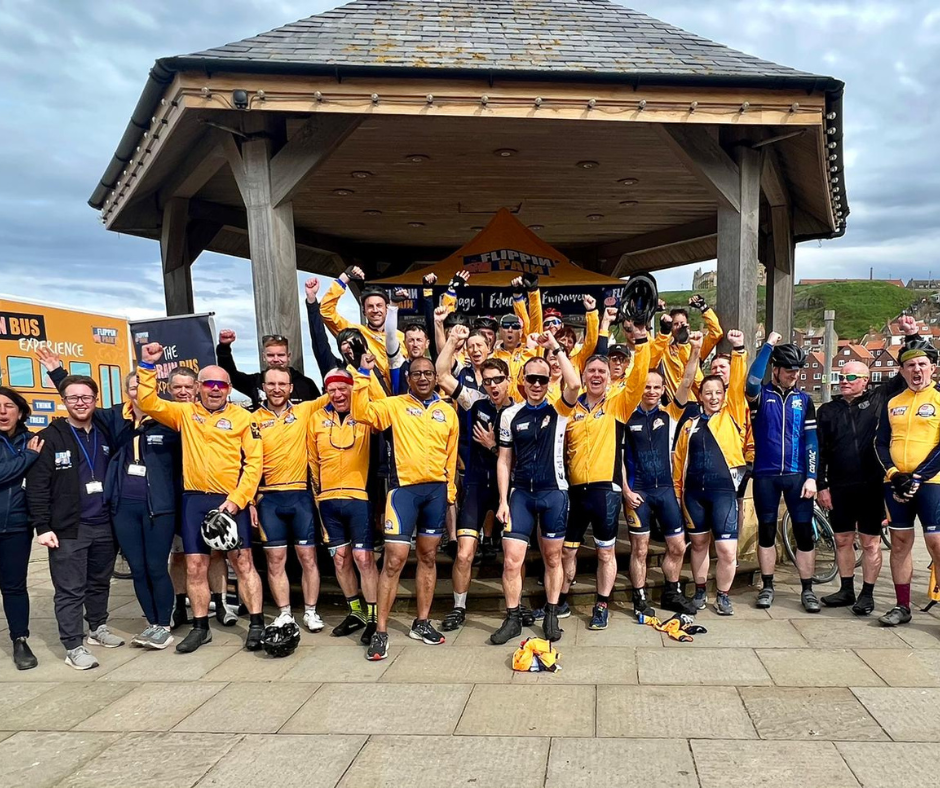
From 7 – 12 May, a group of cyclists travelled in and around the north-east of England, sharing the latest understanding of pain science and management with the people who could benefit the most.

The group behind this feat is Flippin’ Pain, a public health campaign that aims to help people change the way they think about, talk about and treat persistent pain for the better.

Pain education awareness tour

In six days, the team visited eight different communities, holding their trademark ‘Pain: Do You Get It?’ public talks, delivering workshops for local healthcare professionals, and engaging passers-by with the ‘Brain Bus Experience’:  their interactive science lab on wheels.

Final sum raised

The team of 25 cyclists were raising awareness of the tour by completing a week-long peloton. After battling rain and a lot of hills, the team reached their goal of over 180 miles (and more than 10,500 ft of hills!) and raised over £6000 for Pain Concern.

A huge thank you to everyone who took part or donated.

Peer Support. Join the community

“Having chronic pain is very lonely.”

Join the community

Subscribe to Pain Matters

Everything you need to know about how to live with chronic pain

Subscribe


In pain? Don’t understand what’s happening?

“Having someone to help you prepare for your life through pain”

Our Pain Education Sessions

Fundraise for Pain Concern

Help us to help others

Fundraise


This edition of Airing Pain platforms four internationally recognised clinicians from the British Pain Society Annual Scientific Meeting 2022. 

Pain management: What’s around the corner?

Recently healthcare technology and innovation has seen a rapid acceleration, particularly following disruption caused by the Covid 19 pandemic. In this edition we look around the corner and examine the most current technological advances for pain therapy, especially those that can be used with or even in replacement of conventional medical treatments. 

The Airing Pain team attended the British Pain Society ASM in 2022, to listen and interview top thought-leaders on pain technology advancements and the projects they are working on. Hear them introduce their specialist areas of: new scientific evidence for fibromyalgia; neuropathic pain in the form of phantom limb and post-surgery back pain; and cutting-edge developments in neuromodulation techniques, specifically non-invasive Virtual Reality and Gaming for treating neurological distortions. 

Contributors: 

  • Dr Stephen Ward, Chair of Scientific Committee, St Thomas Hospital London 
  • Dr Simon Thomson, Consultant, Pain Medicine and Neuromodulation, Mid and South Essex University Hospitals NHS Trust 
  • Dr Owen Williamson, Pain Medicine Specialist, School of Interactive Arts and Technology at Simon Fraser University Vancouver British Columbia 
  • Dr Timothy Deer, Interventional Pain Doctor West Virginia and President of The Spine and Nerve Centers 

Time Stamps: 

0:20 – Introductory quotes of internationally recognised Clinicians from the British Pain Society Annual Scientific Meeting (ASM). 

1:24 – Introduction by Paul Evans to British Pain Society ASM attendance. 

1:58 – Dr Stephen Ward, Chair of Scientific Committee, St Thomas Hospital London, on emerging scientific evidence for the study of Fibromyalgia. 

5:16 – Dr Simon Thomson, Consultant, Pain Medicine and Neuromodulation, Mid and South Essex University Hospitals NHS Trust introducing the basics of neuromodulation and neuropathic pain, using secondary back pain as an example. 

11:10 – Dr Simon Thomson on the process of Spinal Cord stimulation and equipment. 

18:33 – Dr Owen Williamson, Pain Medicine Specialist, School of Interactive Arts and Technology at Simon Fraser University Vancouver British Columbia, on virtual reality (VR) for chronic pain treatment, particularly the uses of VR for painful distortions. 

25:05 – Dr Owen Williamson on his talk titled ‘Modifying the Matrix: Virtual Reality’ at the British Pain Society ASM. 

30:22 – Dr Owen Williamson on potential drawbacks to using VR Therapy. Followed by a discussion of mitigation techniques; artificial intelligence and body sensors for patient-monitoring in virtual environments.  

32:56 – Invitation to fill out our Online Survey.

32:42 – Introducing Dr Timothy Deer, Interventional Pain Doctor West Virginia and President of The Spine and Nerve Centers of the Virginias on the future of personalised management and remote home programming to benefit those living with chronic pain. 

39:08 – Dr Owen Williamson discussing the optimistic yet cautionary future of virtual reality and wider emerging technologies for pain therapy; the importance of preserving empathy as typically found in the doctor-patient relationship. 

Special Thanks:

This edition of Airing Pain was possible thanks to support from the British Pain Society.


More Information:

Airing Pain 61: Deciding Together
Pain Matters 73: Neuropathic Pain Issue
Manage Your Pain leaflet
Chronic Pain and Health Inequalities

Peer Support. Join the community

“Having chronic pain is very lonely.”

Join the community

Subscribe to Pain Matters

Everything you need to know about how to live with chronic pain

Subscribe


In pain? Don’t understand what’s happening?

“Having someone to help you prepare for your life through pain”

Our Pain Education Sessions

Fundraise for Pain Concern

Help us to help others

Fundraise


First broadcast 26th April 2023


If you would rather listen to the podcast and watch subtitles, take a look at our Youtube video.

Paul Evans This is Airing Pain, the programme brought to you by Pain Concern, the UK charity providing information and support for those of us living with pain, our family and supporters, and the health professionals who care for us. I’m Paul Evans, and we’re grateful for the support of the British Pain Society in the making of this edition of Airing Pain.

Dr Simon Thomson It is a very exciting new thing which has got a long way to go and it’s just really a matter of giving hope to people with secondary back pain, so it’s not a primary pain disorder. It really is one of those game changers.

Dr Timothy Deer Doctors who use the same exact device on every patient will be out of the mainstream. You’ll come in, you’ll meet a doctor who’s open-minded and they’ll look at some markers whether it be your imaging, your blood test, your urine biomarkers, with some factors. We’ll look at those and then we’ll get on the table and put the small wire in and the wire will measure your spinal cord and tell us how your spinal cord responds to different types of electrical current. Based on that, we’ll choose to put in a certain device or a certain waveform that day and we’ll have probably a 95% or more predictability, and we’re seeing this already.

Dr Owen Williamson People who have osteoarthritis in their fingers tend to perceive their hands as smaller than they actually are, and if you put them in a virtual environment and stretch the hands so they perceive them as normal, the pain goes away.

Evans: In the spring of 2022, we at Pain Concern attended the British Pain Society’s annual scientific meeting. It’s an event we always like to go to, to hear internationally recognised clinicians and researchers from around the globe exploring and sharing new developments and ground-breaking research in the pain community. And through Airing Pain, we share that with you. Dr Stephen Ward is chair of the Scientific Programme Committee, which sets the agenda of the meeting. He’s a consultant in pain medicine at Saint Thomas’ Hospital in London, which is probably Europe’s largest pain clinic.

Dr Stephen Ward: Pain management is a specialty. It’s pretty small and we only get to see each other probably on this one occasion per year as a group of individuals. You know, a lot of the discussion is not held in the auditorium, it’s afterwards in restaurants and bars and so on, so it’s a chance to catch up, but also education.

Evans: For people with chronic pain, we don’t all know what is going on behind the scenes. I mean, some people with chronic pain, they never get further than their GP practice and can feel very, very isolated

Ward: Of course.

Evans: So, it’s important for people to know that actually all this stuff, all the science, is being talked about seriously.

Ward: Quite so. A great example of that is in fibromyalgia. You know, there’s just reams of stuff out there about latest research and so on. There are some really, really fascinating experiments in the laboratory around fibromyalgia demonstrating that if you take blood samples from humans with fibromyalgia and humans without fibromyalgia and spin the samples down and inject them into, I think, either rats or mice, the mice injected with the serum from fibromyalgic patients developed symptoms akin to fibromyalgia. I mean it’s astonishing, and it implies that fibromyalgia might be some sort of immune disease process. For people out there who have been told, “Well, you know, there’s no cure. There’s no this. There’s no that,” to just know that somebody out there is doing these experiments that in years to come that will lead somewhere. They should know that and so I tell people this in the clinic. But unless they were to come to this meeting and hear about that, you know, it’s not widely reported. It’s not the sort of stuff that gets into the newspapers.

Evans: You talk about fibromyalgia. It’s very pertinent to me because I have fibromyalgia.

Ward: And did you know about this?

Evans: No, I didn’t.

Ward: We all know about it, and it was awarded, I think, the best presentation or best poster presentation at the EFIC meeting a couple of years ago. It was big news. Well, you know now. And I hope you will learn more with the content of this meeting. In the past I think quite a bit of this was the output of laboratory research presented at a meeting, and it was called the annual scientific meeting. You could see over the years numbers drop a little bit. It’s a multidisciplinary society so I don’t think everybody wants to hear about laboratory experiments exclusively. What we try to do as a committee, and certainly personally, is open it up. At any time point in the day you could find something to interest you.

Evans: And there was plenty to interest me. That was Dr Stephen Ward. Well, after that revelation, what else as a person living with pain don’t I know about what’s around the corner? One of the speakers was Dr Simon Thompson. He’s a consultant in pain medicine and neuromodulation with the Mid and South Essex University Hospitals NHS Trust.

Dr Simon Thompson: Neuromodulation is where the nervous system is impacted by electrical stimulation, sometimes light, sometimes targeted chemicals, or sometimes electrical energy in order to modulate or change the activity of neurones within any part of the nervous system for therapeutic good.

Evans: So, neurons, that’s the nervous system, nerves and brain?

Thompson: Yep, so brain, spinal cord, peripheral nerves, autonomic nervous system.

Evans: And modulate, as you said, is to change something.

Thompson: Change the way they are functioning. So, the important thing is it doesn’t destroy them, it’s non-destructive, but it changes the way they function. Usually in the conditions we’re treating they are functioning in an unhelpful way because of the kind of injury that they’ve had, so often it corrects them to normal.

Evans: Chronic pain is defined, if you like, as pain that is there for three months after an initial cause, or perhaps there wasn’t an initial cause. So, something is happening to the nervous system.

Thompson: Really quite specifically, we are treating secondary pain syndromes where there is a cause. As we’ve got better diagnostically and through our understanding over the years, certain conditions which were known as primary, or could have been known as primary, have more of a secondary cause. You know, it wasn’t so long ago that people didn’t understand neuropathic pain, pain due to injury to any part of the nervous system, with pain felt in the body, even though there was nothing physically wrong with the body. But there was something wrong with that part of the nervous system. And so, you can damage the nervous system through infection, for example, like a viral infection, either of the cord like in transverse myelitis or peripherally like in post-herpetic neuralgia, or you can do trauma through surgical wounds, trauma wounds. The most common thing that we treat is people who have herniated discs that have caused nerve root injury. They may or may not have had previous surgery, but they have persistent pain. So, we can follow the route back and understand the cause of the pain.

Evans: So, take me on that journey from the root of the pain, the physical root of the pain, to why it should hurt in the first place.

Thompson: I think the easiest thing is to think of a herniated disc, and people often think of that as a like a washer. It’s not really, it’s like a doughnut where some of the jam has squirted out. That jam, the nucleus pulposus, in health it hardly sees anything of your blood system and importantly your immune system. And so, when it leaks out, it causes an intense local immune reaction. And it’s the inflammation that activates the nerves that are very nearby and that causes a lot of the pain. The physical mass of the material that might squirt out can also cause compression of the nerve, which actually strangely is not necessarily painful on its own but causes a sort of numbness and some tingling. But it’s the inflammatory response that initiates the acute pain. And then as healing occurs overtime, the changes in the nervous system, that whole nervous system from that nerve root through the spinal cord to the brain becomes sensitised. That’s known as central sensitisation, so even if the inflammation dies away, the changes are still there in the nervous system and that is perceived as pain.

Evans: So, the injury, if you like, has gone, but the pain processor is still working. It’s as if your nerves are amplifying something that actually shouldn’t be there. Am I right?

Thompson: It is. I mean, they’ve been changed physically, so there may have been some loss of axons which are, you know, the fibres within nerves. And so, you change that balance. There can be a change in the receptors expressed in that nerve, how nerves communicate with each other. And some people can end up densely numb in their leg, but they’ve still got pain. I mean, the most extreme example is phantom limb pain, where a limb can be removed. You don’t have a limb, but the patient’s brain map tells them that they have got a limb. In fact, they can even wiggle their toes. And sometimes they get awful pain in the phantom limb.

Evans: So, I’m going back to neuromodulation now. How would that be used in, say, the herniated disc?

Thompson: It’s important to realise that with the herniated disc, there isn’t the idea that there would be a type of surgery that in one deft operation could make it much better. But when that possibility has been exhausted, and it may be because the disc has already resolved and there is no surgical target for them to remove anything, or it can be that they’ve had an operation on that disc. They’ve already removed it and they’ve still got pain and furthermore, scar tissue. So, we have a sort of algorithm of care so that these patients are really quite common. It probably happens in about 20% of patients who have their first back surgery that they have continuing pain. Some patients put up with it. Some patients can resolve with medication, sometimes with a targeted injection, but really beyond that it’s spinal cord stimulation. You know, there’s reasons to believe that the kind of relief that you can achieve with spinal cord stimulation is so much better than repeat injections and being on drugs that actually it probably becomes an even better option. But we tend to try a few conservative type of management strategies first and then move on to spinal cord.

Evans: So, what’s involved in spinal cord stimulation?

Thompson: A day case operation in my hands. Local anaesthetic. Some sedation. An epidural placement of the lead and threading the lead up in the epidural space. On table testing with the engineer through the computer to make sure that the stimulation is felt in the right place, or the leads are in the anatomically correct place. And then implanting a pulse generator, which is like a small microcomputer and all under the skin, usually under the skin of the back area.

Evans: Is this a one-off procedure?

Thompson: So, it’s a rechargeable device that I use and that would last 12 years. You might need attention to it for some of the complications that may occur in that 12-year period. And then eventually, like any rechargeable battery, it doesn’t hold its charge and needs replacing.

Evans: Is there a danger that the body becomes used to this?

Thompson: So, tolerance is, or can be, a feature. I always make the distinction between true tolerance because for some people there’s been a progression of their illness. Now we have multiple wave-type devices so that can be quite good because it mixes up things so the nervous system doesn’t get you so used to it. But there’s much less tolerance with spinal cord stimulation than you see, for example, with TENS (transcutaneous electrical nerve stimulation). That’s important to realise. But I don’t take out that many because of loss of effect. And if I do, there’s more likely a sort of technical issue or an upgrading of the system that can deal with it.

Evans: At what stage would somebody with a herniated disc get to you for this operation?

Thompson: If they’ve had a hernia, the tradition has been that patients are treated conservatively. If it’s continuous, or if there are what we call red flags, and red flags are rapidly progressing neurological change, cauda equina syndrome which is loss of bladder and bowel function and saddle anaesthesia, then they go, well, for cauda equina, urgently to A&E for a decompression. If it’s rapid progression of motor problems and unbearable pain, then usually they’re best served by microdiscectomy. When the surgeons have done that and there has been some allowance for recovery, because typically people are improved for two or three months and the recurrence tends to start after about that time. Sometimes that’s after they’ve been discharged from the surgeon. So, sometimes they get sent back to the same surgeon and there’s a danger there because depending on your type of surgeon, they may feel that they can continue to treat this problem with more surgery and, you know, there are people who will treat chronic pain – well, they don’t call it neuropathic pain but leg pain – with a fusion and a further decompression and there is a law of diminishing returns on successful outcome with that. So, always take care before agreeing to revision surgery. I mean, spinal cord stimulation has been an explosion in innovation and we’re learning about new conditions that we can take on with that. But there’s also other types of neurostimulation. So, there’s restorative stimulation of the nerves that supply the core muscles of the low back. Those muscles are the multifidus muscles, and this is a treatment for, if you like, back pain secondary to multifidus muscle dysfunction where it’s not working properly, and that actually is probably the most common cause of back pain. Typically, those patients are treated, you know, with physiotherapy, core muscle exercising, and sometimes acupuncture. Sometimes they go to the pain clinic and they get interventional treatment with medial branch injections of the nerves and then radiofrequency. That can put quite a lot of patients into long-term remission. And if it’s then coupled with functional improvements, they can then reverse some of the changes that have occurred to their multifidus muscle. But quite often that fails and multifidus nerve stimulation seems to be a rather good thing to do. Not only does it relieve pain, but it actually restores the muscle function. So, typically we find once we’ve put a device in, 40 to 50% of patients are improved significantly by one year, but as each year goes by, you get ever increasing numbers improve. And so, by the time you get out to four years, which is where we are now, 80 to 90% of patients are significantly improved. And that’s in patients who’ve had low back pain on an average of 10 to 14 years.

Evans: Just explain to me what we’re talking about now?

Thompson: So, we’re talking about a device. It looks like a spinal cord stimulator. It’s got leads. It looks like that, but the leads are not in the spine, they’re around the bones of the spine. There is a nerve called the multifidus nerve, where we know anatomically where it is and it feeds into that muscle group. And so, when you stimulate it, you can feel the muscles clench. The therapy is, once it’s implanted, to produce pleasant tetanic activation of the nerve. Patients do this twice a day for half an hour, morning and evening lying down, and it wakes up the whole muscle. The problem with back pain is that that muscle gradually disappears. It isn’t activated in health, and the muscle turns to fat. It’s called fatty infiltration, which is really a sign of the dysfunction. Those muscles have to be really good at maintaining strong loads and adjusting quickly to change in loading and positioning, and they lose all of that. And then what we’re also finding is when they lose that, much like with nerve pain, they end up with changes in the brain. So the cortical representation of where the muscles are in the brain is altered. This is why chronic pain becomes chronic long term because it basically transfers, if you like, from the back to the brain.

Evans: So what you’re saying, if I’ve got this right, is that those muscles that would turn to fat, they are being exercised, if you like, by stimulation, and exercised muscles makes them grow and work properly.

Thompson: We don’t quite know about the growing yet, but it’s all about restoring, perhaps, the types of muscle fibre so that they then do their original function better again. And there are other exciting things. If we do it early enough, will it prevent some of the lumbar spondylotic changes, which is the X-ray and MRI paresis around bones where muscles attach and you get ossification of these structures because they’re being overstrained. And so, if you can then support them with your muscles, it may be that you can actually change the trajectory of the condition.

Evans: That’s really exciting.

Thompson: It is a very exciting new thing which I think has got a long way to go and it’s just really a matter of giving hope to people with secondary back pain. So, it’s not a primary pain disorder. It really is one of those game changers.

Evans: That’s Dr Simon Thompson. So, exciting stuff just around the corner. Dr Owen Williamson is a pain medicine specialist in Canada. He has an academic appointment with the School of Interactive Arts and Technology at Simon Fraser University in Vancouver, British Columbia, where he works with those designing virtual reality environments with the hope of bringing those techniques to the treatment of chronic pain.

Dr Owen Williamson: With acute pain, the virtual reality environment is mainly used to distract people whilst undergoing short-term painful procedures, and this was originally a technique used in paediatric burns units to reduce the amount of sedation children were given during dressing changes. But my particular area of interest is designing virtual environments to help manage people with chronic pain. What we know is there are certain pain conditions that are associated with distortions about the way we perceive our bodies, and those distortions are associated with pain. And if you can correct those distortions, the pain improves.

Evans: What sort of distortions?

Williamson: A common example just off the top of my head is when you go to the dentist and have freezing put in your gum and almost immediately your face feels swollen. Yet if you were to look in the mirror, it looks totally normal. So, what you have done is by having the local anaesthetic injected created a mismatch between the way your body perceives your face normally is and the way it feels once the sensation is taken away. And that manifests itself as this feeling of swelling, where in fact there’s none that’s observable. Another example that people might know about is phantom limb pain, where someone has had an amputation and yet still feels the body part that’s been removed and can in fact feel pain in that body part. So, what we’re interested in is these perceptual distortions. We do have some conditions like phantom limb pain, or the pain associated with the complex regional pain syndrome, that can be treated by treating the perceived body distortions.

Evans: Now I know with phantom limb pain, one of the treatments they use is a mirror which can – tell me if I’m wrong – rewire the brain to thinking that the limb that you see in the mirror is the limb that’s gone. Am I right?

Williamson: Right, correct. And in a way, the virtual reality environments that we use under those circumstances mirror therapy, but in fact we can extend it beyond it because we can actually, in the virtual environment, get the phantom limb or the mirrored limb, however you like to designate it – the non-functional limb – we can get it to perform a whole lot of different tasks, not just copying the movement that is reflected from a normal part.

Evans: How does that work? What is it doing to you?

Williamson: You are correct when you say at some level it’s rewiring the brain. What we have come to appreciate is that the brain as it ages doesn’t create new brain cells, but it can create new connections. New connections can bypass those areas of the brain that have either been damaged in the past – that’s what happens with stroke – or if there is an abnormal perception of pain, what we’re hoping is by using these techniques we can rewire the brain so that signals no longer present themselves to that part of the brain that codes sensations as being painful or not.

Evans: You mentioned lower back pain. What is the body distortion there that maybe you can help get rid of?

Williamson: There are a number of different distortions. For instance, if you get somebody with back pain more on one side than the other, and you get them to draw a picture of their back, they will show that the side that is painful tends to look more swollen than the normal side. If you test sensation in the painful area, the ability of the body to accurately discriminate between points of contact, for instance with sharp objects, is diminished. There are other variations in the way that people perceive touch in chronic back pain in the affected areas compared with normal people. And then ultimately if you were to look at markers of brain metabolism associated with chronic back pain, there are changes in the circuitry that perceives stimuli coming from the back as painful in people with chronic back pain versus people without back pain. So, there are both local distortions and then there are changes within the brain in people that have chronic back pain, and the hope is that through facilitating this process by which nerves can establish new connections, that then we can bypass those processes that cause signals to be perceived.

Evans: So, some of the pain medications modify the brain signal chemically, if you like.

Williamson: Correct. For instance, people get confused when pain doctors prescribe medications that are labelled as antidepressants for pain. They assume that the pain they’re feeling is not pain but it’s being labelled as depression, but in fact some of the antidepressant medications modify the way that signals are processed within the brain. Some of the common antidepressants will actually facilitate the higher structures in the brain to suppress pain signals. Other ones will increase the ability of the brain to send pain dampening signals down the spinal cord, and you feel like you “head pain off at the pass”.

Evans: So, that is chemicals, or drug therapy. But that’s not what you’re talking about. You’re talking about changing the way the brain works without those drugs.

Williamson: Correct. But there is some information that it’s the same process that’s occurring within the brain, it’s just that it’s being triggered by a different modality. And so there is evidence, for instance, that doing interventional pain procedures or using medications, or using virtual reality environments, or using other forms of behavioural therapies, change signals in a similar way.

Evans: We’re at the British Pain Society at the annual scientific meeting. I saw the title of your talk, ‘Modifying the Matrix: Virtual Reality’, and what I immediately thought is these are games. It’s using gaming technology in a medical field.

Williamson: It could be thought simplistically as that.

Evans: I am simple.

Williamson: In acute pain, that’s true. Often the techniques there in virtual reality are to provide distraction. You are providing the brain with an alternate sensory input that distracts from the brain interpreting other signals as being pain signals. In chronic pain we’re actually trying to facilitate what’s called neuroplasticity, or the rewiring of the brain, in order to bypass the areas, if you like, of the brain that are involved in interpreting signals as painful, or facilitating activity in those parts of the brain that suppress the signals that are interpreted as pain. And the reason I talk about modifying the matrix is that you think about the pain sensing system within the brain as being a pain matrix, and hopefully we’re trying to modify that using virtual reality environments rather than operations, injections or drugs.

Evans: I just want to clear up something in my mind that… I mean, you talk about distraction. You distract the attention of a child when you’re changing medications. It’s not to put down distraction as a simple thing. The distraction actually changes what’s going on in your brain.

Williamson: Yes, but there is a difference between which parts of the brain are activated by having fun playing a video game versus undertaking some sort of motor skill within a virtual environment.

Evans: Let me go back to simplicity. Again, if I were having treatment using virtual reality for my bad back or chronic pain, and anything else, would I be wearing the eye things that kids use now?

Williamson: Yeah, it’s called the head mounted display. I mean, for virtual reality to work, the technology has to be occlusive, which means that you have to put something in your field of vision that causes you to focus on the image that you are receiving through the virtual reality application rather than being distracted by external cues. The whole reason for that is to ensure that the experience is immersive. But yeah, I mean the price of these things is coming down and you can have a head mounted display made out of cardboard costing $10 or less.

Evans: So, what would I be seeing through that head display? I mean, what images would be put into my brain?

Williamson: The one that we already using, we call it the virtual meditative walk. But basically it would appear as though you’re walking along a country lane and the way that we’ve developed the programme is that we can use sensors, whether it be related to breathing or skin resistance or pulse, that you learn to modulate, and in doing so you modulate the environment. So, as you walk along and feel relaxed, the stormy clouds disappear, and the sun comes up and the flowers start to grow.

Evans: But if I’m not relaxed, the rain comes down.

Williamson: Exactly, yeah.

Evans: The flowers wilt.

Wiliamson: If you get upset, then the weather gets worse.

Evans: It’s not unlike meditation.

Williamson: Meditation, in a way, is the opposite of distraction. Distraction is really outward looking. Meditation is inward looking, but both of those we would regard as changing attention. But what we’re also looking at now is changing embodiment, which is how we perceive ourselves in time and space. There is some evidence that when there’s a discord between your view of your body and the sensations you’re receiving, when there’s a discord there, you get an unpleasant sensation. And that’s why, for instance, people get motion sick because they’re looking at a steady environment like a book whilst they’re travelling in the car. But the ears are telling them they’re not stable, they’re moving around, and there’s the discord between their visual input and their vestibular balance input. Then they get motion sick. And so there are some conditions in pain that we already know about where there is a disconnect between what someone sees and what they feel. Then they can get an abnormal sensation that they perceive as pain. For instance, people who have osteoarthritis in their fingers tend to perceive their hands as smaller than they actually are. If you put them in a virtual environment and stretch the hand so they perceive them as normal, the pain goes away and it actually stays away for several hours once they leave the virtual environment. So ,under those circumstances, instead of taking anti-inflammatory medications, you might say you just need ten minutes of finger stretching in the virtual environment three times a day for the same effect.

Evans: Are there any downsides to using this sort of popular culture therapy?

Williamson: Yes, I think there are. To create a safe and effective environment is very difficult because there are just so many variables that have to be taken into account. One of the things that we find is that in some environments, instead of people feeling more relaxed, they actually feel more agitated or fearful. The problem is, if someone were to develop a game and call it a virtual environment gain for the treatment of pain and they haven’t gone through all the validation steps, under those circumstances that particular product may make someone feel worse rather than better. So, part of the development programme we do is including some form of patient monitoring so that if they are becoming distressed whilst in an environment, there is some way to mitigate that, either by taking them out of the environment or modifying the environment itself. The problem with the games, the simple games, is they can’t modify the environment in response to the patient other than to start a different chapter of a story that’s pre-written. So, we actually use artificial intelligence and body sensors so that the people in the environment are being monitored by the environment and the environment being modified in order to benefit the patient rather than cause distress.

Evans: That’s Dr Owen Williamson. Now, at the start of each edition of Airing Pain I like to remind you that Pain Concern, the UK charity, provides information and support for those of us living with pain, our family and supporters, and the health professionals who care for us. So, it’s important for us to reflect your opinions and guidance to help shape the future editions of Airing Pain, and you can help us by completing our online survey. It will only take a couple of minutes of your time and would mean a huge amount to us and the rest of the pain community. Just click on the link in the programme details or visit painconcern.org.uk/airing-pain-survey to tell us of your thoughts and we look forward to hearing your feedback. Now, if I may quote the great 16th and 17th century English poet John Donne, “No man is an island entire of itself. Every man is a piece of the continent, a part of the main.” And that, in a nutshell, was the message Dr Timothy Deer shared with delegates at the British Pain Society 2022 annual scientific meeting. He’s an interventional pain doctor in West Virginia and president of the Spinal Nerve Centre of the Virginias in the United States.

Dr Timothy Deer: My closing remarks really were about the interaction between different parts of the world. So, research that was done maybe 100 years ago in Britain may impact research in America today. Also, how we are an international community trying to help pain patients. So, if we think we’re doing something in a vacuum, we’re wrong. There’s always previous work done that influences future work if you’re smart. The other thing I talked about was being humble and crediting others, and what I mean by that is that for every study, there are patients who trust and give their trust to physicians to be in the study. Without the patient no studies ever happen. There are scientists who think of the idea, there are clinicians who offer the treatment. There are statisticians and researchers who analyse the data. So, it’s always a team effort and so if anyone gets to think it’s all about them as a physician or a researcher, they’re wrong. It’s a team effort of multiple people.

Evans: I like to think of it as the treatment I am getting, or your patients are getting now, has been developed over the last decades, if not more. So. the headlines today will be reality in 10 or 20 years’ time.

Deer: Just to play on your question a little bit here because I think it’s a great question. If the evolution of what’s going on, let’s take, for example, complex regional pain syndrome – If you had that condition 15 years ago and we did a spinal cord stimulator for you, you had about a 50% chance of responding really well and a 50% chance you would fail. Now that wasn’t terrible because most of those people had already failed everything else, so it still was better than zero. But now, based on the studies, and the studies have gotten much better, the devices are getting better selections, you have about an 80% chance of a long-term response. So, you’ve gone from 5 out of 10 to 8 out of 10. That’s pretty good, right? That means if you’re a patient you have a chance. 20% will still fail though, and won’t respond. You know, it’s hard to say if you going to be a responder or not. When you respond, it’s wonderful. But I do think based on the new things we’re doing, things like closed loop feedback, for example, where we measure your individual spinal cord, not to someone else’s, but yours… And then biomarkers, I think there’ll be a time in the next 10 years or so when the reality will be I’ll be able to check some specific biomarkers on you and say, “Based on the biomarker, we know this is the best neuromodulation therapy for you personally.” I think that’s going to be where we go to, and I I hope I have another 10 years left in my career to be part of that. I may not be, but we’re training a lot of great young people, so if I’m not, that’s OK.

Evans: So the future is personalised management.

Deer: Absolutely. I think doctors who use the same exact device on every patient will be out of the mainstream. It’ll be that you’ll come in and you’ll meet a doctor who is open-minded. She will look at you and they’ll look at some markers, be it be your imaging, your blood test, your urine biomarkers, some factors. We’ll look at those and then we’ll get on the table and put the small wire in and the wire will measure your spinal cord and tell us how your spinal cord responds to different types of electrical current, for example. Then, based on that we will choose to put in a certain device or a certain waveform that day. We’ll have probably a 95% or more predictability, and we’re seeing this already with some of the new systems we’re doing in America which are shortly available here in the UK, some of them already available in the EU. We can actually, on the table, tell if you’re responding or not based on a measurement system and a feedback loop at 100 times a second. If you quit responding, guess what? Once the device is in your body it’ll tell us when we do analysis that you’re not responding. We’re also doing things now like remote programming. So, let’s say you live on the coast of Great Britain and you’ve had an implant by someone who’s two hours from you by car. The price of gas is pretty terrible right now, and you don’t want to drive there. Now, I can go online, see you measure your device, see what’s going on with your device, and change your programming without you ever leaving your home. We just published an article about that. During COVID that was made allowable by the United States government, but now it’s available here in Great Britain. So, there are certain devices now where you can have remote home programming and never leave your house. I think when you’re in chronic pain that’s very valuable. You know, sometimes it’s hard for you to drive two hours to sit in a waiting room for an hour, get seen, and drive back home, right? That to me is one of the biggest advances this year, but remote home programming is a great thing for people with severe pain, and I think artificial intelligence will take over our world. It’ll be able to do things remotely. We remotely monitor you. We remotely programme you and collect your data. We’re now using a lot of motion sensors and rings that tell us your activity levels. We can measure if you start to go down. We’ll see it on our computers and we’ll call you and say, “We noticed you aren’t moving as much as you were last month, are you doing OK?” And we can make some programming changes based on that, so it’s going to become analytics and artificial intelligence, that’s where we’re going. And with that, our outcomes will improve dramatically. I think what we have to do though is we can’t be set in our ways as physicians and scientists, we have to be open to all those new ideas and realise that sometimes it’s going to be smarter than we are. But I think we also need to not abandon the humanistic traits. So, while we have all these things, it comes down still to discussions with doctor and patient. That we share our ideas, that we listen to our patients, and that we respond to our patients not based on what we think but what we think together because I think you have to really be empathetic to your patients’  needs, particularly when they’re in chronic pain. To me, that’s still going to be critical despite artificial intelligence, despite closed feedback loops, despite new wave forms. If we lose our empathy for our patients we will still fail. So, it comes down to all those things, plus empathy.

Evans: Dr Timothy Deer. As in every edition of Airing Pain, I’d like to remind you of the small print that whilst we in Pain Concern believe the information and opinions on Airing Pain are accurate and sound based on the best judgements available, you should always consult your health professionals on any matter relating to your health and well-being. They’re the only people who know you and your circumstances and, therefore, the appropriate action to take on your behalf. I’ll end this edition of Airing Pain with a few cautionary but optimistic words from Dr Owen Williamson to maybe manage our expectations. It refers to virtual reality, but I think it probably applies to many emerging technologies.

Williamson: There is already sufficient scientific evidence to suggest that it may be of benefit in chronic pain. The technique will need to be validated scientifically, just like we would validate the use of an injection, an operation, or a drug, or any other form of pain therapy. The exciting thing about using virtual reality environments is that they’re becoming much easier to afford and distribute on a global level. I mean, low back pain is a global problem. We want a global solution. A great percentage of the world has access to cheap cell phones and cheap displays where we can place some, and cheap Internet connections where people, even in developing countries in both urban and remote areas or rural areas, can have access to a treatment if we could make it safe and effective and affordable, and we hope that we can do that with virtual reality.

Evans:  Wow, that’s really exciting.

Williamson: It’s just really cool.

End

Peer Support. Join the community

“Having chronic pain is very lonely.”

Join the community

Subscribe to Pain Matters

Everything you need to know about how to live with chronic pain

Subscribe


In pain? Don’t understand what’s happening?

“Having someone to help you prepare for your life through pain”

Our Pain Education Sessions

Fundraise for Pain Concern

Help us to help others

Fundraise


by Cass Macgregor and Bronagh Galvin

Chronic pain, also called persistent or long-term pain, usually means pain that has continued for over 3 months, although for some this may be life-long pain.

It is a very broad category, with some chronic pain associated with other health conditions, and is experienced unequally. The severity, occurrence and disabling nature of chronic pain can increase where people experience poverty, and women are more likely than men to have pain. In predominantly white, high-income countries (e.g., UK and US), the occurrence of pain is higher among racially minoritised groups. A recent Public Health England report found that Black people had 10% higher occurrence of pain than any other ethnic group.

Understanding inequalities

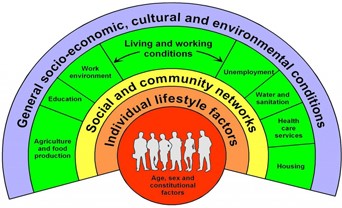
There is no natural law which means that black people living in England or people who grow up in an area of deprivation should have more pain than white people, or those who grow up in more affluent areas. This is why we need to understand more about social, political and economic determinants of health and how they can lead to changes in our experiences of pain. These causes of health inequalities are rooted in unequal distribution of income, power, and wealth, which influence our living and work conditions, our experiences of discrimination (e.g., racism and sexism), and our individual behaviours, lifestyle, and biology. The Dahlgren-Whitehead rainbow shown below illustrates these ideas, and how general socio-economic cultural and environmental conditions can have a direct impact on individual people.

Dahlgren-Whitehead ‘rainbow model’

Health inequalities are defined as systematic, avoidable and unfair differences in health outcomes between groups of people; they are not naturally occurring differences. Understanding power is vital in understanding how health inequalities materialise. Those who hold more power may have difficulty in recognising and identifying the privilege they hold which can also be an uncomfortable experience. Differences in power may be more obvious to those who are adversely affected, as illustrated by the video below.

Inequalities and lived experience

The experience of poverty and marginalisation may also silence the voices of those affected and lead people to place less value on their own lived knowledge. This is important because at a time where, rightly, there is growing emphasis on ‘lived experience’ we must recognise that not all experiences are the same; access to a ‘voice’ in this way, is not experienced equally. Advocating and planning for inclusion is therefore important.

Health and politics

While daily life can sometimes feel far removed from our politicians, their decisions do affect us. Improvements in health, particularly in our poorest communities, were already slowing prior to the Covid-19 pandemic and cost of living crisis. Public health researchers report growing evidence to show this deterioration in health is linked to austerity policies. Recent news items on the current situation in the UK have included: normalisation of people relying on food banks who are employed full-time; doctors starting to prescribe help with energy bills; recent hospital attendances for hypothermia; GPs reporting the rise of malnutrition cases. Some of our patients tell us they can’t afford to eat nutritious food, pay to take part in exercise such as swimming, or to stay warm, and finances bring extra stress. These examples show the social determinants of health taking effect, and may lead to worsening health inequalities and experiences of pain.

Next steps

Steps can be taken to mitigate for health inequalities. Health care is usually designed by healthy people, with their abilities, literacy and capacity in mind. It doesn’t always meet the needs of patients, particularly those affected by poverty and trauma, the effects of which can be experienced across generations. In Scotland there are ambitious plans for a pain management framework and for public services to be trauma-informed. We should be aware when developing new services if they are only accessible to some, this could widen existing inequalities. In chronic pain physiotherapy in Lanarkshire, we are routinely asking patients who attend about money worries, and signposting to financial inclusion services if indicated.

To adequately address health inequalities, however, we require change to the most powerful determinants of health, which lie outwith the health service and this will require an element of wealth redistribution. We should be concerned over further cuts to local authority and NHS spending in the UK and the impact this is expected to have on health. Yet, hope for change is still possible; other countries have made different choices and continue to do so, in the UK we could do this too. Given this situation, we would like to ask readers, what should we do about health inequalities in chronic pain?

About the authors

Cass Macgregor is a physiotherapist with NHS Lanarkshire and PhD student at Glasgow Caledonian University: Email
Twitter: @MacgCass

Bronagh Galvin is a student on the doctoral physiotherapy programme at Glasgow Caledonian University and is currently conducting an evaluation of asking about money worries in NHSL chronic pain physiotherapy.
Twitter: @bgalvinphysio

We would like to acknowledge the work of others in development of this blog for Pain Concern: David N Blane, Shiv Shanmugam, Kerry Noon, Jackie Walumbe, S. Josephine Pravinkumar, Chris Seenan, Emmanuelle Tulle, Gregory Booth

Pain Concern invited us to develop a blog after engagement with our editorial in the Scandinavian Journal of Pain which covers some of the literature on which this blog is based, and we give the additional relevant literature sources below. Please get in touch with Cass for any particular queries.

Macgregor, C, Blane, D N, Pravinkumar, S J and Booth, G. (2022) Chronic pain and health inequalities: why we need to act. Scandinavian Journal of Pain, 2022.

McCartney, G. Popham, F., McMaster, R., Cumbers, A. (2019) Defining health and health inequalities. Public Health. Vol. 172, P 22-30

Marmot, M. (2022) Lower taxes or greater health equity. The Lancet. 400(10349), pp.352-353. Available from Science Direct:

NHS Education for Scotland and Scottish Government (2019) The Scottish Psychological Trauma Training Plan.

Public Health England (2020) Chronic Pain in Adults 2017. Health Survey for England. Public Health England. Department of Health and Social care.

Scottish Government (2022) Pain Management – service delivery framework and implementation Plan.

The Dahlgren-Whitehead Rainbow – image and explainer

Walsh D, Dundas R, McCartney G, et al. (2022) Bearing the burden of austerity: how do changing mortality rates in the UK compare between men and women? J Epidemiol Community Health. DOI: 10.1136/jech-2022-219645

Peer Support. Join the community

“Having chronic pain is very lonely.”

Join the community

Subscribe to Pain Matters

Everything you need to know about how to live with chronic pain

Subscribe


In pain? Don’t understand what’s happening?

“Having someone to help you prepare for your life through pain”

Our Pain Education Sessions

Fundraise for Pain Concern

Help us to help others

Fundraise


Many of you will have watched Prue and Danny’s Death Road Trip (Channel 4 production) in which Prue Leith talks movingly about watching her older brother David die in pain in 2012. Leith now supports assisted dying, while her son, Danny Kruger MP, is against it.

Dame Esther Rantzen has already recently disclosed that, following a lung cancer diagnosis, she is considering assisted dying as an option if her symptoms worsen.

Following this recent coverage of assisted dying, we have gathered some information regarding assisted dying and pain.

Inquiry into assisted suicide and assisted dying

The Health and Social Care Committee is considering evidence into assisted dying/assisted suicide, so we expect to hear more about the issues when they report. It is worth reminding ourselves about pain control at the end of life. Palliative Care services were pioneered in the 1960’s in the UK by Dame Cicely Saunders. Good services should encompass the physical, psychological, social, and spiritual aspects of pain and suffering. 

Yet reports have persisted of the under-treatment of pain or poor access to care, so in 2019 The Faculty of Pain Medicine along with the Association for Palliative Medicine, Association of Cancer Physicians and the Royal College of Radiologists (Faculty of Clinical Oncology), published a framework for pain service provisions for adults in the UK who have cancer or life-limiting diseases. Their guidance called for closer integration of pain management, oncology and palliative care services. Yet in 2021, The Association for Palliative Medicine UK wrote that, ‘Over 300 people a day in this country suffer unnecessarily due to lack of access to specialist palliative care services’.

Share your thoughts on assisted dying

Do you have experience of these services that you would like to share? Are you for or against assisted dying?  Tell us– we want to hear from you and know what you think.

Learn more about palliative care in Airing Pain editions 84: Cancer Pain and 110:Living With Cancer Pain – listen or read the transcripts.

Peer Support. Join the community

“Having chronic pain is very lonely.”

Join the community

Subscribe to Pain Matters

Everything you need to know about how to live with chronic pain

Subscribe


In pain? Don’t understand what’s happening?

“Having someone to help you prepare for your life through pain”

Our Pain Education Sessions

Fundraise for Pain Concern

Help us to help others

Fundraise


Pain Concern invites you to help shape the future of Airing Pain, the award-winning radio programme and podcast.

Please fill in this short survey to support what we do.

If you prefer, refresh your memory before you begin and take a listen to Airing Pain.

Peer Support. Join the community

“Having chronic pain is very lonely.”

Join the community

Subscribe to Pain Matters

Everything you need to know about how to live with chronic pain

Subscribe


In pain? Don’t understand what’s happening?

“Having someone to help you prepare for your life through pain”

Our Pain Education Sessions

Fundraise for Pain Concern

Help us to help others

Fundraise


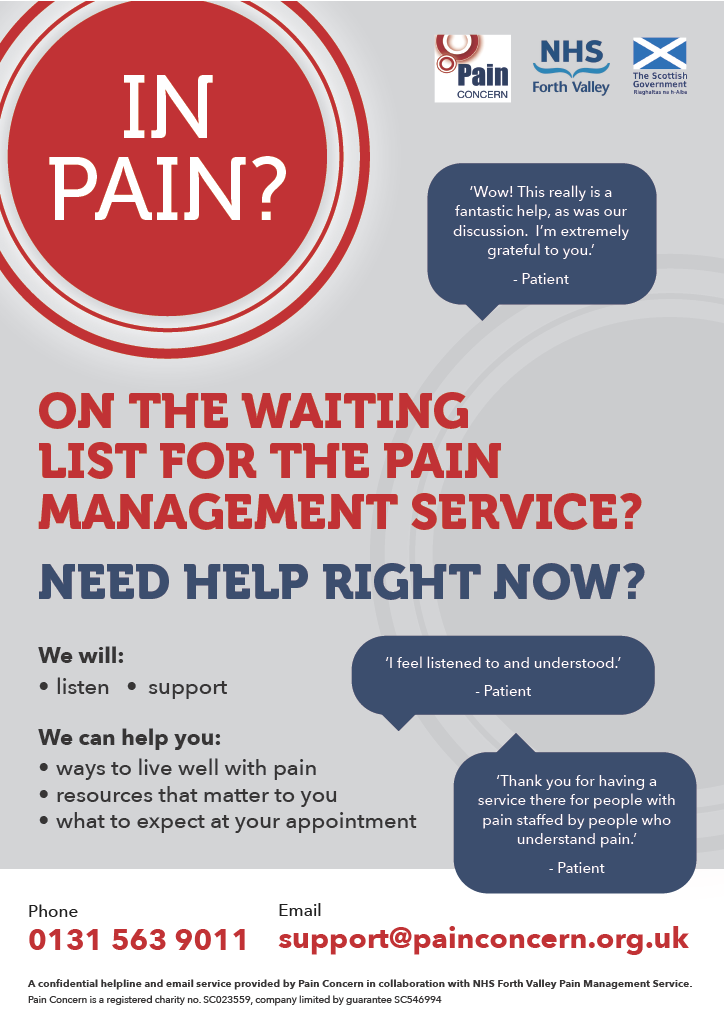
Pain Concern received funding from the Scottish Government to enable us to support patients waiting to be seen by pain management services at NHS Forth Valley.

The helpline service was offered that provided specific information about the Forth Valley Pain Management Service, self-management and how access to helpful resources.

Forth Valley Pain Managment Service Helpline Poster


This helpline has now closed – the general Pain Concern helpline is still available to provide support.

good to know there was someone to call and was very pleased to speak to someone.

Caller feedback

Helpline project details:

  • Over 1000 texts sent to patients  to inform them of the service.
  • Letter and leaflets sent to new and return patients.
  • Regular promotion on social media channels.

Independent Evaluation

An independent overview of the project can be found below, findings included:

  • 70% of callers stated that they felt more positive after speaking to call.
  • 65% said they felt better prepared for their healthcare appointment.
  • 74% of callers received additional resources from Pain Concern.
  • This project was exceptional in that it is an example of a charity and NHS Board working together to reduce waiting lists and focus on efforts to help patients deal with this.


‘Wow! This really is a fantastic help, as was our discussion yesterday.
I am extremely grateful to you – thanks very much’

Caller feedback

Peer Support. Join the community

“Having chronic pain is very lonely.”

Join the community

Subscribe to Pain Matters

Everything you need to know about how to live with chronic pain

Subscribe


In pain? Don’t understand what’s happening?

“Having someone to help you prepare for your life through pain”

Our Pain Education Sessions

Fundraise for Pain Concern

Help us to help others

Fundraise


Airing Pain Programme 135: Pain Management During the Covid-19 Pandemic – Lessons Learnt

First broadcast 22nd February 2022.

How technology developed for the COVID-19 pandemic has changed the working practices in pain clinics and the benefits of patients working together with doctors.

Paul Evans: In the two or so years when COVID-19 was at its most critical, well hopefully anyway, the face to face relationship between doctors and patients was one of the first casualties. Now, with restrictions relaxed have we returned to the status-quo? Or has what was developed at breakneck speed, with necessity being the mother of invention, lead to new working practices? So what did we learn that would actually improve the management of chronic pain into the future? Dr Cathy Price is a consultant in Pain Medicine with the University Hospital Southampton NHS Foundation Trust.

Dr Cathy Price: It’s going to take quite some time I think before we truly learn and understand what the pandemic has taught us. I feel first of all that we can implement change at a very rapid rate when we need to. So we had to go from delivering face to face services to everything being online in a couple of weeks. We learnt from that how to use a lot of technology that probably would have taken years to introduce. And we also learnt what patient preferences were with that. When we introduced this locally what we learnt was what we could safely manage at a slower rate and what we absolutely needed to continue delivering. So we took a really evidence-based approach to deciding who to prioritise but made sure that the people who we couldn’t see at that moment were safe and checked up on them.

We also looked at what was the impact of remote consultations at all different aspects of the patient journey? In the service we found that really the education sessions that we invite people to could be very safely delivered online and that infact people preferred them because they didn’t have to drive and didn’t have to sit with other people because they were afraid of picking up bugs themselves and it was much more convenient. And people like me, my medical appointments didn’t need to be delivered in a clinic so that saves people sitting around waiting for hours, and then we also learnt that the vast majority of psychological interventions could be safely delivered online. What we also learnt was that it wasn’t a great idea to try and do rehabilitation online because people need that face to face reassurance and modelling of what needs to be done.

Paul Evans: What do you mean by that?

Dr Cathy Price: So to understand what the movement looked like and how to do this safely we really needed to see it in action because many people learn by doing. So the physiotherapy side, particularly, said: ‘we’re not doing this remotely and minute more than we have to.’ So in terms of delivery of a service we learnt quite a lot. In terms of impact then the referrals from primary care (primary care as you know had to reform and reshape many times) and when we were merging services and splitting them apart trying to do different cohorts I think many people got lost in that process. It was difficult to get through to general practices so what we learnt was that primary care services needed to be different, you needed to have better access than just remotely and that trying to do it all with a lot of triage was sometimes not in patient’s best interests.

The other thing that we have learnt is the intense loneliness that people have experienced. When you phoned people in the middle of the pandemic they were just glad to hear a voice and glad to do something. I would say that dropped off very quickly as soon as everybody could get out but its really left its mark, so that one of the biggest impacts that we all know about is that impact on people’s wellbeing – emotional health I think is going to be with us for a long time. We’ve been fortunate to at the same time in primary care be able to provide more staff who can support people’s wellbeing. For example social prescribers, health and wellbeing staff and primary care mental health workers. So there is more infrastructure but what I’ve learnt is that all needs really careful management, grouping and leadership to make it work for patients.

Paul Evans: I think with the online consultations, you think there may be a future in that or there is a future in that. Putting my glass half full about the COVID epidemic, if you tried to get that through in a non-epidemic time it would take you donkeys years and there would be so much opposition to it but largely it has worked and people like it.

Dr Cathy Price: Yes. There are definitely some people who it’s very bad for. It’s about trying to get that balance though isn’t it. You’re absolutely right that we would never have done it at the rate of change that we did but it was something I thought was really needed and had been needed for a long time. I’m not sure it’s terribly fair to ask people to get on two sets of buses to come all the way and then sit for an hour on a seat. By that time I think they’re not up to processing very much at all. I’d much rather do things in the comforts of people’s homes if at all possible.

Paul Evans: What are the downsides of that?

Dr Cathy Price: Well firstly that not everybody can grapple with technology. Even if you provide iPads, which we managed to get, not everybody can use them. People have got communication difficulties – and I don’t mean people who are speaking a different language because actually that was relatively straightforward. More people who may have sensory loss or language difficulty really struggle. So you really need to be sure that people can understand and are finding it useful and not just being polite.

Paul Evans: You mentioned physiotherapy. A doctor can work out a heck of a lot just by watching them walk from the door to the seat in the consultation room.

Dr Cathy Price: It absolutely can’t be done online, can it? You’re absolutely right and I think that’s the bit that sometimes is missing so that’s were you need to sometimes allow space to be able to speak to people. Physiotherapists especially, a lot of it is on observation.

Paul Evans: That’s Dr Cathy Price. I want to take you back now to an edition of Airing Pain we made in the Autumn of 2019, so just a few months before COVID 19 grazed its ugly head. ‘Experts by Experience – Working Together in Pain Management Programmes’ was a workshop running in parallel with the British Pain Society’s ‘Pain Management Programme Special Interest Group’ national conference in Bristol, in which patients and practitioners from four different pain management centres around the UK shared their experience of working together. You can still listen to that edition of Airing Pain, it’s number 119 at Pain Concern’s website which is Painconcern.org.uk. But here’s a flavour:

Primrose Granville: Unemployment is one thing but not being employable is a totally other story. It’s a case of ‘you are useless’ and this happened around the same time when our lovely former Prime minister David Cameron came up with the word ‘scroungers’. And here I was, on benefits, a scrounger.

Penny: If you just help one person it’s so worthwhile I had a lady and she was in such distress and anxiousness when I first met her and all she wanted was someone to listen to her and to feel validated that her pain is real. It really is there.

Primrose Granville: And I turned up Week One, Two and then in Week Three that gentleman there who is trying to hide, Rob, who you all know, changed my life with five simple words: ‘I still live with pain.’

Penny: And it’s rewarding if you see someone who is down here to suddenly be in a better place. It’s worth it just for that one person.

Primrose Granville: I’m going to live with this for the rest of my life, but I’m going to have a nice life. I just do things differently and that’s what pain management has done for me. The best part though, is being on the team. You feel so valued.

John Bremner: If only I had had some of this information earlier in my pain journey. Why didn’t I get this earlier I might not have been there in this state if I had had information earlier?

Lindsay: To those who are considering volunteering I would wholeheartedly recommend you to get involved. It is so rewarding and so fulfilling. Very best of luck to you all and please remember to be kind to yourself.

Paul Evans: That was an excerpt from an earlier edition of Airing Pain, number 119, and as I mentioned you can listen to the full edition at the Pain Concern website. And the voices were of participants in the ‘Experts by Experience Working Together in Pain Management Programmes Workshop’ just a few months before we were hit by the COVID-19 pandemic. Of course, a lot of water has gone under the bridge since then, to put it mildly. The workshop was facilitated by consultant and clinical psychologist Dr Nick Ambler of the North Bristol NHS Trust. He and his team were working to create a more personalised form of management and support for people living with chronic pain. Two years on from that workshop, he and colleagues shared their experience with delegates at the 2022 British Pain Society Annual Scientific Meeting.

Dr Nick Ambler: We convened the pain management programme conference in Bristol and I was very keen to run a workshop that would showcase the involvement of service users in service delivery and service organisation and that’s what we did. It was all about the patients.

Paul Evans: And why was it so good?

Dr Nick Ambler: Well I think it’s a refreshing change to take part in a pain science meeting run by the organisation that most represents the practitioners working in the area. It’s nice to hear the involvement of patients alongside that meeting. Very much in tune with what we’re trying to achieve as health professionals – but as partners rather than in the more traditional way of thinking about the work as being ‘we develop the technologies of pain care and we have recipients of pain care lining up to try it out’. We don’t think in that way in pain management work and that felt like a chance to more appropriately reflect that evolution taking place in the involvement of service users.

Paul Evans: I wasn’t aware that there were many health professionals there. I guess there was you and there was Martin Dunbar.

Dr Nick Ambler: There were probably about twelve of us in the room. I guess our target was really to talk more to the patients. So my main focus really was to try and persuade others who had been involved themselves or were curious about it to come along and hear from people who were involved in delivering services in different shapes and forms in different sites around the country, to hear about how they do that and whether or not it works.

Paul Evans: But its not just about people with pain helping people with pain. It’s also about people with pain helping health professionals manage people with pain.

Dr Nick Ambler: It’s supposed to be a partnership, In my profession when you’re learning about consultation methods, one of the tricks of reflecting how well you’re getting on is to ask within yourself. What does it feel like this discussion I’m having with this client? Does it feel like a wrestling match or a dance? To try and have that picture and approximate where your position is. Because if it feels like a wrestling match it’s probably not going very well and you need to think about doing something different. If it feels like dancing then you’re in tune with each other and that’s a fair reflection of a process rolling forward in the right way. So with that in mind the way in which we work in partnership with patients should feel like the organisation and delivery of pain services is like a dance, where it’s good to see the people who need our help and to be working out what they need and how its suited best to them with them rather than to be second guessing.

Paul Evans: I guess the idea is that patients leave with a smile on their face and doctors are left with a smile on their face.

Dr Nick Ambler: Well that’s a big ask Paul, and I’m not sure we’ll get that when dealing with pain but a sense of feeling heard, definitely. The reverse is where somebody is coming away maybe with a list in their pocket which didn’t quite work out, or didn’t feel like they were able to express themselves or that they’ve been patted off. Those things are quite commonplace nowadays and with healthcare under pressure there is a real risk of that worsening not improving But it is worth it for healthcare professionals to focus in on how well they’re getting on in a sense of finding common ground and hearing what people want. Changing the way they approach things to try and smooth out that kind of discussion so it doesn’t feel quite so tense, but I think tension is still prevalent in those kind of consultations.

Paul Evans: Well we’re at the British Pain Society Annual Scientific Meeting 2022. What were you telling the great and good of the scientific world about that?

Dr Nick Ambler: Well if I tried to tell them I don’t think we’d get very far. I’ve been asked to present something along with my colleague Nicola O’Brien about service user involvement and different kinds of pain service. But for both of us at the core of that are pain management programmes and the way in which working in partnership with people who had been former patients but had volunteered to come back, taken part in training and received some supervision to develop them into the role. How that’s different, what you would have as a health professional if you embrace the idea of that, what you need to put into it, what’s expected of you. Some clarity about how it works rather than just trying to sell the idea of it, that’s what we were talking about today and I hope it was somewhat provocative. But my intention was to say ‘you can’t make an omelette without breaking eggs’, which is an old expression about there are crunch moments as you try and move things forward. The issue really is of something which we have a strong sense of commitment to which is valuable but yet to really take off in pain services and more generally in healthcare.

Paul Evans: Well the title of your talk was harnessing patients to deliver care. Now that word deliver is quite an important word.

Dr Nick Ambler: Can I, before we get to the delivery take the harness off which is what I did at the beginning of the talk. I don’t think harnessing anybody is a good idea and we switched the title to working in partnership to deliver services. Do you find ‘deliver’ is a bit of a provocative thought?

Paul Evans: Well the word deliver doesn’t involve me as a patient. You talk about breaking eggs, who are the eggs here?

Dr Nick Ambler: Colleagues.

Paul Evans: So do you think that deliver is the wrong word?

Dr Nick Ambler: I wish I hadn’t mentioned about breaking eggs, I don’t want anyone to get broken. Delivery does reflect a sort of sense of somebody having something to give and they’re being a passive recipient so no in that sense it’s not a good word. But we did, in the talk, cover at some length the transition from the traditional kind of ‘bring your problems and I’ll fix them’ kind of encounter that exists in the relationship between doctors or health professionals generally and patients to one of shared decision making, joint exploration and a sense of trying to work on the things that the person most wants to work on and then reaching decisions through a shared understanding.

Paul Evans: Those traditional views – they are traditional and they still exist. Doctor sits there, patient sits here. ‘Doctor I’ve got a bad shoulder. Fix it.’ It takes education for the doctor but also for the patient. Lets assume the doctor wants to change things but how do you change the patient viewpoint?

Dr Nick Ambler: I’m imagining here a general practitioner that this is happening to at primary care level, and so I’m thinking that from the doctor’s point of view there is a little voice in their head saying ‘why do you keep asking me that because you know that I can’t?’ That is not a friendly thing to say in the consultation. And instead, I’m not sure you’re asking me the right question here Paul (this is an imaginary consultation). It’s been 3 months since you last asked me that. We’ve been round the roundabout of trying to find a means of fixing this pain and I had been thinking ahead to our discussion today about how we look sideways at that, kind of differently. If you can bear with me a few minutes I’ll explain a bit more about what I mean. Would you like me to do that?

Paul Evans: A few minutes is the problem.

Dr Nick Ambler: Again, a mantra for those undertaking training around this – this is about spending time to save time. Think back to where we were a moment ago. This is a repeat consultation. This is a revolving door process. This person has been in the room sitting in the chair asking for help for this injured shoulder. Whatever is going on with the shoulder, several times previously I suspect, and there hasn’t been any sense of moving forward with that so we need to try a different route. It would be a matter of trying to divert in a direction that is probably more productive.

Paul Evans: Pain Concern has done research and is continuing research into patient doctor consultations and they have developed their navigator tool that puts patients and doctors on the same plane. The doctor has to do his or her homework and the patient has to do his or her homework also.

Dr Nick Ambler: So a preparedness to have a different conversation that is ideally better set up if both sides know what that change in direction is. And the tool can help it from the patient’s side. Training in the consultation process in the different format from the health professional side is also a useful idea. If one or other really doesn’t get it it’s much more of a struggle.

Paul Evans: Well there is an elephant in this room and we’re going to have to talk about it and that is COVID. In the workshop we met – that was 2019 – 3 years ago and we’ve had COVID since then. Now, how has that affected what you were trying to put into place in 2019?

Dr Nick Ambler: Well it was a very unsettling period that’s for sure. In the beginning many of us were diverted into other priority areas to deal with the pandemic, to deal with all the other pressures which existed in the hospital. All outpatient activity was blocked for some time. Many pain clinics really had to shut down and the concern at that stage was where we would pick up as we got going again. But even before that happened there was a push within those of us running pain management programmes to go online and to try to meet the demand in a different way. And I think with that, the beginnings of something different had emerged in extreme circumstances so increasingly we were able to go back to more traditional roles, I think, within about a year of the onset of the pandemic hitting the health service. We were up and running with our online course well before then. And they were something which I guess we weren’t particularly under pressure to understand well before then but now have become very much part of the array of things that we do. And we are in a different phase now where we are able to things again about getting going on an outpatient basis. We have got a backlog of work to pick up with. The consequences of that are going to play out for quite sometime. But we’ve jumped forward in our understanding about access that is made available by the means of working with people. That’s evolved in a different direction. I’m not going to tell you that face to face working is less preferable than working online. I don’t believe that for one minute but I’m really glad that we’ve learnt about how to approach this in an alternative way and I think if nothing else right now, in the NHS we are going through a refresh phase looking again at how to do what we can do with a load of work to catch up with. And it demands new thinking and reasoning and that’s what I find encouraging about what has been a very difficult situation.

Paul Evans: I would guess that one of the issues with that word refresh is that everything we learnt in the last two years, that was just a temporary thing and back to the old ways.

Dr Nick Ambler: I can’t imagine that’s going to happen. I don’t see evidence of that around. There has been this opening to improve access. So we have, for example, introduced first contact being by zoom if possible so it’s possible to come into our service with a face to face contact initially but the initial screening is done by zoom calls, by preference. That’s enabled us to pick up more quickly with people. I think one of the initial things that you experience when you’re coming into the service is the sense of a long wait. Well, that’s less the case because of what we’ve learnt about online consultations. But we blended that with face to face follow up, where that’s possible, and we’ve continued with a segment of service which is not face to face open to those people that would prefer to approach it in that way.

I think new stuff has come out of this – grim as it has been – it has shunted things forward with a lurch. We are still under pressure but we’re doing things differently now and I don’t think we can go back.

Paul Evans: I think the word of question that came up in your talk earlier was ‘disheartened’. Are you disheartened?

Dr Nick Ambler: Not at all. There’s a sense of a lot of effort being expended. I might’ve felt set back because today I’m talking about the thing that you and I were talking about three years ago when we last met in Bristol and in a sense I can’t see that there’s been a jump forward in the involvement of service delivery in a way I would’ve hoped and visioned at that stage but realistically we’ve had three years of COVID and we’re facing a very different situation now. This offers an enormous amount of potential input and I see with this and with the idea of a refresh perhaps a better chance to get a more firm footing with that. I was at one of the talks this morning about virtual reality and how that might be been incorporated. Talking to Owen Williamson afterwards about the slow pace at which – something that I think is really quite helpful for acute pain – the slow pace at which that’s moved forward. He was reassuring in a sense. He said: ‘You know you need to understand on average a new piece of technology that’s going to help things along clinically can take on average seventeen years to be implemented.’ I shouldn’t feel disheartened really. I am accustomed to taking the ideas and rehashing them but also with a new sense of the changed situation to continue to draw attention to this as a huge potential asset of volunteers being alongside health professionals, working in partnership for delivering services. I guess we need another term for that. But the broader term is actually co-production – the idea that you’re creating something, you’re finding a way with something and to take that forwards in a sense that that is part of the way out of this difficult situation. Its an evolution and naturally takes a lot of time. I feel encouraged by that but there’s still plenty of work to do.

Paul Evans: That’s consultant and clinical psychologist Dr Nick Ambler of the North Bristol NHS Trust pain management programme. He and his team guest edited issue number 78 of Pain Matters magazine about delivery of pain management throughout the COVID-19 pandemic. You can get details from Pain Concern’s website which is Painconcern.org.uk and you can download all editions of Airing Pain from there and find a wealth of support and information material about living with and managing chronic pain, including more details about this edition of Airing Pain. Now, as in every edition of Airing Pain I like to remind you of the small print that whilst we in Pain Concern believe the information and opinions in Airing Pain are accurate and sound, based on the best judgements available, you should always consult your health professional on any matter relating to your health and wellbeing. They are the only people who know you and your circumstances and therefore the appropriate action to take on your behalf. It’s important for us at pain concern to have your feedback on these podcasts so that we know what we are doing is relevant and useful and to know what we are doing well or not so well so do please leave your comments or ratings on whatever platform your listening to this on or the Pain Concern website of course. That will help us develop and plan future editions of Airing Pain. Back to this edition of Airing Pain. We heard Dr Cathy Price earlier talking about how pain teams have adapted to working through COVID-19 restrictions so what would she like to keep from those two years?

Dr Cathy Price: I’d like to keep the flexibility – our team meetings are so much better since they’ve been online. Haven’t had grumpy people turning up at 8.30am in the morning having fought their way through two hours of traffic, for example. I’d very much like to keep that flexibility. When people have been booked in face to face and I can’t see why I say ‘what would you have wanted’ and they say ‘we’d have been perfectly happy at home’, so we need to really step back and think. I’d like to keep a lot of that technology. I fear we’ll be told it’s too expensive and we won’t have as good access as we have had. I’d like to keep all of the different ways that we’ve communicated with people. I’ve got much better at text messaging, sending links, doing video consultations – much, much better. And people have as well. They have been really open to it. I’d like to keep that openness I think.

Paul Evans: How do you make sure that all the good things aren’t rolled back?

Dr Cathy Price: What we’ve done is done an evaluation to really make sure that you’ve asked people how it has gone and what they’ve felt. You learn from that and you keep asking again and again. Look to see whether you’ve got lots of complaints, also use patient feedback as well and ask the right questions.

Paul Evans: Cathy Price. Going back to that experts by experience working together in  pain management programmes workshop just before COVID hit – Nick Ambler.

Dr Nick Ambler: The person that hit the right tone at the beginning who works with us at Bristol is Primrose Granville, who I thought did a really inspiring talk about how she had found it incredibly useful taking part in a programme, changing her life and then continuing to do that. So I have to say one of my main memories from the period of time when we were all locked in watching TV, which is pretty much all I did when I wasn’t at work. Seeing the local news, seeing Primrose out on the street in one of the suburbs of Bristol where the uptake of vaccinations was very low, stopping people on the street and persuading them to have jabs. And I thought well my immediate reaction was – isn’t that just Primose, she’s phenomenal. Then I thought well I don’t want to lose her. Someone has found her and taken her away from our service and immediately felt quite defensive about that. It just shows you the kind of people that come forward and they know the impact they can have. She was interviewed on TV about why you’re doing this. And she said: ‘Well I’ve realised how important this is and if I can use the way I present things to persuade others to do it I’m going to do that.’ I identify with these people. It’s a poorer suburb of Bristol in the sense of average income so I need to talk to them. I’m the one who should be talking to them. And doesn’t that nail it actually. That’s exactly right. That totally reflects the way in which we became involved with Primrose in trying to improve the way we do things in the pain service.

Paul Evans: And that is patients being involved in a team.

Dr Nick Ambler: Being part of the team.

Paul Evans: Nick Ambler. And so we let Primrose Granville, part of that team have the last words of this edition of Airing Pain.

Dr Primrose Granville: I have been on two pain management courses, so I went to one in the old days. That course didn’t do anything for me. It was purely instructional. I felt like I was in high school again being forced to do maths which I hate. And I got nothing from it whatsoever, absolutely nothing. Fast forward a couple of years, anyone know Dr Greenslade? Yes, so we had a really long conversation. It ranged from articles in the Guardian to articles in The Sun where he was actually trying to convince me to go on a second course and I was like no I’m not doing that, give me the magical pill and I’ll be fine. Give me surgery give me anything. And he was like ‘no you’ve had the surgery, you do need to go on another pain management course, I promise you its different’. And I turned up Week One, Two and then in Week Three that gentleman there who is trying to hide, Rob, who you all know, changed my life with five simple words: I still live with pain. Those were the five simple words that literally changed my entire life. And then he started talking about all kinds of things that he did and I’m like I was stuck and I still live with pain. And I remember leaving the room with my pain friend and we used to be a lot of trouble on the course. You know we were the talkative ones. And we were sitting in my car because I was taking her home that evening and we were like ‘so we can do stuff’. The pain was controlling my life and one of the things I wanted to do was, my only goddaughter lived 146 miles up the M4 and the A13 in deep Essex. Why her parents choose to live there, I don’t know. And I wanted to be able to get in my car and do the journey from beginning to end and just not stop. And he spoke about going down the M5 to Cornwall and how he had to stop several times. And I was like, oh my God, stop several times. But I heard him out and it was like wow so he changed my life with his examples but he got me with those five words and I thought ‘hmm’. And you know the end where they give you that long questionnaire that we all have to fill out, the big long one that looks like an epistle. So when you get to that last question that said: ‘Do you think you could volunteer here?’ or something like that. And I consulted with my friend and she said it’s too much and I said I’m going to try and I ticked the box. And they phoned me the following week and I was like they don’t hang about so I kind of wanted to see what it was like from the other side. To find out if I could impact somebody else the way Rob has impacted me. His simple example, his simple words. His: ‘I still live in pain but I actually have a life that I enjoy.’ And I’m glad I met Rob because I’m glad that I actually volunteered because I felt valuable. I was turning up on Wednesday and when I wasn’t well they missed me. And that’s my why. I feel like I’m doing something that’s worthwhile to someone else. Who would’ve thought the words ‘I still live with pain’ would mean anything to anybody? I wouldn’t have thought it would mean anything to me. But it does now because it was the moment that I decided I’m going to live with this for the rest of my life, but I’m going to have a nice life. I just do things differently and that’s what pain management has done for me. The best part though, is being on the team. You feel so valued. It’s a case of somebody wants you there. For me being that messenger is a lot more important than the message.

End

Contact us:

General enquiries

Media enquiries

Pain Concern Helpline Telephone: 0300 123 0789

Email Pain Concern Helpline Email

Office Telephone: 0300 102 0162

© 2010-2022 Pain Concern. All Rights Reserved.

Registered Charity no. SC023559. Company limited by guarantee no. SC546994. 62-66 Newcraighall Road, Edinburgh EH15 3HS

Peer Support. Join the community

“Having chronic pain is very lonely.”

Join the community

Subscribe to Pain Matters

Everything you need to know about how to live with chronic pain

Subscribe


In pain? Don’t understand what’s happening?

“Having someone to help you prepare for your life through pain”

Our Pain Education Sessions

Fundraise for Pain Concern

Help us to help others

Fundraise


This edition of Airing Pain examines the impact that the Covid-19 pandemic has had on the relationship between patient and healthcare professional. 

At the start of the Covid-19 Pandemic in 2020, the face-to-face consultations between doctors and patients was one of the first casualties. With restrictions relaxed, have we returned to the status quo, or has what was developed at breakneck speed led to new working practices? 

In 2019, just months before Covid-19 became part of our lives, a workshop, ‘Experts by Experience – Working Together in Pain Management Programmes’ explored an innovative approach to pain management in which patients became integral members within the clinical pain team. Has this relationship survived social isolation and lockdowns?


Contributors:

  • Dr Cathy Price, Consultant in Pain Medicine with the University Hospital Southampton NHS Foundation Trust. 
  • Dr Nick Ambler of the North Bristol NHS Trust, and people living with chronic pain. 
  • Patient-volunteer Primrose Granville, and other people living with chronic pain.

Issues covered in this programme include:

COVID, self-management of long-term conditions, peer support, communicating pain, community healthcare, patient volunteer, support group, training course, volunteering and workshops. 


Time Stamps:

1:15 Dr Cathy Price on delivery rapidly changing from face-to-face to online, having to prioritise vital healthcare, and what didn’t work remotely. 
6:00 – Dr Cathy Price on the barriers the technology can create. 
7:05 – Paul Evans recaps Airing Pain 119 Experts By Experience: Working Together In Pain Management Programmes 
10:10 Dr Nick Ambler talks on the Experts by Experience: Working Together In Pain Management Programmes Workshop. 
14:12 Nick on the service user involvement in delivering Pain Management Programmes and what it means for health professionals. 
17:00 Paul ask Nick how a GP could approach a repeat consultation about pain to create a productive outcome. 
19:55 How the Covid-19 Pandemic impacted the work of pain clinics. 
22:25 – Paul questions whether post-pandemic approaches to healthcare will revert. 
27:00 – Cathy Price on the positive outcomes of working during a pandemic. 
28:00 – Nick Ambler on the impact of patients being part of the team. 
30:00 – Primrose Granville on her pain management programme experience. 


Special Thanks:

This edition of Airing Pain was possible thanks to support from the British Pain Society and has been funded by grants from the James Weir Foundation, the Hospital Saturday Fund and the Erskine Cunningham Hill Trust.  


More Information:

Peer Support. Join the community

“Having chronic pain is very lonely.”

Join the community

Subscribe to Pain Matters

Everything you need to know about how to live with chronic pain

Subscribe


In pain? Don’t understand what’s happening?

“Having someone to help you prepare for your life through pain”

Our Pain Education Sessions

Fundraise for Pain Concern

Help us to help others

Fundraise


While #WalkYourDogMonth is an attempt to encourage people to exercise their dogs regularly, the team at Pain Concern reckon that it’s a great opportunity to consider the positive effects that regular dog walks can have for the owners too – whether living with pain, or not.

It goes without saying that we also wanted to introduce you to some of the furry friends who are part of the Pain Concern Community – the pets who belong to our team and volunteers.

We acknowledge that for many people, pain will be a barrier to getting out and about with a dog, so finding exercise within your abilities is key. With that in mind, here are some of our resources that can help with building your fitness:

Pain Concern Pooches:

A dog sits by the shore, with The Forth Rail Bridge beyond.
Marley

This is Marley, who belongs to Sam, our People, Project & Operations Manager at Pain Concern. 

Sam says ‘Taking Marley ‘walkies’ really helps me to relax and meet my daily step count.  It’s always nice to meet other dogs and have a chat with their owners too!’.

An owner cuddles with a dog with sand dunes behind.
Lindsay and Dexter

This is Lindsay with her dog Dexter. Lindsay volunteers on the Pain Concern Listener and Reader panel.

Lindsay says ‘Dexter helps me in getting me out every day and socialising with people. He’s always there to comfort me on the bad days to cheer me up but he does hog the bed!

A dog looks up.
Magic

Ali reviews and proofreads Pain Matters articles and podcasts. This is Ali’s dog Magic, so named for the white tip on her black tail.

Ali says ‘She gets me out in all weathers and even if I am almost completely seized up a walk invariably helps ease those joints and takes my mind somewhere much more pleasurable.

A dog on a beach with it's ball.
Bertie

Miriam is the Media and Production Co-ordinator at Pain Concern, and owner of Bertie.

Miriam says ‘walking my dog Bertie gets me out in all weathers. I always feel refreshed and more relaxed after we’ve been out together – and I love cuddles with him too!’

Betsy

Fiona is a volunteer on the helpline, this is Fiona’s dog Betsy.

Fiona says ‘She loves her walks and since getting her I’ve made a whole new group of friends. I have persistent pain but having Betsy makes me get out and about every single day and I absolutely love her to bits

A large dog sits with an adult on a sofa.
Champ

Owen is an audio transcriber for Pain Concern and has kindly sent in a picture of his dog Champ, who suddenly passed away last December. Owen says ‘We are utterly devastated and miss him dearly. I think the following quote form Dean Koontz will resonate with anyone who has lost a dearly loved dog: Once you’ve had a wonderful dog, a life without one is a life diminished.’

Two dogs run across a sandy beach.
Heather’s dogs

Heather is the CEO of Pain Concern and dearly misses her dogs above, whom she used to walk. She continues to walk her sister’s gorgeous dog, pictured below.

Heather says ‘My dogs helped me to get out and about and meet people. They loved every walk, even the short walks. Watching their radiant faces and shining eyes, lifts your spirits, as does saying ‘good day’ to others as you pass by.’

A dog up a hill with sea beyond.

Find out more about what Pain Concern does, and our current volunteering opportunities – pet dogs are welcome but optional!

Peer Support. Join the community

“Having chronic pain is very lonely.”

Join the community

Subscribe to Pain Matters

Everything you need to know about how to live with chronic pain

Subscribe


In pain? Don’t understand what’s happening?

“Having someone to help you prepare for your life through pain”

Our Pain Education Sessions

Fundraise for Pain Concern

Help us to help others

Fundraise


We’re starting 2023 with a round-up of our recent achievements, including updates on our core services and the support that they provide.

Activities

Every month Pain Concern reaches over 8,000 people. Our charity provides high quality information and support to people living with pain and those who care for them, whether family, friends or healthcare professionals. 

A key objective has been to consolidate our activities: helpline, pain education, Airing Pain podcasts, publications, The Self-management Navigator Tool so they coherently fulfil Pain Concern’s vision of empowering all people living with pain to manage their condition and live life to the full.

Last year, we produced a promotional video that explains what we do and how we can help. We have made subscriptions to our magazine Pain Matters free to anyone living with long-term pain. 

Our reach

We either attend, or our video is played at 6 different NHS Trusts across the UK, and a growing number of NHS pain management programmes promote our free evidence-based resources, for example, 11 of the 14 NHS pain clinics in Scotland receive our magazine. In primary care, we have developed our relationships with Link Workers and GPs, for example recently we met with the Royal College of General Practitioners. 

 ‘The group members were saying they really appreciated the info and hadn’t known about other forms of support‘  – Dr John O’Sullivan, Clinical Psychologist, Chelsea & Westminster Hospital 

Social media

Feedback from a service user

We achieved a steady increase in social media followers to 500 followers across each platform over the year. We use our presence on LinkedIn to reach health care professionals. 

Helpline

‘I really appreciate your help and time‘  – service user 

‘I have learnt so much and I feel like these skills are being put into practice and making a positive difference to people’s lives‘  – helpline volunteer 

The impact of the COVID-19 pandemic on NHS waiting times has been profound. Our helpline now provides a lifeline to those on the long waiting lists or those just struggling to get an appointment. In recognition, in the winter of 2022, the Scottish Government awarded us a 3-month grant. In that short time, we showed that over half of our callers felt better/more positive after speaking to us.

We presented a poster of the results at the Scientific Meetings of the North British Pain Association and the Scottish Pain Research Community (SPARC).  

Our helpline is one of only a few which focus on chronic pain. It has grown steadily, since “lockdown” with over 150 service users contacting us each month by phone or email. We plan to extend our opening hours to 3 days per week and to make better use of our pain educational materials, including the Self-management Navigator Tool. To do this, we are training additional helpliners. Training covers contact skills, pain education and understanding self-management.

Ongoing supervision and support of our helpline team is provided by expert counsellors at Professional Help. To ensure that we provide a high-quality service, we are members of the Helplines Partnership and SAFEcic, following their standards. We have worked extensively with Evaluation Support Scotland to monitor and evaluate our service.  

In 2021 Louise Cromie, one of our helpliners won an Inspiring Volunteer Award: 

Louise Cromie, helpline volunteer. 

Online Community

At HealthUnlocked the Pain Concern online community remains one of the most active forums in the UK, providing high quality and humane support to its 33,964 members. This year we attracted 2,000 new member and received over 5,000 posts 

The Self-management Navigator Tool

The award-winning Self-management Navigator Tool (Navigator Tool for short) is an interactive booklet which is designed to foster supported self-management and actively focus healthcare appointments on meeting the patient’s concerns.  

Our helpliners use the Navigator Tool to help our callers identify their needs and prepare of healthcare appointments. Our web-based edition of the Navigator Tool has made it more accessible. It is used routinely in NHS Gloucester, NHS Grampian and NHS Greater Glasgow and Clyde. Its use is supported by the Scottish Government and it is mentioned in the recent NICE Clinical Guidelines for Chronic Pain.  

We continue to promote its importance, so we were delighted to be contacted by the Pain Society of Alberta. They had watched our videos and loved the Navigator Tool. They invited Pain Concern’s chairman, Dr Martin Dunbar to give a presentation to their 2022 World Pain Summit.  

Praise for The Self-management Navigator Tool

The Navigator Tool can help patients to recognize all the different ways in which pain affects them, and therefore all the ways in which they can be helped or can help themselves. It also allows their healthcare professionals to get a quick in-depth snapshot of the most important areas to address. Most importantly, it allows an informed and realistic conversation about how we can all work together, as patients and professionals, to improve life with pain‘  –

Professor Blair Smith, former National Lead Clinician in Chronic Pain 

The Navigator Tool is a literal treasure chest for the busy clinician. It allows one to discover root pain beliefs and concerns that could otherwise take months to uncover. The tool guides conversations and self-management treatment choices, while avoiding the dreaded pit fall of the patient thinking we don’t believe in their pain. It does the opposite…helps the patient feel heard, and gives us reassurance we are on an “evidence-based path together‘ 
– Alexandra Chisholm, physiotherapist, Calgary, Alberta, Canada 

The tool really helps alleviate my nerves about not being able to get my point across properly‘ – Ruth Barber, service user 

Quality Standards

In the past our leaflets were accredited by Information Standard. This prestigious award certified that they, and aspects of our website, meet the quality standard required by the NHS. The PIF TICK award, administered by the Patient Information Forum, has replaced the Information Standard. We will ensure that we achieve this award in 2023. 

Collaboration

‘TheFour Nation Strategy for Pain Managementis patient focused from point of first contact including, self-help signposting, personalised care and shared decision making‘ – Dr John Hughes, Dean of the Faculty of Pain Medicine 

We were glad once again to support the work of the Faculty of Pain Medicine, by endorsing The Four Nation Strategy for Pain Management which was published in 2022. Likewise, we have endorsed the British Pain Society’s leaflet Managing your pain after surgery.  

As members of the Scottish Government’s National Advisory Committee for Chronic Pain, we have had a say in shaping the Framework for Pain Management Service Delivery. The government’s plans are to work with the Third Sector Network to support the NHS and government to build sustainability in commissioning and coordinating community-based support for people with chronic pain.  

Our helpliners have signposted callers to Flippin’ Pain’s excellent webinars on self-management and we participated in their roadshow campaign to change the way we think about, talk about and treat persistent pain.

We attended a conference organised by CRPS UK as well as a number of community groups throughout the year. We are all stronger through collaboration. 

Airing Pain 

A round-up of Airing Pain in 2022

When I was first diagnosed, I listened to every Airing Pain radio programme. It gave me a bit more hope‘ 

‘So much more information than I got from the consultant, that’s why we need Pain Concern‘  

Airing Pain radio programme is a series of half-hour podcasts supporting Pain Concern’s vision to empower people with chronic pain to manage their pain and live life to the full. They are produced and presented by Paul Evans, a multi-award-winning producer with forty years of experience as a programme maker – 30 years with the BBC and 10 years as an independent producer. He has lived with fibromyalgia for over half his working life, the experience of which combined with his professional expertise bring a unique quality and authenticity to Airing Pain.  

Paul’s purpose is to provide support for everyone who lives with chronic pain, their families, supporters, social circle, employers and healthcare professionals, bringing them all under one umbrella: the pain community. Airing Pain promotes the concept of supported self-management as a recommended, effective intervention for chronic pain, and provides a powerful platform to hear the views and experiences for the all-the-often voiceless patients.  

The assistance of the British Pain Society has enabled us to interview world-class experts and patients at their Annual Scientific Meetings. This year we collaborated with The International Association for the Study of Pain to provide a global perspective on back pain. Pain Concern collaborates with the UK’s only disability internet broadcaster, Able Radio, who broadcast each new edition of Airing Pain

Every edition of Airing Pain is on Pain Concern’s website, along with programme transcripts. In 2021-22 we produced five new podcasts covering: a global perspective on back pain, neuropathic pain, Parkinson’s, shingles, post-herpetic neuralgia – facial pain, pain management programmes and benefits of an online community. Our listener numbers are 13,000. 

From our Airing Pain contributors

Your body needs movement. I’ve always kept that with me that despite the pain I have to move’ – Janet Kerr, on managing Parkinson’s. 

 ‘By sharing our problems, it becomes easier, first of all to really navigate, but it also becomes easier to understand that we are not in this alone‘ – Otieno Martin Ong’wen, physiotherapy ambassador for Kenya in the Global Physical Therapy project. 

There’s not one part of my life that is untouched by pain. So, I would encourage anybody who doesn’t have pain, just to talk to the people they know who do. You just have to say ’How can I be a better support to you? What would make today easier for you?’ – Vina Mohabir, Clinical Research Project Assistant, The Hospital for Sick Children, Toronto. 

There is only one answer to post-herpetic neuralgia, and that’s don’t get it. And the only way we have of not getting it is by shingles vaccination‘ – Dr Richard Johnson, Honorary Senior Research Fellow, Bristol Medical School

Your body needs movement. I’ve always kept that with me that despite the pain I have to move’ – Janet Kerr, on managing Parkinson’s. 

 ‘By sharing our problems, it becomes easier, first of all to really navigate, but it also becomes easier to understand that we are not in this alone‘ – Otieno Martin Ong’wen, physiotherapy ambassador for Kenya in the Global Physical Therapy project. 

There’s not one part of my life that is untouched by pain. So, I would encourage anybody who doesn’t have pain, just to talk to the people they know who do. You just have to say ’How can I be a better support to you? What would make today easier for you?’ – Vina Mohabir, Clinical Research Project Assistant, The Hospital for Sick Children, Toronto. 

There is only one answer to post-herpetic neuralgia, and that’s don’t get it. And the only way we have of not getting it is by shingles vaccination‘ – Dr Richard Johnson, Honorary Senior Research Fellow, Bristol Medical School

Your body needs movement. I’ve always kept that with me that despite the pain I have to move’ – Janet Kerr, on managing Parkinson’s. 

 ‘By sharing our problems, it becomes easier, first of all to really navigate, but it also becomes easier to understand that we are not in this alone‘ – Otieno Martin Ong’wen, physiotherapy ambassador for Kenya in the Global Physical Therapy project. 

There’s not one part of my life that is untouched by pain. So, I would encourage anybody who doesn’t have pain, just to talk to the people they know who do. You just have to say ’How can I be a better support to you? What would make today easier for you?’ – Vina Mohabir, Clinical Research Project Assistant, The Hospital for Sick Children, Toronto. 

There is only one answer to post-herpetic neuralgia, and that’s don’t get it. And the only way we have of not getting it is by shingles vaccination‘ – Dr Richard Johnson, Honorary Senior Research Fellow, Bristol Medical School

Pain Matters magazine

A  Pain Matters magazine cover.
Pain Matters 79

Your magazine offers hope

Staff and patients from NHS pain management programmes have guest-edited the different editions of Pain Matters quarterly magazine. This has brought fresh content and personal accounts that are inspiring to read. Articles that proactively help people in pain to acquire self-management skills and take more control of their lives are appreciated by readers.

Last year guest editors from NHS North Bristol explored how pain services have adapted during the pandemic. We covered the global year about back pain with guest editors from the International Association for the Study of Pain’s Global Alliance of Partners for Pain Advocacy, while in another issue guest editors behind the Advance Pain Discovery Platform showed how researchers and patients are collaborating in their efforts to advance our understanding of pain.  

From our contributors 

Ask yourself: when your doctor prescribed a tablet for your pain, did they discuss what you might do while you wait to see if they help?’ – Professor Michael Nicholas, on the importance of adopting a collaborative approach to care 

It’s hard to explain that this invisible pain in my legs, feet and hands has caused major disruption to my life. It’s an unwanted soundtrack and I can’t turn the volume down‘  – Fiona Talkington, broadcaster, writer and presenter, on how difficult it is to describe pain. 

I’d walk in the park or around the block, just for a few minutes every day. I still miss social interaction so I made sure I spoke to someone each day, just a ‘good morning or a ‘how are you’ helped‘ – Cathy Parker, former attendee of North Bristol pain management programme, on what helped her through the pandemic. 

How could we all work together to ensure changes in the lives of people in pain?’ – Professors Lesley Colvin and David Walsh explain why researchers set up the Advanced Pain Discovery Platform  

Other publications  

Our popular pain education publications remain available on our website and we will post leaflets free of charge. With the support of two charitable trusts, The Stafford Trust and R. S. MacDonald we have created new publications covering Nocturnal pain in Parkinson’s disease (that is when most pain occurs) and, with the Shingles Support Society, Shingles vaccination, explaining why vaccination is central to preventing post-herpetic neuralgia. These publications accompany the Airing Pain podcasts on Parkinson’s pain, shingles and post-herpetic neuralgia. We have been heartened at the response.

The Immunisation and Vaccine Preventable Diseases Division of the UK Health Security Agency has invited us to collaborate with them in 2023 in updating their information. We have progressed our information on opioids for chronic pain, once again collaborating with the charity Maggie’s to produce a new publication on Opioid-induced constipation. We have collaborated with the Brain and Spine Foundation, to publish their article on Signalling for support – navigating life with a hidden condition. 

Pain Press is a free e-newsletter which supplements Pain Matters and keeps beneficiaries and supporters up-to-date with our activities and achievements. We have published 7 editions of the supplement in the year.  


Highlights from across the years

2009 – Pain Concern wins Napp Award in Chronic Pain which allows us to launch Airing Pain radio programme in 2010. 

2015 – Paul Evans wins best Nationals and Regions Producer at the Radio Productions Award, with the judges singling out our Airing Pain programme on ‘Female Genital Mutilation’ as a ‘stop what you are doing’ moment. 

2016 – Our research Barriers to Self-management in Primary Care wins poster prizes at the annual scientific meetings of the British Pain Society and the North British Pain Society. 

2016 - We contribute the chapter ‘Communication with patients’ to the Royal College of Anaesthetist’s Core Standards for Pain Management

2017Barriers to Self-management is published in the British Journal of General Practice

2017 – NHS Greater Glasgow and Clyde’s Pain Education Sessions, along with Airing Pain win Highly Commended Award at the Grünenthal Pain Awards for ‘widening access to pain education.’ 

2019 – The Self-management Navigator Tool wins a Best Poster Prize at the Annual Scientific Meeting of the Scottish Pain Research Community (SPaRC). 

2020 – A pilot evaluation of the Self-management Navigator Tool to enhance communication in primary care consultations about chronic pain is published in The British Pain Society’s Pain News.  

2020 – Open Access Government publishes 2020: Global Year for the Prevention of Pain

2020 – Evaluation Support Scotland publishes Pain Concern Helpline: A Case Study; in 2022 they publish an update on their website.  

2021 – Our helpline volunteers receive an Inspiring Volunteers Award in recognition of their service throughout the pandemic. 

2022 – We present a poster Impact of a Patient-led Helpline on NHS Services at the scientific meetings of the North British Pain Association and the Scottish Pain and Research Community (SPARC). 

Peer Support. Join the community

“Having chronic pain is very lonely.”

Join the community

Subscribe to Pain Matters

Everything you need to know about how to live with chronic pain

Subscribe


In pain? Don’t understand what’s happening?

“Having someone to help you prepare for your life through pain”

Our Pain Education Sessions

Fundraise for Pain Concern

Help us to help others

Fundraise


Pain Concern have created a selection of key resources about shingles, which you can find all in one place on our Shingles, Post-herpetic Neuralgia and Chronic Pain Resources page.


Shingles, or herpes zoster, is caused by the varicella zoster virus which causes chickenpox. After you have had chickenpox, the virus stays inactive in your nerve cells. Shingles begins when the virus becomes active again and spreads down the nerve to the skin. You may feel a tingling, stabbing or burning sensation before the shingles rash appears.  

The shingles rash will be a patch or line of blisters within the area affected by an infected nerve. It will be on one side of the body only. It may be mild and heal in two to three weeks in healthy young adults. However, in people over the age of 50 and patients with weakened immune systems, it can take longer and complications are more likely to develop. The most common complication is post-herpetic neuralgia (PHN), which is described as pain in the nerve (neuropathic pain) and which continues at least three months after the shingles rash appears.   

About half of us who live to the age of 85 will develop shingles, and cases are increasing.   

You are more likely to suffer from post-herpetic neuralgia if you:  

  • are older (people over 50 are 15 times more likely to get post-herpetic neuralgia than those under 50);  
  • have other conditions, such as diabetes;  
  • are taking medications that weaken the immune system, such as steroids and other immunosuppressants;  
  • have an injury, which can reactivate the virus and cause a shingles rash at the site of the injury; or  
  • are suffering from stress.  

Treating post-herpetic neuralgia is difficult. Although there are various treatments, most patients with severe post-herpetic neuralgia are never fully without symptoms.  

Preventing shingles 

The UK vaccination programme was introduced in 2013 for adults in their 70s. GPs can give a single-dose vaccination known as Zostavax (or ZVL) to anyone in this age group.   In the first three years of the programme, cases of shingles fell by 35% and cases of post-herpetic neuralgia by 50%.   

There is now a second vaccine called Shingrix, or ZSV, which is a two-dose vaccine and was approved for use in the NHS from 1 September 2021. This is given to people with immunity problems (such as people who have had cell transplants, those with HIV and those on immunosuppressants) who cannot have the Zostavax vaccine and who are at greater risk of developing shingles.  

The arrival of the new shingles vaccine is welcome. It will prevent many cases of shingles and reduce the possibility of post-herpetic neuralgia in older adults.    

If you have had chickenpox, we would strongly recommend you have a shingles vaccination. Side effects are generally limited to a mild reaction at the site of the injection (for example pain, redness, swelling and itching).  

How to get vaccinated 

Your GP or practice nurse will offer you the Zostavax vaccine when you’re eligible (between the ages of 70 and 79). It is not available on the NHS to anyone aged 80 and over. If Zostavax is not suitable for you, your GP will decide whether to offer you Shingrix instead.  

If you have not been offered a shingles vaccination, contact your GP surgery to arrange an appointment.  

You can have the shingles vaccination at any time of year and at the same time as most other vaccines. However, try to leave seven days between the shingles vaccine and a Covid-19 vaccine.  

For more information, please visit nhs.uk/conditions/vaccinations/who-can-have-the-shingles-vaccine/  


Mick Serpell is a Consultant in Anaesthesia and pain medicine for Greater Glasgow and Clyde NHS, and a Senior Lecturer at Glasgow University. He is Series Editor for Anaesthesia and Intensive Care Medicine, Associate Editor for Pain Management, sits on the Advisory Board for European Journal of Pain and reviews articles for several other pain-related journals. He is Examiner for the Fellowship of the Faculty of Pain Medicine of the Royal College of Anaesthetists (FFPMRCA). 

Thanks go to the Shingles Support Society and healthcare professionals who advised us on the content of this leaflet and peer reviewed it. Shingles Support Society is a UK-based patient support group. If your pain is a result of shingles, you can see the treatment that doctors will use to treat post-herpetic neuralgia and also read self-help suggestions from other sufferers: shinglessupport.org.uk 

Shingles vaccination leaflet © 2022 Mick Serpell. All rights reserved. First published July 2022.  

This publication was funded by The RS MacDonald Charitable Trust and The Stafford Trust  

Peer Support. Join the community

“Having chronic pain is very lonely.”

Join the community

Subscribe to Pain Matters

Everything you need to know about how to live with chronic pain

Subscribe


In pain? Don’t understand what’s happening?

“Having someone to help you prepare for your life through pain”

Our Pain Education Sessions

Fundraise for Pain Concern

Help us to help others

Fundraise


1 8 9 10 11 12 49