Information & Resources

Find information and resources to help manage your pain.

Get Help & Support

Find the tools you need to
help you manage your pain.

Get Involved

Help make a real difference to people
in the UK living with chronic pain.

About Us

Find out about Pain Concern and how
we can help you.

We’re starting 2023 with a round-up of our recent achievements, including updates on our core services and the support that they provide.

Activities

Every month Pain Concern reaches over 8,000 people. Our charity provides high quality information and support to people living with pain and those who care for them, whether family, friends or healthcare professionals. 

A key objective has been to consolidate our activities: helpline, pain education, Airing Pain podcasts, publications, The Self-management Navigator Tool so they coherently fulfil Pain Concern’s vision of empowering all people living with pain to manage their condition and live life to the full.

Last year, we produced a promotional video that explains what we do and how we can help. We have made subscriptions to our magazine Pain Matters free to anyone living with long-term pain. 

Our reach

We either attend, or our video is played at 6 different NHS Trusts across the UK, and a growing number of NHS pain management programmes promote our free evidence-based resources, for example, 11 of the 14 NHS pain clinics in Scotland receive our magazine. In primary care, we have developed our relationships with Link Workers and GPs, for example recently we met with the Royal College of General Practitioners. 

 ‘The group members were saying they really appreciated the info and hadn’t known about other forms of support‘  – Dr John O’Sullivan, Clinical Psychologist, Chelsea & Westminster Hospital 

Social media

Feedback from a service user

We achieved a steady increase in social media followers to 500 followers across each platform over the year. We use our presence on LinkedIn to reach health care professionals. 

Helpline

‘I really appreciate your help and time‘  – service user 

‘I have learnt so much and I feel like these skills are being put into practice and making a positive difference to people’s lives‘  – helpline volunteer 

The impact of the COVID-19 pandemic on NHS waiting times has been profound. Our helpline now provides a lifeline to those on the long waiting lists or those just struggling to get an appointment. In recognition, in the winter of 2022, the Scottish Government awarded us a 3-month grant. In that short time, we showed that over half of our callers felt better/more positive after speaking to us.

We presented a poster of the results at the Scientific Meetings of the North British Pain Association and the Scottish Pain Research Community (SPARC).  

Our helpline is one of only a few which focus on chronic pain. It has grown steadily, since “lockdown” with over 150 service users contacting us each month by phone or email. We plan to extend our opening hours to 3 days per week and to make better use of our pain educational materials, including the Self-management Navigator Tool. To do this, we are training additional helpliners. Training covers contact skills, pain education and understanding self-management.

Ongoing supervision and support of our helpline team is provided by expert counsellors at Professional Help. To ensure that we provide a high-quality service, we are members of the Helplines Partnership and SAFEcic, following their standards. We have worked extensively with Evaluation Support Scotland to monitor and evaluate our service.  

In 2021 Louise Cromie, one of our helpliners won an Inspiring Volunteer Award: 

Louise Cromie, helpline volunteer. 

Online Community

At HealthUnlocked the Pain Concern online community remains one of the most active forums in the UK, providing high quality and humane support to its 33,964 members. This year we attracted 2,000 new member and received over 5,000 posts 

The Self-management Navigator Tool

The award-winning Self-management Navigator Tool (Navigator Tool for short) is an interactive booklet which is designed to foster supported self-management and actively focus healthcare appointments on meeting the patient’s concerns.  

Our helpliners use the Navigator Tool to help our callers identify their needs and prepare of healthcare appointments. Our web-based edition of the Navigator Tool has made it more accessible. It is used routinely in NHS Gloucester, NHS Grampian and NHS Greater Glasgow and Clyde. Its use is supported by the Scottish Government and it is mentioned in the recent NICE Clinical Guidelines for Chronic Pain.  

We continue to promote its importance, so we were delighted to be contacted by the Pain Society of Alberta. They had watched our videos and loved the Navigator Tool. They invited Pain Concern’s chairman, Dr Martin Dunbar to give a presentation to their 2022 World Pain Summit.  

Praise for The Self-management Navigator Tool

The Navigator Tool can help patients to recognize all the different ways in which pain affects them, and therefore all the ways in which they can be helped or can help themselves. It also allows their healthcare professionals to get a quick in-depth snapshot of the most important areas to address. Most importantly, it allows an informed and realistic conversation about how we can all work together, as patients and professionals, to improve life with pain‘  –

Professor Blair Smith, former National Lead Clinician in Chronic Pain 

The Navigator Tool is a literal treasure chest for the busy clinician. It allows one to discover root pain beliefs and concerns that could otherwise take months to uncover. The tool guides conversations and self-management treatment choices, while avoiding the dreaded pit fall of the patient thinking we don’t believe in their pain. It does the opposite…helps the patient feel heard, and gives us reassurance we are on an “evidence-based path together‘ 
– Alexandra Chisholm, physiotherapist, Calgary, Alberta, Canada 

The tool really helps alleviate my nerves about not being able to get my point across properly‘ – Ruth Barber, service user 

Quality Standards

In the past our leaflets were accredited by Information Standard. This prestigious award certified that they, and aspects of our website, meet the quality standard required by the NHS. The PIF TICK award, administered by the Patient Information Forum, has replaced the Information Standard. We will ensure that we achieve this award in 2023. 

Collaboration

‘TheFour Nation Strategy for Pain Managementis patient focused from point of first contact including, self-help signposting, personalised care and shared decision making‘ – Dr John Hughes, Dean of the Faculty of Pain Medicine 

We were glad once again to support the work of the Faculty of Pain Medicine, by endorsing The Four Nation Strategy for Pain Management which was published in 2022. Likewise, we have endorsed the British Pain Society’s leaflet Managing your pain after surgery.  

As members of the Scottish Government’s National Advisory Committee for Chronic Pain, we have had a say in shaping the Framework for Pain Management Service Delivery. The government’s plans are to work with the Third Sector Network to support the NHS and government to build sustainability in commissioning and coordinating community-based support for people with chronic pain.  

Our helpliners have signposted callers to Flippin’ Pain’s excellent webinars on self-management and we participated in their roadshow campaign to change the way we think about, talk about and treat persistent pain.

We attended a conference organised by CRPS UK as well as a number of community groups throughout the year. We are all stronger through collaboration. 

Airing Pain 

A round-up of Airing Pain in 2022

When I was first diagnosed, I listened to every Airing Pain radio programme. It gave me a bit more hope‘ 

‘So much more information than I got from the consultant, that’s why we need Pain Concern‘  

Airing Pain radio programme is a series of half-hour podcasts supporting Pain Concern’s vision to empower people with chronic pain to manage their pain and live life to the full. They are produced and presented by Paul Evans, a multi-award-winning producer with forty years of experience as a programme maker – 30 years with the BBC and 10 years as an independent producer. He has lived with fibromyalgia for over half his working life, the experience of which combined with his professional expertise bring a unique quality and authenticity to Airing Pain.  

Paul’s purpose is to provide support for everyone who lives with chronic pain, their families, supporters, social circle, employers and healthcare professionals, bringing them all under one umbrella: the pain community. Airing Pain promotes the concept of supported self-management as a recommended, effective intervention for chronic pain, and provides a powerful platform to hear the views and experiences for the all-the-often voiceless patients.  

The assistance of the British Pain Society has enabled us to interview world-class experts and patients at their Annual Scientific Meetings. This year we collaborated with The International Association for the Study of Pain to provide a global perspective on back pain. Pain Concern collaborates with the UK’s only disability internet broadcaster, Able Radio, who broadcast each new edition of Airing Pain

Every edition of Airing Pain is on Pain Concern’s website, along with programme transcripts. In 2021-22 we produced five new podcasts covering: a global perspective on back pain, neuropathic pain, Parkinson’s, shingles, post-herpetic neuralgia – facial pain, pain management programmes and benefits of an online community. Our listener numbers are 13,000. 

From our Airing Pain contributors

Your body needs movement. I’ve always kept that with me that despite the pain I have to move’ – Janet Kerr, on managing Parkinson’s. 

 ‘By sharing our problems, it becomes easier, first of all to really navigate, but it also becomes easier to understand that we are not in this alone‘ – Otieno Martin Ong’wen, physiotherapy ambassador for Kenya in the Global Physical Therapy project. 

There’s not one part of my life that is untouched by pain. So, I would encourage anybody who doesn’t have pain, just to talk to the people they know who do. You just have to say ’How can I be a better support to you? What would make today easier for you?’ – Vina Mohabir, Clinical Research Project Assistant, The Hospital for Sick Children, Toronto. 

There is only one answer to post-herpetic neuralgia, and that’s don’t get it. And the only way we have of not getting it is by shingles vaccination‘ – Dr Richard Johnson, Honorary Senior Research Fellow, Bristol Medical School

Your body needs movement. I’ve always kept that with me that despite the pain I have to move’ – Janet Kerr, on managing Parkinson’s. 

 ‘By sharing our problems, it becomes easier, first of all to really navigate, but it also becomes easier to understand that we are not in this alone‘ – Otieno Martin Ong’wen, physiotherapy ambassador for Kenya in the Global Physical Therapy project. 

There’s not one part of my life that is untouched by pain. So, I would encourage anybody who doesn’t have pain, just to talk to the people they know who do. You just have to say ’How can I be a better support to you? What would make today easier for you?’ – Vina Mohabir, Clinical Research Project Assistant, The Hospital for Sick Children, Toronto. 

There is only one answer to post-herpetic neuralgia, and that’s don’t get it. And the only way we have of not getting it is by shingles vaccination‘ – Dr Richard Johnson, Honorary Senior Research Fellow, Bristol Medical School

Your body needs movement. I’ve always kept that with me that despite the pain I have to move’ – Janet Kerr, on managing Parkinson’s. 

 ‘By sharing our problems, it becomes easier, first of all to really navigate, but it also becomes easier to understand that we are not in this alone‘ – Otieno Martin Ong’wen, physiotherapy ambassador for Kenya in the Global Physical Therapy project. 

There’s not one part of my life that is untouched by pain. So, I would encourage anybody who doesn’t have pain, just to talk to the people they know who do. You just have to say ’How can I be a better support to you? What would make today easier for you?’ – Vina Mohabir, Clinical Research Project Assistant, The Hospital for Sick Children, Toronto. 

There is only one answer to post-herpetic neuralgia, and that’s don’t get it. And the only way we have of not getting it is by shingles vaccination‘ – Dr Richard Johnson, Honorary Senior Research Fellow, Bristol Medical School

Pain Matters magazine

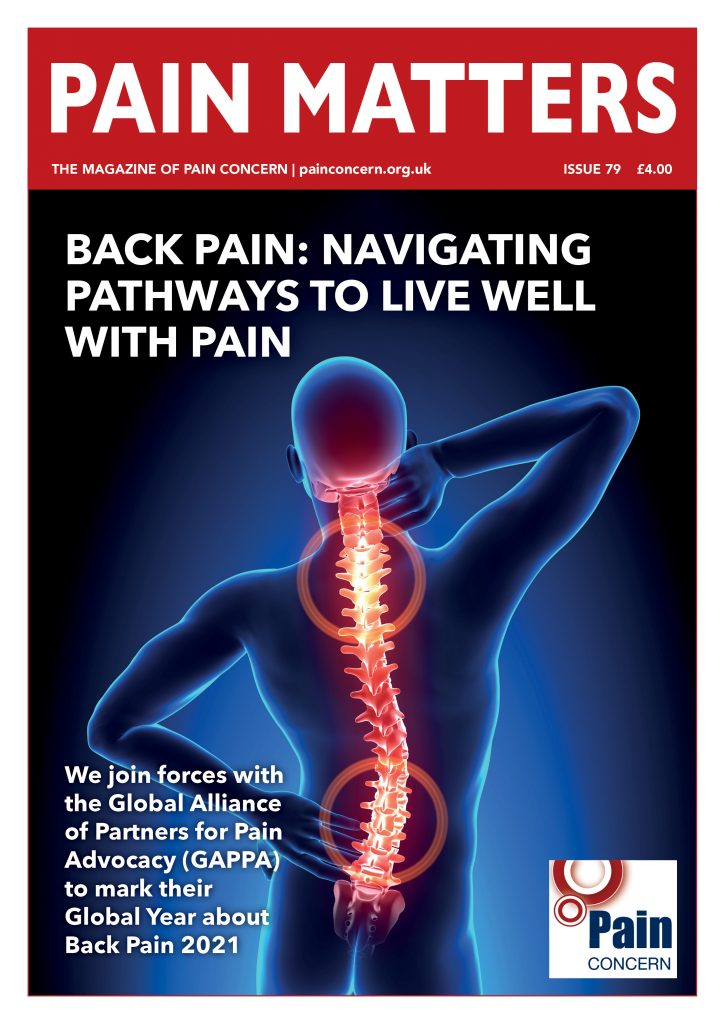
A  Pain Matters magazine cover.
Pain Matters 79

Your magazine offers hope

Staff and patients from NHS pain management programmes have guest-edited the different editions of Pain Matters quarterly magazine. This has brought fresh content and personal accounts that are inspiring to read. Articles that proactively help people in pain to acquire self-management skills and take more control of their lives are appreciated by readers.

Last year guest editors from NHS North Bristol explored how pain services have adapted during the pandemic. We covered the global year about back pain with guest editors from the International Association for the Study of Pain’s Global Alliance of Partners for Pain Advocacy, while in another issue guest editors behind the Advance Pain Discovery Platform showed how researchers and patients are collaborating in their efforts to advance our understanding of pain.  

From our contributors 

Ask yourself: when your doctor prescribed a tablet for your pain, did they discuss what you might do while you wait to see if they help?’ – Professor Michael Nicholas, on the importance of adopting a collaborative approach to care 

It’s hard to explain that this invisible pain in my legs, feet and hands has caused major disruption to my life. It’s an unwanted soundtrack and I can’t turn the volume down‘  – Fiona Talkington, broadcaster, writer and presenter, on how difficult it is to describe pain. 

I’d walk in the park or around the block, just for a few minutes every day. I still miss social interaction so I made sure I spoke to someone each day, just a ‘good morning or a ‘how are you’ helped‘ – Cathy Parker, former attendee of North Bristol pain management programme, on what helped her through the pandemic. 

How could we all work together to ensure changes in the lives of people in pain?’ – Professors Lesley Colvin and David Walsh explain why researchers set up the Advanced Pain Discovery Platform  

Other publications  

Our popular pain education publications remain available on our website and we will post leaflets free of charge. With the support of two charitable trusts, The Stafford Trust and R. S. MacDonald we have created new publications covering Nocturnal pain in Parkinson’s disease (that is when most pain occurs) and, with the Shingles Support Society, Shingles vaccination, explaining why vaccination is central to preventing post-herpetic neuralgia. These publications accompany the Airing Pain podcasts on Parkinson’s pain, shingles and post-herpetic neuralgia. We have been heartened at the response.

The Immunisation and Vaccine Preventable Diseases Division of the UK Health Security Agency has invited us to collaborate with them in 2023 in updating their information. We have progressed our information on opioids for chronic pain, once again collaborating with the charity Maggie’s to produce a new publication on Opioid-induced constipation. We have collaborated with the Brain and Spine Foundation, to publish their article on Signalling for support – navigating life with a hidden condition. 

Pain Press is a free e-newsletter which supplements Pain Matters and keeps beneficiaries and supporters up-to-date with our activities and achievements. We have published 7 editions of the supplement in the year.  


Highlights from across the years

2009 – Pain Concern wins Napp Award in Chronic Pain which allows us to launch Airing Pain radio programme in 2010. 

2015 – Paul Evans wins best Nationals and Regions Producer at the Radio Productions Award, with the judges singling out our Airing Pain programme on ‘Female Genital Mutilation’ as a ‘stop what you are doing’ moment. 

2016 – Our research Barriers to Self-management in Primary Care wins poster prizes at the annual scientific meetings of the British Pain Society and the North British Pain Society. 

2016 - We contribute the chapter ‘Communication with patients’ to the Royal College of Anaesthetist’s Core Standards for Pain Management

2017Barriers to Self-management is published in the British Journal of General Practice

2017 – NHS Greater Glasgow and Clyde’s Pain Education Sessions, along with Airing Pain win Highly Commended Award at the Grünenthal Pain Awards for ‘widening access to pain education.’ 

2019 – The Self-management Navigator Tool wins a Best Poster Prize at the Annual Scientific Meeting of the Scottish Pain Research Community (SPaRC). 

2020 – A pilot evaluation of the Self-management Navigator Tool to enhance communication in primary care consultations about chronic pain is published in The British Pain Society’s Pain News.  

2020 – Open Access Government publishes 2020: Global Year for the Prevention of Pain

2020 – Evaluation Support Scotland publishes Pain Concern Helpline: A Case Study; in 2022 they publish an update on their website.  

2021 – Our helpline volunteers receive an Inspiring Volunteers Award in recognition of their service throughout the pandemic. 

2022 – We present a poster Impact of a Patient-led Helpline on NHS Services at the scientific meetings of the North British Pain Association and the Scottish Pain and Research Community (SPARC). 

Peer Support. Join the community

“Having chronic pain is very lonely.”

Join the community

Subscribe to Pain Matters

Everything you need to know about how to live with chronic pain

Subscribe


In pain? Don’t understand what’s happening?

“Having someone to help you prepare for your life through pain”

Our Pain Education Sessions

Fundraise for Pain Concern

Help us to help others

Fundraise


Pain Concern have created a selection of key resources about shingles, which you can find all in one place on our Shingles, Post-herpetic Neuralgia and Chronic Pain Resources page.


Shingles, or herpes zoster, is caused by the varicella zoster virus which causes chickenpox. After you have had chickenpox, the virus stays inactive in your nerve cells. Shingles begins when the virus becomes active again and spreads down the nerve to the skin. You may feel a tingling, stabbing or burning sensation before the shingles rash appears.  

The shingles rash will be a patch or line of blisters within the area affected by an infected nerve. It will be on one side of the body only. It may be mild and heal in two to three weeks in healthy young adults. However, in people over the age of 50 and patients with weakened immune systems, it can take longer and complications are more likely to develop. The most common complication is post-herpetic neuralgia (PHN), which is described as pain in the nerve (neuropathic pain) and which continues at least three months after the shingles rash appears.   

About half of us who live to the age of 85 will develop shingles, and cases are increasing.   

You are more likely to suffer from post-herpetic neuralgia if you:  

  • are older (people over 50 are 15 times more likely to get post-herpetic neuralgia than those under 50);  
  • have other conditions, such as diabetes;  
  • are taking medications that weaken the immune system, such as steroids and other immunosuppressants;  
  • have an injury, which can reactivate the virus and cause a shingles rash at the site of the injury; or  
  • are suffering from stress.  

Treating post-herpetic neuralgia is difficult. Although there are various treatments, most patients with severe post-herpetic neuralgia are never fully without symptoms.  

Preventing shingles 

The UK vaccination programme was introduced in 2013 for adults in their 70s. GPs can give a single-dose vaccination known as Zostavax (or ZVL) to anyone in this age group.   In the first three years of the programme, cases of shingles fell by 35% and cases of post-herpetic neuralgia by 50%.   

There is now a second vaccine called Shingrix, or ZSV, which is a two-dose vaccine and was approved for use in the NHS from 1 September 2021. This is given to people with immunity problems (such as people who have had cell transplants, those with HIV and those on immunosuppressants) who cannot have the Zostavax vaccine and who are at greater risk of developing shingles.  

The arrival of the new shingles vaccine is welcome. It will prevent many cases of shingles and reduce the possibility of post-herpetic neuralgia in older adults.    

If you have had chickenpox, we would strongly recommend you have a shingles vaccination. Side effects are generally limited to a mild reaction at the site of the injection (for example pain, redness, swelling and itching).  

How to get vaccinated 

Your GP or practice nurse will offer you the Zostavax vaccine when you’re eligible (between the ages of 70 and 79). It is not available on the NHS to anyone aged 80 and over. If Zostavax is not suitable for you, your GP will decide whether to offer you Shingrix instead.  

If you have not been offered a shingles vaccination, contact your GP surgery to arrange an appointment.  

You can have the shingles vaccination at any time of year and at the same time as most other vaccines. However, try to leave seven days between the shingles vaccine and a Covid-19 vaccine.  

For more information, please visit nhs.uk/conditions/vaccinations/who-can-have-the-shingles-vaccine/  


Mick Serpell is a Consultant in Anaesthesia and pain medicine for Greater Glasgow and Clyde NHS, and a Senior Lecturer at Glasgow University. He is Series Editor for Anaesthesia and Intensive Care Medicine, Associate Editor for Pain Management, sits on the Advisory Board for European Journal of Pain and reviews articles for several other pain-related journals. He is Examiner for the Fellowship of the Faculty of Pain Medicine of the Royal College of Anaesthetists (FFPMRCA). 

Thanks go to the Shingles Support Society and healthcare professionals who advised us on the content of this leaflet and peer reviewed it. Shingles Support Society is a UK-based patient support group. If your pain is a result of shingles, you can see the treatment that doctors will use to treat post-herpetic neuralgia and also read self-help suggestions from other sufferers: shinglessupport.org.uk 

Shingles vaccination leaflet © 2022 Mick Serpell. All rights reserved. First published July 2022.  

This publication was funded by The RS MacDonald Charitable Trust and The Stafford Trust  

Peer Support. Join the community

“Having chronic pain is very lonely.”

Join the community

Subscribe to Pain Matters

Everything you need to know about how to live with chronic pain

Subscribe


In pain? Don’t understand what’s happening?

“Having someone to help you prepare for your life through pain”

Our Pain Education Sessions

Fundraise for Pain Concern

Help us to help others

Fundraise


Volunteer Friendly Award logo

Pain Concern is delighted to have achieved the Volunteer Friendly Award. The award is a user-friendly quality standard which supports, recognises and rewards groups who are good at involving volunteers.

We received feedback that our commitment and dedication to volunteers was evident throughout the Volunteer Friendly Award submission, as was our appreciation of volunteers. Our submission was considered excellent and feedback also highlighted how much people enjoy volunteering at Pain Concern, feel supported and get a lot out of volunteering with us. 

Pain Concern Volunteers

Our resources and helpline support are for anyone in the UK who has chronic pain or supports someone who does (including healthcare professionals). To do this, over forty-five volunteers from across the UK and beyond support us in a variety of roles such as helpline volunteer, office, research, illustrations, marketing, social media, website, editorial, audio transcriptions, broadcast assistant and our Listener & Readers Panel members.  

Our volunteers are fundamental to the success of the charity. The submission involved surveying volunteers, who fed back that they felt that their contribution is valued, meaningful and rewarding and 100% of respondents felt Our volunteers are fundamental to the success of the charity. Our Volunteer Friendly submission involved surveying volunteers, who fed back that they felt their contribution is valued, meaningful and rewarding and 100% of respondents felt their expectations, reasons and motivations for volunteering were being met. 

Volunteer Award Feedback

We received the following comments in response to our submission:

‘Overall, the portfolio of evidence submitted by Pain Concern for the Volunteer Friendly Award is exemplary. It highlights the important and outstanding work and volunteering at Pain Concern which is making a real difference for people and the community.’

Mike Melvin, Volunteering Services Manager, ACVO,

‘An excellent submission for the Volunteer Friendly Award from Pain Concern, who have not only met but exceeded the requirements across every strand of the award. It was encouraging to hear the voices of your volunteers, who felt their contribution was welcomed and valued and that Pain Concern was inclusive towards all volunteers, regardless of background.’

Katy Penman, Volunteer Scotland

What is it like to volunteer with Pain Concern?

The Scottish Government recognises that volunteering matters and that it’s all about new experiences, feeling good and making a difference. Here’s some feedback from a couple of volunteers on their experience with Pain Concern: 

‘I chose to volunteer with Pain Concern for many reasons; I really like Pain Concern’s objectives as a charity, and I believe Pain Concern is one of the rare charities providing emotional support, and practical advice for people living with pain. I find it fascinating hearing service users diverse stories on the helpline, and knowing every day is different with different topics of discussion.

I would tell other people who are thinking about volunteering that being with a charitable organisation is rewarding, and good for mental and physical health. Since joining the Pain Concern team, I feel I am not alone with my pain, and I truthfully recognise the pain of service users.’

Jo, Helpline

‘When I first started volunteering at Pain Concern as a research assistant, they explained that it was a partnership and although I would be helping them, they were also able to help me with any skills I wanted to develop or to get involved with anything I found interesting at the charity.

I mentioned during one of my weekly meetings with Sam my supervisor, that I was looking into starting a career within psychology and from reading job descriptions and person specifications, one of the main requirements needed was direct experience of working with services users who had physical and/ or mental health conditions… Sam then very kindly offered to train me on the helpline so I could gain direct experience of supporting people in their chronic pain journey.

This has been extremely beneficial not only to me as I have been able to increase my knowledge and expand my interpersonal experience, but it has also been beneficial to the service users. I love being a part of the helpline team and I have felt a great sense fulfilment.’

Katie, helpline

We are delighted with this outcome and welcome anyone who is interested in volunteering with us to look at our current opportunities.

Peer Support. Join the community

“Having chronic pain is very lonely.”

Join the community

Subscribe to Pain Matters

Everything you need to know about how to live with chronic pain

Subscribe


In pain? Don’t understand what’s happening?

“Having someone to help you prepare for your life through pain”

Our Pain Education Sessions

Fundraise for Pain Concern

Help us to help others

Fundraise


First Broadcast 1st December 2022 

What is mental defeat and does it have an impact on the experiences of those living with pain? 

In this edition of Airing Pain, Paul Evans interviews the team at the Warwick Study of Mental Defeat in Chronic Pain (WITHIN Project), and research participants, as well as taking part in the study as a participant himself.  

The study, which runs until May 2023, is investigating how mental defeat can influence pain sensation, sleep patterns, social activity, physical activity, and the general health of individuals who have chronic pain. 

Mental defeat is defined as the perceived loss of autonomy in the face of uncontrollable, traumatic events. In the context of chronic pain, this can be explained as a loss of identity and self in relation to repeated episodes of pain. 

Paul talks to the team about their experimental, lab-based study and the sleep-tracking survey, then undergoes the lab experiment himself. Afterward, he discusses how he found it and the possible outcomes of the research. He also interviews other participants on their experiences. 

Research into mental defeat is in its early stages. It is hoped that the WITHIN Project will generate important information to help us further understand the influence that mental defeat has on distress and disability in chronic pain patients. This is essential listening for anyone wanting to know more about the research process or wanting to participate. 

Issues covered in this programme include: Mental Defeat, pain research, insomnia, psychological effects of pain, chronic pain, patient perspective, acceptance and commitment therapy, research participation, pain thresholds.  

Paul Evans: This is Airing Pain, a programme brought to you by Pain Concern, the UK charity providing information and support for those of us living with pain, our family and supporters, and the health professionals who care for us. I’m Paul Evans. And this edition of Airing Pain is funded by the Medical Research Council.  

Nicole Tang: Mental defeat is a rather abstract concept. It is a concept that has been developed in the field of depression, post-traumatic stress disorder and even in the field of suicidality. It is only when I have spoken to a large number of pain patients themselves, when I ask them about – you know – how they feel, how they interpret their current situation, they talk to me about something – pain being the enemy. That they have to face it every day and they talk about how defeating it is, especially for their mind, and they talk about how the pain has taken over, how they feel they are belittled by the pain, and sometimes they even think that they don’t feel like they are human beings anymore, they feel like they are just a walking sort of ‘blob of pain’ and that is a very remarkable quote from one of the participants of our studies.  

Evans: Nicole Tang is Professor of Clinical and Health Psychology at the University of Warwick. She is Principal Investigator of the WITHIN Project, that is the Warwick Study of Mental Defeat in Chronic pain. The study’s investigating how mental defeat can influence pain, sleep, social activity, physical activity, and general health and well-being, in people who have chronic pain. But that word ‘defeat’ ….? 

Tang: By ‘defeat’ we try to use that to describe the deeper psychological impact of living day-to-day in battle with pain. When the pain is winning you will get to feel defeated, you will get to feel that you are not winning the battle, or the pain is taking over.  

Evans: So, you are actually talking about a battle against the pain? 

Tang: In a way, I mean, this is what we have heard from qualitative interviews with a large number of chronic pain patients when we talk to them about the psychological experience, how they deal with pain on a day-to-day basis. This is usually something that we get – particularly from those individuals who are most affected by chronic pain.  

Evans: Now you’ve just been talking to the International Association for the Study of Pain Conference, and you showed them a series of images of how pain might feel. One of the images you showed was of a person sitting on the floor and knees up to their chest with flames all around them. That is total helplessness, that really, really shows what it’s like and how dark the tunnel is.  

Tang: You can use the word helplessness to describe it, but I think mental defeat goes beyond just helplessness. If you think about defeat as something that could help to describe the deeper impact of chronic pain it has something to do with people’s self-identity – who they are, you know – what pain has made them become. Sometimes you will hear people say, ‘Wow I am not myself anymore, I used to run marathons but now I can’t even walk a mile.’ They would feel like they have been changed by the pain forever, they have been reduced. So, there is some element about that defeat concept that is not represented by just helplessness, and it goes beyond that.  

Evans: The way you are saying it, it is final; defeat is final.  

Tang: Well, I hope that is not the case because our current research is to find out a little more about that experience, to see how changeable it is over time and what we could potentially do to change that, because we believe that it could potentially be something that we could target in intervention, to help people to make a slightly different interpretation of their situation, because we thought that it is based on how people interpret their current situation in relation to the struggle with chronic pain. If we manage to change that perspective, there is actually hope somewhere that we can help people to see the light at the end of the tunnel.  

Evans: Perhaps I wasn’t right to say it is final, but the perception may be final.  

Tang: That’s what we hope will be the case and that’s what we are striving to understand. But unfortunately, we have also found out that there is a link between the sense of perception of defeat. If it is coming across as final to the person it could potentially increase the risk of suicide in this clinical population and so that’s why I cannot generalise whether or not it is final to such an individual. But we certainly hope that we can work towards understanding the concept and, if it is something that feels quite final for a fleeting moment, or for a short period of time and we can change that, then that is totally something that we need to do in the development of intervention – to not overlook, you know, how much pain could potentially affect a person’s self-identity and how they see themselves, their value in the world. To help them to see, you know, a positive side, you know, the future that can be changed, they can be an agent of change for themselves even though pain medication may not be helpful, even though there may not be an immediate cure for the chronic pain.  

Evans: Nicole Tang. So, I am just thinking of the chicken and egg scenario. Which comes first? Defeat leading to pain or pain leading to defeat?  

Jenna Gillett is a PhD student working with Professor Tang on the WITHIN mental defeat study.  

Jenna Gillett: This is the golden question. The research in terms of defeat is actually fairly new, specifically to chronic pain anyway, in that we are … that’s part of what we are doing within the study – we are trying to track defeat over time to see does it change? Is it the same? Do certain things maybe increase defeat? Is it related to certain other factors, such as self-compassion, pain, self-efficacy? 

We are looking at, sort of, how does defeat manifest in people? When you talk about it with other clinicians, when you talk about it with people who live with pain, lots of people go, ‘Yes I know exactly what you are talking about, I have seen this in my clinic, I have seen this on the wards, I have seen this in my friends when I go to my Fibromyalgia Support Group’. Lots of people know what you are talking about in terms of, ‘I can relate to the experience’, but not many people go, ‘Oh, so that’s called mental defeat is it?’. So, part of what we are doing is, I guess, getting the word out that, in terms of psychological variables, in particular, this is something worth looking at. It’s something that is really important in terms of helping people live well with pain – and mental defeat could be a really interesting and quite important variable that we need to be paying more attention to.  

We have a Sleep and Pain lab so, as the name implies, we are looking at the sort of people who have issues with their sleep and also people who experience chronic pain. Typically, what you find is that people who experience chronic pain also have worse sleep. They might struggle to fall asleep; they might struggle to stay asleep. A lot of them will meet the clinical cut-off for diagnosable insomnia. So, this is again something that Professor Nicole Tang has paved the way for in this kind of area of research. 

OK, so we are looking at people’s pain outcomes, but we also need to look at their sleep as well because this is a massive area of health that is really, really important to the overall experience and, again, living well with pain. So, the sleep tracking study fits in here. It’s a specific branch of the study. It has unfortunately closed to testing now, but we are so grateful for the people that did do it because the data is going to be so rich, and we are going to be able to really learn a lot from this particular design of this study. 

Evans: That’s Jenna Gillett. [Now over to] Nicole Tang.  

Tang: Sleep could potentially be one of the many pathways that will change the way in how you perceive pain. And change your mood because if you are not sleeping well you will wake up grumpy, you will wake up feeling irritated, tired, not feeling that you are ready to face the day. And so, it has a huge impact on pain management and so we felt that sleep could potentially be one of the pathways. And also, sleep is not detached from what we do on a day-to-day basis so we have a tracker where we can use that to monitor both sleep and physical activity during the day. So, we are going to look at the participants’ data to see how perception of defeat is linked to these day-to-day processes and then peoples’ pain experiences and outcomes.  

Evans: Well one thing I would say is that after a poor night’s sleep, I certainly ache a lot more.  

Tang: When people are sleeping better their physical activity level will go up because they feel better, they feel like their body is ready to take on the day and this is something that we have seen in our own research data where, without any intervention, following a night of good quality sleep people spontaneously would do more the next day. And so that’s the magical quality of a good night’s sleep. It is a daily therapy for people, it refreshes you, it helps you to face the next day and so sleep is really important.  

Evans: But how in your study, using sleep and the pain experiment, how do these two things link in together? 

Tang: So, they will be treated separately because we have three elements, like three branches of the whole programme of study so we are using a different approach . For the experiment we will be more focused on looking at the activation of mental defeat and its direct effect on, you know, your pain rating and pain anticipation, etc. For the other study – where we are testing the association between defeat, sleep, physical activity, and pain – we take it out of the laboratory in people’s day-to-day life, in their usual environment to see how the different pathways translate the sense of defeat into what we do and what we experience during the day. So, they are complementing each other but the data will be analysed separately.  

But you are right when you said earlier that when you didn’t have a good night’s sleep you tend to ache more during the day and it is exactly what we found in experimental research when we introduce sleep deprivation in healthy, pain-free volunteers and even for those young adults with no pain whatsoever, if we take away the sleep they tend to complain about pain a little bit more and when we do testing they feel the pain more. So that is the interesting thing about doing research, you can actually see the association really clearly.  

What we understand these days is that when the sleep disturbance has been here for some time it takes on a different shape and form so the mechanisms that maintain the insomnia would be slightly different from the mechanisms that trigger the insomnia, in the first place. And because of that change, the more we understand these days is that some of the cognitive behavioural treatments that work for people with insomnia in itself actually works really well for people experiencing pain and insomnia at the same time. And so, potentially, we can use a combination of drug and non-drug treatment or even just non-drug treatment to help people to sleep better.  

Evans: Nicole Tang. Jenna Gillett again. 

Gillett: We started this study right before Covid hit and that was a huge learning curve for all of us, I think, because nobody in the world knew what was going on, knew what was going to happen and we had to really sort of ‘adapt or die’ to the situation so to start with this study originally had a longitudinal questionnaire … 

Evans: So, just explain to me, what do you mean by longitudinal?  

Gillett: Longitudinal is ‘across time’, so with this longitudinal questionnaire we had three time points. So, we did a baseline timepoint, we did one six months later and then we did one another six months later, so overall you’ve got three time points across 12 months of data that you can then look at and you can track different factors, different things, mental defeat across those time points. So, you then get a snapshot of a 12-month period, if you like, of what’s kind of going on and you’re looking for trends and patterns in the data.  

So, with Covid and us running a longitudinal sleep-tracking study we had to really adjust things in order to be able to run it from the comfort of people’s own homes. Now, whilst this was something that was borne out of a pandemic, which is obviously quite a negative thing that the world went through, it’s actually resulted in a real positive thing and the response that we got from the people who wanted to take part in this study was just overwhelming. In the end, we had over 200 people which was just really incredible that, even with everything going on during Covid, the aftermath of Covid, people were really wanting to take part in this research which was just really nice and is why we do it, so it was really nice to have that kind of feedback as well.  

Evans: Jenna Gillett. One of the participants who took part in both the sleep and lab-based study is Lauren Pulsford.  

Lauren Pulsford: I have rheumatoid arthritis, currently only diagnosed as being in my right knee, so basically my chronic pain is any movement of the joint – time on my feet, especially, is just always constantly painful.  

Evans: What did you understand about mental defeat before taking part in this programme?  

Pulsford: Some days you just feel like … well it’s that … essentially that depression feeling isn’t it of ‘what’s the point? If I’m going to feel like this every day for the rest of my life there’s nothing that’s going to make me feel better, there’s nothing that’s going to make me normal’. That’s essentially what I understood it as, as something very similar to depression.  

Evans: Do you understand the principle of victory? Feeling victorious with your pain?  

Pulsford: To me that would be, I suppose, situations where you work through it, you beat the pain, you think this is something that I can’t possibly do because I’m going to be in so much pain but then you go and do it anyway. So, for instance, for me, you know, that would be something where I was stood up and on my feet for hours at a time without feeling like I was going to have a breakdown because of the pain.  

Evans: Why did you take part in the mental defeat research programme?  

Pulsford: Just for … I’m only in my 30s, I shouldn’t be sat at home doing nothing, day in, day out, the rest of my life, because I’m constantly in pain. So, I sort of thought, this sounds like something that sounds like me. Somebody with chronic pain and feeling defeated because of that pain and it seemed like a no-brainer to help do some research in the hope that it can help people.  

Evans: That was Lauren Pulsford who took part in the study. The sleep part is now closed but the lab-based part will remain open until May 2023, and the team need as many people as possible between the ages of 18 and 65 to volunteer. I’ll give contact details later, but I am within that age group, so I did volunteer. But for reasons of confidentiality and validity, we decided to separate my involvement as a participant from that of making this edition of Airing Pain. So, the day before meeting the rest of the team to record this podcast, I met Research Fellow, Kristy Themelis, at the University of Warwick Pain and Sleep Laboratory.  

Kristy Themelis: The session today will take about two- to-two and a half hours. We’ll start off with just setting up the heart-rate monitor. Are there any questions, so far, that you might have?  

Evans: I’m fairly nervous. Is that normal? 

Themelis: Yes that’s normal. There’s a lot to take in and it’s maybe a new experience. Is there anything that you are particularly nervous about today?  

Evans: Opening old wounds. 

Themelis: OK, so talking about some of these experiences? Yeah, and it can be tricky to talk about some of these things. It can come with some strong emotions. At any point, if you would like a break, just let me know and we can stop it or have a pause. For now, I’ll just begin.  

Evans: Right. I’m all yours.  

Themelis: Right, so this is a heart-rate monitor. It’s a chest strap …. [fades away] 

Evans: Kristy, we met yesterday because I have taken part in the mental defeat study. The boot is on the other foot now. So, what we went through were three statements from me. Looking back at a time when I felt defeated, which I take as being the lowest I’ve felt, another time when I felt victorious of my pain, i.e., feeling as if this is fantastic and everything is sorted, and then just almost like a control ‘how do I feel normally’.  

Themelis: Yeah. 

Evans: You put them into three sealed envelopes, one, two and three, and gave me a random number of which envelope to open without you seeing it, so you know nothing about … no prejudgement whatsoever.  

Themelis: [back to the research interview]  

OK. So that brings us to the next bit, which is where I will ask you a bit more about your experiences. We call it a thought-catching exercise where the aim is to identify some memorable moments in your life, where you either felt defeated, victorious or neutral in relation to your pain. So, what do I mean by that? By defeat, I mean disabling and negative thoughts about yourself in relation to your pain, victorious would be a strengthening, a positive thought about yourself in relation to your pain and neutral would be everyday and mundane thoughts about yourself. They are all very personal experiences, so there’s no right or wrong answer, and the thoughts and memories, which I hope you will recall, may come with some strong emotions, because they are important to you and represent who you are or who you are yet to become. So, is this something that you can relate to, something that you think … [fade away] 

Evans: I found the process quite emotional – looking at the bad times – and completely the opposite – looking at the good times. Actually, the average times – I don’t know what I felt. Is this normal? I mean really getting people to almost dredge through how bad they have felt?  

Themelis: Yes, so we are asking … in particular the defeating one … we are asking about very personal experiences. It often relates to a time where they felt very low. It can be quite difficult to talk about that or think about that. And it may therefore come with strong emotions, and we want to create a safe space where people are able to share some of these experiences.  

Evans: We will return to my time in the lab in just a moment but, I want to pick up on something Nicole Tang said about research into the relationship between mental defeat and PTSD, or post-traumatic stress disorder.  

Tang: What we have come to understand is that for those people who have experienced torture, a sexual or physical assault, if they did experience a high level of mental defeat they are also the people who are more likely to develop greater PTSD symptoms or, you know, poorer response to treatment in the future. And you can imagine the link between all these physical assaults and torture experiences with the sense of pain. It is almost like the physical tracker of that sense of threat to your personal integrity, for your identity and so there is an element of association between chronic pain and PTSD in that sense. And also from research, we know that there is a high level of comorbidity between chronic pain and PTSD. For example, if the pain developed as a result of an accident you could experience both at the same time, or if it is linked to a trauma, you can experience both PTSD and pain at the same time and pain being the trigger of memories of what happened in the past.  

We know that there is an association between high level of mental defeat and high level of distress and disability among people with chronic pain. But we don’t understand what would happen when that sense of defeat is strong and activated. For example, will it affect your pain experience in itself, so when you are experiencing thoughts of, you know, you being reduced by the pain, you being someone defeated by the pain, would that affect your pain experience? This is something that we would like to test out in a more controlled experimental setting.  

What we understand from our previous research is that it would definitely change your mood, it would change the way how you focus your attention. It will also change the way how you anticipate pain. But this time, we want to understand whether or not it will actually change your pain experience. So that’s why we are doing testing in a laboratory.  

The other thing that we are doing is that we are trying to find out, over a longer period of time, whether or not that sense of defeat would change naturally or whether or not it would change in response to intervention. So, we are doing a longitudinal study where we re-contact our participants who have completed a survey for us, at six months and twelve months, so that we find out over time how people will be reporting in terms of the level of mental defeat and also the level of functioning. So, we are interested in, you know, the association between the sense of defeat and the functioning quality of life.  

Evans: Nicole Tang.  

Well, could there be another association with mental defeat? Acceptance and Commitment Therapy (ACT) is a recognised approach for the management of chronic pain.  

Jenna Gillett. 

Gillett: Yeah, it’s very interesting. Obviously, with Acceptance and Commitment Therapy, there’s a whole host of research that, you know, says, this is a brilliant sort of infrastructure and technique that we can use with people who live with pain and, as the name implies, Acceptance and Commitment Therapy, you are working with someone to help them accept where they are. And that’s might not be where they necessarily want to be, but it’s about accepting that this is where you are and that’s OK. And it’s sort of giving the individual back a sense of power, if you like. So, in terms of where defeat might fit in with that, it could be potentially down the road that maybe Acceptance and Commitment Therapy could be applied to people who experience mental defeat. We don’t know. The research is quite early on in terms of where we are at with it, but acceptance is definitely something that’s quite important, and I think would heavily feature in relation to people who experience defeat.  

Evans: Jenna Gillett. Back to the lab with Kristy Themelis.  

Themelis: This is where we have got our equipment when we’ve had people come in and have had sleep studies. We would have monitors connected and now this is where we do most of our testing. There are three tests in total. So, this is called an algometer and it has a little probe on the end and all it does is it measures the amount of resistance against that probe. So, I’ll place it on your hand in this case and then very slowly start to increase pressure. And I want you to say ‘Stop’ the moment it becomes painful. And I’ll remove the probe straight away.  

Evans: So, this isn’t a macho thing?! 

Themelis: Exactly [they both laugh] it’s not about how long you can last. So that’s a completely different test, and something that we also wouldn’t get past Ethics [laughs]. No, this is that very first moment and we call that a Pain Pressure Threshold. So, I will count down three, two, one, start and then I’ll start to apply pressure, so I want you to say ‘Stop’ the first moment it becomes painful. Are you ready? In three, two, one … [silence and a short pause] 

Evans: Stop. 

Themelis: OK, so behind you, on that cupboard, there’s a rating scale, zero to a hundred. I would ask you to rate that pressure pain. Zero being no pain at all to a hundred being worst pain imaginable.  

Evans: I’d say it was a three.  

Themelis: So, the second test is over here and it’s using this bath of water at core temperature, and, in a moment, I will ask you to place your hand inside. And then remove it as soon as it becomes painful.  

And then, yes, take it out as soon as it becomes … right. So how much would you rate that? Zero to a hundred?  

Evans: Zero to a hundred? I would say not far off sixty.  

Themelis: Sixty? Are you happy to continue? Yes? So, the third one is actually a combination of the two, so this time I will ask you again to put your right hand inside. What I will do is apply pressure on your left shoulder, on there, and I want you to say ‘Stop’ the first moment the pressure becomes painful.  

Evans: The pressure on my shoulder?  

Themelis: On your shoulder, yes. So, it’s not the water, it’s when that pressure becomes painful. Now with the hand that goes in the water, try to keep it in as long as possible. If you have to remove it, just take it out and put it back in until the pressure is ceased. Three, two, one – go … [fade away] 

Evans: To recruit participants during lockdown, the team used social media platforms of various organisations and charities supporting people with chronic pain, including Pain Concern. Successful to a point, but there were some anomalies. Paige Karadag is the Research Assistant with the WITHIN mental defeat programme.  

Paige Karadag: Jenna was actually the one to identify that there were some responses that didn’t quite look human. This could have gone unnoticed if we weren’t so diligent in checking. Each time a person screened we would manually read their responses. It’s not really an automated computer that does that, it’s us that’s looking into their responses. Are they eligible?  

But you have to think that if we are using social media and you get 50 responses come through, you know, overnight, that is a lot to check. At the time there was kind of an influx of 100 or 200 responses overnight and at first, we thought, ‘Wow, we’ve been really successful; we’ve clearly hit the jackpot and reached the right demographic here’. But then, once we looked more closely at the responses, there were things that just didn’t quite sit right. Would a human really put those responses? There were some letters that didn’t look like they were from the UK alphabet, so kind of tell-tale signs, but, in terms of did they meet the eligibility criteria at a glance, yes, because they put they had arthritis, they put keywords that would be associated with a chronic pain condition so, at a glance, they might have then been eligible to do.  

Especially the questionnaire, which doesn’t have such strict criteria than, for example, the experiment does and, of course, with the questionnaire, there’s no face-to-face contact, there’s no phone call contact, really, other than emails. And I think one way to kind of look at it was it would be responses if someone had maybe English as their second language, so they could have been human and just weren’t very fluent in English. But after looking into it more carefully, it was clear that these, perhaps, were fraudulent responses in a block. And so, we were tasked with filtering through because, of course, there would be some genuine ones in there and we wouldn’t want to just scrap all of these responses if some of them were actually genuine people living with chronic pain who had given up time to take part in the questionnaire.  

Evans: I mean this is completely baffling to me. A bot is not a human, it’s an automated artificial intelligence response to a certain thing.  

Karadag: Yeah, and I think the key there is ‘intelligent’ because we tried lots of methods to prevent this from happening. So, we removed any examples because, at one stage, there was in the question ‘Do you have chronic pain?’ – for example … and then a list of arthritis, fibromyalgia and then we think that this intelligence essentially would use those keywords, put it in the box and that was a pattern that we were seeing. And kind of, as we developed the questionnaire, the bots could develop as well, so it was a very clever system and we’re not sure if they were targeting chronic pain studies in particular, because since then, we have found that other researchers have experienced this, and there’s a blog that has been put out by one who actually had to restart the study altogether, because they couldn’t decipher the genuine from the non-genuine responses. So, we did spend a lot of time to try and prevent any fraudulent ones from going through, and that included manually reading every person’s answer to be confident that this is a real person with chronic pain.  

Evans: I find that really upsetting because research is so important that somebody – I mean it would have been somebody behind that artificial intelligence – should feel that it’s appropriate to attack genuine research projects that would help humans.  

Themelis: [end of test with Evans] OK. Right, so we’re all done. So, let’s, shall we, go to the room next door? We can … it’s a bit more comfortable and we can do a debrief. Right, so you’re all done. How was that for you? [fades]. 

Evans: You’ll have to remind me of the order. We went through certain pain tests of putting your hand into cold water and seeing when it becomes painful – which, in my case, was pretty quick [laughs]. And then the pressure tests of putting something on my arm, increasing pressure and finding out when the pain kicks in there. Now, that was the control side, but I guess this was before we did the emotional stuff.  

Themelis: Yeah. We first asked you about the three different emotional experiences and then we did the first round of tests of pain testing those, sort of, three tests that you talked about. And then I asked you to open one envelope and we kind of kept it secret from me, as the experimenter, as to which one you were asked to open and then repeated the test again, so there was a before and after thinking about a specific memory.  

Evans: Actually, I can say now, the envelope that I opened was the ‘defeated’ envelope. We did all those physical tests again, whilst I was thinking about those emotions and thinking about what I had written. I was quite surprised actually that I did feel a little bit tearful doing it then. Why were you doing it like that? You know, what were you expecting to see or what will the experiment show? Not just with me – with all the participants.  

Themelis: We only asked you to open one envelope, and, in this case, you had the defeat one, so we are particularly interested in those defeating experiences and how they might affect the way the body processes pain. But that on its own wouldn’t necessarily tell us much, as we want to know how does your body respond under different conditions? So, that’s why we also include a victorious memory, and I would expect if there was any effect to the defeat, that the victorious would be almost the opposite effect. But we don’t know that. We need to kind of look at the data. Then there’s the neutral one, for which we don’t necessarily expect much to happen.  

Evans: Do you find that some people have the same experience that I’ve had? It’s actually [pause and exhalation of air] a little bit of a shock to dig through those memories.  

Themelis: Yeah, yeah. And some people, when they come in, they might be a bit nervous, and it might be the first time that they are taking part in research, so my hope is that by having that face-to-face contact and having the time to talk about the research, and having time to listen about their experience, I can hopefully create an environment where they do feel that they are able to talk about it.  

Evans: I’m only speaking from personal experience now. It can be quite cathartic, looking back at the defeated experience because, in my case, it was the only time I have ever told anybody and the confidentiality makes it really, really cathartic. Do other people find that? 

Themelis: Yes, interesting you mention that. So, we’ve had a few people comment at the end that they’ve found it a positive experience to think about some of the … and talk through some of these things, even if it may be difficult to think about those memories. That’s what we are trying to do with this sort of research is really listening to people’s experiences and taking that as a starting point, and then look at it with our research head and what can we learn from this.  

Evans: Well, what I find interesting, as well, is that you’re not my therapist, you’re not offering me solutions to go away with to try this, that, and the other. You are, excuse me, a blank sheet of paper. It’s totally confidential and I find that actually very rewarding.  

Themelis: That’s really interesting to hear and I think you capture it really well. We are not in the position to provide advice or anything but if we can create an environment where people are able to share their experiences then – ah yeah.  

Evans: Kristy Themelis. We heard earlier from research assistant Paige Karadag, about battling those internet bots, or robots, that had targeted the online recruitment programme.  

[Back to interview with Karadag] OK let’s assume you’ve got all the right people, then there’s the eligibility. Who is eligible? 

Karadag: Chronic pain is so subjective, and we have tried to be a really inclusive project in that we want all types of chronic pain, whether that’s primary chronic pain, secondary chronic pain, from another underlying long-term health condition, but what that means is for some participants who would fit, you know, kind of the textbook. They have chronic pain, it’s persistent, it’s intense, it’s there 80% of the time so, with those people, they think, ‘Yes this is me’. Whereas, for other people, who perhaps have episodes of chronic pain or it’s not intense, they might then think, ‘Am I actually eligible?’. And we have had people say, especially for the lab-based study, ‘I don’t want to waste your time, I don’t want to take up a spot that someone else could be doing’. And I think what’s really important is just having that communication and that dialogue with participants and, if we have any future participants who think, ‘Oh, you know, I don’t think I’m eligible’, please just get in touch to have that conversation because you absolutely are. Chronic pain comes in all shapes and forms.  

Evans: Paige Karadag. Jenna Gillett again. 

Gillett: So, if anyone listening is interested in participating in the lab study, we are looking for people who are aged between 18 and 65, who live in the UK, speak English, and experience chronic, non-cancer pain. If you are not sure whether you are eligible or not, do please get in touch with us because we’re happy to help and go through our specific inclusion and exclusion criteria with you. We can do this over the phone, or we can also do it over email, as well, so yes please do get in touch with us.  

Evans: The study is running till May 2023, and I found taking part really rewarding, and I’d encourage others to get in touch with the team or check out the website. The address is a little long to remember, so I just put the words ‘mental’, ‘defeat’, and ‘Warwick’ into the search engine, and the Warwick Study of Mental Defeat in Chronic Pain came top of the list. Or you can email the team at WITHINstudy@warwick.ac.uk. They are really friendly.  

As in every edition of Airing Pain I’d like to remind you of the small print. That was – we in Pain Concern believe the information and opinions on Airing Pain are accurate and sound, based on the best judgements available; you should always consult your health professional on any matter relating to your health and well-being. They are the only people who know you, your circumstances, and, therefore, the appropriate action to take on your behalf.  

Do check out Pain Concern’s website at painconcern.org.uk where you can download all editions of Airing Pain and find a wealth of support and information material about living with and managing chronic pain, including details of how to order our Pain Matters magazine. And, of course, for more information about this edition of Airing Pain.  

Now, it’s important for us at Pain Concern to have your constructive comments about these podcasts, so that we know that what we’re doing is relevant and useful, and what we’re doing well or maybe not so well. So, do please leave your comments or ratings on whichever platform you listen to this on, such as Apple Podcasts, Spotify, or the Pain Concern website. That will help us develop and plan future editions of Airing Pain.  

Back to this edition of Airing Pain. Caroline Perry was another participant in the study. She has had ME and Fibromyalgia for three to four years. She can have the last words. A positive experience Caroline?  

Caroline Perry: Absolutely, and if the research can go on to help others or the research can go on to have some kind of understanding why it’s the pain, then they know that it’s always a good thing, so absolutely, I’m so glad I did it.  

Evans: And you’d encourage other people with pain to get involved?  

Perry: Absolutely. I’ve got a couple of loved ones who I know, and I have actually passed it on to them because the more people who can do this the more research we can have from it.  

Contributors:  

  • Dr Nicole Tang, Principal Investigator, WITHIN project, University of Warwick. 
  • Jenna Gillett, PhD Student, WITHIN project, University of Warwick. 
  • Lauren Pulsford, research participant with lived experience of chronic pain. 
  • Dr Kristy Themelis, Research Fellow, WITHIN project, University of Warwick. 
  • Paige Karadag, Research Assistant, WITHIN project, University of Warwick.  
  • Caroline Perry, research participant with lived experience of chronic pain. 

End 


Special Thanks:

This edition of Airing Pain has been funded by grants from the Medical Research Council. Pain Concern would like to thank all at the WITHIN project, University of Warwick, for their time and support.

More Information:

Peer Support. Join the community

“Having chronic pain is very lonely.”

Join the community

Subscribe to Pain Matters

Everything you need to know about how to live with chronic pain

Subscribe


In pain? Don’t understand what’s happening?

“Having someone to help you prepare for your life through pain”

Our Pain Education Sessions

Fundraise for Pain Concern

Help us to help others

Fundraise


What is mental defeat and does it have an impact on the experiences of those living with pain?

In this edition of Airing Pain, Paul Evans interviews the team at the Warwick Study of Mental Defeat in Chronic Pain (WITHIN Project) and research participants, as well as taking part in the study as a participant himself.

The study, which runs until May 2023, is investigating how mental defeat can influence pain sensation, sleep patterns, social activity, physical activity and the general health of individuals who have chronic pain.

Mental defeat is defined as the perceived loss of autonomy in the face of uncontrollable, traumatic events. In the context of chronic pain this can be explained as a loss of identity and self in relation to repeated episodes of pain.

Paul talks to the team about their experimental, lab-based study and the sleep-tracking survey, then undergoes the lab experiment himself. Afterwards, he discusses how he found it and the possible outcomes of the research. He also interviews other participants on their experience.

Research into mental defeat is in its early stages. It is hoped that the WITHIN Project will generate important information to help us further understand the influence that mental defeat has on distress and disability in chronic pain patients. This is essential listening for anyone wanting to know more about the research process, or wanting to participate.


Issues covered in this programme include:

Mental defeat, pain research, insomnia, psychological effects of pain, chronic pain, patient perspective, acceptance and commitment therapy, research participation, pain thresholds.


Within study logo

Time Stamps:

0:25 – Dr Nicole Tang, the Principal Investigator at the WITHIN Study of Mental Defeat in Chronic Pain, discusses the definition of mental defeat.
5:55 – Jenna Gillett, PHD student and study researcher, on the relationship between pain and mental defeat.
7:17 – Jenna Gillett and Dr Nicole Tang explain the sleep tracker study.
10:04 – Dr Nicole Tang breaks down the elements of the study – the laboratory experiment and the sleep tracker.
11:00Dr Nicole Tang discusses how having consistently disrupted sleep effects pain and what kind of treatments can be considered.
12:19 – The impact of the COVID pandemic on the study – adaptations and the unexpected outcomes.
14:00 – Participant Lauren Pulsford describes her experience of taking part in the study.
16:00 Airing Pain Producer Paul Evans meets Research Fellow Kristy Themelis to participate in the lab-based experiment.
20:00 – Dr Nicole Tang on the association between chronic pain and Post Traumatic Stress Disorder.
21:00 – Exploring what happens to those with chronic pain have a strong sense of mental defeat.
22:00 – Explanation of the longitudinal study – looking at sense of defeat, pain and activity over time.
23:00 – Jenna Gillett talks about Acceptance and Commitment Therapy and its possible links with mental defeat.
24:00 – Back in the lab with Paul Evans and Kristy Themelis, measuring his pain pressure threshold.
27:00 – Paige Karadag, research assistant, explains the challenges of recruiting research participants online.
31:30 – Paul Evans and Kristy Themelis discuss the experiments that he participated in and how he found it.
35:30 – Paige Karadag and Jenna Gillett outline the criteria for research participants for the study, which will be running until May 2023.
39:00 – Participant Caroline Perry offers her take on why people should take part.


Contributors:

  • Dr Nicole Tang, Principal Investigator, WITHIN project, University of Warwick.
  • Jenna Gillett, PHD student, WITHIN project, University of Warwick.
  • Lauren Pulsford, research participant with lived experience of chronic pain.
  • Paul Evans, research participant with lived experience of chronic pain.
  • Dr Kristy Themelis, Research Fellow, WITHIN project, University of Warwick.
  • Paige Karadag, Research Assistant, WITHIN project, University of Warwick.
  • Caroline Perry, research participant with lived experience of chronic pain.

Special Thanks:

This edition of Airing Pain has been funded by grants from the Medical Research Council. Pain Concern would like to thank all at the WITHIN project, University of Warwick, for their time and support.

UKRI Medical Research Council

More Information:

Peer Support. Join the community

“Having chronic pain is very lonely.”

Join the community

Subscribe to Pain Matters

Everything you need to know about how to live with chronic pain

Subscribe


In pain? Don’t understand what’s happening?

“Having someone to help you prepare for your life through pain”

Our Pain Education Sessions

Fundraise for Pain Concern

Help us to help others

Fundraise


Pain Concern’s podcast can help you to further your professional knowledge.

Did you know that Members of the Faculty of Pain Medicine of the Royal College of Anaesthetists can gain Continuing Professional Development credits by listening to, and reflecting on, relevant episodes of Pain Concern’s Airing Pain Podcast?

The Faculty of Pain Medicine guidelines state that all doctors should keep up to date with the professional knowledge base through personal study, which includes listening to relevant podcasts.

These activities should be self-accredited, with one CPD credit earned for each hour of activity, when accompanied by documented reflective learning.

There are over 130 episodes to choose from, covering a wide range of topics on managing chronic pain, including neuropathic pain, arthritis, long covid and more.

If you have listened to Airing Pain to earn credits and have reflections to share, then please let us know your thoughts!

Peer Support. Join the community

“Having chronic pain is very lonely.”

Join the community

Subscribe to Pain Matters

Everything you need to know about how to live with chronic pain

Subscribe


In pain? Don’t understand what’s happening?

“Having someone to help you prepare for your life through pain”

Our Pain Education Sessions

Fundraise for Pain Concern

Help us to help others

Fundraise


Opioids are a group of medicines that come from the extract of poppy seeds or other medicines that work in the same way. This leaflet by Dr Roger Knaggs explains all about their uses, including the benefits and risks associated with their use.

Includes

Types
Before taking
Side effects
What can and can’t I do while on opioids?

Peer Support. Join the community

“Having chronic pain is very lonely.”

Join the community

Subscribe to Pain Matters

Everything you need to know about how to live with chronic pain

Subscribe


In pain? Don’t understand what’s happening?

“Having someone to help you prepare for your life through pain”

Our Pain Education Sessions

Fundraise for Pain Concern

Help us to help others

Fundraise


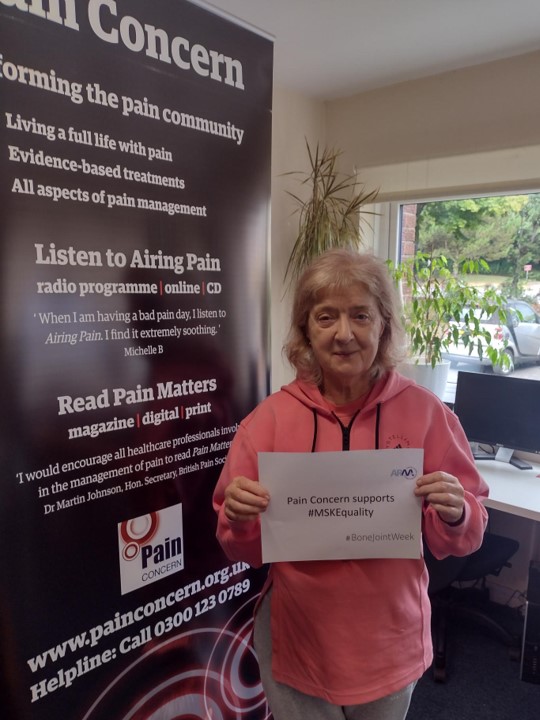
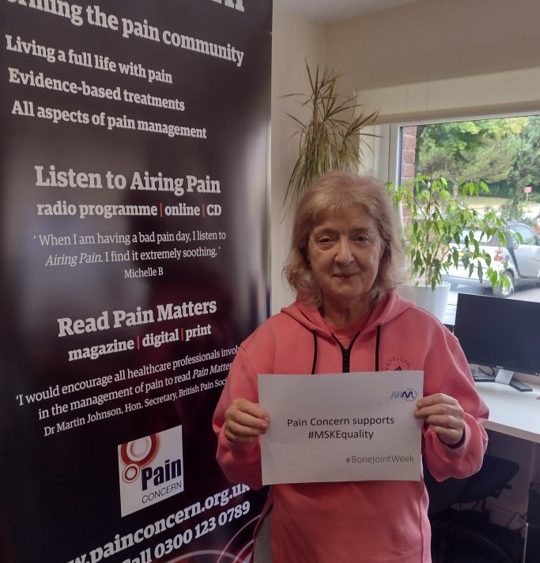
This week, from Wednesday 12th October – Thursday 20th October is official Bone and Joint Week 2022. In order to raise awareness of bone and joint conditions, Pain Concern have worked with ARMA (Arthritis and Musculoskeletal Alliance) to deliver informative content throughout this week.

To take a look at the great work and case studies ARMA are sharing as part of this week, click here to visit their website!

Also, as part of this important week, here are some of our own resources on musculoskeletal conditions:

Pain Concern CEO Heather Wallace shows support of musculoskeletal equality
Pain Concern CEO Heather Wallace

Peer Support. Join the community

“Having chronic pain is very lonely.”

Join the community

Subscribe to Pain Matters

Everything you need to know about how to live with chronic pain

Subscribe


In pain? Don’t understand what’s happening?

“Having someone to help you prepare for your life through pain”

Our Pain Education Sessions

Fundraise for Pain Concern

Help us to help others

Fundraise


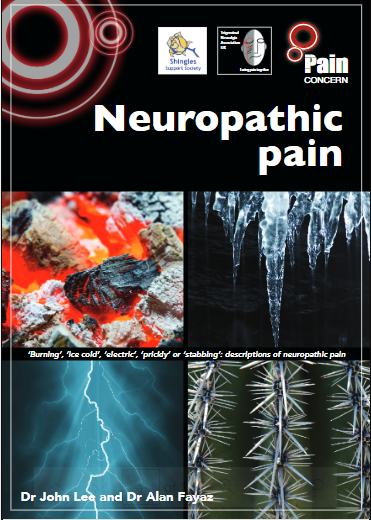
What is neuropathic pain? What causes it and how can it be managed? Pain specialists Dr John Lee and Dr Alan Fayaz explain the condition and provide information on the treatment options available.

Includes

Causes
Medications
Treatments
Understanding neuropathic pain

Peer Support. Join the community

“Having chronic pain is very lonely.”

Join the community

Subscribe to Pain Matters

Everything you need to know about how to live with chronic pain

Subscribe


In pain? Don’t understand what’s happening?

“Having someone to help you prepare for your life through pain”

Our Pain Education Sessions

Fundraise for Pain Concern

Help us to help others

Fundraise


Funded by The RS MacDonald Charitable Trust and the Stafford Trust.

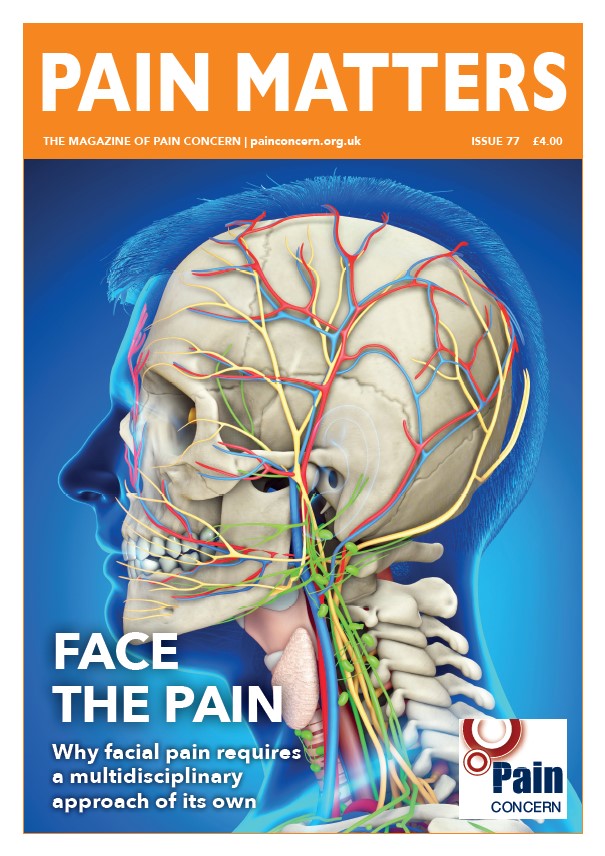
Pain Concern have produced a selection of key resources about shingles, post-herpetic neuralgia and pain associated with shingles. Just over a year ago in August 2021, we released an Airing Pain podcast programme – #129 ‘Shingles & PHN (Post-herpetic Neuralgia). Alongside the facial pain team at Eastman Dental Hospital in London, we produced an issue of Pain Matters magazine titled Face the Pain.

Now, as we approach winter 2022, we are releasing two additional publications on the topic. Our Shingles Vaccination Information Leaflet and Shingles Vaccine Hesitancy and Post-herpetic Neuralgia article have both been co-badged by the Shingles Support Society and have received the prestigious Crystal Mark accreditation from the Plain English Campaign.

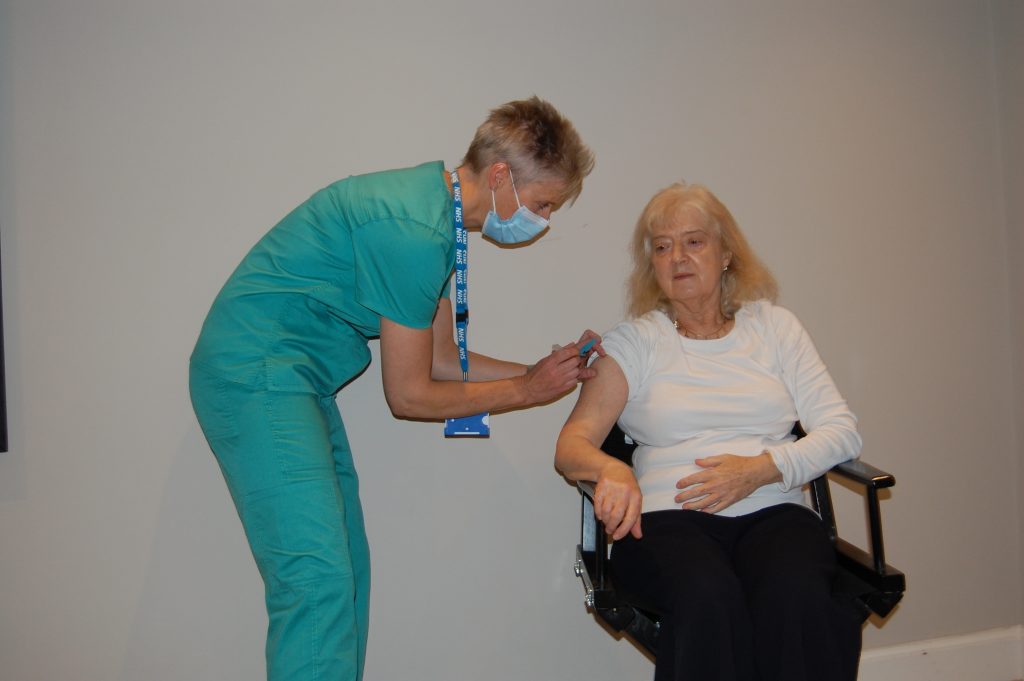
Pain Concern CEO Heather Wallace receives shingles vaccination

Heather Wallace, CEO of Pain Concern, photographed receiving her shingles vaccination
5th October 2022

‘Around one in four of us will get shingles during our lifetime and, if we live to eighty that statistic rises to one in two of us. Shingles is common and presents a high risk for developing long-term pain. If you are in the eligible group, please get vaccinated.

GP, administering vaccination

Shingles, post-herpetic neuralgia (PHN) and pain resources:


Shingles vaccination information leaflet

Once you download or open the below PDF you can view,
scroll up or down and zoom in or out of this file.

Shingles vaccine hesitancy and PHN (post-herpetic Neuralgia) by Mick Serpell

Once you download or open the below PDF you can view,
scroll up or down and zoom in or out of this file.

Airing Pain 129: Shingles & Post-herpetic Neuralgia (PHN)

Or listen on Spotify, Apple Podcasts, Google Podcasts, Deezer and more.

Pain Matters 77: Face the Pain

Front cover of Pain Matters issue 77
Click on the front cover!

When you have pain in your face, who do you go to see about it? The dentist might be your first port of call, but what happens if the problem is not dental? The Facial Pain Team, based at the Eastman Dental Hospital in London, have taken the reins for this issue. The multidisciplinary service they provide is the  largest and most comprehensive of its kind in the UK.

We are delighted to have this team, who were runners up in the Clinical Leadership Team of the Year category at the 2019 BMJ Clinical Excellence Awards, on board. In this issue, they explain all about how pain in the jaw, mouth and surrounding nerves differs from other types of pain, and explore the different treatment options available.

Click here to purchase

Crystal Mark - clarity approved by Plain English Campaign
Shingles Vaccination Information Leaflet
Crystal Mark - clarity approved by Plain English Campaign
Shingles Vaccine Hesitancy and Post-herpetic Neuralgia
shingles support society logo

Peer Support. Join the community

“Having chronic pain is very lonely.”

Join the community

Subscribe to Pain Matters

Everything you need to know about how to live with chronic pain

Subscribe


In pain? Don’t understand what’s happening?

“Having someone to help you prepare for your life through pain”

Our Pain Education Sessions

Fundraise for Pain Concern

Help us to help others

Fundraise


We are pleased to share the North British Pain Association Autumn Scientific Meeting 2022 Poster Prize Winner Cassandra MacGregor’s poster: An Ecosystem of Accepting Life with Chronic Pain: A Meta-ethnography. View the poster in full below.

Cassandra’s MacGregor and her PhD team’s poster An Ecosystem of Accepting Life with Chronic Pain: A Meta-ethnography was chosen not just for its aesthetic qualities but also its clinical relevance to contemporary pain management. It highlights the importance of language and meaning, and the fluctuating state of acceptance. We hope that Cassandra will be able to tell us more about her work at the next North British Pain Association meeting.
Sigrun Groves-Raines, Team Lead Pain Management Physiotherapist, Falkirk Community Hospital.

Peer Support. Join the community

“Having chronic pain is very lonely.”

Join the community

Subscribe to Pain Matters

Everything you need to know about how to live with chronic pain

Subscribe


In pain? Don’t understand what’s happening?

“Having someone to help you prepare for your life through pain”

Our Pain Education Sessions

Fundraise for Pain Concern

Help us to help others

Fundraise


To manage the symptoms of long-term pain and long COVID.

We are thrilled to announce that the latest episode of the Airing Pain podcast is out now! Click here to listen to the programme now. To accompany the new programme, we are publishing an exclusive article which will be included in the upcoming issue of Pain Matters. This article was written by GP and Airing Pain interviewee Dr Rupa Joshi.

Dr Rupa Joshi is a GP Partner at Woodley Centre Surgery, Berkshire, England. She is also co-clinical director of Wokingham North Primary Care Network and workforce lead for Berkshire West PCNs. Dr Joshi has a keen interest in Quality Improvement, she is primary care improvement clinical advisor for the general practice transformation programme and is a lifestyle medic and coach.

Peer Support. Join the community

“Having chronic pain is very lonely.”

Join the community

Subscribe to Pain Matters

Everything you need to know about how to live with chronic pain

Subscribe


In pain? Don’t understand what’s happening?

“Having someone to help you prepare for your life through pain”

Our Pain Education Sessions

Fundraise for Pain Concern

Help us to help others

Fundraise


1 9 10 11 12 13 49