Information & Resources

Find information and resources to help manage your pain.

Get Help & Support

Find the tools you need to
help you manage your pain.

Get Involved

Help make a real difference to people
in the UK living with chronic pain.

About Us

Find out about Pain Concern and how
we can help you.

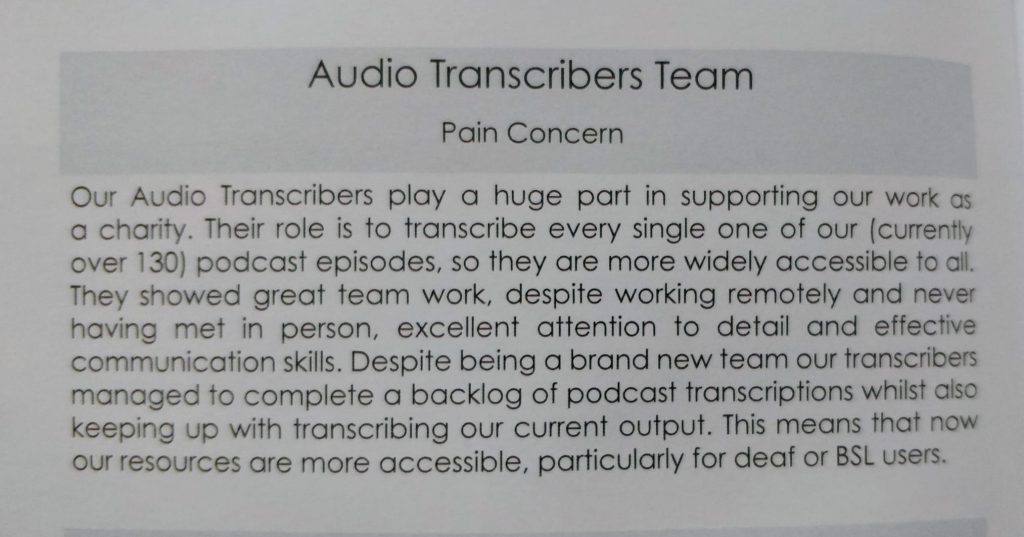
We are thrilled to announce that our dedicated Audio Transcription Volunteers Alisa, Fiona, Cara and Owen were recognised this year at the Inspiring Volunteer Awards held at Edinburgh City Chambers. They play a huge role here at Pain Concern making our podcasts more accessible and inclusive, particularly for service users who are deaf or have a hearing impairment.

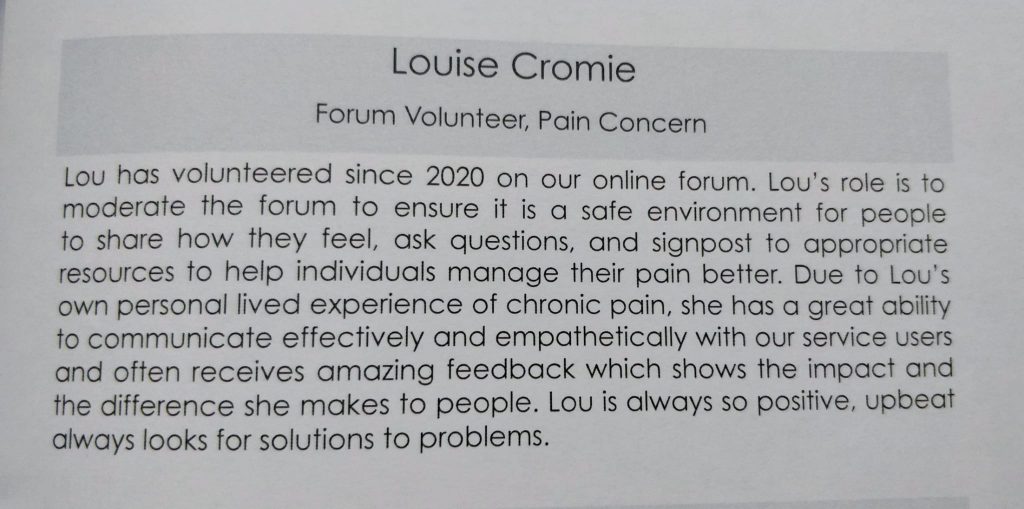
Our Forum Volunteer Louise Cromie was also recognised for her hard work in making our online forum a safe environment to discuss pain self-management. Lou has done some great work over the year, showing empathy and problem-solving skills which our community of service users have really fed back to us.

Thank you all for all your great work! We want to say a huge congratulations and a big thank you to our whole team of valued volunteers. It is a great honour to be recognised at the Inspiring Volunteer Awards.

Image displays the awardee description for our team of audio transcribers from the Inspiring Volunteer Awards programme
Image displays the awardee description for our forum volunteer Louise Cromie from the Inspiring Volunteer Awards ceremony programme

Peer Support. Join the community

“Having chronic pain is very lonely.”

Join the community

Subscribe to Pain Matters

Everything you need to know about how to live with chronic pain

Subscribe


In pain? Don’t understand what’s happening?

“Having someone to help you prepare for your life through pain”

Our Pain Education Sessions

Fundraise for Pain Concern

Help us to help others

Fundraise


This is an article by Julie Sinclair and Salma Angelinetta and was included in the February 2022 issue of Pain Press — The Pain Matters Supplement.

Although it’s not as common as the more generic ‘chronic pain’, neuropathic pain is thought to affect up to 8% of the population in the UK alone. The term is defined by the International Association for the Study of Pain as ‘pain caused by a lesion or disease of the somatosensory nervous system’, and is essentially how we describe any of the unwanted sensations (e.g., pain, aches, tingling, itching, burning, etc.) that can be experienced following damage to nerves. The problem may lie in the nerves leaving the spinal cord (the peripheral nervous system) or in the central nervous system (the brain and spinal cord). This damage to nerves can give rise to any number of changes for in individual, from numbness, increased sensitivity and pain, to experiencing weakness and spasms or changes in temperature and sweating. 

As a form of chronic pain, drugs may be prescribed as part of the pain management, but due to the nature of neuropathic pain regular painkillers are often ineffective. Similarly, people who have neuropathic pain have often not responded well in traditional pain management programmes, due to their difficulty managing sudden increases in pain common to sufferers.  

Management through mindfulness 

The team at the Pain Management Centre at University College London Hospitals realised a different approach was needed. Based both on their clinical experience of neuropathic pain and feedback from their patients, they concluded a tailored programme would be more helpful and believed some common neurological pain symptoms might respond well to a mindfulness-based cognitive therapy approach. They devised a programme centred around mindfulness and meditation called the Matrix programme, named after the term ‘pain neuromatrix’, which some scientists use to refer to changes in the nervous system that develop in people living with chronic pain. Salma Angelinetta, a physiotherapist and Julie Sinclair, a clinical psychologist, have been part of the team running this programme.  

The meditation practices taught in the programme encourage participants to adopt a different relationship with pain, almost akin to taking an outsider’s view of the situation, where they practice observing the sensations of pain with curiosity, rather than trying to stop of reduce it. Gradually, participants learn to identify and observe the thoughts, emotions and physical sensations associated with pain and life in general.  

The skills they develop help them to reduce getting carried away by their thoughts and to focus on present-moment experiences, such as their breath or the feeling of their feet on the floor. Participants are encouraged to notice changes in their thoughts and how the mind reacts to their feelings and body sensations during the day and when experiencing pain flares or difficult experiences.  

Julie explains: ‘Whether it is thoughts such as “I can’t cope with this”, “this is killing me” or “I shouldn’t feel like this”, learning to recognise the way the mind works makes it possible to respond in a more helpful way, rather than in an automatic manner.’ Once people begin to recognise and make room for thoughts, emotions and body sensations as they are and without resistance, they can begin to let go of them and to focus their attention and energy on things that are of value to them. 

Enter the Matrix 

The Matrix programme consists of eight day-long sessions, once a week for eight weeks. The meditation practices taught in the groups can be done lying down (the body scan), sitting (mindfulness and breathing) and during activities and exercise (mindfulness of movement). As well as these, there are also information and educational sessions on a range of topics dealing with pain and pain management, such as the role of the central nervous system in pain, sleep and medication.  

The Matrix team consists of a psychologist, a physiotherapist and a specialist pain nurse to embrace a holistic, biopsychosocial approach to chronic pain. Patients initially attend a one-hour assessment with the physiotherapist and psychologist, where they explore their pain journey, their life values, the impact pain has on their lives, their understanding of the mindfulness-based approach and ultimately their goals for attending the programme.  

Julie states: ‘Participants have shared with us how often they get caught up in thoughts, dwelling on the past and the future – trying to solve things that can’t be solved or avoiding things that make them feel bad, instead of connecting with meaningful life activities.’ 

During the programme, participants learn to notice how the mind struggles with unpleasant thoughts and feelings related to pain. Through meditation practices they are encouraged to notice the tendency to push difficult events away, a response which can actually lead to increases in discomfort and occasionally even worsening symptoms.  

A key part of the programme comes with its focus on the importance of living a life based on values, referring back to participants’ goals, which are defined together with the Matrix team in order to be specific, measurable, achievable, relevant and time-specific – and always based on the patient’s values. In this way, patients are encouraged to move in the direction that matters to them, even in the presence of unwanted experiences caused by pain.  

Although still early in its existence, individuals who have already participated in the programme have reported high levels of satisfaction from the group intervention and have expressed gratitude for the help received. The success of the approach has meant that while it was initially created specifically for people experiencing neuropathic pain, the programme has since been extended to include any patients who are interested in mindfulness-based approaches to pain management. 

Salma states: ‘We try to deliver the programme in a compassionate, respectful and curious manner and under the framework of self-kindness and self-acceptance. We believe that if participants can be helped to separate the experience of bodily feelings and emotions from the thoughts and ‘stories’ that appear in the mind, they are able to manage their pain more effectively and life a fuller, more fulfilled life.’ 

Julie Sinclair is a Clinical Psychologist at UCLH Pain Management Centre. Salma Angelinetta is a Highly Specialist Physiotherapist in pain management and works at the Pain Management Centre at UCLH. Both are interested in the use of mindfulness-based approaches to support people living with pain. 

Anyone affected by neuropathic or chronic pain can access a whole host of free resources on www.painconcern.org.uk, or call the Pain Concern Helpline on 0300 123 0789. 


More on neuropathic pain

Peer Support. Join the community

“Having chronic pain is very lonely.”

Join the community

Subscribe to Pain Matters

Everything you need to know about how to live with chronic pain

Subscribe


In pain? Don’t understand what’s happening?

“Having someone to help you prepare for your life through pain”

Our Pain Education Sessions

Fundraise for Pain Concern

Help us to help others

Fundraise


Many people living with chronic pain report difficulties with sleep. Pain makes getting comfortable in bed harder and can delay falling asleep. It can also reduce sleep continuity, which means increasing the amount of times you wake at night and waking you earlier than usual in the morning. This leaflet, by Corran Moore, Victoria Collard and Nicole Tang from the Warwick Sleep and Pain Laboratory, explains more.

Includes

Eating, drinking and smoking
Physical activity and daily routine
Circadian rhythme
Napping
Sleep environment
Homeostasis

Peer Support. Join the community

“Having chronic pain is very lonely.”

Join the community

Subscribe to Pain Matters

Everything you need to know about how to live with chronic pain

Subscribe


In pain? Don’t understand what’s happening?

“Having someone to help you prepare for your life through pain”

Our Pain Education Sessions

Fundraise for Pain Concern

Help us to help others

Fundraise


Book review as featured article in Pain Press – January 2022

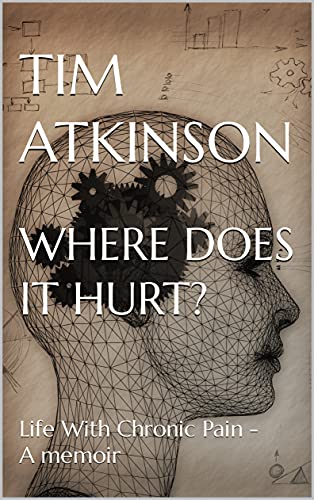
Book Review: Where Does It Hurt?: Life With Chronic Pain – A Memoir by Tim Atkinson
Dotterel Press, 249 pp, £9.99
ISBN: 978-0956286932
Published: September 2021


Tim Atkinson’s Where Does It Hurt?: Life With Chronic Pain – A Memoir is a unique book in that it brings together a 360 degree view on living with pain. It isn’t necessarily a self-help book, although it is undoubtedly a useful resource for people with pain, it is more similar to an encyclopedia than a self-help book. Atkinson brings together lived experience, the history of pain, personal diary entries and interesting facts to create a gem of pain literature.


The writing style Atkinson utilises in Where Does It Hurt? is accessible and easy to read, but most importantly Atkinson’s voice is a relatable one to pain sufferers, because he is a pain sufferer himself. In fact, his own lived experience runs throughout the book in the form of diary excerpts and personal opinions. This serves as a frequent reminder to the reader that they are not alone in their pain, which can be an extremely isolating experience. In learning about the author’s pain, we can open ourselves up to learning more about our own pain as well.


This isn’t just a book about Atkinsons pain journey though. Where Does It Hurt?: is full of historical information about pain and its treatment, notable research and science experiments, pop culture references and a sense of humour which makes it a joy to read. Atkinson covers a vast range of topics from substance/medication abuse problems to post-surgery recovery and does so in a way which is clear and easy to understand.


The only issue with accessibility that the book may have is its lack of a contents page and chapter headings. Sometimes, people with pain may not be able to read or hold a book for long and having clear headings can help people get to the information they need faster. However, the content and writing style are of a standard which would be useful to anybody who lives with pain or wants to learn more about it.


Where Does It Hurt?: Life With Chronic Pain – A Memoir by Tim Atkinson is an excellent, information packed book about life with pain, written by someone who knows what it’s like. There is no sense of being preached at or talked down to when you are reading it. Atkinson’s book is a cathartic learning experience and a gateway to exploring and understanding your own pain more.

Review by Jennifer Bowey, Managing Editor & Project Co-ordinator at Pain Concern

Peer Support. Join the community

“Having chronic pain is very lonely.”

Join the community

Subscribe to Pain Matters

Everything you need to know about how to live with chronic pain

Subscribe


In pain? Don’t understand what’s happening?

“Having someone to help you prepare for your life through pain”

Our Pain Education Sessions

Fundraise for Pain Concern

Help us to help others

Fundraise


What causes different types of face pain and what treatment is available? 

In collaboration with UCLH Royal National ENT & Eastman Dental Hospitals.


In this episode of Airing Pain we cover facial pain in its many forms, what treatments are available and how to cope better with your pain.

The way our face feels and how we move it is a massive part of our identity. Feeling pain in the face, or not being able to use your face the way you want to, is not only a physical burden on the person suffering, but a heavy psychological load to cope with as well.


Issues covered in this programme include:

facial pain, unnecessary dental treatments, tooth ache, face and identity, management techniques, trigeminal neuralgia, neuropathic pain, carbamazepine, neurosurgery, pain management programmes, psychology and pain, temporomandibular disorder, burning mouth syndrome, persistent idiopathic facial pain, central sensitisation syndrome, physiotherapy, acceptance & commitment therapy


Time Stamps:

01: 54 – Trigeminal neuralgia (TN): what is it and what does it feel like? Dr Joanna Zakrzewska explains.
06:27 – Dr Zakrzewska discusses what treatments are available for TN, including carbamazepine.
10:37 – How can neurosurgery help treat TN?
18:11 – Psychology Pain Management Programmes (PMPs) for sufferers of TN.
19:11 – Susie Holder on the psychological impact of face pain.
21:36 – Dr Roddy McMillan discusses temporomandibular disorder (TMD) as a source of face pain.
22:29 – Burning mouth syndrome and other types of face pain.
25:50 – Treatments available for other types of face pain.
28:30 – TMD and how it is different from other types of face pain (usually neuropathic in origin).
30:00 – What is central sensitisation syndrome?
32:21 – Pain management for chronic pain sufferers.
36:05 – Susie Holder explains what acceptance and commitment therapy (ACT) is.
44:07 – Obstacles to living well with pain, including the coronavirus pandemic.


Special Thanks:

This programme exists due to funding from The Hospital Saturday Fund, John Kirkhope Young Endowment Fund, The Tillyloss Trust & Swinton Paterson Trust.

Contributors:

  • Dr Joanna Zakrzewska, consultant in oral medicine specialising in trigeminal neuralgia at the Department or Oral Medicine and Facial Pain at the UCLH NHS Foundation Trust.
  • Susie Holder, clinical psychologist on the facial pain team at the Royal ENT and Eastman Dental Hospitals, UCLH NHS Foundation Trust.
  • Dr Roddy McMillan, consultant in oral medicine and facial pain at the Royal ENT and Eastman Dental Hospitals, UCLH NHS Foundation Trust.

More Information:

Peer Support. Join the community

“Having chronic pain is very lonely.”

Join the community

Subscribe to Pain Matters

Everything you need to know about how to live with chronic pain

Subscribe


In pain? Don’t understand what’s happening?

“Having someone to help you prepare for your life through pain”

Our Pain Education Sessions

Fundraise for Pain Concern

Help us to help others

Fundraise


What causes different types of face pain and what treatment is available? 

In collaboration with UCLH Royal National ENT & Eastman Dental Hospitals.

To listen to the programme please click here.

In this episode of Airing Pain we cover facial pain in its many forms, what treatments are available and how to cope better with your pain.

The way our face feels and how we move it is a massive part of our identity. Feeling pain in the face, or not being able to use your face the way you want to, is not only a physical burden on the person suffering, but a heavy psychological load to cope with as well.


Issues covered in this programme include:

facial pain, unnecessary dental treatments, tooth ache, face and identity, management techniques, trigeminal neuralgia, neuropathic pain, carbamazepine, neurosurgery, pain management programmes, psychology and pain, temporomandibular disorder, burning mouth syndrome, persistent idiopathic facial pain, central sensitisation syndrome, physiotherapy, acceptance & commitment therapy


This programme exists due to funding from The Hospital Saturday Fund, John Kirkhope Young Endowment Fund, The Tillyloss Trust & Swinton Paterson Trust.


Paul Evans:

This is Airing Pain, a programme brought to you by Pain Concern, the UK charity providing information and support for those of us living with pain and for those who care for us. I’m Paul Evans, and this edition of airing pain is supported with a grant from the Hospital Saturday Fund.

Dr Joanna Zakrzewska:

It’s recorded that up to 20% of patients may have unnecessary dental treatment. So, I mean, if you’ve taken out a tooth, that’s it. You’ve lost a tooth.

Roddy McMillan:

There’s, very often, not any outwardly visible signs so that somebody can look at somebody and say ‘oh they’ve got chronic pain of the face’. The amount of negative impact that facial pain can have on patients can be extremely high.

Susie Holder:

We could probably manage to get by if we weren’t using one arm or one hand or something. You know there’s no way round it, you can’t really get by without being able to eat. It’s difficult to express yourself. I suppose it’s difficult to be who you are if you can’t use your face.

Rachel Stovell:

I’m not going to promise people, and I’m not going to set up expectations that I can’t actually meet. But what I can say to them is that extra level of suffering that comes on top of dealing with those symptoms, that is somewhere that I can have some impact on.

Evans:

Our face is the portal, if you like, to our world: eating, talking, smiling, kissing, breathing and much more. In this edition of Airing Pain, we’ll be looking at conditions that cause facial pain, and management techniques and strategies that will help us live with it. Trigeminal Neuralgia is not a common condition, but it is debilitating. Professor Joanna Zakrzewska is a consultant in facial pain at the Royal National ENT and Eastman Dental Hospitals in London, and she is internationally recognized as one of the world’s leading experts in Trigeminal Neuralgia.

Zakrzewska:

Trigeminal Neuralgia is a facial pain, a very severe one-sided excruciating pain that comes in bursts. A single burst can last just for a few seconds to two minutes, or you can have a burst that lasts quite long because there’s so many of them, a series of stabs that you actually think that it’s lasting much longer, and that can sometimes go on for several hours. But then you have a break, and that’s very, very important, and the break can be for anything from just minutes to hours. You may only get two or three attacks a day, you may get no attacks and then you can go into periods of what are called remission, when there is no pain at all.

Then there are other periods [that] we call the relapse period [when] the pain is brought on. It’s an electric shock like pain brought on by light touch. So, it’s just gently touching your face, trying to shave, trying to wash your face, and it’s made worse obviously by eating, drinking, talking, and it is mostly, except in 3% of patients, one side of the face only. Lower part of the face most commonly, least likely in the top of the face, but it can be all three divisions of what’s called the Trigeminal Nerve, and initially it often feels like a toothache because it often presents around the mouth and the natural thing is to think I’ve got toothache and therefore start your journey on this condition by going to see your dentist.

The first thing the dentist will do is examine all the teeth to check whether there is potentially a dental cause. They will often do X-rays as well to check that there isn’t an abscess forming or some other decay under a tooth. Now this is the difficulty, some dentists will then be in a dilemma because they can see that there is potentially a dental problem, but they’re not quite sure, some will go ahead and do dental work. That is, they may do root canal work, or they may even take the tooth out. And yet after those procedures, the pain doesn’t settle and it’s very difficult for dentists to actually recognize that it is Trigeminal Neuralgia, because it is rare, and it’s about teaching dentists to ask the right questions. Four or five questions could be helpful to try and diagnose that, so again, the onus is also on the patient to try and record a history as carefully as possible.

But it is this paroxysmal nature, that is the intermittent nature of the pain that is often a pointer to the fact that it isn’t a dental pain because dental pain tends to be constant and there the whole time, and particularly if you touch a particular tooth, it is likely to set off a dental pain. Whereas in a patient with Trigeminal Neuralgia, just touching the gum around the teeth or the cheek area can set off an attack, and therefore that doesn’t come from the teeth, but it is very difficult because the Trigeminal nerve supplies all our teeth, and every single tooth has a piece of Trigeminal nerve in it. So that’s why it gets very confusing and sometimes the dentists have to hold off and wait a moment before they do anything drastic, because it’s recorded that up to 20% of patients may have unnecessary dental treatment and the problem is that this dental treatment is often irreversible. So, I mean, if you’ve taken out a tooth, that’s it, you’ve lost a tooth. Whereas if patients go to their GP, they might be given various drugs, but at least you can take the drugs off and start again. So, a dentist has a big onus and we’re now trying also to develop a short questionnaire, a screening questionnaire, that dentists could ask their patients to try and see whether they can diagnose Trigeminal Neuralgia, as opposed to a dental problem.

Evans:

So Trigeminal Neuralgia has been diagnosed by the dentist. What’s the treatment then?

Zakrzewska:

So, the first treatment is Carbamazepine, a drug that has been recommended by the NICE guidelines, by our guidelines and is taught everywhere. Now dentists can actually prescribe Carbamazepine, but it’s a very, as we call it, a black drug in the States and it’s a dangerous drug to use, difficult to use. So, if you’re not used to using [Carbamazepine], it’s much better that the GP prescribes it first. So, what happens in good communities is that the dentist will write to the GP and say ‘I think this is Trigeminal Neuralgia, I think the treatment is Carbamazepine,’ and leave it to the GP to start the first dosages. And the NICE guidelines say use Carbamazepine. If Carbamazepine fails, either because [the patient] doesn’t respond, which is unusual, or [because] they have severe side effects, then they should be referred to the secondary care sector. The big dilemma is who to and how to do that referral. But in the first instance, Carbamazepine can act as a diagnostic drug, and only a small dose of it is sufficient to really turn that pain off in those first few weeks or months of the pain. So, we often call it a diagnostic drug.

Evans:

So, basically, if the Carbamazepine works, it’s Trigeminal Neuralgia, if it doesn’t work, it’s something else. What else could it be?

Zakrzewska:

It could be some other form of neuropathic pain, nerve injury pain, possibly related to having had dental treatment, or an infection post-shingles or due to trauma to the face. So, one has to then start looking at other causes for it, and what we do encourage is that if you can’t find a cause, then do refer [the patient] to the secondary sector. If you refer to dental schools, then we can get an opinion from oral physicians who are well skilled to recognize Trigeminal Neuralgia and other types of facial pain. We also have the back-up that we have restorative dentists who are skilled in reviewing for rare causes of dental pain, because the one that’s most difficult to differentiate is, in fact, what we call cracked tooth – where the tooth has a crack in it- and every time you bite on it, you get pain. But here, the pain occurs on release of the tooth from biting. So, in Trigeminal Neuralgia it’s that very first touch that sets off the pain, and that’s a difficult one to diagnose. Some dentists in primary care may not find that because it’s quite subtle. So, if in doubt, we suggest referral in for second opinions.

Evans:

Is Trigeminal Neuralgia curable or is it just manageable?

Zakrzewska:

That’s a very difficult question to [answer], whether it’s curable or not. Some patients will feel that it is curable, but I think in general it’s a long-term condition that can be managed very effectively. So, when we have just done a long-term cohort study, that is, we’ve followed patients up for a minimum of six years, what we found was that just under 50% had undergone neurosurgery in order to get pain relief, the others had remained on medication. And at the time of the survey, 80% of patients were saying that they were in a good place and that they were relatively pain free. Although quite a large percentage of them had to be on drugs, so I would say it is a long-term condition, but it is manageable and probably more manageable than other chronic pains and some patients who undergo major neurosurgery can be totally pain free, off all medication and no need to see us anymore.

Evans:

OK, you brought up neurosurgery. Where in the treatment path would that come?

Zakrzewska:

So, neurosurgery is obviously a complex set of procedures, and patients need to be prepared for it. Now what we suggest in our unit and in our guidelines, is that all patients, once they’ve been diagnosed, we’re sure about the diagnosis and we call this phenotyping, and we have done an MRI scan because every patient with Trigeminal Neuralgia should have a scan. Once we have both of these, we do a joint clinic. That is, I am present, plus a neurosurgeon and together with the patient and their spouse or their significant other, we discuss the treatment, so we will look at the scans. The surgeons will propose what potential surgeries are available given the medical history as well, because that will influence the choice, and what drugs are available. At that consultation, patients can either decide ‘I want surgery’ and which type of surgery, and can be immediately put on waiting lists or even have surgery fairly quickly if they’re in desperate pain, or they can opt to stay on medication.

But the door is always open, so the moment they get more severe pain and they decide they can’t cope with the drugs anymore because either the drugs are no longer working or the side effects are intolerable, they can opt to have surgery because they’re known to the neurosurgeons and they can have their surgery fairly quickly. So, the deciding factors are lack of efficacy of a variety of drugs, because I will have tried several drugs, and tolerability. Tolerability is a major, major problem, patients [can] feel cognitively impaired, they can’t think properly, they can’t find their words, they have memory loss. They get very tired [and] fall asleep at the drop of a hat. They can get unsteady on their feet, they can have double vision, they can start to fall over, so those are side effects that we recognize in all these patients, and again, we’ve shown this by having patients doing computer programs and tests. This is an indicator for neurosurgery.

So, neurosurgery is done, mostly now by neurosurgeons, who are particularly skilled in working in what we call the posterior fossa, that is, in the head rather than, say, on the spine. So, the most effective procedure is a Microvascular Decompression, which is a big neurosurgical procedure because the neurosurgeons have to enter the skull. They do a small incision behind the ear, and they get right inside the skull, not into the brain, and they look for the vessel. There’s a big blood vessel that presses on the nerve, and that therefore causes the loss of insulation between different type of fibers and allows for this crosstalk, between light touch and sharp pain. And so, they move this vessel out of the way, and maybe several vessels, there may be veins, but often it’s a very big large artery which they have to do very delicately, because if you touch that one, you’ve got a stroke or even death. Then close everything up very tightly, so everything is sealed again, and the cerebrospinal fluid (CSF), the CSF, is contained again within the brain. Now that gives the best option, 70% of patients will be totally pain free at ten  years and off their medications. But there is still this 30%, side effects are obviously [a risk], there is always a risk of death, but it is very low indeed, 0.1%, and the main [risk]  is this leak of CSF fluid, but that can be mended. There can sometimes be loss of hearing, which is often a temporary loss of hearing, not permanent, but it is a big procedure. Patients stay in the hospital for three days and it takes up to six weeks to recover.

Now patients who are not fit enough to have the operation or feel reluctant to have a big operation can have smaller procedures done, which are done under a short-acting general anesthetic where a needle is passed through the cheek into what’s called the Gasserian Ganglion. This is a point at which all the three major branches of the Trigeminal nerve congregate together. They put the needle in, they do X-rays to check that the needle is in the Ganglion, and then they can do a variety of three  different things and it depends which one the surgeon chooses. They can heat it by putting an electrical current through it, or they can fill that Ganglion with glycerol, a toxic substance. Or they can actually compress it with a little balloon; and all those three therefore cause destruction, so the patient will feel sensory change, that is, that side of the face might be numb, and it’s unpredictable. So, you don’t know when it’s going to be numb and how much numbness. It can be just one little area of the face, or it can be the whole side of the face, and that doesn’t give as good a result. We’re talking about 50% of patients having relief for five years, up to five years.  These procedures can be repeated time and time again, but the risk of causing permanent sensory loss increases and you can get what we call Anesthesia Dolorosa.

The final treatment is the Gamma knife, or what is more generally known as Stereotactic Radiosurgery. Gamma Knife is the trade name and this is the least invasive, because all you have  to have is four  pins put under local anesthetic just to stabilize a helmet that is put on the head. And then you’re in [something] similar to a scanner, and radiation is projected onto the nerve in the place where we think the main source of the pain is. Now this treatment can take one month up to six months to work, so it’s not an immediate result. With the other procedures you wake up from your anesthetic and you’re pain free, so this one takes a little bit longer to do, but is available to every single patient. There’s virtually-except if you’ve got a pacemaker or some metal within you, when you can’t put somebody into a scanner, that one is available to everybody.

So, there are a lot of surgical options which can be repeated and patients are warned that they can have this procedure again because the big problem with Trigeminal Neuralgia is its total unpredictability, and that’s what patients live with, the fear of pain [returning], and often isolation because they’re on their own. They haven’t met anybody with it and that’s why we also run a psychology program specifically for these patients. We have a pain management program with our psychologists and our physiotherapists, and we teach and make patients aware of how to manage flare-ups, how to meet each other and how they can use things like meditation, mindfulness. The first thing we do is recommend that they go to websites to help them with that such as www.my.livewellwithpain.co.uk, a very useful website for them to have.

Evans:

Isn’t it strange how a printer would choose to do its maintenance tasks just when you least expect it. That was Professor Joanna Zakrzewska and I’ll give you the address of the my.livewellwithpain.co.uk website at the end of this edition of Airing Pain. Susie Holder is a clinical psychologist working within that facial pain team at the Royal National ENT and Eastman Dental Hospitals in London.

Holder:

The psychologist role in the facial pain team is about recognizing and acknowledging the impact that facial pain has on people. Facial pain can feel really threatening because it impacts on your vital functions, the things that you need to be doing every day, like communicating, eating, intimacy, and it’s really important that we get to grips with what the impact is on them and also think about what they can be doing differently. Learning to manage and learn skills to be able to manage more effectively on a day-to-day basis.

Evans:

For a patient, it must be a fairly difficult thing to get your head around: [that you’re] going to a doctor to have your pain cured. Yet you’ll get to see a psychologist: a head doctor.

Holder:

You’re right, and that’s really difficult, isn’t it, and a lot of patients can feel really distressed by that, and it is the way in which it’s introduced that’s really important. So, one of the things that our team – our medicine team – and facial pain team are really good at doing – the doctor or dentist that they see on the team – what they’re really good at doing is actually suggesting that this is really hard to live with. This is really difficult. We understand the impact that this is having on you. So it’s not that we’re suggesting that this is made up in any way, that this is a fictional problem. But this is really looking at how hard this is and one of the things that we know, just like with other chronic pain conditions, is that people can experience things like anxiety [and] depression as a result of living with a long-term persistent condition.  And that’s true of any long-term condition, not just facial pain. But [we understand] that it brings difficulty and the skills that we have to manage those [symptoms] may not be working for them, and [the skills] might need looking at. [The skills] might need broadening out, and [patients] might need to learn different skills to help to manage that impact better on a day-to-day basis.

Evans:

We’ll explore some of those skills a little later. Now, we’ve been focusing so far on Trigeminal Neuralgia, but not all facial pain is Trigeminal Neuralgia. In fact, compared to other conditions, it’s not very common at all. Doctor Roddy McMillan is a consultant in oral medicine and facial pain at the Royal National ENT and Eastman Dental Hospitals in London.

McMillan:

The most common one, by quite some way, is the Temporomandibular Disorders, or TMD as we call it for short, which is basically pain around the jaw joint and the muscles that are associated with the jaw. So, that tends to be on the sides of the face but can radiate elsewhere, including into the ears and side of the neck, for instance, as well as presenting with pain inside the mouth. The other conditions that we tend to manage are mostly related to some form of nerve wear and tear or nerve damage. One of the most common ones that we see is called Burning Mouth Syndrome, which presents generally towards the front part of the mouth. For instance, the tongue and the inside of the lips and the gums, and that is to do with wear and tear of the nerves, that’s what we call a neuropathic pain condition, and that’s probably one of the more common ones that we will tend to see. We also see quite a mixture of nerve damage related pains or neuropathic pains, particularly affecting the teeth, and around that sort of area we have a condition that we see not uncommonly called Persistent Idiopathic Facial Pain. It used to be called Atypical Facial Pain, and that’s actually pretty common, particularly following dental treatments. Even relatively innocuous dental treatments such as root canal treatment. We know that around about 5%, at least 5% of people who have had a perfectly good root canal treatment conducted by their dentist will have persistent discomfort in and around the tooth following that procedure. More obvious types of neuropathic pain includes those related to trauma damage such as people who’ve had surgery for cancer or any other types of surgery in and around the face or the mouth. Procedures such as extractions of teeth, particularly lower wisdom teeth, is an example that can directly lead to nerve damage, which can cause continuous or persistent pain following the procedure.

Evans:

How would somebody know that it wasn’t just pain from having the tooth out?

McMillan:

If we’re dealing with pain following a dental extraction, if there’s direct nerve injury associated with that, such as in the case of a lower third molar wisdom tooth, then quite often the area supplied by the nerve in question may be tingling or numb following the procedure. You would normally expect it to be quite numb immediately following the procedure if you’ve had local anesthetic there, but the numbness of the tingling can persist. That doesn’t always happen, but that certainly would be a suggestion that there’s been some – at least – bruising, not damage to the nerve itself. Following a dental extraction people expect it to be a bit sore for a few days or a couple of weeks afterwards, and generally as a rule of thumb, people that have nerve damage pain relating to dental extractions, despite the fact that area is healed up, they would have persistent numbness and tingling potentially. In the case of people with neuropathic pain, we would tend to expect discomfort to persist in that area following the healing process. So as a rule of thumb, the figure of three months is used, in reality most of these people will be aware of persistent discomfort much sooner than that. So, these patients may have a combination of numbness or altered sensation, such as when they touch their face or their lip or their tongue it’s perhaps tingly combined with this persistent discomfort or pain on top of that, it can present without numbness or tingling, and in the case of the Idiopathic facial pain that we mentioned previously. They don’t always have numbness or tingling or altered sensation in that region afterwards. They may just have discomfort, which is persistent. So, it’s either there all the time or it tends to be present most of the time.

Evans:

What is the treatment for that?

McMillan:

As a rule of thumb, most of the conditions in facial pain are neuropathic or related to some form of nerve damage or nerve injury, with the exception of Temporomandibular disorders, which tend to be more musculoskeletal, joint related or muscle related. The management of the neuropathic pain conditions affecting the face tend to be quite similar. The exception of course is Trigeminal Neuralgia, which has quite a unique set of medication options, but in terms of the other neuropathic conditions that we deal with, such as persistent idiopathic facial pain or trigeminal neuropathic pain, which is the one that we tend to see following surgical damage to the nerves for instance, [they are quite similar].

The main part of the initial consultation that we tend to do is take your history. The important thing is listening to the patient’s story, the patient’s- what we call the patient’s narrative, so actually finding out from the patient what has happened. Listening to how they’re describing their pain, also actually quite importantly, listening to what they think may be causing the pain as well, because very often the assumptions from clinicians may be one thing, but the patient’s beliefs, and indeed their expectations, can be completely different, so that’s an important point. So, part of the process may be that we will send patients for scans; most of the time we don’t need to send them for X-rays, so things like dental X-rays have usually been conducted by the referring clinician, whether that be a dentist, an oral surgeon, or a neurologist, or whoever it may be. It’s important to note that scans don’t actually diagnose these pain conditions, they just help to rule out other potential causes for the symptoms.

In the case of the pandemic, for several months actually, we were not able to see patients face-to-face for facial pain conditions, and we found that the accuracy of our diagnosis using videoconference or telephone was actually extremely good. The important thing to get across to patients is that even though we can see no disease process as-such, like an inflammation or an infection, or a fracture or dental problem or whatever it may be, that doesn’t mean to say the pain isn’t real.  And [it] is certainly well recognized that in the majority of the conditions that we treat in the face, we can’t find an underlying identifiable focus of a problem that will account for the pain. The history alone is the important feature here in terms of trying to get an accurate diagnosis, and really listening to the patient’s story is absolutely crucial in this situation.

Evans:

Now you mentioned Temporomandibular disorder. That’s not a nerve pain.

McMillan:

It’s a collection of different conditions which effectively result in dysfunction or impaired function of the jaw, the jaw joints and the jaw muscles and or pain of the jaw, joint, and jaw muscles. The majority of these patients do not have an underlying arthritic process with the jaw, that can happen, and we do see that from time to time, but it’s relatively rare for patients to develop arthritic-related TMDs, we call it temporomandibular disorder. Those patients will tend to present more with functional problems such as they say ‘I can’t open my mouth wide enough to eat my dinner or open my mouth, and it jams open and I have to wiggle it back into position or [there’s] a clicking of the joints,’ etc. The majority of patients that we see [who don’t] have a significant underlying arthritic process or mechanical problem with the jaw, will tend to be in more pain, affecting the jaw joints and the jaw muscles.

The research would suggest about 1/3 of people develop this pain condition during their lifetime and the consensus would tend to suggest that for the majority of those patients it will not be related to traumatic events such as dental treatment or bash to the face or whatever it may be. It tends to come on fairly insidiously and be associated very strongly with stressful periods in life, and as we mentioned earlier, this is not considered to be a neuropathic pain condition. It’s actually a lot more complicated than that, so it’s what we would call a Central Sensitization Pain Syndrome. To try to explain that in reasonably simple terms, in the areas of the brain that process pain, there’s a number of different areas that often overlap with other features in the brain, such as the areas that would deal with stress, anxiety, depression, these kind of negative emotional aspects of things. What we suspect happens with TMD and at least in the musculoskeletal or the muscle related pain condition, is that when people become stressed or anxious, it sensitizes the pain centers in the brain, and then signals will come down the nerves into the muscles and joints of the face and release chemicals in those areas which lead to the muscles and joints becoming tight, sore, sensitive [and] painful. For 80% of those patients the problem will not last for a huge amount of time. It may last for a few days or a few weeks, then it will usually settle down.

The 20% of people who have what we call chronic TMD or long-term issues with the pain where it’s either there all the time or it comes and goes very regularly and is more of a problem. Those patients, by and large, not always but usually, will have other risk factors in the background: reasons why this sensitization process hasn’t switched off. Top of the list are conditions that are painful chronic pains elsewhere in the body. One condition which is at least physiologically almost the same as TMD is Fibromyalgia, which is quite common, a widespread musculoskeletal central sensitization pain syndrome, other conditions we know are associated are things like anxiety, depression, sleeping problems which often come as a package together and last but not least, would be headache conditions, particularly tension type headache and migraines, which are again regarded as central sensitization pain syndrome. So, it’s a very complicated condition, and if somebody has chronic TMD, it’s not a condition [for which] we can say we’ll give you a treatment which will definitely make this disappear or go away, and that’s true of more or less all of the conditions that we see, but certainly in terms of the management of these patients, then that kind of discussion is really crucial. One of the areas that we do tend to focus on is the role of regular exercise and physical relaxation activities in the management of chronic pain. We’re not very prescriptive in our service about what we recommend patients do, but if you speak to the physiotherapist, they will often say ‘I don’t care what you do as long as you move every day, and enjoy what you’re doing,’ and that’s really crucial.

Evans:

Doctor Roddy McMillan, Consultant in oral medicine and facial pain at the Royal National ENT and Eastman Dental Hospitals in London. Well, Rachel Stovell is a specialist physiotherapist in the facial pain team.

Rachel Stovell:

We do spend time explaining pain, explaining how pain works, explaining some of the neuroscience behind pain, just to help people to appreciate that pain is a bit more complicated than ‘if I find the bit that’s broken and fix it, it will all go away.’  Doesn’t quite work like that with chronic pain, and also then helping them to – alongside our psychologists – recognize how we might need to work with normal behaviors and body parts and gain activity. But do it in a way that is recognising this sensitivity, but recognising everything else that influences [the pain].  So alongside them we will work with perhaps movement and exercise, exercise – in this instance – of the face and then restoring their functional ability. It’s all very well to exercise your face, to open and close and things, but that’s not helpful if it doesn’t mean that you’re able to talk more, eat more and be intimate again. You know, those are the things we want to do, but you might have to start somebody off with gentle exposure to just moving that part of the body in a really simple way before you do the complex behaviors of eat, chew and talk.

Evans:

It seems to me that if I have pain in my mouth or my jaw, if I’m eating or chewing something hard, that will make it hurt more. So, I stopped doing that. I start drinking soup instead of chewing things, but that is not addressing the problem.

Stovell:

It’s not, but I suppose with persistent pain conditions, it’s difficult to address the problem because we haven’t found a way of being able to get that nervous system to not be sensitive.  But what we know with all of these conditions is that if we adapt the way that we use our body part that’s painful in such a way that we’re not doing what it’s designed for, then we might have the problem of getting other issues.  The area becomes weak, it becomes stiffer, it becomes out of condition and on top of already having pain and sensitivity, that’s not helpful and it probably maintains some of that sensitivity because we’re not perhaps exposing the area to normal stimuli and therefore we’re going to get perhaps a bigger response to something than we would do normally, because [that body part is]  now being avoided. So, yeah, one of the things that we promote and encourage in our work is this idea of exploring and working with that body part, particularly the face in facial pain to allow for us to do what’s normal in the presence of pain. With the understanding that you’re not harming yourself, that you’re not actually creating damage or harm, that you’re using muscles, joints, ligaments, bones normally and that actually they need to do that to stay healthy.

Evans:

That’s Rachel Stovall, specialist physiotherapist in the facial pain team at the Royal National ENT and Eastman Dental hospitals in London. Earlier we heard from her colleague psychologist Susie Holder that skills can be learned to help the patient self-manage their pain. The therapy comes under the acronym ACT and it’s suitable for people with all kinds of chronic pain, not just facial pain.

Holder:

ACT is acceptance and commitment therapy. It comes out of cognitive behavior therapy, so lots of people have heard about CBT, but it’s a slightly different approach, and it incorporates a number of different important mechanisms that we use when we’re working with patients, either in a group or in individual. So, those sorts of things that include things like acceptance- actually it’s quite difficult word, acceptance… yeah. People find that a difficult thing to digest. Often a doctor will say ‘you know you need to learn to accept this condition’ and that’s a hard thing. A difficult message for people to hear. I actually prefer the word willingness: ‘can I willingly live with these symptoms?’ One of the problems is that [when] living with any sort of long-term condition, you’ve got the symptoms that you’re experiencing, and that might be pain. Or it might be something else for another condition, but on top of that comes a huge amount of discomfort, distress. The suffering that comes on top.

What we say to patients as psychologists is ‘what I can’t do is I can’t cure.’ I can’t take away that pain and that’s really hard to digest, isn’t it? That’s really hard to accept, that really they’ve come to our service because they’re hoping that we’re going to get rid of their condition, to cure it. But the reality is, they’re going to need to learn to live with it. How could they live in a better way, in the presence of those symptoms? So, I can’t get rid of those symptoms. I’m not going to promise people, and I’m not going to set up expectations that I can’t actually meet. But what I can say to them is that extra level of suffering that comes on top of dealing with those symptoms, that is somewhere that I can have some impact on. You may not want those symptoms of course, you don’t want those symptoms, but actually, could we approach it slightly differently? Could you come on a journey with me and I could help you to learn some skills to help you to manage it in a different way on a day-to-day basis?

Evans:

Some people say that you need to stop looking for that magic cure, that golden bullet if you like. And I’m speaking to somebody who said ‘actually I don’t have a pain condition anymore, the pain is there, but this is me.’

Holder:

One thing that can happen living with any sort of long-term condition is that life can narrow. We can spend so much time and energy, caught up in looking for those cures. What can happen is that we stop doing the things that are important to us and that over time people can find that life can get very narrow. So yeah, can we learn to live alongside pain? ‘Yes, pain’s there. I don’t really want it to be there. I don’t like it. I’d love to get rid of it, but it probably isn’t going to happen. So can I find a way of living with it, but still doing the things moving towards the values, doing the things that are really important to me in the presence of pain?’

Evans:

That, I guess, is the acceptance bit. Now it’s commitment, that I struggle with.

Holder:

ACT is really all about changing behavior and doing things differently and not being pushed around by our thoughts and feelings and our pain as well. The things that get in the way of us doing the things that are important to us. Part of the passage of this sort of treatment is recognizing what our goals are, but setting up steps towards goals, so small sustainable goals, that are in line with our values and so it’s really all about changing our behaviors, doing the things that are important to us. You know, it might be that you want to socialize more, so your goal might be to go to a coffee shop and meet somebody, COVID permitting. So, we’re asking people to commit to goals. OK, now we also know that commitment is really difficult. Yeah, if you ever try to change a behavior, we all know how difficult that can be. It can take weeks, months to actually put a behavior in place that actually becomes automatic that we don’t have to think about anymore, and sometimes people commit to something and then it falls off, and what we need to think about is how can we recommit. ‘It’s OK that I’ve stopped doing it. Can I recommit again and again and again and again to doing the behaviors that are moving towards the goals that I have, and are in line with the values that I have?’ That’s what’s important to me going forward.

Evans:

It’s avoiding a blame game if you like, ‘well, I failed, I failed again.’

Holder:

Absolutely, so one of the big elements is also working on those thoughts and feelings, so we all have a tendency to judge and criticise ourselves, that is a normal part of being a human being. That’s what we do all the time. But if we get caught up in those feelings, then what tends to happen is that impacts on what we do, or ‘I’m not going to do that because I’m not going to do that well. I’m not going to do that Pain Concern podcast, because it’s just not going to work out for me.’ You know, I could have called you, couldn’t I?  And said ‘actually, I don’t think I [can] do this,’ but I chose to recognise [the] anxiety that it provokes, [which] shows that despite that anxiety I’m going to do it anyway. So, one of the important things we do is recognise that criticising – that tendency to criticise and judge ourselves – and learn techniques to unhook from that.

So, we use various different ideas to help people take a step back from what they’re thinking rather than getting involved with it and caught up with it. Worrying about what we’ve done in the past or worrying about what could be in the future, or beliefs that we have about ourselves and learn to unhook from those ideas, and that’s one of the key skills that psychologists have for working with people; and we’re looking at opening up life again, engaging with things, whilst recognising that there’s stuff that comes up that gets in the way and we need to be aware of that. We need to observe that we may need to use that information to help us to overcome some of the obstacles that get in the way.

Evans:

Clinical psychologist Susie Holder. Well before we go on, I just need to remind you that whilst we in Pain Concern believe information and opinions on Airing Pain are accurate and sound based on the best judgments available, you should always consult your health professional on any matter relating to your health and well-being. They are the only people who know you and your circumstances and therefore the appropriate action to take on your behalf. Do check out Pain Concern’s website at painconcern.org.uk where you can download all editions of Airing Pain and find a wealth of support and information material about living with and managing chronic pain and there you can find details of how to order edition number 77 of our Pain Matters Magazine, which is guest edited by the facial pain team at the Eastman Dental Hospital in London who are featured in this edition of Airing Pain. The ‘my live well with pain’ website recommended by Professor Zakrzewski can be found at: my.livewellwithpain.co.uk., that’s: my.livewellwithpain.co.uk, and if you or someone you know has Trigeminal Neuralgia, the Trigeminal Neuralgia Association UK website is: tna.org.uk.

Well to end this edition of Airing Pain, Susie Holder was talking about obstacles to living better with pain. As we record this edition of Airing Pain just before Christmas 2021, there couldn’t be a better time to talk about obstacles, as the Omicron variant of the Coronavirus is scuppering any chance of returning to what we used to call a normal way of life.

Holder:

Obviously, we did all our work face-to-face prior to COVID and we’ve had to change very quickly the way in which we work. It’s been great that we’ve been able to offer people telephone consultations, but also video consultations. So, it’s really changed the way that we work. What I’ve found is that, in a sense, what’s happening is I’m actually [virtually] going into somebody’s house in a sense. That when I make a phone call [or] when I make a video call, I’m in their own environment. It has some advantages [because] they’re making changes or thinking about making changes in their own environment. But I’m also picking up on lots of things that, you know, somebody is not just dealing with facial pain, but they’re also dealing with the difficulty, or perhaps loneliness or being on their own for many people, or feeling cut off from other people with similar sorts of conditions as well.

We run an about face pain management program for facial pain that’s been really helpful as an online platform. At least you’ll be able to have that interaction with other people who’ve got similar conditions to you, so that’s been helpful as well, but yeah. If you think about it, you know you’re dealing with facial pain, but you’re also dealing with a very threatening, fearful situation. I do wonder whether that level of threat and fear can also have an impact on the whole system and how we manage our facial pain. But there’s so much you can do on a daily basis. There’s so much you can do in the present moment, we can enjoy making ourselves a nice cup of tea, but we can actually experience it. We can actually be in the present moment with it. We can use some of those mindfulness skills that we’ve learned together, to be in the present moment and actually enjoy everyday activities. Something as simple as putting hand cream on. We can all do that. Something very simple. ‘What’s that like? What’s the feeling like of that cream on my hand? What does it feel like when I spread it out? What does it smell like? What’s the texture?’ All of that actually being in the present moment rather than getting caught up with the worries about the past, or perhaps fears about the future, and a lot of the skills that we talk about in psychology are transferable to lots of different types of situations as well.

Evans:

If you had just one tip to give somebody, not just with facial pain, [but] with chronic pain, to get them through however long this COVID period lasts, just to help them get through, what would you say?

Holder:

One of the things that I keep hanging onto is ‘this will pass, this will pass.’ We will learn to live with it. We will have learned a lot about ourselves in the process. I think that we need to show ourselves self-compassion and look after ourselves as well within this and recognise ‘yeah, this is difficult. This is hard, but how can I best look after myself within this?’

END

Transcribed by Owen Elias, edited by Georgia Gaffney


Contributors

  • Dr Joanna Zakrzewska, consultant in oral medicine specialising in trigeminal neuralgia at the Department or Oral Medicine and Facial Pain at the UCLH NHS Foundation Trust.
  • Susie Holder, clinical psychologist on the facial pain team at the Royal ENT and Eastman Dental Hospitals, UCLH NHS Foundation Trust.
  • Dr Roddy McMillan, consultant in oral medicine and facial pain at the Royal ENT and Eastman Dental Hospitals, UCLH NHS Foundation Trust.

More Information:

Peer Support. Join the community

“Having chronic pain is very lonely.”

Join the community

Subscribe to Pain Matters

Everything you need to know about how to live with chronic pain

Subscribe


In pain? Don’t understand what’s happening?

“Having someone to help you prepare for your life through pain”

Our Pain Education Sessions

Fundraise for Pain Concern

Help us to help others

Fundraise


Inside issue 77: When you have pain in your face, who do you go to see about it? The dentist might be your first port of call, but what happens if the problem is not dental? The Facial Pain Team, based at the Eastman Dental Hospital in London, have taken the reins for this issue. The multidisciplinary service they provide is the  largest and most comprehensive of its kind in the UK.

We are delighted to have this team, who were runners up in the Clinical Leadership Team of the Year category at the 2019 BMJ Clinical Excellence Awards, on board. In this issue, they explain all about how pain in the jaw, mouth and surrounding nerves differs from other types of pain, and explore the different treatment options available.


Guest-edited by the facial pain team at the Eastman Dental Hospital in London.

Funded by the John Kirkhope Young Endowment Fund & the Hospital Saturday Fund.

Peer Support. Join the community

“Having chronic pain is very lonely.”

Join the community

Subscribe to Pain Matters

Everything you need to know about how to live with chronic pain

Subscribe


In pain? Don’t understand what’s happening?

“Having someone to help you prepare for your life through pain”

Our Pain Education Sessions

Fundraise for Pain Concern

Help us to help others

Fundraise


We are thrilled to announce that the next episode of our podcast Airing Pain will be on the topic of facial pain!

Following on from our 2021 face pain magazine (click here to get the magazine) in collaboration with The Eastman Dental Hospital, this programme will be released on 11th January 2022.

Join the countdown by clicking HERE and we’ll announce our speakers and release the trailer for the programme soon.

1st speaker announced – Dr Joanna Zakrzewska, consultant in oral medicine, specialising in trigeminal neuralgia, who works in the Department of Oral Medicine and Facial Pain at the UCLH – University College London Hospitals NHS Foundation Trust.

More to be announced soon…

Peer Support. Join the community

“Having chronic pain is very lonely.”

Join the community

Subscribe to Pain Matters

Everything you need to know about how to live with chronic pain

Subscribe


In pain? Don’t understand what’s happening?

“Having someone to help you prepare for your life through pain”

Our Pain Education Sessions

Fundraise for Pain Concern

Help us to help others

Fundraise


A message from Rehab 4 addiction

The festivities of the Christmas season bring happiness and joy to a lot of families and people. For some, Christmas brings a chance to have big parties, and connect with distant family and friends.

For others, it’s an opportunity to enjoy a lowkey celebration with their closest, and most immediate loved ones. However, for a significant proportion of people, the Christmas period is the cause of anxiety and stress, which can build-up to cause a serious decline in mental well-being.

The source of Christmas-related worries can vary from person to person. A lot of people will relate to worrying about the financial cost that Christmas can bring, and the accumulation of unwanted debt that it can cause.[1]

Some people’s anxiety over Christmas is related to feelings of stress which stem from being too busy and having too much to do: shop for presents, attend Christmas parties, visit family, and organise Christmas food.

Some drink an excessive amount of alcohol to ‘self-medicate’ their worries and ‘celebrate’ the end of the year.[2] However, a significant number of people see a decline in mental well-being around Christmas due to emotional, rather than financial or practical, reasons. Because of its associations with family, the Christmas season can understandably remind people of lost loved ones. It isn’t uncommon for the period to bring back memories which can be complicated to deal with. [3]

Even happy memories can result in sadness and resurfaced feelings of loss. Therefore, knowing that the Christmas season is close by, and expecting complex emotions, can be the source of intense anxiety for some people.

These feelings can leave people feeling emotionally isolated from others who are enjoying the festivities, and can result in a serious impact on mental well-being.

Seeking comfort from family or friends, rather than containing emotions, can be an effective way to mitigate against the most strongly negative emotions.

Sharing your feelings, and discussing them with someone you trust, can help you to reflect on them and understand their cause.

Loneliness is another common emotion that can be intensified during the Christmas period. If you have a difficult relationship with your family, or if you live in an area where you have few family or friends, the Christmas season can be especially hard.

Watching other people enjoying festivities and spending time with family and friends can emphasise underlying feelings of isolation, making the holiday a source of significant anxiety.

There are several steps you can take to avoid or reduce the feelings of loneliness felt during the Christmas period. First, it’s important not to compare your situation to other people’s.

Everyone’s circumstances are different, and making comparisons can often amplify negative emotions. Secondly, it can be useful to keep yourself busy with something productive.

This could be as simple as learning a new hobby (you could try something seasonal, like crocheting) or could be more complex, like a volunteering project.

By working on a Christmas volunteering project you know that, even though it might be a difficult time of year for you, you’re helping to do something positive for other people. Most importantly, reach out to your local community.

There will be other people in your area in a similar situation, experiencing similar emotions. You can use the Christmas time to find new friends, and form strong bonds with your local community.

While Christmas can lead to complex emotions and negatively impact mental well-being, there are ways those feelings can be managed and addressed.

Learn about other tips on how to protect your mental well-being during the Christmas period by checking out the infographic above.

References

[1] Talking about your money worries at Christmas https://www.burnley.gov.uk/news/don%E2%80%99t-get-debt-christmas-talk-about-your-money-worries

[2] Covered in more detail in the Rehab for alcohol in London article.

[3] Money and anxiety at Christmas https://www.housebeautiful.com/uk/lifestyle/a34110937/money-anxiety-christmas/

Peer Support. Join the community

“Having chronic pain is very lonely.”

Join the community

Subscribe to Pain Matters

Everything you need to know about how to live with chronic pain

Subscribe


In pain? Don’t understand what’s happening?

“Having someone to help you prepare for your life through pain”

Our Pain Education Sessions

Fundraise for Pain Concern

Help us to help others

Fundraise


Our new issue, Pain Matters 79, is released today, Monday 22nd November 2021

What do we mean when we talk about pain?

Inside issue 79: The Global Alliance of Partners for Pain Advocacy (GAPPA) was started by the International Association for the Study of Pain (IASP) in 2018. IASP is the leading global organisation supporting the study and practice of pain and pain relief. IASP brings together scientists, clinicians, healthcare providers and policymakers from around the world in pursuit of their mission to bring relief to those who are in pain. With the creation of GAPPA, people with lived experience of pain are now a part of supporting IASP in achieving its goals. 


Also in issue 79, following on from Airing Pain programme 127 on neuropathic pain, an article on nocturnal pain in people with Parkinson’s disease by Kirsty Bannister, Katarina Rukavina & Dr. K Ray Chaudhuri from King’s College Hospital NHS Foundation Trust.

View Pain Matters Subscription Options

Buy or subscribe at painconcern.org.uk/product-category/pain-matters/.

Or why not try our digital version, available at pocketmags.com/pain-matters-magazine.

Peer Support. Join the community

“Having chronic pain is very lonely.”

Join the community

Subscribe to Pain Matters

Everything you need to know about how to live with chronic pain

Subscribe


In pain? Don’t understand what’s happening?

“Having someone to help you prepare for your life through pain”

Our Pain Education Sessions

Fundraise for Pain Concern

Help us to help others

Fundraise


Subscription options (the printed version is available only in the UK):

Subscribe for 4 FREE issues


Renew for 4 FREE issues (existing subscribers only)


Subscribe Digitally  


Peer Support. Join the community

“Having chronic pain is very lonely.”

Join the community

Subscribe to Pain Matters

Everything you need to know about how to live with chronic pain

Subscribe


In pain? Don’t understand what’s happening?

“Having someone to help you prepare for your life through pain”

Our Pain Education Sessions

Fundraise for Pain Concern

Help us to help others

Fundraise


Scotland’s Pain Management Programmes (PMPs) and what support is available after graduating.

To listen to the programme please click here.

This edition of Airing Pain has been funded by a grant from the Health and Social Care Alliance Scotland Self Management Fund  administered on behalf of the Scottish Government. 

What do you know about Pain Management Programmes (PMPs)? Do you know how they function? About the positive outcomes they have? Do you know if there are any PMPs near you?

In this episode of Airing Pain we learn about PMPs and the support networks that are being formed as a result.

With the help of Health Unlocked and Alliance Health and Social Care Scotland, Pain Concern have created a small number of online forums. These forums are designed for PMP graduates in order to stay connected. They allow them to continue to support one another once the programme has ended. Graduates can communicate with one another on our Health Unlocked forums. Additionally, they can also communicate with the healthcare professionals who delivered their PMP.

So for Pain Concern this is a test to see whether forums like these are useful! Also, should we create more?

Paul Evans speaks to Health Unlocked moderator and PMP graduate Louise Cromie about all things Pain Management Programmes. For example, how support networks can be key in someone’s pain journey.

Issues covered in this programme include: pain management programmes, self-management, supporting one another in pain, pain community, pain education, the spoon theory, managing pain in a crisis, fatigue, burnout

Please zoom in if text is too small!

Paul Evans: 

This is Airing Pain, a programme brought to you by Pain Concern, the UK charity providing information and support for those of us living with pain and for those who care for us. I’m Paul Evans. And this edition of Airing Pain is funded by The Health and Social Care Alliance Scotland Self Management Fund administered on behalf of the Scottish Government.  

Louise Cromie: 

We had a message come via the pain team from Pain Concern saying we are thinking that these groups that you guys are making after your pain courses if we had somewhere central that you could all go to then that experience and that shared journey and the shared wealth of knowledge from the eight of you could be bigger.  

Evans: 

Pain Concern in collaboration with the Scottish National Residential Pain Management Programme and the NHS Greater Glasgow and Clyde Pain Management Programme have developed two separate online communities that will provide ongoing support for those graduates of the two pain management programmes.  

Lou Cromie is a graduate of the three-week Scottish National Residential Pain Management Programme and she’s a moderator of that forum.  

Cromie: 

My chronic pain started just off as an injury when I was 13 and I dislocated my knee, you know you’re 13 they put it back together and you kind of got on with things and things just got worse and worse as time went on.  It dislocated, subluxed and we then discovered there was a reason for all this happening with the leg length discrepancy which they couldn’t fix which, in time, caused my pelvis to be out of alignment which caused my spine to be out of alignment, which then just causes all of its own problems and I ended up with complex regional pain syndrome throughout my whole body as well as osteoarthritis in various joints, my pelvis, my spine, my knees … 

Evans: 

So you’ve been on a pain journey from the age of 13 when your teens started?  

Cromie: 

Pretty much. And you don’t realise at 13 that this is the rest of your life. You think at 13 you are starting out. My plans – you know I used to do running and everything, I loved it.  And you push through these things when you’re 13 and you’re 19 and your 20s and your 30s but then you release that you can’t push through it any more and it’s too much and it gets on top of you and life stops happening so you have to do something about it.  

Evans: 

At what age was it decided that you had to do something about it? 

Cromie: 

I had just had my children at 30 and I was maybe about 34/35 and things were getting unmanageable and when I realised I couldn’t get down on the floor to play with my children, I couldn’t run after them in the park, the pain was, it was more about, you know, what I could do to try and get out of bed to actually do anything rather than the joy of getting out of bed to have a day at work or a day with the kids.  That was when I would say something needs to be done here and you do the whole bouncing round all the doctors and the GPs before you finally end up at a pain clinic.  

Evans: 

Having all those conditions what help were you getting up to that point?  

Cromie: 

My GP was good in as much as he would see me and he would listen and he would try to do what he could as a General Practitioner but he wasn’t a specialist so he would refer me on and you would see orthopaedics, you would see endocrinology just in case it was something like rheumatoid arthritis and you got passed around the houses and passed around all the departments with the ‘well your scan’s clear, there’s nothing on your scan’ or ‘well, yes there’s a little bit of deterioration, maybe more than we’d think for somebody your age but it shouldn’t be causing you this amount of pain’ and I’m fairly certain everyone who’s been on a pain journey has had this and you just whack up against every brick wall that the medical profession has. They can’t fix it they expect you just to live with it.  

Evans: 

So, you were being treated for x number of conditions rather than one condition which is pain.  

Cromie: 

That’s right, yeah. If they couldn’t find a physical cause you almost felt like they were making you think it was in your head.  You really start to doubt yourself and you think ‘Am I imagining this, is this in my head?’ but you know it’s not because when you are physically blacking out from pain, when you are having pain spasms that are lasting 3, 4, 5 hours and you are in tears and gasping for breath you can’t make that up.  Your pulse goes through the roof, you break out in pain sweats and it wasn’t until somebody finally says ‘I think we’re going to refer you to the Pain Team because there’s nothing else that we can do’.  And I thought ‘There’s a pain team!  There’s a team that actually deals with this and I’m only seeing them now!’ [Laughs] 

Evans: 

That expression ‘there’s nothing more we can actually do’. That’s a brick wall really, isn’t it? 

Cromie: 

It is, it is and I think everyone who gets to a pain team has hit that brick wall.  They have been banging their head against it for years.  And I can see from a point of view the medical professionals on the other side of that wall putting it up.  There is nothing that they can do because sometimes what is wrong you can’t see on an X Ray, you can’t see on a CAT scan you can’t see on an MRI.  Pain is very, very complex and it does take a certain, I think, mindset and understanding to work out what causes it, why it impacts the way it does and what you need to do to be able to manage it.  And you’re not going to get rid of it but it can be managed and you can live with it.  

Evans: 

So, you’ve arrived at your brick wall and they’ve referred you to a pain team. What happened then? 

Cromie: 

The first thing that happened then was apprehension, thinking how’s this going to go, and then the utter relief and breaking down in tears, I can remember to this day sitting in my consultant’s office when she said ‘I believe you, I believe the amount of pain that you are in, it is real’. Just that acknowledgement, that acceptance, the validation that everything that I had been saying to all these other doctors who were saying ‘but there’s nothing there’.  No, it was real.  And then she explained why I was feeling pain and explained why nobody else was picking up on it and that helped me understand and because I could understand it I could accept it.  And because I could accept it, I could then move on in the journey to try to manage it.  

Evans: 

What did she mean by it when you said ‘why nobody else picked it up’?  

Cromie: 

The mindset a lot of the doctors seem to have is they are looking for physical conditions, they are looking for a physical cause and sometimes in pain the physical cause is so small it doesn’t show up.  You could maybe catch it on a functional MRI scan and that’s where you actually see the part of the brain firing off in colour so you can actually see the reaction in the brain to what’s happening in the body.  They are very, very, very, very hard to come by so because these doctors, who are great at their jobs, because they don’t see lesions, they don’t see a broken bone, they don’t see a torn muscle, they are at a brick wall so for her to be able to say well actually what’s happening is your brain is perceiving pain because it’s getting flooded with pain messages coming from your nerves, and it’s getting flooded with messages, rather, and your brain is interpreting it as pain.  OK so there is actually something happening, it is going to my brain, my brain saying this is pain but nobody can see it because these messages are so small.  They’re tiny electrical signals.  

Evans: 

It’s all very well for your experience of pain to be validated and to have it explained to you why it is pain but where does that lead you.  

Cromie: 

So, when you know it’s real then you can do something about it.  The approach that our pain team used in the Borders is a biopsychosocial approach so you learn a bit about the biology, you learn a bit about the psychology behind it and the social impact that it has.  And when you understand why these things happen the way they do and why we typically respond to these things the way that they are happening, we can then adjust how we react to things.  So instead of having the days where, and you got them occasionally, the days when you’d wake up and you’d think wow I feel I could actually do something today and you go hell for leather and you’re just out there and you do everything you can, you get the house cleaned, you go and do the shopping, you know, you go and see friends that you’ve not seen for ages and then the next day and the day after and the day after you pay for it.   

So, this boom-and-bust cycle that you have of, you know, ‘I’m going to go for it’, and then you flop, that doesn’t work.  What you are looking to do with this whole biopsychosocial approach is trying to, instead of going from this roller coaster where we’re sort of up and down and up and down, you want to go on a sort of merry-go-round.  So, you’re still going up and down like those carousel horses do, you are still going to go up and down but it’s a smoother journey, you go round and round, it’s a much smoother journey, you’ve got more control over it.  So, you are maybe still doing things on the days where you’re sore, you’re not lying down to it but on the days that you’re good you are pacing yourself, you’re not going mad so that you know the next day you’re not going to have to recover.  And it just makes such a difference, you learn to manage your pain so it’s not managing you and that gives you a life back and when you’ve had your life snatched away from you by pain for 10, 15, 20 odd years it’s a gift just to suddenly have that understanding and the knowledge and the power to be able to say ‘no I’m having my life back’.  I’ll still have my pain but I’m managing it, it’s not managing me.  

Evans: 

That sounds absolutely great and it’s fine but the biopsychosocial, the social side of it doesn’t always fit a neat plan.  Now I know that you were in a dental crisis with your child yesterday, that wasn’t in the pain handbook.  How do you cope with things like that? 

Cromie: 

Well, that’s life, life happens, that happens to everybody whether you have pain or not and we all have a toolkit whether you have pain or not.  We have toolboxes. When you’ve got pain you’ve just got to adapt your toolbox a little.  So, for example, if I was a healthy, happy normal working person I would phone my work and say, sorry I’ve got a crisis with my child, I need to take some personal time. So as somebody who isn’t able to go out to work, I need to say to myself, ok, I can’t do what I was planning to do today I’m going to have to put my energy and resources into this, which means I’m going to have to cut back a little bit later on from somewhere else.  And there’s a theory called the Spoon Theory which really helps with this and I’m fairly certain that anybody that has pain has heard of the Spoon Theory. This is one of these occasions where you borrow some spoons. You know you might pay for it a little but there are things that you have to make the judgement. It’s worth paying for.  Especially when it’s comes to things like your child.  [Laughs] 

That can work for, you know, if you have a wedding to go to. You know that you might pay for it afterwards but the benefits you get from being able to have a little bit of life can get you through these little tough days afterwards.  It is a balance, it’s all about pacing and it’s not easy.  It’s very much a case of putting it in to practice and finding out what best approach works for you and it takes time.   

Evans: 

All this stuff, all this pacing and booming and bust.  How was that taught to you, how did you find out about that? 

Cromie: 

My pain consultant had suggested I go on a pain management programme. Now when she said this I thought OK tell me about it.  So she says well we get a group of patients and we sit around and we discuss the theories of pain and we talk about how we manage pain and I am sitting there going ‘Yeah.  Not for me thank you very much’.  I’m very much one of these people when you go on holiday and they have the organised resort activities to do on holiday and I’m like ‘Yeah no I’ll just sit at the bar thanks. Crack on’. So the idea of sitting in a room full of other people who were all suffering, all of us sitting whinging about our pain was not floating my boat at all.  And my consultant tried for 8 years to get me to do a pain course. She never forced it.  She just every time I saw her and we had our reviews she’d say ‘have you given any more thought …’ I was like ‘yeah, you know what it sounds good for some people but not for me thank you very much’. And it took me hitting rock bottom to actually say to her ‘look I need to do something.  Give me this pain course’.  

Evans: 

Was that a residential pain course?  

Cromie: 

Initially the course that I’d done with the Borders General Hospital it was over ten weeks and it was maybe two hours, one to two hours a week every week for ten weeks. It was good because it wasn’t overwhelming. You had time to process things during the week and it wasn’t exhausting. But I did eventually go on to do a three-week residential course with the Scottish National Residential Pain Management Programme in Glasgow.  So that was very much the same principles but they were showing you how to put the principles in to practice, giving you actual physical tools – you’ve dropped something on the floor you need to get down on the floor and you need to get back up. How do you do it?  Simple things that we all do, or all need every day and it helped cement everything that I had learned over the ten weeks with the Borders team as well.   

Evans: 

That’s overcoming sort of physical problems.   Picking things up. But what about the psycho, the psychological, your mind. How did they help you put your mind in a different place? 

Cromie: 

Every team that’s a pain team has a psychologist on it and they are very much aware of what pain does to us.  Where pain puts us.  And my psychologist knows I have absolutely no qualms. If I didn’t have my family here I wouldn’t be here, I would take the exit door because my family make my life worth carrying on with. That’s how bad things can get.  But they understand this and they listen.  And they don’t judge and they help us realise that, well maybe you need to find something for yourself, yes you’re managing your pain or you’re trying to manage your pain and you’re trying to do it for your family but what are you doing for you because people with pain tend to end up putting themselves on the back burner because we get used to putting a mask on for friends and for family. So, you walk around with this mask. My family are quite good.  They can see when I have it on but you will see friends and they’ll say ‘oh wow I’ve not seen you for ages you’re looking great, it’s great you are feeling so much better’ and you’re thinking ‘no I’m not really’.  [Laughs]. But your psychologists on these teams help you realise that it’s ok to lower the mask and it’s ok to say, you know, it’s not good just now but I can do this for me.  So, for example, one of my things, I’ve started an Open University degree.  At 45 I’ve decided I’m going to get a degree.  I have something for me now.  So, the psychology team help you put you in focus again, help keep you in focus and keep the balance.   

Evans: 

Lowering that mask, I guess, is a skill in itself because you could lower it and just be labelled a ‘Moaning Minnie’ – ‘leave her alone, come on let her get on with it’.  

Cromie: 

And that’s scary.  When you have pain you find out who your true friends are and you find out the people that actually listen to what you say and it’s not easy to lower the mask and to reveal what’s really going on but the percentage of people in our country that are living with chronic pain is way higher than people realise.  There are a lot of masks being worn out there.  Wouldn’t it be nice if we could all just see each other, realise, you know, they’re struggling.  What can I do to maybe help them a little bit, to make their day a little bit better, a little bit easier. And maybe if we didn’t all have our masks on all the time, we might be able to achieve that.  

Evans: 

Well, I mean I have chronic pain. I have fibromyalgia and I‘ve found that one of the worst things, that really annoys me, and I don’t know how to cope with, is people saying’ how are you feeling’ because the answer is ‘rubbish’.  

Cromie: 

Well, the answer is always ‘rubbish’. I have circles. My inner circle, my very core of my circle, I have my immediate family, and then my next circle out are my best friends, the ones who I don’t need to wear a mask around, and then the next group out I have people who, you know, maybe people I know from church that I’ll have a little bit of a mask on. They know what my situation is but they try to stay positive, it’s coming from a good place, you know I’ve got neighbours, it’s coming from a good place.  They’ll do the, you know, ‘how are you feeling’ and you’re like ‘well you know, I’m here which is something that hasn’t happened for a while’ or, you know, well ‘it’s amazing what make-up can do’.  I have little retorts.  The further out my circles go the more my mask will stay on because there are sometimes you get people that are just, ‘have you tried yoga?’ or ‘have you had this diet?’ or ‘I’ve ‘well heard meditation works wonders’ and those people you kind of keep the mask on and you think to yourself ‘is it worth my energy getting riled up, getting in to a debate, getting in to an argument’ – because that’s exhausting – or is this somebody that I could just kind of say, ‘look do you know what that’s a great idea, I’ll have a think about it’ and move the conversation on gently.  So you choose who you keep your mask on around, I think, and that’s one of the things that I’ve learned on my pain course.  

Evans: 

That’s a really good tip because the number of times somebody will come up to me, or other people with chronic pain, and say ‘oh I’ve read an article in the Daily Blurb that says something about putting a pebble in your shoe.  Have you tried that, I’ve kept the clipping for you’.   

Cromie: 

I know [laughs] and you just, inside of you, you just want to grab them and shake them and say ‘it’s not like that’.  But you know [laughs] the beauty about having pain is that we have mastered an inner monologue when we have pain.  I just need to remember sometimes I have to turn my inner monologue on and off.  But yes sometimes we can have the inner monologue of ‘pebble in my shoe, really?  Tell you what I’ll take the concrete ones off first and then I’ll try a pebble’ but you’re like ‘how very interesting’.  Is this person actually worth this discussion, worth my energy or am I just going to say ‘how interesting’ and move the conversation along [laughs].  

Evans: 

I just need to say that having a pebble in your shoe is just pure fantasy from my little brain [laughs]. 

Cromie: 

Well do you know if I could trade what we are, I’m sure you would be the same, if you could trade what you are living with to having to walk around for the rest of your life with a pebble in your shoe, I know I what I would choose.  I’d have that pebble in my shoe [laughs]. 

Evans: 

Well now you’ve broached on this as well. How does your family, your teenage children … I mean who educates them about your pain and how to deal with you? 

Cromie: 

I have. And also, my pain team because we have sessions where they can come along and learn about pain.  My son has done his Duke of Edinburgh Volunteering section for his Duke of Edinburgh Award with my physiotherapist as his instructor so that he can help me do physiotherapy at home.  But I’m the one who has taught them about it. That was something I learned on my pain course because all they ever saw was mum’s sore or my husband would say, you know, I’m really, really sore. They would see the results, the end result, the crying, blubbering mess or the person that couldn’t get out of bed.   

The other thing they would do is try and do everything for you which is coming from a good place. And when you’ve done your pain course you realise that actually you need to be doing some things for yourself. You know you can’t lie down to your pain and having to say to them ‘actually thank you but I’m going to go and try and make myself a cup of tea – would you like one?  I might need you to carry them through’.  ‘Oh but mum, mum I can do it, you relax it’s fine’ it will be sure.  Yes but I need to be moving, I need to be doing things so by educating them what I need to do, why I need to do it, they have then went [sic] ah ok so you are doing that for this reason, I’ll support you by doing what? What do you need me to do? What would you like me to do rather than the brain of a child or a husband saying ‘I’ll do it for you’ because it’s easier.  Tell them what you need.  Communication is a big part and that’s something you get very isolated on a pain journey before you take control. You don’t communicate very well. We like to keep it all to ourselves because we don’t want to be the Moaning Minnie or the whinger.  

Evans: 

Right, you’ve been on the three-week residential pain management programme.  What’s on my mind is that being locked away, if you like, with like-minded adults for three weeks – at the end of it you’re all wound up and ‘yes’ yes we’re ready to go now’ and then the gang plank is pulled away from underneath you. You have to go back to real life.  

Cromie: 

To real life.  Well our particular course actually happened just before Christmas so we finished our course and we had Christmas, we had New Year and you know how everybody has that slump in January?  We were all like, oh, we were exhausted after Christmas and New Year, everything just seems boring and blue and you know the pay check seems miles away.  

Imagine having that after having had three weeks of positive ‘we can do this’ mentality.  We were all just like ‘oooohhhh arrrgh could we get any lower’ but we reached out to each other because we had formed a little group, we kept a little Whatsapp group going and we’d be like, you know, ‘I’m struggling, is anyone else having this struggle just now’.  ‘Oh gosh yes I am’. And the messages would flood in. There were only eight of us on this course and to just know that this is normal, this is ok I’m not the only one feeling this, this is real, this is justified and valid.  

We kept each other going through that and because we had each other to lean on it wasn’t a solitary dark January any more or a solitary dark life after pain clinic.  We kept each other going and we had follow-ups with the pain clinics at three months and six months and that’s something that they had said that they noticed that patients bond with each other, form a group and that helps keep us going because when you get to the stage of ‘guys I need to do this and I’ve got no idea where to start, I’m so exhausted, my head is sore, I’m not coping well’ somebody in the group has the answer.  Or, at least, has an idea of where to send you for the answer so having that support structure the ‘gang plank’ wasn’t really taken away. We actually had a bridge built so we had a message come via the pain team from Pain Concern saying we are thinking that these groups that you guys are making after your pain courses, if we had somewhere central that you could all go to then that experience and that shared journey and the shared wealth of knowledge from the eight of you could be bigger.  Your bridge could go from being a couple of metres wide to several Forth Road Bridge sizes wide.   

We went along to have a meeting and a focus group and discussed what would work and what wouldn’t work and what we would want to see and what we thought we would need and the project developed and the Board became in to being and we started looking for people to help keep it going in the right direction.   

Evans: 

Before we go on, I’ll just remind you as usual that whilst we in Pain Concern believe the information and opinions on Airing Pain are accurate and sound, based on the best judgements available, you should always consult your health professional on any matter relating to your health and well-being.  They are the only people who know you and your circumstances and, therefore, the appropriate action to take on your behalf.   

Do check out Pain Concern’s website at painconcern.org.uk where you can download all editions of Airing Pain and find a wealth of support and information material about living with and managing chronic pain.  

Now the online forums we’ve been talking about in this edition of Airing Pain are restricted to those who’ve been through the Scottish National Residential Pain Management Programme or NHS Greater Glasgow and Clyde Pain Management Programme.  So contact your pain management team to find out how to join.  

Lou Cromie, who I’ve been talking to, is the Moderator for the Residential Programme Forum.  What does that mean? 

Cromie: 

We try to keep the Boards flowing, we try to respond to every post that comes up, make sure that nobody feels alone – there’s always a response there.  We try to keep the Boards a safe place not just for if somebody is really, really struggling, you know we will reach out and try and get them help that they need, but also if we see conversations starting to wind off, as you may see on other social media groups, you go down for six hours sometimes where the conversation waddles off into the realms of fantasy almost, we try to stop that happening, try to keep it real and accurate.  Life isn’t just about pain when you have pain. Sometimes we need to have fun and games too so, I throw in the odd fun thing on our Board, get some jokes and some little quizzes and things going too.  

Evans: 

I mean this is new to me because I’d assumed the chief function of a Moderator was censorship to stop all those barking pebble theories.  

Cromie: 

If somebody said to me ‘I’ve got chronic pain and I’ve tried this pebble theory’ I’d be like ok – as a moderator thing eh how accurate is that but right you can steer it but ‘oh so where did you hear about it, do you know of any clinical research papers there are, let’s see if we can find some solid evidence, some solid research and we’ll put that on the Board and everybody can have a look at the research’.  If it’s something valid, properly conducted clinical research then why not leave it up there, let people have a think about it, let them read the research and make their own decisions.  It’s about directing. It’s not about censorship, it’s more about steering things in the right direction, keeping it out of the rapids.  

Evans: 

What control, if control is the right word, do the health professionals have.  

Cromie: 

They’re effectively moderators as well. It’s great having them there because they will probably be more aware of new research within the pain area so they’ll share little snippets that they find but they don’t censor anybody, they don’t turn round and say you’re doing this wrong.  There is no real wrong.  They help guide us when we really start to struggle but mostly it’s patients helping patients.  

Evans: 

I think that’s interesting as well because I’m sure lots of people with pain might think this – ‘What if there’s a cure and nobody has told me about it.  What if there’s a new treatment and nobody has told me about it’.  I suppose keeping in touch with those in the healthcare, healthcare professionals, does keep you in touch with current practice.  

Cromie: 

It certainly does and they are as passionate about pain as we are.  They are happy to shout from the rooftops when they hear about something new, that’s positive.  

Evans: 

The great thing is that you can trust this forum – the worldwide web is a big place and you can get a lot of bad information.  Your forum is to be trusted. 

Cromie: 

Yes, it’s a safe place.  We’re not going to have rabbit holes that you fall down on the worldwide web. You know that everybody in this forum have all been on the same type of pain course.  We have all learned the same thing, we all have the same basis and same grounding.  We all have the same basic knowledge.  We have professionals there to support us, we’re all singing from the same hymn sheet which is great because that helps us all keep going in the same positive direction.   

END 

Contributors:  

  • Louise Cromie is a current Moderator for the Health Unlocked Forum. She is also a graduate of a Pain Management Programme.  

More information:  

Shape

With thanks to: 

Peer Support. Join the community

“Having chronic pain is very lonely.”

Join the community

Subscribe to Pain Matters

Everything you need to know about how to live with chronic pain

Subscribe


In pain? Don’t understand what’s happening?

“Having someone to help you prepare for your life through pain”

Our Pain Education Sessions

Fundraise for Pain Concern

Help us to help others

Fundraise


1 12 13 14 15 16 49