Information & Resources

Find information and resources to help manage your pain.

Get Help & Support

Find the tools you need to
help you manage your pain.

Get Involved

Help make a real difference to people
in the UK living with chronic pain.

About Us

Find out about Pain Concern and how
we can help you.

Subscription options (the printed version is available only in the UK):

Subscribe for 4 FREE issues


Renew for 4 FREE issues (existing subscribers only)


Subscribe Digitally  


Peer Support. Join the community

“Having chronic pain is very lonely.”

Join the community

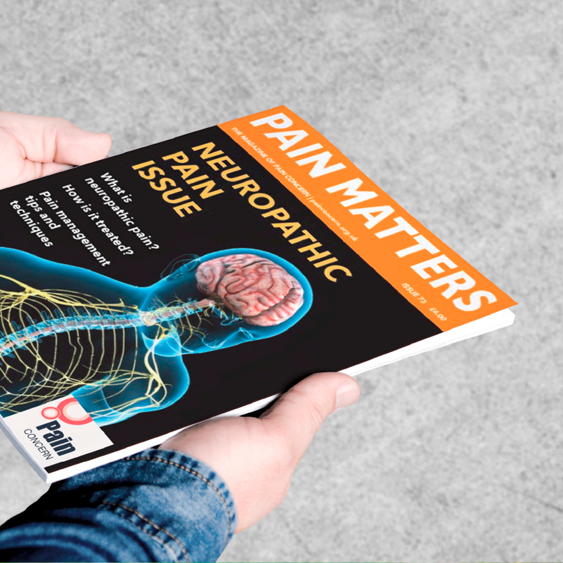
Subscribe to Pain Matters

Everything you need to know about how to live with chronic pain

Subscribe


In pain? Don’t understand what’s happening?

“Having someone to help you prepare for your life through pain”

Our Pain Education Sessions

Fundraise for Pain Concern

Help us to help others

Fundraise


Scotland’s Pain Management Programmes (PMPs) and what support is available after graduating.

To listen to the programme please click here.

This edition of Airing Pain has been funded by a grant from the Health and Social Care Alliance Scotland Self Management Fund  administered on behalf of the Scottish Government. 

What do you know about Pain Management Programmes (PMPs)? Do you know how they function? About the positive outcomes they have? Do you know if there are any PMPs near you?

In this episode of Airing Pain we learn about PMPs and the support networks that are being formed as a result.

With the help of Health Unlocked and Alliance Health and Social Care Scotland, Pain Concern have created a small number of online forums. These forums are designed for PMP graduates in order to stay connected. They allow them to continue to support one another once the programme has ended. Graduates can communicate with one another on our Health Unlocked forums. Additionally, they can also communicate with the healthcare professionals who delivered their PMP.

So for Pain Concern this is a test to see whether forums like these are useful! Also, should we create more?

Paul Evans speaks to Health Unlocked moderator and PMP graduate Louise Cromie about all things Pain Management Programmes. For example, how support networks can be key in someone’s pain journey.

Issues covered in this programme include: pain management programmes, self-management, supporting one another in pain, pain community, pain education, the spoon theory, managing pain in a crisis, fatigue, burnout

Please zoom in if text is too small!

Paul Evans: 

This is Airing Pain, a programme brought to you by Pain Concern, the UK charity providing information and support for those of us living with pain and for those who care for us. I’m Paul Evans. And this edition of Airing Pain is funded by The Health and Social Care Alliance Scotland Self Management Fund administered on behalf of the Scottish Government.  

Louise Cromie: 

We had a message come via the pain team from Pain Concern saying we are thinking that these groups that you guys are making after your pain courses if we had somewhere central that you could all go to then that experience and that shared journey and the shared wealth of knowledge from the eight of you could be bigger.  

Evans: 

Pain Concern in collaboration with the Scottish National Residential Pain Management Programme and the NHS Greater Glasgow and Clyde Pain Management Programme have developed two separate online communities that will provide ongoing support for those graduates of the two pain management programmes.  

Lou Cromie is a graduate of the three-week Scottish National Residential Pain Management Programme and she’s a moderator of that forum.  

Cromie: 

My chronic pain started just off as an injury when I was 13 and I dislocated my knee, you know you’re 13 they put it back together and you kind of got on with things and things just got worse and worse as time went on.  It dislocated, subluxed and we then discovered there was a reason for all this happening with the leg length discrepancy which they couldn’t fix which, in time, caused my pelvis to be out of alignment which caused my spine to be out of alignment, which then just causes all of its own problems and I ended up with complex regional pain syndrome throughout my whole body as well as osteoarthritis in various joints, my pelvis, my spine, my knees … 

Evans: 

So you’ve been on a pain journey from the age of 13 when your teens started?  

Cromie: 

Pretty much. And you don’t realise at 13 that this is the rest of your life. You think at 13 you are starting out. My plans – you know I used to do running and everything, I loved it.  And you push through these things when you’re 13 and you’re 19 and your 20s and your 30s but then you release that you can’t push through it any more and it’s too much and it gets on top of you and life stops happening so you have to do something about it.  

Evans: 

At what age was it decided that you had to do something about it? 

Cromie: 

I had just had my children at 30 and I was maybe about 34/35 and things were getting unmanageable and when I realised I couldn’t get down on the floor to play with my children, I couldn’t run after them in the park, the pain was, it was more about, you know, what I could do to try and get out of bed to actually do anything rather than the joy of getting out of bed to have a day at work or a day with the kids.  That was when I would say something needs to be done here and you do the whole bouncing round all the doctors and the GPs before you finally end up at a pain clinic.  

Evans: 

Having all those conditions what help were you getting up to that point?  

Cromie: 

My GP was good in as much as he would see me and he would listen and he would try to do what he could as a General Practitioner but he wasn’t a specialist so he would refer me on and you would see orthopaedics, you would see endocrinology just in case it was something like rheumatoid arthritis and you got passed around the houses and passed around all the departments with the ‘well your scan’s clear, there’s nothing on your scan’ or ‘well, yes there’s a little bit of deterioration, maybe more than we’d think for somebody your age but it shouldn’t be causing you this amount of pain’ and I’m fairly certain everyone who’s been on a pain journey has had this and you just whack up against every brick wall that the medical profession has. They can’t fix it they expect you just to live with it.  

Evans: 

So, you were being treated for x number of conditions rather than one condition which is pain.  

Cromie: 

That’s right, yeah. If they couldn’t find a physical cause you almost felt like they were making you think it was in your head.  You really start to doubt yourself and you think ‘Am I imagining this, is this in my head?’ but you know it’s not because when you are physically blacking out from pain, when you are having pain spasms that are lasting 3, 4, 5 hours and you are in tears and gasping for breath you can’t make that up.  Your pulse goes through the roof, you break out in pain sweats and it wasn’t until somebody finally says ‘I think we’re going to refer you to the Pain Team because there’s nothing else that we can do’.  And I thought ‘There’s a pain team!  There’s a team that actually deals with this and I’m only seeing them now!’ [Laughs] 

Evans: 

That expression ‘there’s nothing more we can actually do’. That’s a brick wall really, isn’t it? 

Cromie: 

It is, it is and I think everyone who gets to a pain team has hit that brick wall.  They have been banging their head against it for years.  And I can see from a point of view the medical professionals on the other side of that wall putting it up.  There is nothing that they can do because sometimes what is wrong you can’t see on an X Ray, you can’t see on a CAT scan you can’t see on an MRI.  Pain is very, very complex and it does take a certain, I think, mindset and understanding to work out what causes it, why it impacts the way it does and what you need to do to be able to manage it.  And you’re not going to get rid of it but it can be managed and you can live with it.  

Evans: 

So, you’ve arrived at your brick wall and they’ve referred you to a pain team. What happened then? 

Cromie: 

The first thing that happened then was apprehension, thinking how’s this going to go, and then the utter relief and breaking down in tears, I can remember to this day sitting in my consultant’s office when she said ‘I believe you, I believe the amount of pain that you are in, it is real’. Just that acknowledgement, that acceptance, the validation that everything that I had been saying to all these other doctors who were saying ‘but there’s nothing there’.  No, it was real.  And then she explained why I was feeling pain and explained why nobody else was picking up on it and that helped me understand and because I could understand it I could accept it.  And because I could accept it, I could then move on in the journey to try to manage it.  

Evans: 

What did she mean by it when you said ‘why nobody else picked it up’?  

Cromie: 

The mindset a lot of the doctors seem to have is they are looking for physical conditions, they are looking for a physical cause and sometimes in pain the physical cause is so small it doesn’t show up.  You could maybe catch it on a functional MRI scan and that’s where you actually see the part of the brain firing off in colour so you can actually see the reaction in the brain to what’s happening in the body.  They are very, very, very, very hard to come by so because these doctors, who are great at their jobs, because they don’t see lesions, they don’t see a broken bone, they don’t see a torn muscle, they are at a brick wall so for her to be able to say well actually what’s happening is your brain is perceiving pain because it’s getting flooded with pain messages coming from your nerves, and it’s getting flooded with messages, rather, and your brain is interpreting it as pain.  OK so there is actually something happening, it is going to my brain, my brain saying this is pain but nobody can see it because these messages are so small.  They’re tiny electrical signals.  

Evans: 

It’s all very well for your experience of pain to be validated and to have it explained to you why it is pain but where does that lead you.  

Cromie: 

So, when you know it’s real then you can do something about it.  The approach that our pain team used in the Borders is a biopsychosocial approach so you learn a bit about the biology, you learn a bit about the psychology behind it and the social impact that it has.  And when you understand why these things happen the way they do and why we typically respond to these things the way that they are happening, we can then adjust how we react to things.  So instead of having the days where, and you got them occasionally, the days when you’d wake up and you’d think wow I feel I could actually do something today and you go hell for leather and you’re just out there and you do everything you can, you get the house cleaned, you go and do the shopping, you know, you go and see friends that you’ve not seen for ages and then the next day and the day after and the day after you pay for it.   

So, this boom-and-bust cycle that you have of, you know, ‘I’m going to go for it’, and then you flop, that doesn’t work.  What you are looking to do with this whole biopsychosocial approach is trying to, instead of going from this roller coaster where we’re sort of up and down and up and down, you want to go on a sort of merry-go-round.  So, you’re still going up and down like those carousel horses do, you are still going to go up and down but it’s a smoother journey, you go round and round, it’s a much smoother journey, you’ve got more control over it.  So, you are maybe still doing things on the days where you’re sore, you’re not lying down to it but on the days that you’re good you are pacing yourself, you’re not going mad so that you know the next day you’re not going to have to recover.  And it just makes such a difference, you learn to manage your pain so it’s not managing you and that gives you a life back and when you’ve had your life snatched away from you by pain for 10, 15, 20 odd years it’s a gift just to suddenly have that understanding and the knowledge and the power to be able to say ‘no I’m having my life back’.  I’ll still have my pain but I’m managing it, it’s not managing me.  

Evans: 

That sounds absolutely great and it’s fine but the biopsychosocial, the social side of it doesn’t always fit a neat plan.  Now I know that you were in a dental crisis with your child yesterday, that wasn’t in the pain handbook.  How do you cope with things like that? 

Cromie: 

Well, that’s life, life happens, that happens to everybody whether you have pain or not and we all have a toolkit whether you have pain or not.  We have toolboxes. When you’ve got pain you’ve just got to adapt your toolbox a little.  So, for example, if I was a healthy, happy normal working person I would phone my work and say, sorry I’ve got a crisis with my child, I need to take some personal time. So as somebody who isn’t able to go out to work, I need to say to myself, ok, I can’t do what I was planning to do today I’m going to have to put my energy and resources into this, which means I’m going to have to cut back a little bit later on from somewhere else.  And there’s a theory called the Spoon Theory which really helps with this and I’m fairly certain that anybody that has pain has heard of the Spoon Theory. This is one of these occasions where you borrow some spoons. You know you might pay for it a little but there are things that you have to make the judgement. It’s worth paying for.  Especially when it’s comes to things like your child.  [Laughs] 

That can work for, you know, if you have a wedding to go to. You know that you might pay for it afterwards but the benefits you get from being able to have a little bit of life can get you through these little tough days afterwards.  It is a balance, it’s all about pacing and it’s not easy.  It’s very much a case of putting it in to practice and finding out what best approach works for you and it takes time.   

Evans: 

All this stuff, all this pacing and booming and bust.  How was that taught to you, how did you find out about that? 

Cromie: 

My pain consultant had suggested I go on a pain management programme. Now when she said this I thought OK tell me about it.  So she says well we get a group of patients and we sit around and we discuss the theories of pain and we talk about how we manage pain and I am sitting there going ‘Yeah.  Not for me thank you very much’.  I’m very much one of these people when you go on holiday and they have the organised resort activities to do on holiday and I’m like ‘Yeah no I’ll just sit at the bar thanks. Crack on’. So the idea of sitting in a room full of other people who were all suffering, all of us sitting whinging about our pain was not floating my boat at all.  And my consultant tried for 8 years to get me to do a pain course. She never forced it.  She just every time I saw her and we had our reviews she’d say ‘have you given any more thought …’ I was like ‘yeah, you know what it sounds good for some people but not for me thank you very much’. And it took me hitting rock bottom to actually say to her ‘look I need to do something.  Give me this pain course’.  

Evans: 

Was that a residential pain course?  

Cromie: 

Initially the course that I’d done with the Borders General Hospital it was over ten weeks and it was maybe two hours, one to two hours a week every week for ten weeks. It was good because it wasn’t overwhelming. You had time to process things during the week and it wasn’t exhausting. But I did eventually go on to do a three-week residential course with the Scottish National Residential Pain Management Programme in Glasgow.  So that was very much the same principles but they were showing you how to put the principles in to practice, giving you actual physical tools – you’ve dropped something on the floor you need to get down on the floor and you need to get back up. How do you do it?  Simple things that we all do, or all need every day and it helped cement everything that I had learned over the ten weeks with the Borders team as well.   

Evans: 

That’s overcoming sort of physical problems.   Picking things up. But what about the psycho, the psychological, your mind. How did they help you put your mind in a different place? 

Cromie: 

Every team that’s a pain team has a psychologist on it and they are very much aware of what pain does to us.  Where pain puts us.  And my psychologist knows I have absolutely no qualms. If I didn’t have my family here I wouldn’t be here, I would take the exit door because my family make my life worth carrying on with. That’s how bad things can get.  But they understand this and they listen.  And they don’t judge and they help us realise that, well maybe you need to find something for yourself, yes you’re managing your pain or you’re trying to manage your pain and you’re trying to do it for your family but what are you doing for you because people with pain tend to end up putting themselves on the back burner because we get used to putting a mask on for friends and for family. So, you walk around with this mask. My family are quite good.  They can see when I have it on but you will see friends and they’ll say ‘oh wow I’ve not seen you for ages you’re looking great, it’s great you are feeling so much better’ and you’re thinking ‘no I’m not really’.  [Laughs]. But your psychologists on these teams help you realise that it’s ok to lower the mask and it’s ok to say, you know, it’s not good just now but I can do this for me.  So, for example, one of my things, I’ve started an Open University degree.  At 45 I’ve decided I’m going to get a degree.  I have something for me now.  So, the psychology team help you put you in focus again, help keep you in focus and keep the balance.   

Evans: 

Lowering that mask, I guess, is a skill in itself because you could lower it and just be labelled a ‘Moaning Minnie’ – ‘leave her alone, come on let her get on with it’.  

Cromie: 

And that’s scary.  When you have pain you find out who your true friends are and you find out the people that actually listen to what you say and it’s not easy to lower the mask and to reveal what’s really going on but the percentage of people in our country that are living with chronic pain is way higher than people realise.  There are a lot of masks being worn out there.  Wouldn’t it be nice if we could all just see each other, realise, you know, they’re struggling.  What can I do to maybe help them a little bit, to make their day a little bit better, a little bit easier. And maybe if we didn’t all have our masks on all the time, we might be able to achieve that.  

Evans: 

Well, I mean I have chronic pain. I have fibromyalgia and I‘ve found that one of the worst things, that really annoys me, and I don’t know how to cope with, is people saying’ how are you feeling’ because the answer is ‘rubbish’.  

Cromie: 

Well, the answer is always ‘rubbish’. I have circles. My inner circle, my very core of my circle, I have my immediate family, and then my next circle out are my best friends, the ones who I don’t need to wear a mask around, and then the next group out I have people who, you know, maybe people I know from church that I’ll have a little bit of a mask on. They know what my situation is but they try to stay positive, it’s coming from a good place, you know I’ve got neighbours, it’s coming from a good place.  They’ll do the, you know, ‘how are you feeling’ and you’re like ‘well you know, I’m here which is something that hasn’t happened for a while’ or, you know, well ‘it’s amazing what make-up can do’.  I have little retorts.  The further out my circles go the more my mask will stay on because there are sometimes you get people that are just, ‘have you tried yoga?’ or ‘have you had this diet?’ or ‘I’ve ‘well heard meditation works wonders’ and those people you kind of keep the mask on and you think to yourself ‘is it worth my energy getting riled up, getting in to a debate, getting in to an argument’ – because that’s exhausting – or is this somebody that I could just kind of say, ‘look do you know what that’s a great idea, I’ll have a think about it’ and move the conversation on gently.  So you choose who you keep your mask on around, I think, and that’s one of the things that I’ve learned on my pain course.  

Evans: 

That’s a really good tip because the number of times somebody will come up to me, or other people with chronic pain, and say ‘oh I’ve read an article in the Daily Blurb that says something about putting a pebble in your shoe.  Have you tried that, I’ve kept the clipping for you’.   

Cromie: 

I know [laughs] and you just, inside of you, you just want to grab them and shake them and say ‘it’s not like that’.  But you know [laughs] the beauty about having pain is that we have mastered an inner monologue when we have pain.  I just need to remember sometimes I have to turn my inner monologue on and off.  But yes sometimes we can have the inner monologue of ‘pebble in my shoe, really?  Tell you what I’ll take the concrete ones off first and then I’ll try a pebble’ but you’re like ‘how very interesting’.  Is this person actually worth this discussion, worth my energy or am I just going to say ‘how interesting’ and move the conversation along [laughs].  

Evans: 

I just need to say that having a pebble in your shoe is just pure fantasy from my little brain [laughs]. 

Cromie: 

Well do you know if I could trade what we are, I’m sure you would be the same, if you could trade what you are living with to having to walk around for the rest of your life with a pebble in your shoe, I know I what I would choose.  I’d have that pebble in my shoe [laughs]. 

Evans: 

Well now you’ve broached on this as well. How does your family, your teenage children … I mean who educates them about your pain and how to deal with you? 

Cromie: 

I have. And also, my pain team because we have sessions where they can come along and learn about pain.  My son has done his Duke of Edinburgh Volunteering section for his Duke of Edinburgh Award with my physiotherapist as his instructor so that he can help me do physiotherapy at home.  But I’m the one who has taught them about it. That was something I learned on my pain course because all they ever saw was mum’s sore or my husband would say, you know, I’m really, really sore. They would see the results, the end result, the crying, blubbering mess or the person that couldn’t get out of bed.   

The other thing they would do is try and do everything for you which is coming from a good place. And when you’ve done your pain course you realise that actually you need to be doing some things for yourself. You know you can’t lie down to your pain and having to say to them ‘actually thank you but I’m going to go and try and make myself a cup of tea – would you like one?  I might need you to carry them through’.  ‘Oh but mum, mum I can do it, you relax it’s fine’ it will be sure.  Yes but I need to be moving, I need to be doing things so by educating them what I need to do, why I need to do it, they have then went [sic] ah ok so you are doing that for this reason, I’ll support you by doing what? What do you need me to do? What would you like me to do rather than the brain of a child or a husband saying ‘I’ll do it for you’ because it’s easier.  Tell them what you need.  Communication is a big part and that’s something you get very isolated on a pain journey before you take control. You don’t communicate very well. We like to keep it all to ourselves because we don’t want to be the Moaning Minnie or the whinger.  

Evans: 

Right, you’ve been on the three-week residential pain management programme.  What’s on my mind is that being locked away, if you like, with like-minded adults for three weeks – at the end of it you’re all wound up and ‘yes’ yes we’re ready to go now’ and then the gang plank is pulled away from underneath you. You have to go back to real life.  

Cromie: 

To real life.  Well our particular course actually happened just before Christmas so we finished our course and we had Christmas, we had New Year and you know how everybody has that slump in January?  We were all like, oh, we were exhausted after Christmas and New Year, everything just seems boring and blue and you know the pay check seems miles away.  

Imagine having that after having had three weeks of positive ‘we can do this’ mentality.  We were all just like ‘oooohhhh arrrgh could we get any lower’ but we reached out to each other because we had formed a little group, we kept a little Whatsapp group going and we’d be like, you know, ‘I’m struggling, is anyone else having this struggle just now’.  ‘Oh gosh yes I am’. And the messages would flood in. There were only eight of us on this course and to just know that this is normal, this is ok I’m not the only one feeling this, this is real, this is justified and valid.  

We kept each other going through that and because we had each other to lean on it wasn’t a solitary dark January any more or a solitary dark life after pain clinic.  We kept each other going and we had follow-ups with the pain clinics at three months and six months and that’s something that they had said that they noticed that patients bond with each other, form a group and that helps keep us going because when you get to the stage of ‘guys I need to do this and I’ve got no idea where to start, I’m so exhausted, my head is sore, I’m not coping well’ somebody in the group has the answer.  Or, at least, has an idea of where to send you for the answer so having that support structure the ‘gang plank’ wasn’t really taken away. We actually had a bridge built so we had a message come via the pain team from Pain Concern saying we are thinking that these groups that you guys are making after your pain courses, if we had somewhere central that you could all go to then that experience and that shared journey and the shared wealth of knowledge from the eight of you could be bigger.  Your bridge could go from being a couple of metres wide to several Forth Road Bridge sizes wide.   

We went along to have a meeting and a focus group and discussed what would work and what wouldn’t work and what we would want to see and what we thought we would need and the project developed and the Board became in to being and we started looking for people to help keep it going in the right direction.   

Evans: 

Before we go on, I’ll just remind you as usual that whilst we in Pain Concern believe the information and opinions on Airing Pain are accurate and sound, based on the best judgements available, you should always consult your health professional on any matter relating to your health and well-being.  They are the only people who know you and your circumstances and, therefore, the appropriate action to take on your behalf.   

Do check out Pain Concern’s website at painconcern.org.uk where you can download all editions of Airing Pain and find a wealth of support and information material about living with and managing chronic pain.  

Now the online forums we’ve been talking about in this edition of Airing Pain are restricted to those who’ve been through the Scottish National Residential Pain Management Programme or NHS Greater Glasgow and Clyde Pain Management Programme.  So contact your pain management team to find out how to join.  

Lou Cromie, who I’ve been talking to, is the Moderator for the Residential Programme Forum.  What does that mean? 

Cromie: 

We try to keep the Boards flowing, we try to respond to every post that comes up, make sure that nobody feels alone – there’s always a response there.  We try to keep the Boards a safe place not just for if somebody is really, really struggling, you know we will reach out and try and get them help that they need, but also if we see conversations starting to wind off, as you may see on other social media groups, you go down for six hours sometimes where the conversation waddles off into the realms of fantasy almost, we try to stop that happening, try to keep it real and accurate.  Life isn’t just about pain when you have pain. Sometimes we need to have fun and games too so, I throw in the odd fun thing on our Board, get some jokes and some little quizzes and things going too.  

Evans: 

I mean this is new to me because I’d assumed the chief function of a Moderator was censorship to stop all those barking pebble theories.  

Cromie: 

If somebody said to me ‘I’ve got chronic pain and I’ve tried this pebble theory’ I’d be like ok – as a moderator thing eh how accurate is that but right you can steer it but ‘oh so where did you hear about it, do you know of any clinical research papers there are, let’s see if we can find some solid evidence, some solid research and we’ll put that on the Board and everybody can have a look at the research’.  If it’s something valid, properly conducted clinical research then why not leave it up there, let people have a think about it, let them read the research and make their own decisions.  It’s about directing. It’s not about censorship, it’s more about steering things in the right direction, keeping it out of the rapids.  

Evans: 

What control, if control is the right word, do the health professionals have.  

Cromie: 

They’re effectively moderators as well. It’s great having them there because they will probably be more aware of new research within the pain area so they’ll share little snippets that they find but they don’t censor anybody, they don’t turn round and say you’re doing this wrong.  There is no real wrong.  They help guide us when we really start to struggle but mostly it’s patients helping patients.  

Evans: 

I think that’s interesting as well because I’m sure lots of people with pain might think this – ‘What if there’s a cure and nobody has told me about it.  What if there’s a new treatment and nobody has told me about it’.  I suppose keeping in touch with those in the healthcare, healthcare professionals, does keep you in touch with current practice.  

Cromie: 

It certainly does and they are as passionate about pain as we are.  They are happy to shout from the rooftops when they hear about something new, that’s positive.  

Evans: 

The great thing is that you can trust this forum – the worldwide web is a big place and you can get a lot of bad information.  Your forum is to be trusted. 

Cromie: 

Yes, it’s a safe place.  We’re not going to have rabbit holes that you fall down on the worldwide web. You know that everybody in this forum have all been on the same type of pain course.  We have all learned the same thing, we all have the same basis and same grounding.  We all have the same basic knowledge.  We have professionals there to support us, we’re all singing from the same hymn sheet which is great because that helps us all keep going in the same positive direction.   

END 

Contributors:  

  • Louise Cromie is a current Moderator for the Health Unlocked Forum. She is also a graduate of a Pain Management Programme.  

More information:  

Shape

With thanks to: 

Peer Support. Join the community

“Having chronic pain is very lonely.”

Join the community

Subscribe to Pain Matters

Everything you need to know about how to live with chronic pain

Subscribe


In pain? Don’t understand what’s happening?

“Having someone to help you prepare for your life through pain”

Our Pain Education Sessions

Fundraise for Pain Concern

Help us to help others

Fundraise


For full details & transcription click here

Peer Support. Join the community

“Having chronic pain is very lonely.”

Join the community

Subscribe to Pain Matters

Everything you need to know about how to live with chronic pain

Subscribe


In pain? Don’t understand what’s happening?

“Having someone to help you prepare for your life through pain”

Our Pain Education Sessions

Fundraise for Pain Concern

Help us to help others

Fundraise


Scotland’s Pain Management Programmes (PMPs) and what support is available after graduating.

What do you know about Pain Management Programmes (PMPs)? Do you know how they function? About the positive outcomes they have? Do you know if there are any PMPs near you?


In this episode of Airing Pain we learn about PMPs and the communities and support networks that are being formed as a result.


In collaboration with Health Unlocked and Alliance Health and Social Care Scotland, Pain Concern have created a small number of online forums designed for people who have graduated a PMP to stay connected and continue to support one another once the programme has ended. These forums are open only to PMP graduates. Not only can graduates communicate with one another on our Health Unlocked forums, they can also communicate with the healthcare professionals who delivered their PMP.


For Pain Concern this is a preliminary experiment to determine whether forums like these are beneficial, and if we should create more!


Paul Evans speaks to Health Unlocked moderator and PMP graduate Louise Cromie about all things Pain Management Programmes, how support networks can be pivotal in someone’s pain journey and, of course, about our Health Unlocked forums.


Issues covered in this programme include: pain management programmes, self-management, supporting one another in pain, pain community, pain education, the spoon theory, managing pain in a crisis, fatigue, burnout

Time Stamps:

00:21 – Louise Cromie & Paul Evans discuss the origins of the Health Unlocked forums.
01:13 – Louise Cromie shares her own journey with chronic pain.
03:37 – When doctors tell you ‘there’s nothing we can do’ & the vital role specialist pain teams can play.
06:05 – Being believed & having your pain experience validated.
08:36 – A biopsychosocial approach to pain & how to break the cycle of doing too much on good days, then paying for it after.
11:02 – How to manage your pain in unforeseen circumstances.
12:44 – How do Pain Management Programmes (PMPs) help people in pain.
14:53 – The mask we wear when we’re in pain & learning how to lower it.
20:43 – Helping those around you learn about pain & how to be supportive.
22:50 – How to continue coping once a Pain Management Programme ends.
25:14 – How did Pain Concern get involved in supporting PMP graduates?
27:08 – Louise Cromie on becoming a Health Unlocked forum moderator.

Contributors: 

  • Louise Cromie, current Moderator for the Health Unlocked Forum & graduate of a Pain Management Programme (PMP).

More information:

Peer Support. Join the community

“Having chronic pain is very lonely.”

Join the community

Subscribe to Pain Matters

Everything you need to know about how to live with chronic pain

Subscribe


In pain? Don’t understand what’s happening?

“Having someone to help you prepare for your life through pain”

Our Pain Education Sessions

Fundraise for Pain Concern

Help us to help others

Fundraise


The theme for Pain Awareness Month 2021 is #PAINCOUNTS

The World Health Assembly (WHA) – a subsection of the World Health Organization (WHO) – has declared September Pain Awareness Month. This month is dedicated to raising public awareness and understanding of pain. Many organisations around the world contribute, including the U.S. Pain Foundation, the International Pain Foundation and the American Massage Therapy Association (AMTA).

During September, the U.S. Pain Foundation will be sharing 30 stories of people living with pain over 30 days, while the AMTA has posted resources to inform people of the role of massage therapy in pain management strategies. Here at Pain Concern, we will be posting regularly on social media.

Everyone can play a part during this month by using the hashtag #PainAwarenessMonth.

You can also get involved by ‘liking’/‘following’ Pain Concern on Facebook and Twitter to stay up to date and share the cause.

We would like to share the following link to an Airing Pain programme we worked on during the COVID-19 pandemic. The topic of the programme is Domestic Abuse and Chronic Pain, but the programme dedicates a significant amount of focus to the effects of COVID-19 restrictions on communication and the effects of social isolation on those of us with pain. In a time where pain is on the backburner due to the global pandemic, it’s’ never been more important to say #paincounts.

To listen to the programme, or read the transcript, please click here.

Links:

Peer Support. Join the community

“Having chronic pain is very lonely.”

Join the community

Subscribe to Pain Matters

Everything you need to know about how to live with chronic pain

Subscribe


In pain? Don’t understand what’s happening?

“Having someone to help you prepare for your life through pain”

Our Pain Education Sessions

Fundraise for Pain Concern

Help us to help others

Fundraise


Trigger warning: suicide, suicide ideation, self-harm


The 10th of September marks World Suicide Prevention Day 2021. So, here at Pain Concern, we decided to do some research on the links between suicide and chronic pain.

Despite the fact that research in this area is limited, there is already some extremely enlightening literature on the subject.

We also had the privilege to receive a statement from survivor Ruth Hunt, who has first hand experience of how long-term pain and suicidality often go hand in hand.

Early stage research on the topic

The following journal article, published in 2020, was written by Senior Research Fellow at the Center for Contextual Psychiatry Olivia Kirtley, Professor of Health Psychology at Staffordshire University Karen Rodham and Research Psychologist at the University of Oxford Catherine Crane.

They highlight a more holistic approach towards chronic pain and mental health problems (particularly suicide), which have previously been treated more as separate issues. Kirtley, Rodham and Crane assert that ‘individuals with chronic pain are at elevated risk of suicide’ and propose that actually these two topics are inextricably linked and should be treated as such in the medical field.

To read this publication in full please click here.

We hope that funding and research in this area continues to gain traction in the coming years.

Words from a survivor

The following is a first hand account written by Ruth Hunt about her own ongoing experiences of suicide and chronic pain:

I was just 18 years old when I stepped off a window ledge and dropped forty feet, hitting the back of my heels first, causing life-changing damage in my back, with burst fractures damaging my spinal cord at L1, L2. This means that below my waist I have a lack of mobility and sensation.

Thirty years later, and that initial injury has been joined by an amputated right leg. When I was in my late twenties (and in my thirties and forties) I began to suffer from spinal cord related osteoporosis and kyphosis. The bipolar disorder that contributed to the incident when I was 18 is now mostly under control, but has been replaced by a persistent reactive depression that, as I have got older, has become more of a problem.

A defining moment for me was the year when I lost my leg in 1999. I had expected relief, after suffering for ten years with a pressure sore on the heel.  Instead, the pain was pure agony, and I could no longer go out to work because of it.

I fell into a deep depression and at the end of the year tried to end my life. After a week in intensive care, I was put on a Section 3 and spent the next three years in a psychiatric hospital. During this period, I had to leave the job I worked so hard to get, my marriage with the only man I have loved ended and my home, which we had only just bought, had to be sold at a loss. Homeless in hospital, I faced the prospect of starting completely over again. I thought things couldn’t get any worse.

Bit by bit I began again, but it became clear that not only had my confidence taken a huge knock, but my physical state was considerably worse. Bone-pain was added to neuropathic pain and phantom pain.

My spinal surgeon diagnosed me with osteoporosis. The curve in my back, kyphosis, began to be monitored, something I viewed then (and still do) as pointless as I’ve been told it’s too much of a risk to operate on me.

The medication to treat my pain is mostly opiates, and when I was in my forties my dose reached 900 mg a day. My GP is reluctant to increase it any further, so I rely on PRN medication to try and get me through the day and night.

 My world got smaller to the point where I am now, completely isolated at home.  I have care staff who barely communicate with me, as they assist me with personal care.

 Increasingly, thoughts about ending my life have dominated my days, but I don’t have anybody to talk it over with me. My journal is my way of ‘talking things over with myself’, but it’s not enough.   When I tried to talk to the GP, she looked alarmed, cut me off and asked if I was still taking my medication…My bipolar isn’t the problem – was my reply, but by then I had lost her attention.

Harrowing accounts like Ruth’s serve to highlight just how vital it is that more time and money is dedicated to researching and finding more effective ways to treat patients who experience suicidality associated with their pain. This may mean that in time, Ruth, and many others with similar experiences, will be able to feel hopeful about the future. We would like to thank Ruth profusely for sharing her story with us.

More Information:

Please click on any of the below to be taken to their websites.

Follow us on twitter @PainConcern and join the conversation with #WorldSuicidePreventionDay

Peer Support. Join the community

“Having chronic pain is very lonely.”

Join the community

Subscribe to Pain Matters

Everything you need to know about how to live with chronic pain

Subscribe


In pain? Don’t understand what’s happening?

“Having someone to help you prepare for your life through pain”

Our Pain Education Sessions

Fundraise for Pain Concern

Help us to help others

Fundraise


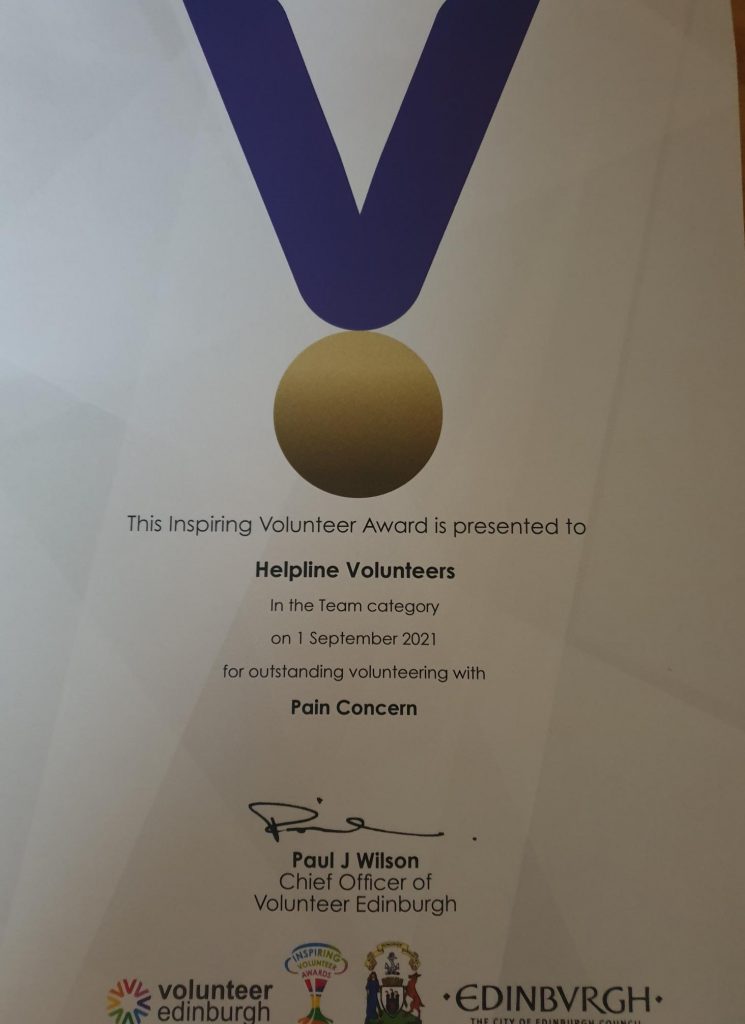
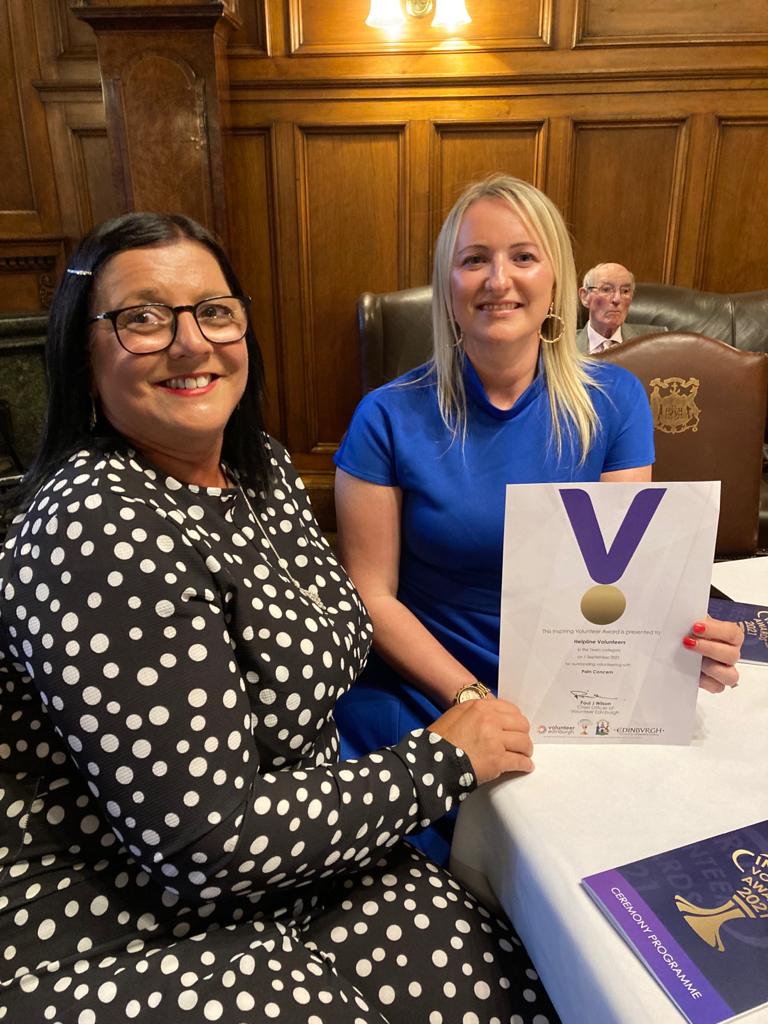
We are thrilled to announce that last night at Volunteer Edinburgh Inspiring Volunteer Awards 2021, our helpline volunteers received recognition in the Team category! We want to say a huge congratulations and thank you to our team of volunteers!

Here are some pictures from the big night!

Certificate
Helpline volunteer Julie Menzies and Helpline Supervisor Samantha Mason at the awards

To find out more about our renowned helpline service please click here.

Peer Support. Join the community

“Having chronic pain is very lonely.”

Join the community

Subscribe to Pain Matters

Everything you need to know about how to live with chronic pain

Subscribe


In pain? Don’t understand what’s happening?

“Having someone to help you prepare for your life through pain”

Our Pain Education Sessions

Fundraise for Pain Concern

Help us to help others

Fundraise


Determining what Shingles really is and why vaccine uptake is so low?

To listen to the programme please click here.

 This edition of  Airing Pain has beenfunded by a grant from The RS Macdonald Charitable Trust and The Stafford Trust. 

What exactly is Shingles? We often hear it thrown into conversation alongside a virus many of us have already had: Chickenpox. So how are the two linked? Why is one more associated with young people and the other with older people? The answer is they are both infections caused by the varicella-zoster virus. The vast majority of us had the Chickenpox virus when we were children, with many parents even intentionally exposing their children to the virus. Shingles, on the other hand, occurs after someone has already had Chickenpox when the virus (which remains in the body) is reactivated. 

One of the main worries people have about having Shingles is the potential to develop Post Herpetic Neuralgia (PHN). This is defined as persistent pain 3 months after the initial rash developed. Unfortunately PHN is a chronic condition which causes burning neuropathic pain. This condition is caused by the damage the virus inflicted during its reactivation. 

Paul Evans speaks to health professionals and somebody with lived experience of Shingles & PHN in order to illuminate the intricacies of the varicella-zoster virus, how it works and how it affects us throughout our lives. 

Issues covered in this programme include: Shingles, Chickenpox, varicella-zoster virus, neuropathic pain, Post Herpetic Neuralgia, pain management, virus reactivation, insomnia, vaccination, vaccine uptake, side effects, amitriptyline, Gabapentinoids and depression. 


Please zoom in if text is too small!

Paul Evans: This is Airing Pain, a programme brought to you by Pain Concern, the UK charity providing information and support for those of us living with pain, and for those who care for us. I’m Paul Evans, and this edition of Airing Pain is funded by The RS Macdonald Charitable Trust and The Stafford Trust. 

Dr. Richard Johnson: 30% of us will get Shingles during our lifetime. But if we live to eighty, it’s 50%. So your chance of getting Shingles is actually pretty high.  

Jan Fisher: 24/7, for eight years, I never have a minute that I don’t have pain. It’s been there for so long, they know now it’s not going to clear up because it’s really damaged all the nerve endings.  

Johnson: Now not everybody is going to get post herpetic neuralgia. But the chance of getting Shingles is high. And you can’t choose whether you get post herpetic neuralgia or a not. So really, the only choice you can make is to prevent getting Shingles. 

Evans: Chickenpox, one of those childhood illnesses most of us had, whether we knew it or not, causes few problems in childhood. But it-, or the herpes varicella zoster virus that causes it-, can come back to bite us for want of a better word, as a much more serious illness in later life as Shingles. And the trouble doesn’t necessarily end there. Because nerve damage caused by having Shingles can lead to intermittent or continuous nerve pain, the condition called post herpetic neuralgia. But, and here’s the good news, a vaccine introduced in 2013 will help avoid getting the infection in the first place. The bad news is that the take-up by those eligible for the vaccine-, that’s people in their seventies-, is poor. Dr. Michael Serpell, is a consultant in anaesthesia and pain medicine at Queen Elizabeth Hospital in Glasgow, and for the past twenty-five years has worked within its multidiscipline pain team.  

Serpell: Shingles is a reactivation of a virus, which you’ve already been infected by, in the form of chickenpox. Usually, as a youngster. That virus remains dormant within your body, usually within the nerve tissue. And at some point, it can be reactivated generally when you’re older. And it causes a rash and pain in a certain part of your body. And this usually causes a particular rash with little vesicles that can be painful in itself for several weeks. 

Evans: Let me take you back a little bit. In fact, in my case, take me back about sixty-four years, I had chickenpox. And certainly with my parents, my children and my grandchildren, it was considered to be a good thing for your child to have chickenpox. So perhaps it’s not such a good thing.  

Serpell: Getting chickenpox is better when you’re younger, because you do recover much quicker, and with less complications than you do as an adult. Once you get over the age of twenty, there are quite uncommon, but very serious complications like meningitis, sterility, you know, which can really, you know, be quite significant for the adult. But children seem to breeze through chickenpox illness over a matter of a week or so. 

Evans: My parents were obviously… and we were obviously right to get our children and me to have chickenpox. But then you say the virus stays dormant and can come out as Shingles. So why is that?  

Serpell: It’s only reactivated, in most cases, when the immune system you have starts to subside. That often happens as you get elderly, that’s just the general process of getting elderly a lot of your organ systems and immune system in particular do get less active and so the virus can emerge. It can also emerge if you are rundown, you know, a very severe illness from another cause, which runs your body down. Or if you’re given drugs like steroids, which can suppress your immunity. These are opportunities for the virus to suddenly become reactive.  

Evans: Now I have two experiences of Shingles in my family, one with my daughter in law, who was in her thirties and didn’t even know she’d had Shingles, and my grandmother in her mid-eighties, who really did know she had Shingles, it looked as if her face had been burned in a fire. So the severity might come with age.  

Serpell: It’s much less common in the younger people. So with age, the incidence of having a flare up of Shingles increases. And we also know that generally speaking, it tends to be more severe during the actual flare up but also there is a higher incidence of developing this chronic pain condition called post herpetic neuralgia, the older you are compared to a younger person. So the example you gave me there, it shows you, you know, the rash was not obvious in your daughter law, she’s younger. It’s less common, but it’s not unknown for people just to have an itch or a funny feeling and have no rash. But they have had Shingles if you do the tests to prove it. Your older relative had a much more pronounced reaction, the skin rash that’s typical of older people, demonstrating more sensitivity to a flare up. 

Evans: How long should Shingles last?  

Serpell: The skin flare up, the vesicles usually subside after a few weeks, you can be left with painful, sensitive skin for several more weeks after that, but it should generally heal by a month to six weeks. But the real worry is developing what we call post herpetic neuralgia.  

Evans: That’s Dr. Michael Serpell, consultant in anaesthesia and pain medicine at Queen Elizabeth Hospital in Glasgow. So what is post herpetic neuralgia? As a consultant anaesthetist, Dr. Robert Johnson ran the pain clinic at the Bristol Royal Infirmary with a particular interest in post herpetic neuralgia. Since retiring from clinical work, he continues with research, writing and teaching. 

Johnson: We’ve had to create a definition for post herpetic neuralgia, because in the past people have called any pain that follows Shingles-, even a week after Shingles-, post herpetic neuralgia. But in fact, almost invariably, that’s going to get better. And post herpetic neuralgia is now pain three months or more after developing the rash of Shingles, so all the results of studies that you might read are based on that definition of post herpetic neuralgia.  

Evans: And that’s a standard definition for chronic pain, pain that remains three months after the initial injury should have healed.  

Johnson: That’s right. But with Shingles, the Shingles virus will have ceased to be active a long time before three months after developing the rash. And in fact, much of the virus will have migrated back along the nerves from the skin back to the spinal cord where it had been ever since having chickenpox usually as a child.  

Evans: So just explain the process… chickenpox is a virus.  

Johnson: Yes. The varicella zoster virus 

Evans: And that sticks around?  

Johnson: Yes, from the rash that we have with chickenpox, which is, you know, can be pretty widespread. It migrates literally [within nerves] that carry sensation, back to some specialised nerve tissue around the spinal cord, and indeed, around certain parts of the brain as well. And it just stays there. You’re unaware of it, it’s not doing any harm. As it happens, we know that it does reactivate intermittently during life not causing any symptoms, but it does cause an immune response, which is very valuable because that delays the chance of getting Shingles.  

Evans: So we might not even know that it’s been reactivated? 

Johnson: Absolutely not. No.  

Evans: So what happens to make it reactivate into Shingles? 

Johnson: Oh there’s a big question. Simply put, we grow older, the part of our immune system that deals with this particular virus [gets] weaker as we get older, and we get to a point where we get below a critical level of immunity, and the virus is able to reactivate, it takes advantage of the situation and then it spreads along the nerves that carry sensation to the skin and you’ve got Shingles.  

Evans: So if I get this right, one of the downsides of us living longer, which we think is a good thing, and then the advances of medicine have helped us to live longer, but the downside is our immune system is going and we may well catch it.  

Johnson: I’m going to quibble with the [term], ‘Catch it’, but yes… (laughs) 

Evans: Reactivated. 

Johnson: Reactivated. Exactly.  

Evans: So once it’s reactivated, what happens? 

Johnson: It replicates, so it divides, within cells so there’s more and more virus as the acute Shingles continues, and it spreads along within nerves that carry sensation to the skin [into something that] we call [a] dermatome. Almost invariably, it only reactivates in one little segment of the body on one side of the body. It can be anywhere from the top of the head to your big toe, but it’s usually only in one area. During the reactivation during the immune response, which there will be to the virus having reactivated, there is damage done to the tissues where the virus is. And that means to parts of the sensory nerves and even sometimes part of the spinal cord itself. And that is what leads to the long term pain. It’s not the virus still remaining active, it’s the damage that was done during the actual attack-, if you like-, of Shingles, 

Evans: Hence, the term post herpetic.  

Johnson: Exactly. That’s right.  

Evans: The virus has wrecked some part of the nervous system.  

Johnson: Yes. And it isn’t always the same nerve fibres, in every patient, every person who gets Shingles, some people have total numbness in the area. Some people have extreme sensitivity in the area such that a breeze or touching [of] the clothes is painful, we call that allodynia. So it can differ a lot and the nature of the pain differs. You can get constant pain, which could be an aching or a burning pain. You can get tingling. You can get shooting pains, sudden electric shock-like pains. Some people get all of them. Some people just get one. It varies a lot from individual to individual.  

Evans: Dr. Robert Johnson. Jan Fisher has had post herpetic neuralgia since having Shingles eight years ago.  

Fisher: I’ve had it in the left front quarter of my head, so from my left eye, through to that corner of the head.  

Evans: How did it feel when it started? 

Fisher: I just felt like a raging headache at the top of my head and I noticed two tiny little red spots on the brow right into the hairline itself. But the pain was excruciating. And we were aware with our friends, we were in Salisbury. And it happened when we were just walking around Salisbury just before we left. And we had to drive all the way back and I was just in mortal agony from Salisbury to Norwich.  

Evans: And what steps did you take?  

Fisher: Well, I somehow knew-, I don’t know why-, but something… I think it was these red spots, I somehow knew that it was Shingles. Then after that, it just got worse and worse and worse to the extent that my eye completely closed over. And it was just all covered in scabs-, for want of a better word-, associated with herpes. So I just couldn’t open my eye. I couldn’t get out of bed, I lost a stone in weight. For the first two weeks, I was practically bedridden, couldn’t walk at all I was just so ill.  

Evans: How long did that last?  

Fisher: It took four weeks before my eye opened. But I got out of bed on a regular basis. I think after two and a half weeks, then we were due to go on holiday because we’re keen sailors and we rented boats, our friends and us out in Greece. So I thought, ‘Right it’s on the mend now, I’ll go’, and of course it wasn’t like that at all. I was still ill while I was out there. [I was] not very well when I got back but slowly I felt better in myself because I never ever got rid of the pain in the head and the rash cleared up. I had the eye looked at the hospital just to make sure there was no permanent damage done to the eye. But I was lucky it was just on the eyelid and round about the eye rather than the eye itself.  

Evans: The outward signs-, the scabs as you call them-, did they go?  

Fisher: Yes, they did. But because it was in my hair, it was very, very difficult to treat it. Fortunately, the old style calamine lotion was still available. I mean, it was the only thing that soothed my head and face, so I just had it caked on sort of day and night around the eye and all the way in the head and the hair. So it wasn’t very nice, but at least it stopped the itching because it itches. I mean that’s what I’m left with today as well. It’s not just pain, which is more like a… Now it’s a light tingling effect until about six o’clock and then it ramps up. But I break out with a rash every so often and I have at the moment. So last night I never slept because [of] this rash all over my head like an eczema. But of course [the pain] being in my head… The natural reaction when you’ve got pain is to cuddle yourself or [hold] a hot water bottle. But when it’s on your head-, it’s like having an earache or toothache-, you can’t comfort it in any way.  

Evans: Jan Fisher, the Shingles Support Society has been running since 1987. with the aim of giving advice to people who have Shingles and to raise awareness of the Shingles vaccine. More on that later. Here’s the society’s Marian Nicholson: 

Marian Nicholson: Anyone who suspects they’ve got Shingles needs to see a doctor right away. And therefore awareness of what Shingles is, is very important. We’ve got leaflets that we send out to GP surgeries, just so that people who are vaguely interested and have vaguely heard of Shingles can pick it up and learn more about how to identify the beginning of a Shingles outbreak. It’s that weird sensation in a small area of [the] body. And I can’t be more specific, because for some people, it’s a burning [sensation on the] skin, like an area of scalded skin. And for other people, it’s a needling sensation, as though someone were hitting your skin with one of those wire brushes they use on rust. So it could be absolutely anything. But a small weird sensation, and then that’s followed by spots that appear in that same region. Little blistery things like chickenpox spots. 

Evans: You’re in charge of the Shingles Support Society. What do people want to know from you?  

Nicholson: They read up on three different topics really about Shingles. One of them is the infectivity. So people are worried, that, now they’ve got Shingles, are they allowed to mix with the public? And the answer is yes. Because only somebody who’s never had chickenpox could catch anything from you. And there aren’t many of those around. And anyway, they would have to actually rub against the area of Shingles. And as so often Shingles is on the ribs or is under clothing, people are not going to come in contact with it. If it’s on the face, obviously, keep your face away from other people. But most people have had chickenpox and, therefore, most people are never going to be able to catch anything from you. The other topic is treatment. And then the final topic now is that people are ringing up to find out if it’s okay for them to get the Shingles jab.  

Evans: Marian Nicholson of the Shingles Support Society. So that’s the infectivity of Shingles dealt with. We’ll deal with the vaccine later. But treatment, Dr. Robert Johnson: 

Johnson: There are drug treatments and there are non-drug treatments. The most common drug treatments these days would be amitriptyline, which is a drug which was originally introduced and used as an antidepressant, but in much higher doses. And it happens that in low doses, it has an effect on parts of the transmission of impulses within nerves, pain impulses in this case, which can be very beneficial. So in nerve pain, it can be very helpful. And the other main class of drugs that are given a drugs called the gabapentinoids: gabapentin and pregabalin. They don’t give benefit to everybody. Some people get side effects which are worse than the benefit. But they are helpful in many cases, there’s no doubt about that.  

Evans: Is that a long term treatment?  

Johnson: It can be. My practice was to use drugs until one had got control. Continue for at least another month, and then just gradually reduce the dose to see what happened. Sometimes you had to go back to the original dose. Sometimes you could actually stop the drug. But the answer is to test it and see. 

Evans: What happens when those drugs aren’t effective?  

Johnson: We’ve got problems. There are some topical treatments, one can apply local anaesthetic usually in special very expensive patches, which are helpful to some people. There are substances… there’s one called capsaicin, which is actually derived from hot chilli peppers. And that can be applied as an ointment, which is a messy business because it’s three times a day, and it stings for about twenty minutes or more each time it’s applied. [It] can give help to some people, there’s no doubt about that. There are again, skin patches, we’re using capsaicin, which is a much higher concentration, which are applied maybe every twelve weeks or so. In some people, there is benefit but it’s not hugely successful. And there are all sorts of other things which are really unproven. [Such as] botulinum toxin, Botox, is used in some centres. There’s been some success with it, but I think not enormous. The truth is [that] probably less than 50% of people get really satisfactory effects from treatment of post herpetic neuralgia. Now, one thing to remember though, which is important. Post neuralgia starts at three months. It doesn’t necessarily go on forever. It only goes on for as much as twelve months in about four in 100 people, something like that. Most people are still going to get a reduction over time, after it has developed. 

Evans: Dr. Robert Johnson. Jan Fisher again:  

Fisher: I was on medication for a number of years. I’ve been down to the specialist neurology research centre in London. And I had three infusions of lidocaine. And each infusion lasted, I think it was two or three hours, and he just had no effect whatsoever. So I’ve had that, I’ve had all the pills, I’ve been on various antidepressants, because that’s known to sort of treat nervous complaints. But in the meantime, had all of the side effects that you would get with taking these pills long term. So I decided, well, I’ve got pain with the medication, I don’t like taking the medication. So I just stopped taking it all. And basically, that’s where we are now. I’m no worse off for not taking it. And I was no better off for taking it. So there’s days when it’s really, really bad. And I just cry, more out of frustration than anything. And then, you know, it’ll go away. And I just think, ‘Okay, fine, it’s gone. Get on with it with your life.’ I know I’ve got for the rest of my life. All the experts have told me this. It might go away. It might not. But chances are, it won’t.  

Evans: Jan Fisher, Dr. Michael Serpell, consultant in anaesthesia, and pain medicine, with a multidiscipline pain team at Queen Elizabeth Hospital in Glasgow: 

Serpell: A lot of people do come expecting the pain, you know, to be completely taken away with drugs or other treatments that we might do, injections, for example. But the reality is often, it’s only helped a little bit, if at all, and maybe only one in five to one in ten get a worthwhile improvement in the pain. So the majority of people are going to have to accept their degree of pain and learn to cope with it, learn to live with it, and get as useful a life as possible. That’s quite a difficult thing for a patient to understand and [accept], but that’s what education and talking helps to impart.  

Evans: Now I know that in pain clinics like your pain clinic, I’m sure, it’s not just drug management, pain is a bio psycho social business. How do you teach people to self-manage it, and how effective is it?  

Serpell: There are specific techniques that we can train the patient in, once they accept that they’re going to have to come to terms and cope with the degree of pain. So there are specific techniques like mindfulness, cognitive behavioural therapy that we use, that will help people accept the degree of pain they’re in, they can dissociate themselves somewhat from it. And they can sort of let the pain wash over them rather than become tense and fearful of the pain, which then amplifies the unpleasant experience of the pain.  

Evans: You use term, ‘Learn to live with it’, that doesn’t mean, ‘Well, that’s it, get on with it’, there are approaches to self-management that really can help people with chronic pain.  

Serpell: Absolutely, yes. ‘Learn to live with it’, is not just a passive throwaway statement saying, ‘We’re going to discharge you, learn to live with it’, it is actually trying to empower patients with training and give them the tools to cope not just with the intensity of the pain that they will experience-, during the daytime, there will be flare ups-, you can give them techniques to sort of get through that phase of the day. But also other aspects like improving their sleep, you know, getting a good night’s sleep can make such a difference to how you feel and what your pain levels are experienced like, so improving your sleep, improving your mood… We know that if you’re depressed or anxious, that amplifies the pain response as well. So it’s trying to deal with these peripheral things which the pain makes worse, but they also make the pain worse.  

Evans: Is it the circle of pain? [As in] you have the pain, you get depressed about it, you stop exercising, you stop eating properly, and that feeds into the pain and makes it worse. And then it goes round and round again, everything feeding into each other. And you have to break that circle, I guess.  

Serpell: Yeah, absolutely. It’s a vicious circle and it’s a self-perpetuating one. So trying to break the deleterious effects of the pain can help actually reduce the pain itself. So having better understanding and education, not being so anxious, seeing some hope, seeing some positivity, and, therefore, [belaying] depression. All these things will make the experience of pain, bad as it is less bad than it would otherwise have been. So it allows some escape and by asserting or demonstrating to yourself that you have some control over the 

degree of pain that you suffer, that gives you confidence to actually start to move in a positive way and know that you can control to a degree, the amount of pain and, therefore, get on with your life and function as best as possible despite the pain still being there, but you hopefully are able to push it into the background. 

Evans: And pain management programmes help you to break that circle. 

Serpell: Absolutely. [A] pain management programme is a very intense structured programme done as a group, usually a dozen or so patients at a time, go through a prolonged course, it’s usually a full day for twelve weeks in a row. So it’s a very intense programme as a group, with a lot of physiotherapy and psychology training along the way. We bring in CBT, cognitive behavioural therapy, mindfulness techniques. And we train people up to understand that and start using the simple tools in order for people to come out [at] the end with empowerment to be able to control the pain as best as they can.  

Johnson: There is only one answer to post herpetic neuralgia, and that’s don’t get it. And the only way we have of not getting it is by vaccination.  

Evans: So Dr. Robert Johnson has brought us to the third of those concerns we mentioned earlier, expressed [by] the Shingles Support Society, vaccines. Now, the vaccine was rolled out in the UK in 2013. And I must confess that I, like many of us, found guidelines of who was eligible to have it and why we should have it rather confusing. Marian Nicholson of the Shingles Support Society: 

Nicholson: When it was first introduced, because there wasn’t a great deal of supply, and because they didn’t want to overwhelm GPs, they brought it in on a catch up scheme, where people who were seventy and seventy-nine, were eligible for the drug. And then the next year, it was people who were seventy, seventy-one and seventy-nine. Slowly each year, they’ve been adding another year. And now finally, they’ve met in the middle. So now, the Shingles vaccine is available to anyone from their seventieth birthday through to the last day of their seventy-ninth year. And we are encouraging people to get that vaccine, because it prevents half the cases of Shingles. And in the other half where people do actually develop Shingles, it lessens the chances of this post herpetic neuralgia that we’ve been talking about. 

Evans: Marian Nicholson of the Shingles Support Society. So whilst the initial take-up of the vaccine in 2013 may have been satisfactory, the subsequent take-up has been poor. Robert Johnson: 

Johnson: I think it’s because of the lack of knowledge of us, as a population, about the disease and the potential problems. There have been one or two international studies of looking at knowledge of Shingles. And they all show that it’s only people who’ve had a close relative, or a close friend who has developed Shingles and post herpetic neuralgia who really know anything much about it. Otherwise, it’s thought of as a slightly painful rash that people sometimes get. And of course, ‘Sometimes get’, is an interesting point, because by the time we get to eighty, eleven in every 1000, every year of the population will get Shingles. And to put that into an easier concept, perhaps, 30% of us will get Shingles during our lifetime. But if we live to eighty, it’s 50%. So your chance of getting Shingles is actually pretty high. Now, not everybody is going to get post herpetic neuralgia, but the chance of getting Shingles is high. And you can’t choose whether you get post herpetic neuralgia or not. So really, the only choice you can make is to prevent getting Shingles.  

Evans: So that vaccine is all-important?  

Johnson: Yes. I don’t like being a scare monger. But I have to say, I wouldn’t want long standing post herpetic neuralgia. I think it’s well worth avoiding. If the vaccine were a dangerous vaccine, I’d take a different, more balanced view on that. But the vaccine is not [dangerous]. It is a live attenuated vaccine. The virus has been treated in a way where it does not cause a disease of any interest at all. It’s been used for many, many years in a much more dilute form to give to children in America. In fact, since 1995, I think. All children have been given this vaccine to prevent chickenpox and the one we use for Shingles is exactly the same virus, but in a rather larger dose. The only reason for the larger dose is, as we get older, as we’ve said, our immune systems are less effective. Therefore, to get a response to the vaccination, it has to be a stronger dose of the virus that’s given.  

Evans: Well, going back to childhood. It’s the same chickenpox virus that resides in your body. If you don’t get chickenpox as a child, you can’t get Shingles.  

Johnson: That is true. Most of us are not aware perhaps that we had chickenpox. And we rely on our parents to have told us that. But we do know from testing blood samples in large numbers of people that in this part of the world [over] 95% of people have had chickenpox by the time they reach the age of say, twenty. So it is almost universal, that we have had chickenpox, so virtually everybody is possibly going to get Shingles.  

Evans: If you’re vaccinated while you have Shingles, will that help stall the post herpetic neuralgia?  

Johnson: No, it’s too late. By the time the vaccine’s actually had an effect… As we know with COVID vaccination, we’re told that it’s two to three weeks away before we get an effect, well, it’s the same, and it wouldn’t have any beneficial effect, no. 

Evans: Well, the other thing is, you mentioned COVID. We’re recording this towards the end of June 2021, where the UK, like many other countries, may be facing its third wave of COVID-19. If you have the Shingles vaccine, will it affect the COVID vaccine or vice versa?  

Johnson: I don’t think there’s been any specific work on this. My opinion on this would be that it would be not sensible to have it within two or three months of the COVID vaccine for no particularly good scientific reason. But just a hunch that I think beyond that, yes, [it’s] perfectly reasonable to go ahead with Shingles vaccination.  

Evans: Dr. Roberts Johnson. I’ll just remind you that whilst we in Pain Concern believe information and opinions on Airing Pain are accurate and sound based on the best judgments available, you should always consult your health professional on any matter relating to your health and wellbeing. They’re the only people who know you and your circumstances, and therefore the appropriate action to take on your behalf. Do check out Pain Concern’s website at painconcern.org.uk where you can download all editions of Airing Pain and find a wealth of support and information material about living with and managing chronic pain. So the Shingles vaccine is a major step to avoiding having Shingles and, therefore, post herpetic neuralgia. But what’s around the corner? Amitriptyline, a drug commonly used for the treatment of chronic pain, including Shingles was mentioned earlier. Robert Johnson: 

Johnson: Well, there are two ways of using amitriptyline one is to treat the pain once it’s occurred. But there is a view that amitriptyline in low doses may actually prevent post herpetic neuralgia if it’s taken shortly after the Shingles has commenced. And there is about to be a large study testing whether this is true. People who present to their general practitioner with Shingles in certain parts of the country will be invited to take part in the study and they will then be offered a low dose amitriptyline or a dummy, a placebo, to assess whether it really works or not. We would then be looking at whether the amitriptyline prevented post herpetic neuralgia or not. There have been studies-, not totally satisfactory studies-, which indicate that it may well do so.  

Evans: So that, if it works, would be taking the amitriptyline… you wouldn’t have to do that before you had the Shingles?  

Johnson: No, you would start as soon as possible after having the Shingles. [It is a] little difficult to say how long [it] would go on for. We’re testing it for seventy days, and then looking for post herpetic neuralgia. After that it would certainly not be intended to be a long term use, it would be a short term use to see if it prevents post herpetic neuralgia developing. 

Evans: Dr. Robert Johnson. I recommend that you look at the Shingles Support Society website at Shinglessupport.org.uk. And there you can find a treasure trove of reliable information to support living with and managing Shingles and post herpetic 

neuralgia. There’s information for patients and healthcare professionals. Now, if we’ve left you in any doubt about the importance of at least considering getting vaccinated against Shingles, I’ll leave you with Jan Fisher. 

Fisher: 100%, please get the vaccine, do not risk having any sort of long term after effects of it. And even if they’re short term effects, for that length of time that you have it, your life will change. It will change and there’s no doubt about it. And yes, there could be more serious illnesses which could afflict you, but it really does dampen the spirit, it’s depressing, it’s painful. It’s a social disease because you cannot go out, you cannot socialise once you’ve got it because you can’t participate. So 100%, 1,000% don’t ever ever risk getting where I’m getting it. Once you’re offered it, get it. 


Contributors:  

  • Dr Michael Serpell, Consultant in Anaesthesia & Pain Medicine at Stobhill Hospital Glasgow. 
  • Marian Nicholson, Director of the Herpes Viruses Association & Shingles Support Society. 
  • Dr Robert Johnson, Honorary Senior Research Fellow, Bristol Medical School, University of Bristol. 
  • Jan Fisher, had the Shingles virus & lives with Post Herpetic Neuralgia. 

More information:  

Peer Support. Join the community

“Having chronic pain is very lonely.”

Join the community

Subscribe to Pain Matters

Everything you need to know about how to live with chronic pain

Subscribe


In pain? Don’t understand what’s happening?

“Having someone to help you prepare for your life through pain”

Our Pain Education Sessions

Fundraise for Pain Concern

Help us to help others

Fundraise


Determining what Shingles really is and why vaccine uptake is so low?

This edition of Airing Pain has been funded by a grant from The RS Macdonald Charitable Trust and The Stafford Trust

What exactly is Shingles? We often hear it thrown into conversation alongside a virus many of us have already had: Chickenpox. So how are the two linked? Why is one more associated with young people and the other with older people? The answer is they are both infections caused by the varicella-zoster virus. The vast majority of us had the Chickenpox virus when we were children, with many parents even intentionally exposing their children to the virus. Shingles, on the other hand, occurs after someone has already had Chickenpox when the virus (which remains in the body) is reactivated.

One of the main worries people have about having Shingles is the potential to develop Post Herpetic Neuralgia (PHN). This is defined as persistent pain 3 months after the initial rash developed. Unfortunately PHN is a chronic condition which causes burning neuropathic pain. This condition is caused by the damage the virus inflicted during its reactivation.

Paul Evans speaks to health professionals and somebody with lived experience of Shingles & PHN in order to illuminate the intricacies of the varicella-zoster virus, how it works and how it affects us throughout our lives.

Issues covered in this programme include: Shingles, Chickenpox, varicella-zoster virus, neuropathic pain, Post Herpetic Neuralgia, pain management, virus reactivation, insomnia, vaccination, vaccine uptake, side effects, amitriptyline, Gabapentinoids and depression.


Time Stamps:

1:55 – Dr Michael Serpell speaks: What is Shingles and how does it affect us?
6:15 – Dr Robert Johnson speaks: What is Post Herpetic Neuralgia (PHN)?
11:35 – Jan Fisher, who has lived with PHN for 8 years, speaks about her experience.
14:55 – Marian Nicholson from the Shingles Support Society speaks: Shingles awareness, treatment & what to do if you think you have Shingles?
16:55 – Dr Robert Johnson speaks about treatment for Shingles & PHN.
20:05 – Jan Fisher elaborates on her own experience of medication for PHN.
21:25 – Dr Michael Serpell on what you can expect from PHN treatment & pain management techniques.
26:10 – Dr Robert Johnson discusses the Shingles vaccination.
26: 45- Marian Nicholson speaks about the rollout of the Shingles vaccination and who is eligible.
27:45 – Dr Robert speaks about the low uptake of the vaccine and why it’s important to get it.
33:11 – Dr Robert Johnson on amitriptyline and studies on preventing PHN.
35:15 – Final words from Jan Fisher on why you should get the Shingles vaccine.


Contributors: 

  • Dr Michael Serpell, Consultant in Anaesthesia & Pain Medicine at Stobhill Hospital Glasgow.
  • Marian Nicholson, Director of the Herpes Viruses Association & Shingles Support Society.
  • Dr Robert Johnson, Honorary Senior Research Fellow, Bristol Medical School, University of Bristol.
  • Jan Fisher, had the Shingles virus & lives with Post Herpetic Neuralgia.

More information: 

Peer Support. Join the community

“Having chronic pain is very lonely.”

Join the community

Subscribe to Pain Matters

Everything you need to know about how to live with chronic pain

Subscribe


In pain? Don’t understand what’s happening?

“Having someone to help you prepare for your life through pain”

Our Pain Education Sessions

Fundraise for Pain Concern

Help us to help others

Fundraise


We are very pleased to announce a new pain management toolkit designed for people who experience pain in the work place, or whose chronic pain impacts their work day.

To access the PAW Toolkit please click here!

“This toolkit aims to provide supportive information, advice and guidance for people working in any role, organisation and sector, who experience chronic or persistent pain. This toolkit is for anyone with chronic or persistent pain. Your pain may or may not be related to a disability. Everyone’s experience of chronic or persistent pain is different and each person’s needs at work vary and can change over time. This is a large toolkit, please read it at your own pace and use what you need, when you need it. Different sections and resources may be useful to you at different times.”

The PAW Toolkit has 5 key sections:

  1. What is chronic or persistent pain?
  2. Chronic or persistent pain and disability
  3. Work capacity, advice and support
  4. Self-management Strategies 
  5. Resources

Developed by: Greaves S, Somerset S, Abbott-Fleming V, Blake H.  PAW (Pain at Work) Toolkit: A toolkit for people with chronic or persistent pain at work. The University of Nottingham. Version 3: 31 March 2021.

Peer Support. Join the community

“Having chronic pain is very lonely.”

Join the community

Subscribe to Pain Matters

Everything you need to know about how to live with chronic pain

Subscribe


In pain? Don’t understand what’s happening?

“Having someone to help you prepare for your life through pain”

Our Pain Education Sessions

Fundraise for Pain Concern

Help us to help others

Fundraise


Looking into one of the most globally prevalent types of pain, back pain, and exploring different cultural attitudes towards pain.

This edition of Airing Pain was created in association with the International Association for the Study of Pain (IASP) and has been funded by the Plum Trust.

Back pain is one of the most common types of pain that people report. It can arise due to any number of causative factors and can occur in any part of the back. Lower back pain and Sciatica are particularly common and affect approximately 577 million people globally.

In this episode of Airing Pain we have collaborated with the International Association for the Study of Pain (IASP) who are dedicating their global year 2021 to back pain. 2021 Global Year About Back Pain – IASP (iasp-pain.org)
We also dedicate a portion of the episode to useful pain management advice that will benefit anybody living with pain, including those with back pain.

Issues covered in this programme include: pain from a global perspective, pain in developing countries, Global Alliance of Partners for Pain Advocacy (GAPPA), chronic condition management, back pain, IASP Global Year about Back Pain, self-management approaches, physiotherapy, therapeutic exercise, pain in rural areas, physical strategies, pharmaceutical strategies, psychological strategies, the ‘3 P Method’, masking pain, pain psychology.


Time Stamps:

  • 2:00 – Pain Patient Advocate Mary Wing from GAPPA speaks: what is GAPPA?
  • 5:25 – IASP Global Year about Back Pain.
  • 6:20 – Physiotherapist Otieno Martin Ong’wen speaks: global attitudes towards pain and therapeutic exercise.
  • 14:00 – Clinical Research Project Assistant Vina Mohabir speaks: Living with long-term pain and attending pain clinics and the ‘3 P Method’.
  • 19:31 – Otieno Martin Ong’wen speaks: on fostering patient empowerment.
  • 22:05 – Vina Mohabir speaks: on communicating your pain and masking pain.
  • 23: 55 – Mary Wing speaks: on her experience with pain, pain psychology and pain management courses.
  • 26:46 – Otieno Martin Ong’wen speaks: on how different cultural approaches impact psychological therapies for the treatment of pain and therapeutic exercise.
  • 39:56 – Final words from Vina Mohabir.

Contributors:

  • Mary Wing, Pain Patient Advocate, Global Alliance of Partners for Pain Advocacy (GAPPA), Australia.
  • Otieno Martin Ong’wen, Orthopedic Manual Therapist, Movement Dysfunction Specialist, Physiotherapist, Afyafrica Orthopedic Services, Nairobi.
  • Vina Mohabir, Clinical Research Project Assistant, The Hospital for Sick Children, Toronto.

More information:


With thanks to:

Peer Support. Join the community

“Having chronic pain is very lonely.”

Join the community

Subscribe to Pain Matters

Everything you need to know about how to live with chronic pain

Subscribe


In pain? Don’t understand what’s happening?

“Having someone to help you prepare for your life through pain”

Our Pain Education Sessions

Fundraise for Pain Concern

Help us to help others

Fundraise


Looking into one of the most globally prevalent types of pain, back pain, and exploring different cultural attitudes towards pain.

To listen to the programme, please click here.

This edition of Airing Pain was created in association with the International Association for the Study of Pain (IASP) and has been funded by the Plum Trust.

Back pain is one of the most common types of pain that people report. It can arise due to any number of causative factors and can occur in any part of the back. Lower back pain and Sciatica are particularly common and affect approximately 577 million people globally.

In this episode of Airing Pain we have collaborated with the International Association for the Study of Pain (IASP) who are dedicating their global year 2021 to back pain. 2021 Global Year About Back Pain – IASP (iasp-pain.org)
We also dedicate a portion of the episode to useful pain management advice that will benefit anybody living with pain, including those with back pain.

Issues covered in this programme include: pain from a global perspective, pain in developing countries, Global Alliance of Partners for Pain Advocacy (GAPPA), chronic condition management, back pain, IASP Global Year about Back Pain, self-management approaches, physiotherapy, therapeutic exercise, pain in rural areas, physical strategies, pharmaceutical strategies, psychological strategies, the ‘3 P Method’, masking pain, pain psychology.


This is Airing Pain, a programme brought to you by Pain Concern, the UK charity providing information and support for those of us living with pain, and for those who care for us. 

I’m Paul Evans and this edition of Airing Pain has been funded by the Plum Trust. 

Chronic Pain has no geographical boundaries, so this edition of Airing Pain is truly a global effort. 

Vina Mohabir: It’s not just the pain that we cope with, it’s how it impacts our entire life, how it impacts our relationships, our careers, our energy levels, our sleep. It impacts everything.  

Otieno Martin Ong’wen: In Africa, and in Kenya, if you look at our education system, it’s more or less the old British system of education where, ‘What I say is rule of thumb, you need to do this.’ There’s not a lot of empowerment in our patients to self-care, or self-manage themselves.  

Evans: The International Association for the Study of Pain, IASP, brings together scientists, clinicians, health-care providers, and policymakers across the globe to share experience, knowledge and best practice in pain management. And if you think there’s one missing component to that list of professionals, that is, the millions of us across the globe who live with chronic or persistent pain, under IASP’s umbrella is GAPPA, another acronym I’m afraid, for the Global Alliance of Partners for Pain Advocacy.  

Mary Wing in Adelaide, Australia, is a peer educator and patient advocate who’s lived with neuropathic pain for many years. She holds a Post Graduate Diploma in Chronic Condition Management and facilitates chronic condition self-management programmes locally and online in America and Canada. As well as sitting on numerous chronic pain policy panels at state and national levels, she’s a member of the international GAPPA taskforce. 

Mary Wing: GAPPA started, in a very small way, in Boston in 2018 at their World Congress, and it expanded in 2019 to twenty-one members. Some of the people are what I call, ‘Plain patients,’ like me [laughs]. Some people are health professionals who also have pain and some are researchers who also have pain. They’re trying to incorporate the patient voice into research and make sure that there’s always a patient voice in everything, and hoping that the rest of the world follows suit. It makes a huge difference. I think they’ve done some studies and they’ve found out that when they involve patients in the planning of research projects and the conducting of [them] as well, they find they get a different result. And interestingly, a lady, a researcher from one of their universities here, asked me last year if I’d go in there and help her with some questions that she was organising for a research programme she was doing. When I got in there-, I don’t know how many you would have filled out, Paul, but I have filled out numerous research projects and often you get to one and you just don’t have an answer for it. And you think, ‘Now, if that wording had been slightly different, I could answer that.’ So, it was very interesting. We went through that and she quite happily changed some of the wording. I had someone else coming in after me and I’ve no doubt that he did the same. So, that’s before they’ve even got started and, you know, if you’re going to ask questions that are more user-friendly, obviously you’re going to get a better outcome. And that’s just one small part of the research before you really get going. The last thing you want to be is the patient that they have to have. You want to be included because they can see the value in having patients included, not because they have to include you.  

It’s the same with the congress, the IASP gives us things to do at the conferences [such as] presentations, [a] lived experience area. They’re also trying to make sure that other chapters that they have have patient involvement in their areas as well so that this is a, sort of, ongoing thing and it starts to grow. Instead of being a novelty for a year or two, they want it to keep going. 

Evans: IASP, the International Association for the Study of Pain. How important is this international link up of people with pain? 

Wing: I think it’s very important because we’ve had, sort of, pockets of people who’ve been keen to include patients in activities, and to have it on a global level means that so many different countries know about it and are involved in it. You know, we have a researcher from Queensland and another one from New South Wales, so we’ve got three people from Australia there, and so there are other countries that have one or two people as well. I think it’s really good to hear other people’s perspectives on things from different countries. It’s amazing to be able to discuss things with other people on that global scale. I’ve found it fascinating. Mind you, you’d be surprised how similar the problems are from country to country. But I don’t think we can really begin to complain when you start to think about developing countries and the major problems that they have accessing pain care. 

Evans: That’s Mary Wing in Australia. 

The International Association for the Study of Pain has designated 2021-, that’s the year we’re recording this programme-, as its Global Year About Back Pain. Do go to their website at https://www.iasp-pain.org/GlobalYear where you’ll find excellent articles for managing back pain, including Mary’s article, Back Pain: Myths versus Reality. 

According to the World Health Organisation, ‘low back pain is the single biggest cause of years lived with disability worldwide,’ occurring, ‘in similar proportions in all cultures.’ So, in this edition of Airing Pain we’ll be crossing continents and cultures to focus on universally accepted self-management approaches, not just to back pain, but to all chronic pain conditions. 

Otieno Martin Ong’wen is a physiotherapist and educator in Nairobi, the capital of Kenya, in East Africa. He’s a member of the Kenya Society of Physiotherapists and the Physiotherapy council of Kenya as well as the Physiotherapy ambassador for Kenya in the global Physical Therapy project. He’s [a] mentor to students and graduates across Kenya and a clinical instructor at the Kenya Medical Training College. He’s also a champion for the advocacy of exercise as medicine. 

Ong’wen: We pretty much have the same musculoskeletal problems. You know, lower back pain is very common in our out-patient and in-patient clinics. We have patients with rheumatoid arthritis, osteoarthritis, all those musculoskeletal conditions that we do know of. Most of the out-patients are usually just musculoskeletal conditions from foot and ankle pain, knee pain, hip pain, shoulder pain as well. Physiotherapists are a lot more generalist in Kenya, so in the in-patient hospitals you get to see stroke patients. They’re in the ICU department, they’re in the orthopaedic department, where we’ve had people with road traffic accidents. It’s the same problems [as] we [do] have all over the world.  

Evans: Tell me about the people you teach. 

Ong’wen: I started teaching five years ago. It was more or less like a baptism of fire. I got selected as one of the trainers who were being trained in a programme that was run by the Jackson’s Foundation, so it was almost like a residency programme in orthopaedic manual therapy where we had different lecturers from the US come to Kenya to teach and advance skills and physiotherapy skills. I started teaching because I was enjoying every aspect of being part of that class, so I thought the best way that I could enhance myself, from a knowledge base, was to teach others. I started teaching physiotherapists mostly, so whatever I learnt in class, whatever I learnt either from a podcast or out of my listening to other physiotherapists from different parts of the world, reading research, I thought that would best fill the gap. Because there is a very big gap, in terms of knowledge, of evidence-based medicine’s latest research in Africa. So, we thought, ‘We could do that.’ I teach mostly physiotherapists but over the years we’ve been teaching all sorts of other clinicians; nurses, clinical officers, doctors who attend some of the CMEs that we provide in different rural areas. We teach patients as well. Whenever we go for the medical counts in the rural areas, we tend to have an educative session for the patients, mostly targeted towards non-communicable diseases where it’s more or less a preventative approach rather than a curative approach. Those are my students; patients, medical professionals, and the Kenyan population in general.  

Evans: Let’s start with the professionals. You mentioned there’s a gap, or there was a gap, in knowledge. 

Ong’wen: If you look at the model of training that we [had] for physiotherapists, it was pretty much 100 years old and the curriculum kind of stayed that way. It was more or less very heavily targeted towards the bio-medical aspect rather than the bio-social aspect, so a lot of the information in relation to psychology, social aspects and social determinants of pain, as well as other musculoskeletal conditions, were missing from our training. For a long time, I felt that we were mostly technicians because you got a referral from a doctor and you were told to do TENS, to provide a heat pack, to provide an ultrasound. [Those were the only things] physiotherapists used to do. The element of getting to talk to your patient to understand what brings them into the clinic, or the element of having a clinical reasoning base and doing a proper assessment on your patient was not there. [You] were handed over a sheet by the doctor and that sheet had instructions. So, the patient would hand you the sheet and say, ‘The doctor told me I have osteoarthritis and these are the things that you need to do for me to get better.’ A lot of the physiotherapists who finished school did not bother to go back to school anymore. None of them were participating really in aspects of continuous medical education. So, there was a gap. And there’s still a very big gap in and around East Africa that we are trying to fill by either providing online CMEs-, because right now, the world has kind of, you know, moved from in-contact sessions to an online platform where I feel there’s access to a lot more people, especially in the urban areas. It’s a little bit of a different story in the rural areas.  

Evans: You talk about that patient-doctor relationship, it’s a doctor’s job to prescribe how you get better. How do they take the business of giving a patient his or her own voice? 

Ong’wen: A lot of the time, in Africa, and in Kenya, doctors like to take a lot more of an instructor role, or a teacher role. If you look at our education system, it’s more or less the old British system where, ‘What I say is rule of thumb. You need to do this.’ There’s not a lot of empowerment in our patients to self-care or self-manage themselves. A lot of times I’ve had patients who’ve had rheumatoid arthritis, and rheumatoid arthritis, for example, is a condition that patients really need to know how to self-manage. But you have a patient who is diagnosed with rheumatoid arthritis and they’re very dependent on their doctor. They come to you and they don’t have any education whatsoever, [don’t know] what rheumatoid arthritis really is and how to best manage it. Most of the educated patients tend to navigate their own way in terms of understanding what the problem is. But I can tell you that a lot of times, since physiotherapists spend a good amount of time with patients, patients get a lot more education from physiotherapists and nurses because that is where they spend a lot of their time together. So, if you get a good physiotherapist who’s really keen on looking at the evidence, who’s really keen on finding out information about, you know, how certain diseases are managed, then you get a lot of better outcomes as a patient compared to just any other physiotherapist who’s finished school, they show up at work and that’s it. There’s not a lot of information out there that is provided to patients, that can help them grow, or that can help them self-navigate or find out [how] to help themselves. So there is a lot of misinformation, you know, because they want to go onto Google, for example. You get information but you don’t get the best answers out of Google.  

Evans: Otieno Martin Ong’wen from Nairobi in Kenya. So, from Africa to Canada. 

Vina Mohabir works in patient engagement and pain research at The Hospital for Sick Children in Toronto, Canada. She’s lived with chronic pain since her teens and has been through two pain management programmes, one for adults and a paediatric or ‘sick kids’ one when she was in her teens. 

Mohabir: The Sick Kids chronic pain clinic really focused on using the ‘Three P’ method to help with pain management. So, physical strategies, pharmaceutical strategies, and psychological strategies. The pharmaceutical strategies allowed me to have enough control over my pain that I could pursue the psychological and the physical strategies. The psychological shift was probably the biggest change. Coming to the realisation that I was fifteen and I had no idea what the rest of my life would look like with pain, but coming to the realisation I could make an impact on my pain, and I didn’t have to let it take away who I am and who I wanted to be, completely changed things for me. Realising that chronic pain is its own condition and that, although a lot of times I heard from doctors, ‘We can’t see anything physically wrong with you,’ knowing that there were neurological changes in my brain and feeling validated from that almost, that there were things happening, it was definitely this big shift in my mindset about how pain could play out in the rest of my life.  

Originally, when I was first referred, I was probably in one of the deepest depressions of my life because I really thought I was insane; I really thought that there was no logical explanation for what I was feeling and maybe something in my brain went wrong and I was imagining the whole thing. You know, you question everything around you. So, all of a sudden, being able to trust myself again was so powerful. Instead of looking at life as, like, a five-year plan, or a ten-year plan, or whatever that may be, the way you think before you have an illness or you have pain, learning to shift my thinking into what today looks like and surviving the day, the next day, and the day after that, recognising smaller changes while, you know, my pain was constant, it wasn’t stagnant. It was dynamic, it was changing day to day, and recognising that experience… I had a physio tell me-, and she was brilliant in my recovery process-, she told me, ‘You know Vina, part of changing your mindset is recognising that yes, your pain goes up, but it also comes down. You have the power to help calm down your body enough to go back down to your baseline level.’ 

Evans: So how do you do that? 

Mohabir: That’s a great question. So, this was in 2010. I think mindfulness and meditation was making its way into healthcare. But it wasn’t, you know, part of that traditional CBT process that you would normally have. I began, actually, with hypnotherapy, funnily enough. So, I had my psychiatrist, who had a wonderful accent like you, kind of guide me through [these, like] getting down into a state of relaxation and being able to relax other parts of my body, and almost, like, find a vacation spot in my body that didn’t hurt as much as the rest. Having a mental break by just focusing on that spot. So, I began with that hypnotherapy element. Then we shifted more into meditation and mindfulness, and mindfulness CBT, and using things like acceptance commitment therapy as well, and that’s really where I found peace again. You’re so uncomfortable in your body, like, all the time. It’s so hard for people to understand what it’s like, I mean, you really feel like you want to crawl out of your skin at every point and you’d rather be anywhere else. But it taught me that I can exist in my body and have it be a comfortable experience. I can be in pain and I can also be comfortable, and I can also find joy and relaxation and all these other things. Being aware of that and being aware of these, like, changing bodily sensations, gave me hope and it helped me stop existing in an all-or-nothing plain. It really helped me exist in my new reality which was that it wasn’t pain or no pain, but it was really finding the techniques that gave me a level of power over what I was experiencing.  

Evans: Helping patients get the ‘power’ Vina talks about, to have a role in the management, the self-management of their pain, is not always an easy concept for the healthcare professionals to get over to their patients.  

Otieno Martin Ong’wen: 

Ong’wen: I tend to try and engage my patients in a manner that makes them feel and own this. I tell them, ‘Consider me as a teacher who’s helping you through your journey, not as an instructor. You only have a limited amount of time with me. But what happens when I am not around?’ So, there is usually-, there’s a book I read when I was, you know, just new in the medical field, of where there is no doctor. This is a conversation that I usually tend to bring to the table a lot with patients because I’ve had instances where I ask my patients, ‘Can I do a physical examination on you?’ Or, ‘Can I [even] take a proper history from you?’ And the patient tells me, ‘How do you not know? The doctor already gave you a prescription. You should know.’ You know, you’re considered a magician or a god of sorts, like, ‘You already know from seeing me. You should already know what to do to me [for me] to get better.’ But of course, I try to bring in conversations of, you know, the right foods to eat, simple exercises and measures to help them. So, it’s usually difficult, especially with patients who don’t have education, like higher education levels. It’s difficult, but since I spend a lot more time with them, it’s a matter of getting them to trust me enough, but also getting them to trust themselves enough with their care to the extent that they change. And you know, changing belief systems is one of the most difficult processes. As a clinician myself, changing my own beliefs is not easy, so trying to really put emphasis on a self-management approach on patients is usually not the easiest way to approach things. But, it’s a collaboration of sorts. I try to show them, I ask them, you know, ‘Can you read?’ I try to translate, depending on the languages that they speak. A lot of the time I tend to involve the family as well. So, you might get that there’s a generation of Kenyans who did not get proper education, but whenever they come to the clinic I ask them, ‘Do you have children?’ and if the children are educated, I educate them to educate the patient in a language that they can understand.  

Evans: Children teaching parents is an interesting turnaround but not confined to Africa. Vina Mohabir, in Toronto, again. 

Mohabir: When I used to go the doctors my mom would come with me to an appointment. She’d say, ‘Show what the pain is doing to you. Don’t laugh. Don’t brush it off.’ It was a big issue because I learnt how to cope with my pain so well that I would go to the doctor’s, or I would see other healthcare professionals, and they’d be, like, ‘Oh she’s fine, she’s coping well.’ And then I’d go home and I’d be crying or, you know, I’d be in a lot of pain, and my mum was, like, ‘Now you’re not going to get help.’ But it shouldn’t matter that I can laugh and I can smile, and I can have consideration of other people. I can have manners and say, ‘How are you?’ and things like that. Pain doesn’t take away those things. It’s almost this idea of what a pain patient has to be, and I stopped doing that because I want them to know that yes, I can cope with my pain. But I can also live with a tremendous amount of pain and just because I’m coping well doesn’t mean that treatment should stop, or that I don’t deserve adequate medical care, or that I don’t deserve a referral to see somebody to help lower my pain. Just because I can cope with what I have doesn’t mean I should, and it doesn’t mean that I have to stop being myself either.  

Evans: The visibility of pain-, do I look like I’m in the pain I say I’m in? Is it OK to smile, laugh even, what sort of message does that send? Many people living with pain will have experienced that dilemma, I certainly have. It’s also the case that when psychological therapy is recommended for what is obviously, well, obviously to you anyway, a physical problem, wires can get crossed. 

Mary Wing. 

Wing: I’d been told two things. One, that I would be better in twelve months, and then I was told that it was all my fault when I wasn’t. So, by the time it got to 2006, I was really in a dark place because every solitary person in the world that I knew was working, except for me, so I didn’t have anyone to catch up for a coffee or a lunch with, or to talk to on the phone. So, by the end of winter I was pretty down. But then in 2007 all these different things happened to me. I had a doctor who I see, who has nothing to do with pain management, who had been trying to see if he could come up with a solution for me. When he couldn’t, he said to me, ‘How would you feel about seeing a pain psychologist?’ I said, ‘Well, that’s okay with me, but why?’ And he said, ‘Because you’re so frightened.’ And I said, ‘Well, yes I am, actually.’ She was an amazing help.  

I also had my eye on a postgraduate university course on chronic condition management that I wanted to study. I knew that I had to do something to distract myself because I was sitting there just wrapped up in this pain day in and day out, and I thought, ‘I like to study’, so I thought if I could study something-, it was distance [education] so it was online, so therefore I wouldn’t have to worry about, sort of, traipsing around massive university campuses. She encouraged me to apply for that, because I’d been too gutless to do that up until then, and once I applied, I got in and that kept me busy for a good two and a half years. That was really fantastic. I also attended a six-week self-management course for chronic conditions which was run, at the time, by a local not-for-profit here in Adelaide. Those three things together that year not only kept me very busy, but I noticed that my pain levels were much better at the end of it. I learned how to pace myself, I learned how to set goals, I learned how to do all those self-management techniques. Plus, I had the distraction of [university] and the psychologist to talk to if I needed her.  

Evans: Tell me how the psychologist helped you. 

Wing: She helped me to realise that pain doesn’t necessarily equal harm. She taught me to relax. That was the first thing that she taught me to do. She taught me self-hypnosis and gave me some recordings to listen to. She suggested I do that several times a day and I did, and it helped. When I got up in the morning, my pain levels would be a reasonable level. Then it would just, sort of, go up and up and up and by the evening I was just a mess. But, when I started to do all these other things, and in particular the relaxation, I found that the levels were going up and down more in the daytime. So, when it got to the evenings, it was actually much more pleasant for me and obviously then much easier to go to bed and get to sleep. 

Evans: Mary Wing.  

Now, how psychological therapy for chronic pain is broached depends very much on the patient’s culture.  

Otieno Martin Ong’wen in Kenya. 

Ong’wen: It’s actually considered a taboo to have mental health problems. When I was undergoing my training and we were talking about mental health screening tools, one of the questions on the mental health screening tool, which was the PHQ-9, was, ‘Are you depressed?’ That was the first question, and the second question was, ‘Are there things in life that you used to do that you don’t fancy doing anymore?’ The first question, when I tried it out in the clinic the first time[s], I got into so many problems with most of my patients because they were, like, ‘What makes you think, or what makes you decide that I am depressed?’ Then I was, like, ‘No, no, this is not me saying that you’re depressed. This is me trying to find out a little bit more about some of the psychology aspects of contributors [as] to why you’re in pain.’ So, I needed to figure out how best to ask that question because of the traditional aspect that you’re not supposed to be depressed, you’re supposed to be a man, you’re supposed to be strong, be a warrior. It’s not been an easy journey. It’s been a lot of learning on the way. And you know, sometimes it’s difficult to incorporate research that is considered evidence-based practice and considered the guidelines on how to manage certain aspects. Yet, the research did not include some of the cultural aspects of African communities. How do you go about some of those problems in terms of addressing them? It’s been a journey of really trying to pick what actually works, kind of like juggling in between trying to make my patients understand these approaches of therapy that could benefit them.  

Evans: It’s a very difficult bridge to cross, isn’t it? Somebody might come in with back pain and you explain the role of the mind, the psychology, in pain. Because many patients, in the UK and probably everywhere else in the world, would come away from that conversation saying, ‘The doctor thinks I am mad. I am not. I have a bad back.’  

Ong’wen: Yes, I would say me trying to highlight some of the social contributors to some of the symptoms that we feel has been a difficult journey for me. But the beauty of it is the patients, as they move on, and as they journey on, they tend to realise or pick up some of those determinants or contributors to their pain, or contributors to the symptoms of their pain. So, it’s usually a journey of patients, and [then] they come to that self-realisation and self-actualisation that there are certain things in the environment that are actually contributing to the symptoms that they have. And of course, I’ve run into so many problems with patients about patients telling other patients, or their doctors, that, ‘My physiotherapist said I was crazy.’ Because if you look at how a lot of the pain science was taught, it was, you know, ‘Pain is in the brain.’ You try going to tell an African that pain is in their brain. It’ll not go well. [laughs] 

Evans: Well, the other thing is that you talk about exercise as medicine. Well, medicine is tablets.  

Ong’wen: Yes, I try to really approach that topic in so many different ways. We do know the benefits of exercise and physical activity. I try even not to talk about exercise. I try to address it as physical activity and movement, so the patients get surprised that actually some simple movements can be solutions to [their] problem[s]. I usually tend to lean towards the African culture of movement. You know, Africans have been very keen at moving from one point to another, from the nomadic ways, us living in environments where we needed to walk from one point to another because there was no technology for us to have the luxury of sitting on a motorbike or sitting [in] a car. But if you look at technology, [and] everyday technology one way or another is designed to make work easier for us, but it also takes away a lot of the movement aspects of being human, right?  

I try to encourage my patients to, you know, think about grandma. They use [a lot of the] grandparents as examples a lot in a clinical set-up. So I say, you know, ‘Grandma never needed to go to the hospital, and I guess these are the reasons why. First of all, she was very fit. She still cooks while squatting.’ You know, we have, like, a three stone kind of thing where you have one stone at the end, another stone, and a third stone, and you have wood put in between. The only way for you-, you can’t cook while standing, so you need to get into a squatting position to cook, or a kneeling position. I use examples of such movements to encourage that, because sometimes I ask my patient, ‘Is it possible for you to get in and out of a squat?’ Most of them realise that this is a movement [they] haven’t done in so many years, for example. Or it’s a movement that [they] only do when [they’re] in the rural areas because it’s a pit latrine. You don’t have the luxury of having a toilet but we’ve since developed to the extent that you find that in the rural areas. But also, since we are religious, I use a lot of religious examples. So, pick Elijah for example. Elijah used to walk from one point to the other. Moses had to go up Mount Sinai, which is some sort of serious physical activity and also, he needed to carry the stones back down. So, some simple examples from a religious perspective. And dance. Africans like to dance, from a traditional perspective. Dancing at weddings, dancing at marriages, dancing when [we] have certain ceremonies. I don’t tend to use the gym as an area where you are going to get all of your exercise as medicine. I use simple movements that we tend to do on a day-to-day basis. Once they get comfortable moving, I can start the discussion [on], ‘What do you feel about transitioning to a gym set-up? What do you feel about moving, or advancing or increasing, your levels of physical activity? But it’s difficult to convince patients, especially those who’ve never been to a physio, that movement can actually help you feel better. 

Evans: I’m just looking at some of the conferences you’ve spoken to around the world. What do people outside Africa-, in America, in the UK, in Europe-, what can they learn from you in East Africa?  

Ong’wen: Africans are very resilient people, and the pain culture in Africa is a little bit different, to the extent that sometimes it can be dangerous. You need to be strong no matter what. It’s a resilience culture, which is great. But when it so happens that you have a medical condition that is serious and needs immediate attention, for example, or needs to be looked into, it becomes problematic. Whenever we go to the rural areas, we ask patients, ‘Do you get hip pain?’ [They reply], ‘Why are you asking me that? It’s normal to have hip pain. It’s not a bother for me. Actually, it wasn’t even a bother for me until you asked about it.’ They want to come to the clinic when they cannot move anymore or when there’s actually too much pain. So, on a scale of zero to ten, it’s probably a twenty [laughs]. There’s the elemental resilience, but to what extent? What we can learn is-, and I don’t know whether this is a lack of access to immediate healthcare provision-, but in general, we tend to be very resilient in our journeys, or in our pain journeys. The beauty about it is, of course, our patients are going to move regardless because they don’t  have a choice. In some ways you find that that movement in itself actually heals them of the pains that they had. This is not documented. There’s no research in and around that to say that because of this, then that. But I want to believe that the elements of resilience, and the elements of keeping [moving], are beneficial, but they can also be detrimental at the same time because maybe what we’ve transitioned [to] now is to try and teach patients that this looks like a red flag. 

There are certain pains that are actually not normal pains. ‘It’s not that you’re bewitched, it’s not that you have some cultural connotation to it, but it sounds like this is cancerous pain,’ for example. So, we tend to teach our patients red flags so that they understand when to come to hospital, especially for the men. If you look at the population of men in Kenya who have some sort of cancer, they die early as compared to the females, because, first of all, they never really talk about it. Maybe it’s the cultural thing, to the extent that when you say you’re in pain you’re told, ‘Take it as a man. Brave it on. Warrior on.’ It’s too painful, and the man in you does not want to bother the rest of the family with a pain that [makes you look weak]. If that is the case, where do they go? I’ve tried on so many levels to encourage men to come out or speak about their pains, because maybe you getting to speak to somebody else or you getting to interact with somebody else who has the same problem makes that problem less of a burden than thinking that you’re in this alone. So, I like to go to patient gatherings and just sit there and listen to patients having [a] conversation. 

There’s a group of cancer patients who are female. Whenever they meet, they’re talking, they’re reaching out to one another, they’re encouraging one another. They’re figuring out things, ‘Oh, how did you grow your hair? How did that happen? Your hair looks nice.’ There’s that interaction that makes you feel that [you’re] not in this alone. It makes you feel that [you’re] strong and we’re strong and there’s nurture, and there’s somebody I can reach out to. So, pick a group of men and, you know, tell them, ‘Let’s talk about prostate cancer.’ You can have up to ten minutes of silence before somebody says something. It’s a culture that-, I don’t know how long it will take to change it. I am also learning how to open up, to my friends for example, or even to my patients. Or even having open conversations and feeling vulnerable, or feeling weak, as a man myself.  So I guess it’s going to be a journey that we get to understand with a lot more education, but also just understanding, or helping the men understand that we can also share our problems, and by sharing our problems it becomes easier, first of all, to really navigate, but it also becomes easier to understand that we are not in this alone.  

Evans: Otieno Martin Ong’wen. 

I’ll just need to remind you that whilst we in Pain Concern believe the information and opinions on Airing Pain are accurate and sound based on the best judgements available, you should always consult your health professionals on any matter relating to your health and wellbeing. They are the only people who know you and your circumstances and therefore the appropriate action to take on your behalf. 

Do check out Pain Concern’s brand new shiny website at www.painconcern.org.uk where you can download all editions of Airing Pain and find a wealth of support and information material about living with and managing chronic pain.  

The International Association for the Study of Pain and Global Alliance of Partners for Pain Advocacy Taskforce has a really good website that brings the latest scientific developments into simple language for the understanding of patients and the wider public at https://relief.news, very simple. And to remind you about the International Association for the Study of Pain Global Year about Backpain, it’s at https://www.iasp-pain.org/GlobalYear 

Last words in this edition of Airing Pain go to Vina Mohabir in Canada. 

Mohabir: There’s not one part of my life that is untouched by my pain. So, I would encourage anybody who doesn’t have pain, or doesn’t cope with pain, to just talk to the people they know who do. You just have to say, ‘How can I be a better support to you? What would make today easier for you?’  


Contributors: 

  • Mary Wing, Pain Patient Advocate, Global Alliance of Partners for Pain Advocacy (GAPPA), Australia. 
  • Otieno Martin Ong’wen, Orthopaedic Manual Therapist, Movement Dysfunction Specialist, Physiotherapist, Afyafrica Orthopaedic Services, Nairobi. 
  • Vina Mohabir, Clinical Research Project Assistant, The Hospital for Sick Children, Toronto. 

More information: 


With thanks to: 

Peer Support. Join the community

“Having chronic pain is very lonely.”

Join the community

Subscribe to Pain Matters

Everything you need to know about how to live with chronic pain

Subscribe


In pain? Don’t understand what’s happening?

“Having someone to help you prepare for your life through pain”

Our Pain Education Sessions

Fundraise for Pain Concern

Help us to help others

Fundraise


1 13 14 15 16 17 49